Español
 عربى
 русский
Content
- 1 Product Overview
- 2 Why Faceplate Design Matters in Structured Cabling
- 3 Four-Port Capacity for Flexible Installations
- 4 45° Angled Port Orientation
- 5 Concealed Fixing for a Cleaner Appearance
- 6 Spring-Type Dust-Proof Doors
- 7 Port Identification and Administration
- 8 ABS Engineering Plastic Construction
- 9 Environmental Performance and RoHS Considerations
- 10 Manufacturing Strengths Behind the Product
- 11 Injection Molding and Process Control
- 12 Assembly and Quality Management
- 13 Advantages Compared with Basic Competitor Faceplates
- 14 Applications in Commercial and Residential Projects
- 15 Installation Recommendations
- 16 Packaging, Storage, and Logistics
- 17 Procurement and Customization Support
- 18 Long-Term Value for System Integrators
- 19 Quality, Appearance, and Total Installation Cost
- 20 Recommended Use and Limitations
- 21 Frequently Asked Questions
- 21.1 What type of product is the SMT-4306-140P-4X?
- 21.2 How many ports can be installed?
- 21.3 Which modules are compatible with the faceplate?
- 21.4 What is the purpose of the 45° angle?
- 21.5 Are the fixing screws visible from the front?
- 21.6 Does the faceplate include port identification features?
- 21.7 What is the function of the spring-type dust-proof door?
- 21.8 What material is used?
- 21.9 What is the operating temperature range?
- 21.10 Does the product meet environmental requirements?
- 21.11 How should the product be stored?
- 21.12 Can the packaging be customized?
- 21.13 Is the faceplate suitable for outdoor installation?
- 21.14 Can the product be used in phased projects?
- 21.15 What should be checked before bulk purchasing?
- 22 Conclusion
- 23 References
- 24 Product: SMT-4306-140P-4X Two Gang 45°Flat Frame UK Type Faceplate
Modern buildings depend on dependable physical connectivity. Offices, schools, hotels, homes, commercial facilities, and automation environments all require a clean and practical way to terminate network and telephone cabling at the user end. Although a faceplate may appear to be a simple accessory, its design influences installation efficiency, port protection, labeling, appearance, maintenance, and the long-term reliability of the complete structured cabling system.
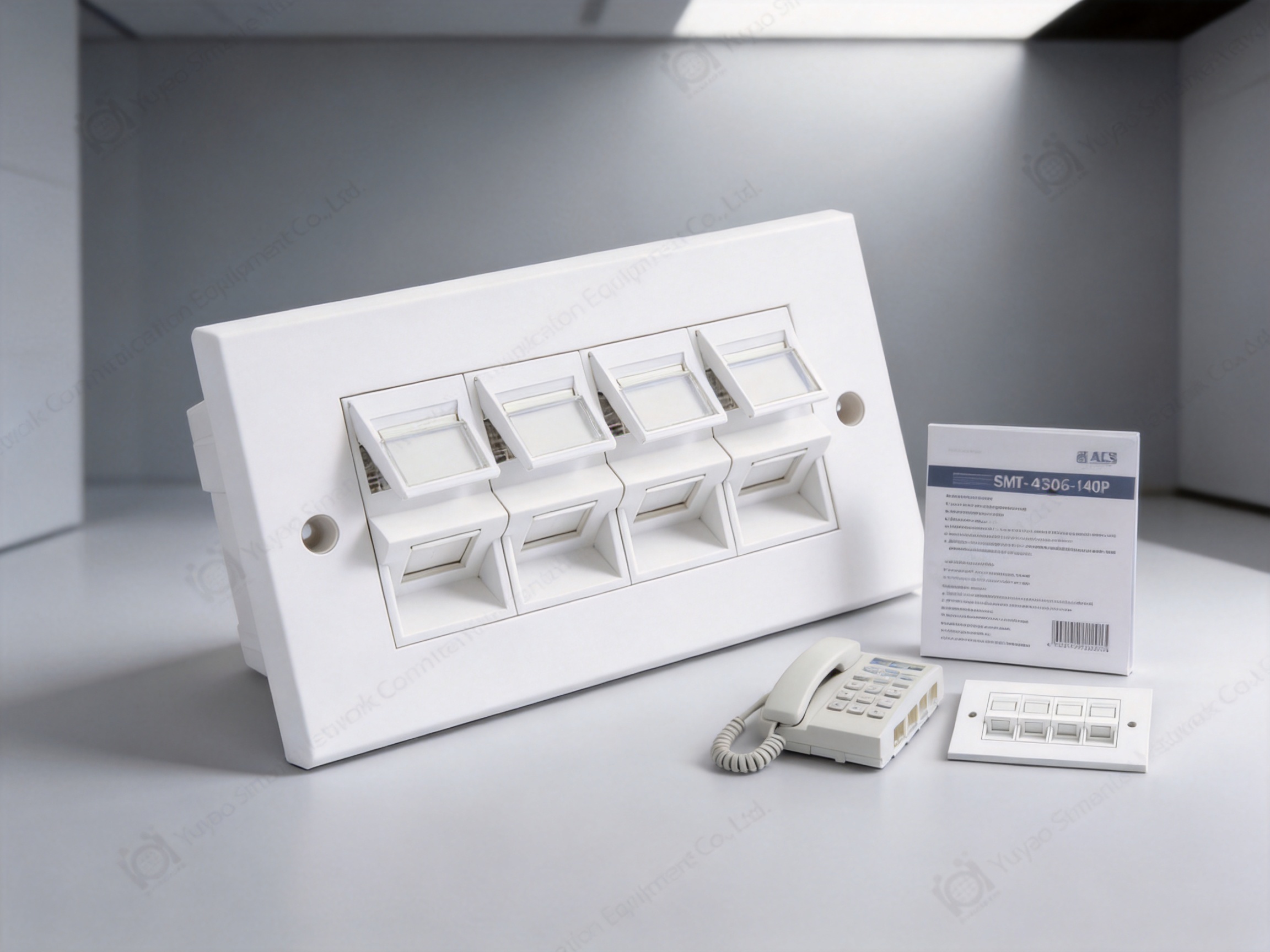
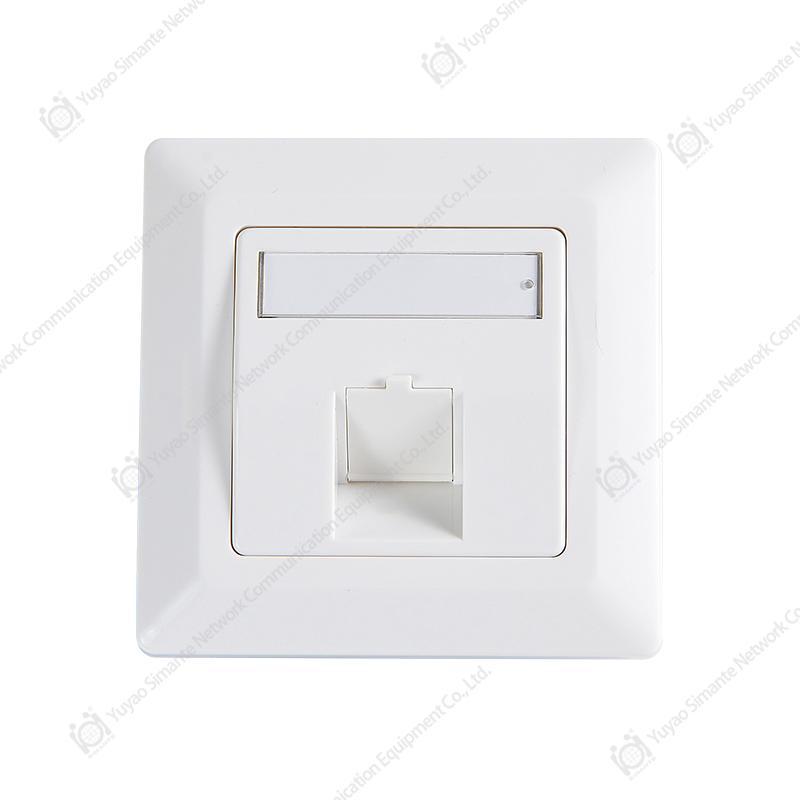
The SMT-4306-140P-4X Two Gang 45° Flat Frame UK Type Faceplate is designed to provide a professional termination point for copper and compatible information or telephone modules. Its two-gang UK-style format, 45° angled flat frame, four-port capacity, concealed fixing arrangement, spring-type dust-proof doors, identification windows, and robust ABS construction make it suitable for a broad range of structured cabling applications.
Produced by an experienced network communication equipment manufacturer, the faceplate combines practical field installation features with controlled manufacturing processes. It is intended for projects that require a neat wall-mounted outlet, clear port administration, protection against everyday dust, and compatibility with Amp interface information and telephone modules.
Product Overview
The SMT-4306-140P-4X is a two-gang, four-port faceplate for UK-style wall outlet installations. The product is designed to accept up to four compatible modules, allowing installers to create a consolidated connection point for data, voice, and other low-voltage communication services.
Its 45° angled design helps direct connected patch cords toward the user or equipment position. Compared with a completely vertical outlet, an angled port can help reduce excessive bending immediately behind or below the plug. This is particularly useful where several cables are installed close together or where the outlet is positioned near furniture, workstations, cabinets, or equipment enclosures.
The faceplate uses an embedded frame. Once installed, fixing screws are not visible on the front surface. This gives the outlet a cleaner appearance and reduces the exposed hardware that can collect dust or be disturbed during routine use.
A spring-type dust-proof door is provided for each port position. The door helps cover an unused connector opening and supports a more orderly appearance when fewer than four modules are installed. The front also includes a logo or identification window, together with a detachable labeling plate, allowing installers and facility managers to identify ports clearly.
The faceplate is manufactured from high-quality ABS engineering plastic. This material provides a useful combination of impact resistance, dimensional stability, processing consistency, and practical cost efficiency. It is intended to resist ordinary knocks and handling during installation and service without easily deforming.
| Product characteristic | Specification or design feature | Practical benefit |
|---|---|---|
| Product type | Two-gang 45° flat frame UK type faceplate | Suitable for organized wall-mounted communication outlets |
| Port capacity | Up to four connectors or compatible modules | Supports multiple services from one outlet location |
| Interface compatibility | Information and telephone modules using the Amp interface | Enables flexible copper and communication installations |
| Fixing design | Embedded frame with concealed front screws | Improves appearance and reduces exposed hardware |
| Port protection | Spring-type dust-proof doors | Helps protect unused openings from everyday dust |
| Identification | Front logo window and detachable logo plate | Supports port labeling and future administration |
| Material | High-quality ABS engineering plastic | Provides impact resistance and dimensional stability |
| Environmental compliance | Designed to meet RoHS requirements | Supports projects with restricted-substance requirements |
| Operating temperature | -25°C to +70°C | Suitable for a wide range of indoor installation conditions |
Why Faceplate Design Matters in Structured Cabling
A structured cabling system is more than a collection of cables and connectors. Every transition point, outlet, patch panel, and enclosure contributes to system organization and serviceability. A well-designed faceplate protects the termination area, presents a consistent interface to users, and makes future maintenance easier.
Without a suitable faceplate, cables can be left exposed, modules can be poorly supported, and port identities can become unclear. These problems may not cause immediate network failure, but they can increase the risk of accidental damage, incorrect patching, difficult troubleshooting, and an untidy installation.
The SMT-4306-140P-4X addresses these requirements through a combination of mechanical support, modular capacity, labeling, and physical protection. It offers a practical front-end component for data cabling systems where several services must be presented in a compact wall location.
The two-gang format provides more usable installation space than a single-port outlet while remaining visually compact. Four available positions can be populated according to the project design. An installation may use one module for data, another for voice, and leave the remaining positions available for expansion. Alternatively, all four positions can be used where a workstation, meeting room, reception desk, or smart-home control area requires multiple connections.
Four-Port Capacity for Flexible Installations
One of the principal advantages of this faceplate is its ability to accommodate up to four connectors. The capacity is useful for modern environments in which one outlet location may serve several communication functions.
In a commercial office, four ports can support a combination of network connections, voice services, wireless access point backhaul, control equipment, or other low-voltage applications compatible with the selected modules. In a hotel or residential project, the same capacity can provide flexibility for broadband, telephone, entertainment, and automation-related services, subject to the modules and cabling specified by the project engineer.
The modular arrangement also supports phased installation. A contractor may install the faceplate and the required initial modules during the first construction phase, while keeping additional positions available for later expansion. This can reduce the need to replace the entire wall outlet when the user’s requirements change.
Compared with a fixed, single-application outlet, a modular four-port faceplate offers a more adaptable platform. It allows installers and system integrators to select the appropriate information or telephone modules rather than committing the outlet to one permanent configuration.
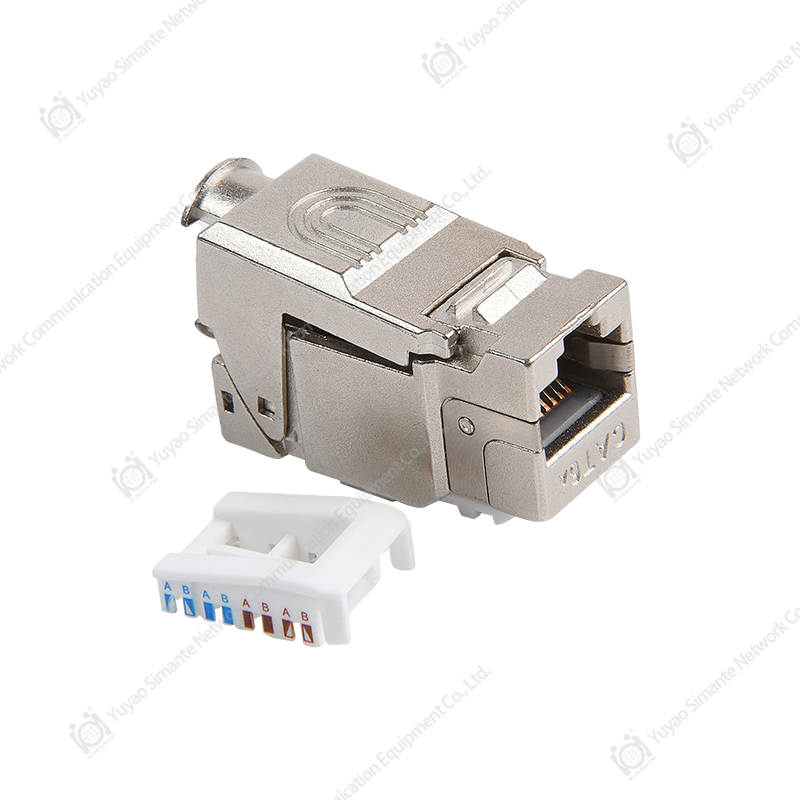
The faceplate is compatible with all information and telephone modules of the Amp interface within the stated application range. Before ordering, installers should verify the exact module dimensions, connector type, cable category, and system performance requirements to ensure complete compatibility.
45° Angled Port Orientation
The 45° port orientation is a practical feature for cable routing and user access. When a patch cord is inserted, the angled direction can help guide the cable away from the wall rather than forcing it to make an abrupt turn immediately at the connector.
Reduced cable stress is important in any structured cabling installation. Excessive bending near a plug or jack can place unnecessary mechanical pressure on the connector, cable jacket, latch, and termination area. A suitable angled outlet can help create a more natural cable path, particularly when the connected device is positioned below or in front of the faceplate.
The angled format can also improve visibility and access during patching. In workstations, communication cabinets, educational facilities, and equipment rooms, technicians may need to insert or remove patch cords regularly. A clear angle can make the port easier to reach while reducing interference between neighboring cords.
The 45° design is not intended to replace compliance with the bend-radius requirements of the installed cable or patch cord. Installers should still follow the cable manufacturer’s recommendations and avoid pulling, crushing, sharply bending, or twisting the cable assembly.
Concealed Fixing for a Cleaner Appearance
The embedded face frame is designed so that fixing screws are not visible on the finished front surface. This feature provides a more refined appearance than exposed screw heads and helps the outlet blend into modern interior environments.
Concealed fixing is especially valuable in offices, hotels, retail premises, conference rooms, educational buildings, and residential projects where the communication outlet is part of the visible interior. A clean front surface can support consistent architectural styling and make the installation appear more professionally completed.
From a maintenance perspective, the removable or embedded frame arrangement allows the faceplate to be installed and disassembled without permanently damaging the visible front surface. Technicians can access the modules or wiring area when required while preserving the appearance of the outlet after reassembly.
Installers should use suitable wall boxes, screws, and mounting practices for the specific substrate. Correct alignment is important because a faceplate that is mounted on an uneven or incorrectly positioned box may not sit flush, even when the faceplate itself is accurately molded.
Spring-Type Dust-Proof Doors
Unused openings can become collection points for dust and small particles. The spring-type dust-proof doors on the SMT-4306-140P-4X help cover port positions when they are not occupied by a connector or module.
The spring mechanism allows the door to return toward its closed position after the port is no longer in use. This provides a simple form of passive protection without requiring a separate cap to be stored and replaced manually.
Dust protection is useful in offices, classrooms, workshops, hotel rooms, equipment areas, and other locations where airborne particles may enter an open outlet. Keeping unused openings covered can also improve the visual consistency of partially populated installations.
The dust-proof door should be treated as a protective feature rather than a guarantee of complete sealing. The product is a wall-mounted communication faceplate and is not described as a waterproof or dust-tight enclosure. It should therefore be installed in an environment appropriate for indoor information and telephone outlets.
Port Identification and Administration
Clear identification is an essential part of structured cabling management. When outlets are not labeled, technicians may need to trace cables manually, interrupt services, or spend additional time testing ports before making changes.
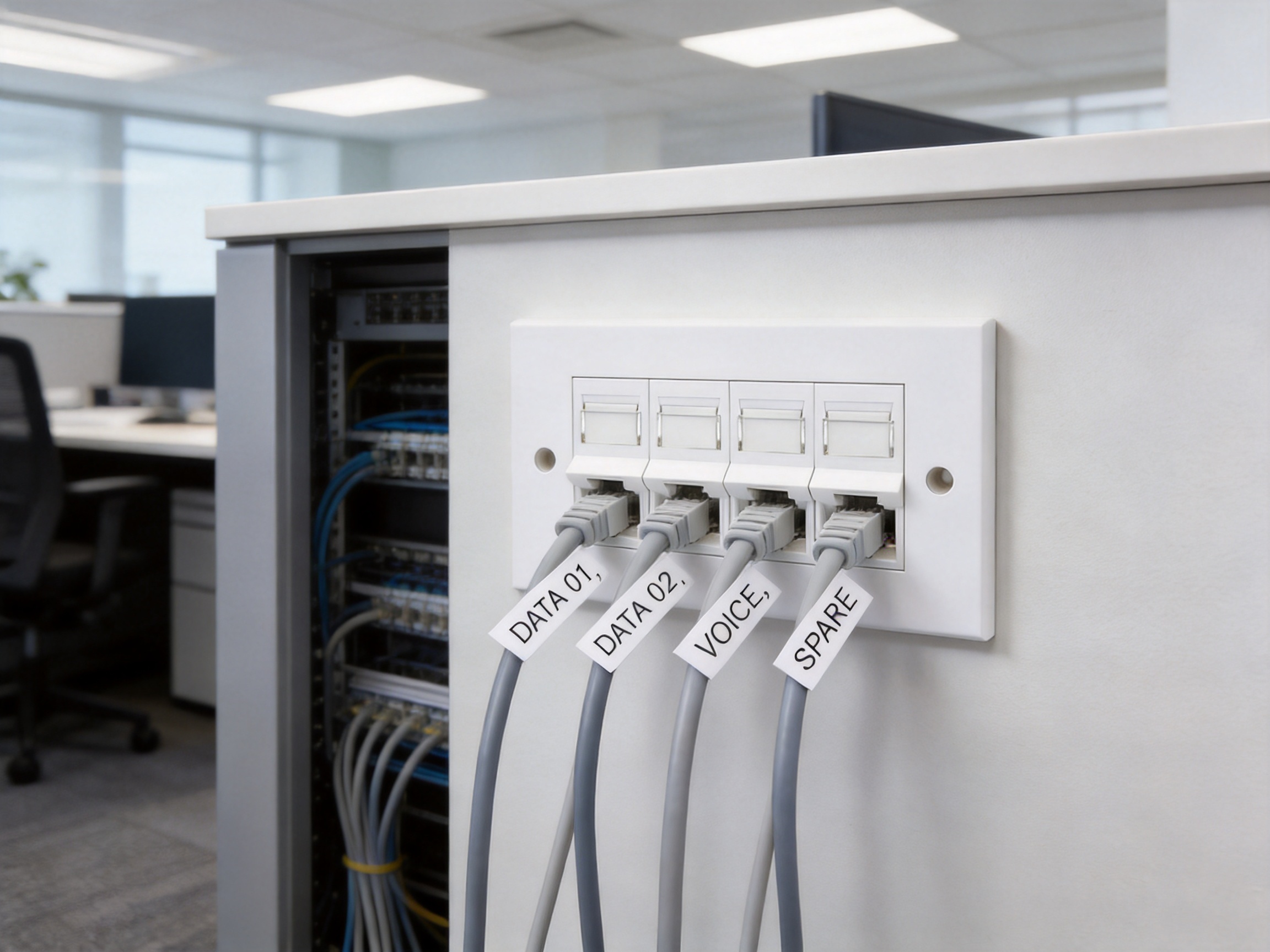
The faceplate includes a logo window on the front and a detachable logo plate. These features provide a dedicated area for port identification, room numbering, service designation, or customer-specified labeling.
For example, an installer may identify the ports as DATA-01 through DATA-04, assign each position to a workstation, or use labels such as VOICE, LAN, CONTROL, and SPARE. The exact labeling method can be adapted to the building’s cable schedule and administration plan.
A detachable plate can be useful when room functions change. Instead of replacing the complete faceplate, an administrator may be able to update the identification insert. This supports more efficient changes in offices, rental properties, educational facilities, and shared workspaces.
Good labeling should be coordinated with the patch panel, rack documentation, cable identifiers, floor plans, and network management records. The faceplate’s identification area is most effective when it forms part of a complete administration system rather than being used in isolation.
ABS Engineering Plastic Construction
The product uses high-quality ABS engineering plastic, selected for the practical demands of a wall-mounted communication accessory. ABS is widely used for electrical and communication components because it can be molded into precise shapes and can provide a balanced combination of rigidity, impact resistance, surface quality, and processing efficiency.
For a faceplate, dimensional consistency is important. The frame must align with the wall box, the module openings must retain their intended geometry, and the front components must operate smoothly. Controlled injection molding can produce repeatable parts while supporting the integrated details required by the frame, port openings, labeling areas, and dust doors.
The stated design emphasizes resistance to collision and impact. This is valuable during transportation, installation, furniture movement, routine cleaning, and everyday use. A faceplate must withstand normal handling without easily cracking or deforming.
Material selection also affects appearance. A stable molded surface can help maintain a uniform finish across production batches. This is useful for projects requiring multiple outlets throughout a building, where visual inconsistency between faceplates can be noticeable.
Although ABS provides useful mechanical performance, installers should avoid excessive force, inappropriate solvents, sharp tools, and heavy impacts. Cleaning should be carried out with methods suitable for engineering plastics and the project’s hygiene requirements.
Environmental Performance and RoHS Considerations
The product is designed to meet RoHS requirements. Restrictions on certain hazardous substances are increasingly important in international supply chains, commercial construction, public procurement, and environmentally responsible product selection.
RoHS-oriented production requires attention to material selection, component sourcing, supplier control, and documentation. A manufacturer serving international customers must understand that environmental compliance is not limited to the visible plastic part. It also involves the materials and processes used throughout the product’s supply chain.
The stated operating temperature range is -25°C to +70°C. This broad range supports use in many indoor and sheltered installation environments. Project designers should nevertheless assess the actual site conditions, including direct sunlight, heat sources, condensation, chemical exposure, and ventilation.
The storage requirements specify an ambient storage temperature of -5°C to +30°C, relative humidity not exceeding 70%, and an environment free from acid, alkali, and other corrosive gases. Following these conditions can help protect the appearance, mechanical parts, packaging, and long-term usability of the product before installation.
Manufacturing Strengths Behind the Product
The faceplate is manufactured by Yuyao Simante Network Communication Equipment Co., Ltd., a professional supplier of network cabling solutions and optical fiber products. The company integrates design, development, sales, and service, allowing product requirements to be addressed across the complete development and supply cycle.
The company reports nearly 20 years of service in the network communication equipment field. This experience provides an important foundation for understanding the practical requirements of installers, distributors, system integrators, and project owners.
Product quality begins at the design stage. The company operates a mature research and development system and employs more than 10 engineers, supported by more than 30 full-time technical personnel. This technical structure supports product improvement, design review, manufacturing coordination, and quality promotion.
For a molded faceplate, engineering experience is relevant to more than appearance. It influences the design of mounting points, module retention, frame alignment, door movement, labeling areas, material thickness, and mold release. These details affect whether the product performs consistently in the field.
The manufacturer operates regular and customized production lines. This supports both standardized products and customer-specific requirements. In structured cabling projects, customization may involve packaging, labeling, product marks, color, configuration, or other project details, subject to technical and commercial confirmation.
The reported equipment base includes 10 fully automatic injection molding machines, 20 semi-automatic injection molding machines, and eight automatic installation machines. This combination indicates the ability to support high-volume molded production while retaining options for different product structures and assembly needs.
Manufacturing capacity is particularly valuable for distributors and project contractors who require consistent supply. The company reports an annual output of more than nine million units across its product range. Stable capacity can help reduce supply interruptions and support repeat orders for multi-site projects.
Injection Molding and Process Control
Injection molding is a central process for producing a faceplate of this type. Plastic material is heated, injected into a precision mold, cooled, and ejected as a formed component. The quality of the final part depends on material preparation, mold design, injection parameters, cooling control, ejection, inspection, and subsequent assembly.
Process stability helps reduce common molding problems such as warpage, sink marks, short shots, flash, inconsistent wall thickness, and surface defects. These issues can affect both appearance and fit. A faceplate that is slightly warped may not sit flush against the wall box, while inaccurate openings may interfere with module installation.
Automatic and semi-automatic equipment can support repeatability when properly maintained and monitored. Automated equipment may improve production consistency and reduce manual variation in high-volume operations. Semi-automatic lines can provide flexibility for products requiring additional handling or configuration.
Engineering review is also important before mass production. Mold flow, gate position, cooling layout, draft angles, parting lines, and ejection points all influence the finished component. A mature manufacturer can use its accumulated experience to refine these features for practical assembly and appearance.
Assembly and Quality Management
A faceplate is not only a molded plastic frame. Its completed function depends on the correct assembly of the frame, dust-proof doors, identification components, fixing elements, and compatible module interfaces.
Automatic installation equipment can help support repeatable assembly for suitable components. Controlled assembly reduces the possibility of missing parts, incorrect orientation, incomplete seating, or inconsistent movement of the spring-type door.
Quality management should address incoming materials, in-process production, finished products, packaging, and shipment. Typical control points for this type of product may include visual inspection, dimensional verification, fit testing, door operation, module compatibility checks, surface inspection, and packaging review.
The company states that it conducts performance testing to meet customers’ comprehensive testing requirements. For project buyers, this is important because structured cabling components may be evaluated according to internal specifications, distributor requirements, installation standards, and customer quality plans.
Manufacturing quality does not eliminate the need for correct installation. The faceplate must be mounted on a suitable wall box, the modules must be installed according to their own instructions, and the connected cable must be terminated using the appropriate tool and wiring scheme.
Advantages Compared with Basic Competitor Faceplates
The SMT-4306-140P-4X offers several practical advantages when compared with basic faceplates that provide only a flat plastic frame and exposed fixing screws.
First, its four-port capacity supports a wider range of installation configurations. A basic one-port or two-port plate may require additional wall outlets when the number of services increases. The four-port design can consolidate multiple connections in a compact two-gang location.
Second, the 45° orientation can provide a more practical cable exit direction. Completely vertical or poorly oriented ports may create tighter cable bends or make patching less convenient, especially where furniture or equipment is positioned close to the wall.
Third, the embedded frame and concealed screws create a more finished appearance. In visible areas, this can distinguish the product from lower-cost plates that leave hardware exposed on the front.
Fourth, spring-type dust-proof doors provide a useful feature that is not always included in basic open-port designs. The doors help cover unused openings and support a cleaner, more protected outlet.
Fifth, the detachable identification plate improves administration. A faceplate without a dedicated labeling area can make port identification dependent on adhesive labels or handwritten marks that may become difficult to read or remove.
Sixth, the use of engineering-grade ABS and controlled manufacturing supports mechanical consistency. Product value should not be judged only by initial purchase price; fit, appearance, installation time, serviceability, and replacement frequency can also affect the total cost of ownership.
These advantages are most valuable when the product is selected as part of a complete cabling design. The faceplate should be matched with compatible modules, wall boxes, cable categories, patch panels, and installation practices.
Applications in Commercial and Residential Projects
The faceplate is suitable for offices where several network or telephone services must be presented at a workstation, reception desk, meeting room, or shared collaboration area.
In education facilities, four-port outlets can support classroom computers, teacher equipment, interactive systems, telephones, and future expansion. The labeling area can help school maintenance teams identify outlets across multiple rooms.
Hotels and serviced apartments can use modular faceplates for guest rooms, reception areas, conference rooms, and back-office spaces. A tidy concealed-fixing design is appropriate where the communication outlet forms part of the interior finish.
Residential projects may use the faceplate in home offices, living areas, media locations, utility rooms, and smart-home installations. The ability to use different compatible modules allows the same basic faceplate format to support different room functions.
Retail stores, healthcare support areas, warehouses, and light industrial offices can also benefit from a clearly labeled multi-port outlet. The suitability of the installation depends on the environmental conditions and the selected modules.
Installation Recommendations
Before installation, confirm that the wall box, mounting pattern, module interface, and available wall depth are compatible with the faceplate. The installer should review the project drawings and cable schedule before fixing the product in position.
Prepare the cables with sufficient service slack for module termination and future maintenance. Avoid placing excessive force on the cable where it enters the module or faceplate. Maintain the recommended bend radius and do not compress the cable behind the outlet.
Install the compatible information or telephone modules securely. Each module should be fully seated and retained according to the module manufacturer’s instructions. The four positions should be populated in accordance with the project’s intended service arrangement.
Align the faceplate carefully before tightening the fixing screws. Over-tightening can damage the wall box, distort the frame, or create unnecessary stress. The finished plate should sit evenly against the wall surface.
After installation, test each connected port and compare the result with the project documentation. Confirm that the port labels correspond to the correct patch panel positions or service circuits.
Where a port is not in use, ensure that the dust-proof door can close properly. Remove any protective film, debris, or packaging material that may interfere with the door or identification window.
Packaging, Storage, and Logistics
The product is placed in a special blister bag and then packed in a cardboard box. Product accessories are placed with the faceplate, and a label identifying the product model and quantity is applied to the upper-left area of the carton front according to the supplied packaging information.
The packaged products should be stored in a warehouse with an ambient temperature of -5°C to +30°C and relative humidity not exceeding 70%. The surrounding air should not contain acid, alkali, or other corrosive gases. The stated storage period is three years under the specified conditions.
The regular packing information is stated as 10 boxes per carton, 20 units per box, and 200 units per carton. Because packaging terminology can vary between suppliers and markets, purchasers should confirm the final packing configuration, carton dimensions, gross weight, and accessory count on the commercial order documents.
Appropriate packaging helps protect molded surfaces from scratching, prevents small accessories from becoming separated, and supports efficient inventory management. Correct model and quantity labeling is especially useful for distributors handling several similar faceplate designs.
The product use mark is identified as customer-specified packaging. This means packaging details, marks, or labeling can be discussed for project requirements, subject to confirmation with the manufacturer.
Procurement and Customization Support
For distributors, contractors, and original equipment customers, product selection often involves more than a standard catalog order. Required details may include the number of ports, module interface, color, logo, labeling, packaging, accessories, shipment quantity, and delivery schedule.
The manufacturer’s regular and customized production lines can support discussions about project-specific requirements. Customers should provide technical drawings, installation conditions, expected annual volume, packaging instructions, inspection criteria, and destination-market requirements as early as possible.
Customization should be evaluated carefully so that changes do not compromise module compatibility, mechanical strength, labeling visibility, or assembly efficiency. A professional manufacturer can review the requested modification and advise whether it is best addressed through tooling, insert changes, printing, packaging, or assembly instructions.
OEM and ODM support is also relevant to network equipment distributors and system brands that want a faceplate aligned with their own product portfolio. Consistent engineering review, controlled production, and documented inspection are important when customized products are supplied under a customer’s specification.
Long-Term Value for System Integrators
System integrators need components that can be installed consistently across many rooms and sites. A faceplate with a modular four-port configuration reduces the need to maintain many different outlet formats in inventory.
The labeling window helps technicians connect the physical installation with the network documentation. The concealed frame improves the finished appearance, while the dust-proof doors help maintain unused positions during phased deployment.
Manufacturing capacity and international export experience can also support project continuity. The manufacturer reports stable exports to Europe, Australia, Africa, the Middle East, and Southeast Asia. This broad market experience suggests familiarity with different customer expectations, packaging practices, and distribution environments.
For a project owner, the value of the product lies in the combination of design and supply capability. A technically suitable faceplate is more useful when it can be delivered consistently, supported with clear product information, and adapted to the project’s commercial requirements.
Quality, Appearance, and Total Installation Cost
The purchase price of a faceplate is only one part of the total installation cost. Labor time, labeling, rework, replacement, inventory complexity, and maintenance access can have a significant effect on the final project budget.
A modular four-port plate may reduce the need for separate outlets. Concealed fixing can reduce the need to correct an untidy finished appearance. A detachable label can reduce the labor associated with future port changes. A spring dust-proof door can help keep unused openings presentable without requiring separate protective caps.
Consistent molding and assembly can also reduce installation delays caused by poor fit, damaged parts, or inconsistent component movement. While every project should evaluate its own requirements, these practical factors contribute to the total value of the faceplate.
Recommended Use and Limitations
The SMT-4306-140P-4X is intended for wall-mounted structured cabling applications using compatible information and telephone modules. It is suitable for indoor or appropriately sheltered environments within the stated temperature and storage conditions.
It should not be treated as a substitute for a sealed outdoor enclosure, a waterproof outlet, or a specialized industrial housing. Areas exposed to water, corrosive chemicals, extreme contamination, or unusual mechanical loads require products specifically designed for those conditions.
Electrical and communication performance depends on the installed modules, cable category, termination method, patching equipment, and test results. The faceplate provides the mechanical and presentation platform; it does not independently determine the transmission performance of the complete channel.
Project engineers should verify applicable local standards, customer specifications, fire and building requirements, module compatibility, and installation clearances before final approval.
Frequently Asked Questions
What type of product is the SMT-4306-140P-4X?
It is a two-gang, 45° flat frame UK type faceplate designed for wall-mounted communication outlets. It can accommodate up to four compatible information or telephone modules.
How many ports can be installed?
Up to four connectors or compatible modules can be installed, depending on the selected module type and project configuration.
Which modules are compatible with the faceplate?
The product is described as compatible with information and telephone modules using the Amp interface. Exact module dimensions and connector specifications should be confirmed before ordering.
What is the purpose of the 45° angle?
The angled orientation helps direct patch cords away from the wall and can make port access easier. It may also reduce sharp cable turns near the connector when the installation is planned correctly.
Are the fixing screws visible from the front?
No. The embedded face frame is designed to conceal the fixing screws on the finished front surface.
Does the faceplate include port identification features?
Yes. It includes a front logo window and a detachable logo plate for port identification and administration.
What is the function of the spring-type dust-proof door?
The door helps cover an unused port opening and returns toward the closed position after the opening is no longer in use. It supports cleanliness and a more consistent appearance.
What material is used?
The faceplate is made from high-quality ABS engineering plastic, selected for impact resistance, practical rigidity, molding consistency, and resistance to ordinary deformation.
What is the operating temperature range?
The stated environmental temperature range is -25°C to +70°C. Actual project suitability should be assessed according to the complete installation environment.
Does the product meet environmental requirements?
The product is designed to meet RoHS requirements. Purchasers requiring formal compliance documentation should request the applicable documentation for the specific order.
How should the product be stored?
It should be stored at -5°C to +30°C, with relative humidity no higher than 70%, in an area free from acid, alkali, and other corrosive gases. The stated storage period is three years under these conditions.
Can the packaging be customized?
The product information identifies customer-specified packaging as a possible requirement. Packaging marks, labels, quantities, and other details should be confirmed with the manufacturer before production.
Is the faceplate suitable for outdoor installation?
It is intended for wall-mounted communication applications and is not described as a waterproof or outdoor-rated enclosure. Outdoor or exposed locations require a separate environmental suitability review.
Can the product be used in phased projects?
Yes. The four-port capacity allows a project to populate only the required positions initially while leaving other positions available for future services, provided the project design supports this approach.
What should be checked before bulk purchasing?
Buyers should confirm module compatibility, wall-box dimensions, port configuration, color and labeling requirements, packaging details, inspection criteria, storage conditions, delivery schedule, and any required compliance documents.
Conclusion
The SMT-4306-140P-4X Two Gang 45° Flat Frame UK Type Faceplate is a practical component for organized copper and communication structured cabling systems. Its four-port capacity provides installation flexibility, while the 45° orientation supports convenient cable routing and access.
The concealed fixing design, spring-type dust-proof doors, identification window, detachable logo plate, and robust ABS engineering plastic distinguish it from basic faceplates focused only on providing an opening in the wall. These features address the daily requirements of installers, users, facility managers, and maintenance teams.
The product is supported by a manufacturer with nearly two decades of industry experience, an engineering and technical workforce, injection molding capacity, automated installation equipment, regular and customized production lines, and international export experience. These manufacturing strengths are important for customers seeking consistent quality, scalable supply, and OEM or ODM support.
For offices, commercial buildings, hotels, educational facilities, residential developments, and other structured cabling environments, the faceplate offers a balanced combination of appearance, modularity, protection, labeling, and production capability. When paired with compatible modules and installed according to the applicable cabling requirements, it can provide a clean and maintainable endpoint for modern communication infrastructure.
References
1. Product specification information for SMT-4306-140P-4X Two Gang 45° Flat Frame UK Type Faceplate, including product features, environmental conditions, packaging, and storage requirements.
2. Manufacturer information for Yuyao Simante Network Communication Equipment Co., Ltd., including company history, engineering resources, production lines, equipment capacity, export markets, and OEM and ODM services.
3. General structured cabling installation principles concerning modular outlets, cable bend radius, port identification, termination practices, and telecommunications administration.
4. General engineering guidance for ABS injection-molded components, including dimensional stability, impact resistance, molding process control, and finished-part inspection.
5. General RoHS-oriented product compliance principles concerning restricted substances, material selection, supplier management, and technical documentation.
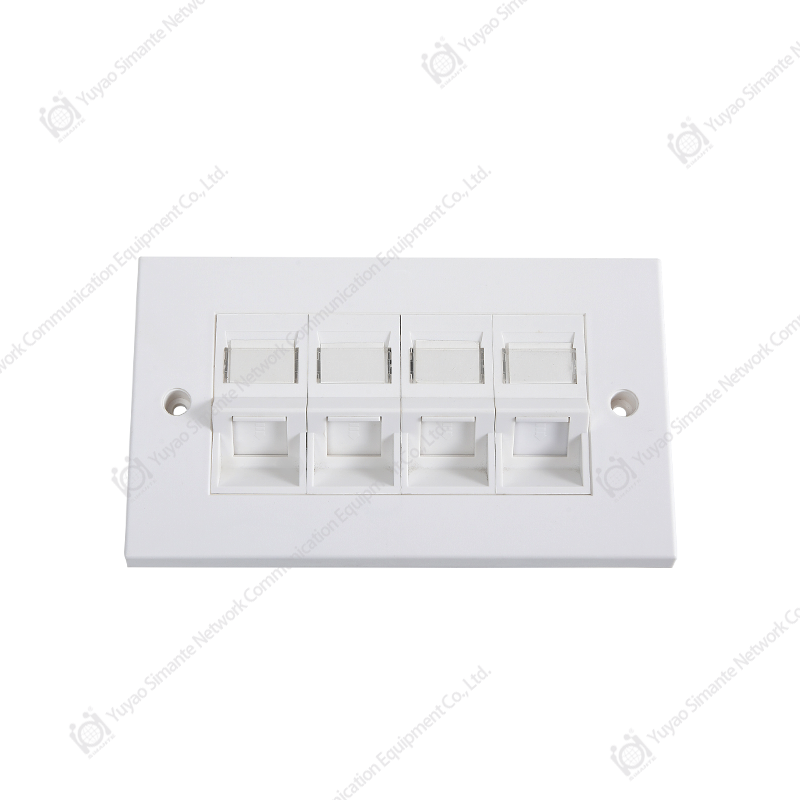
SMT-4306-140P-4X Two Gang 45°Flat Frame UK Type Faceplate