Español
 عربى
 русский
Content
- 1 Product Overview
- 2 Why CAT6A Connectivity Matters
- 3 Low-Profile Design for High-Density Installations
- 4 Advantages of the 45-Degree Cable Entry
- 5 Screened FTP Construction and Interference Control
- 6 Tool-Less Termination for Faster Installation
- 7 Comparison with Conventional Keystone Jack Designs
- 8 Manufacturing Strengths and Engineering Capability
- 9 Quality Control from Design to Shipment
- 10 Application Areas
- 11 Installation Guidance
- 12 Testing and System Verification
- 13 Advantages for Distributors and System Integrators
- 14 Advantages over Less Specialized Alternatives
- 15 Procurement and Project Selection Considerations
- 16 Company Manufacturing and Service Profile
- 17 Frequently Asked Questions
- 17.1 What type of product is the SMT-1079T8C6A-FTP?
- 17.2 What does FTP screening mean?
- 17.3 Does the jack require a separate punch-down tool?
- 17.4 Why is the cable entry angled at 45 degrees?
- 17.5 What is the benefit of the low-profile construction?
- 17.6 Can the product be used with unshielded cable?
- 17.7 Is the product suitable for CAT6A network projects?
- 17.8 Where can the jack be installed?
- 17.9 Does the jack support OEM or ODM projects?
- 17.10 How should the completed connection be tested?
- 17.11 What information should be included in a quotation request?
- 18 Conclusion
- 19 References
- 20 Product: SMT-1079T8C6A-FTP FTP Screened Low Profile 45 Degree Cable Entry Jack Toolles
Modern communication networks require cabling components that combine electrical performance, mechanical reliability, installation efficiency, and long-term serviceability. As data rates increase and equipment rooms become more compact, the keystone jack has become much more than a simple termination point. It must preserve the performance of the horizontal cable, support dependable field installation, fit within crowded enclosures, and provide an organized transition between permanent links and patching equipment.
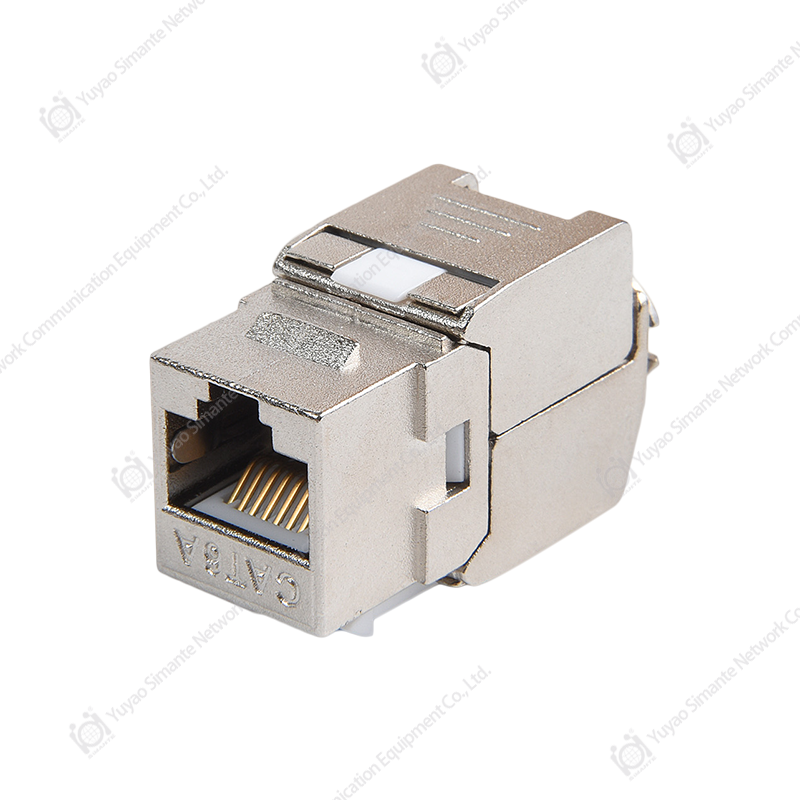
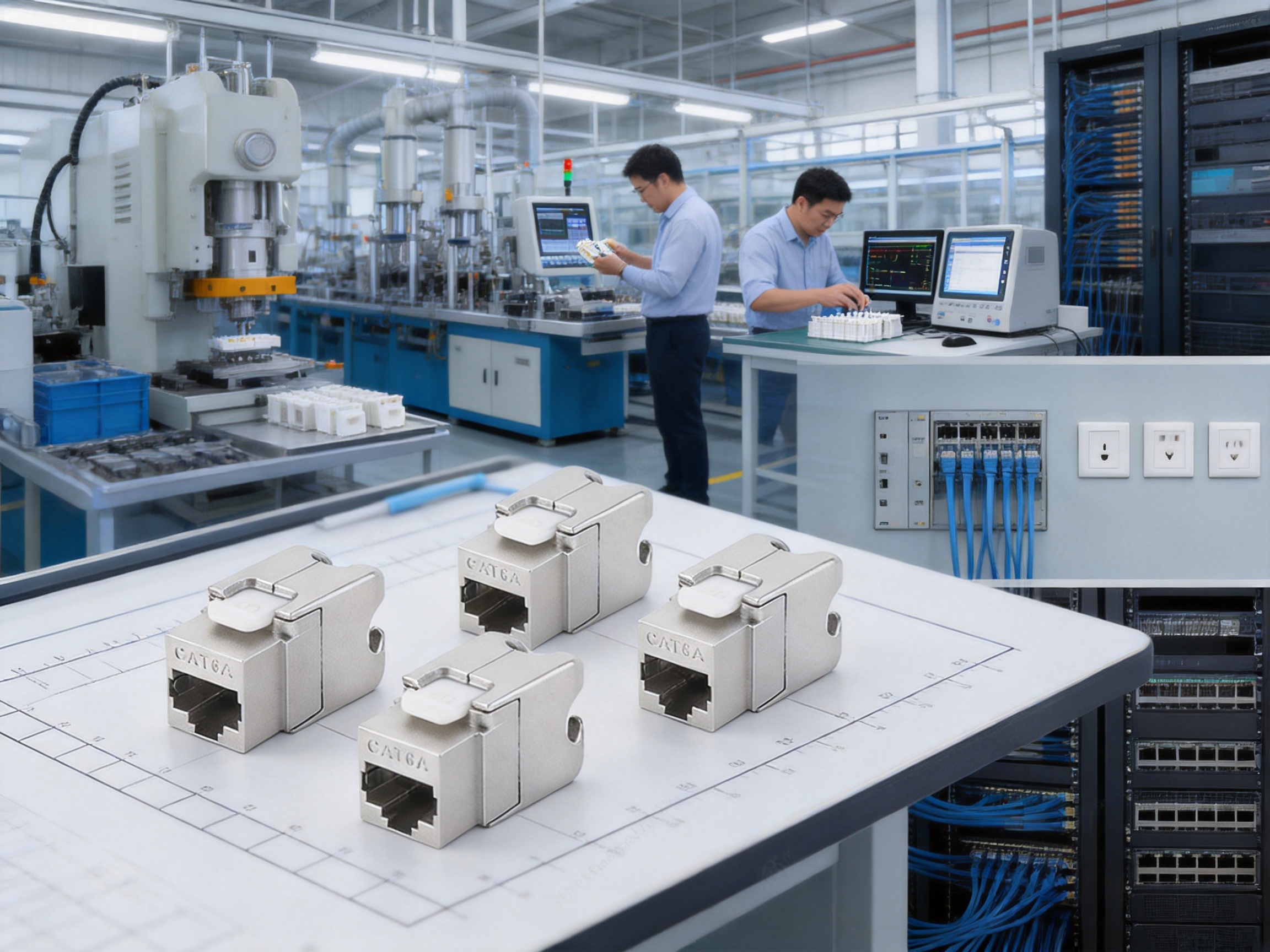
The SMT-1079T8C6A-FTP is a screened CAT6A keystone jack designed for structured cabling systems that require a low-profile, 45-degree cable entry and tool-less installation. Its design addresses several common challenges in modern network deployment, including limited space, difficult cable routing, electromagnetic interference, termination time, and inconsistent installation quality. The product is suitable for copper communication systems used in commercial buildings, data rooms, smart homes, automation installations, and other structured network environments.
Manufactured by Yuyao Simante Network Communication Equipment Co., Ltd., the product reflects the company’s experience in developing and producing network cabling solutions and optical fiber products. The manufacturer integrates product design, development, sales, and service, supported by engineering personnel, technical specialists, automated equipment, semi-automated production resources, assembly lines, and product performance testing. This combination enables the company to provide both standard products and customized OEM or ODM solutions for customers with different network infrastructure requirements.
Product Overview
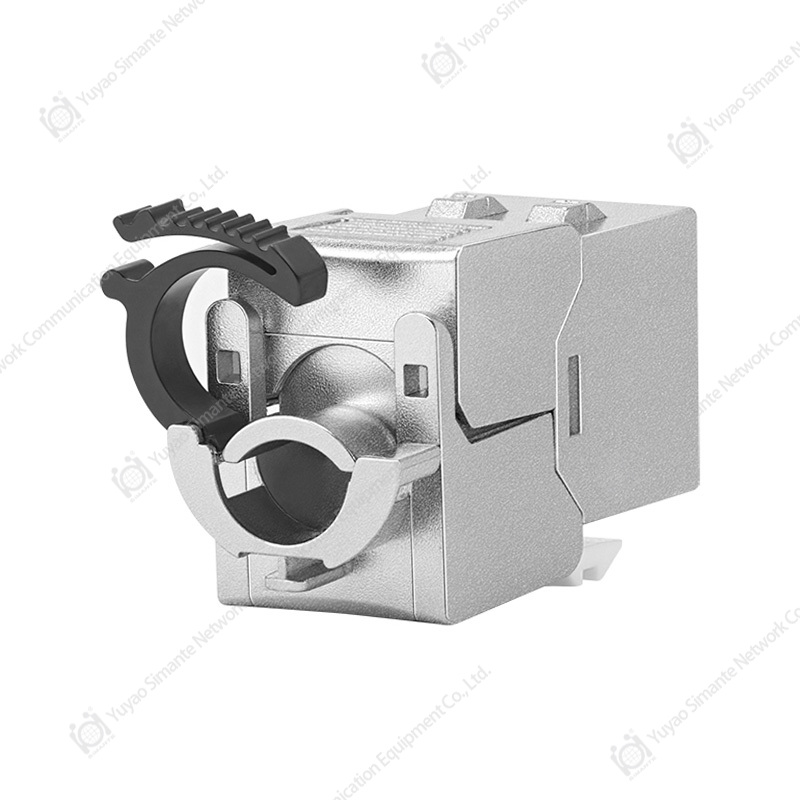
The SMT-1079T8C6A-FTP is a CAT6A keystone jack with a screened construction, a low-profile body, and a 45-degree cable entry orientation. The angled entry guides the incoming cable in a direction that can reduce sharp bending and improve cable management when the jack is installed in a patch panel, wall plate, floor box, or other modular outlet.
The product is designed as a tool-less termination solution. During installation, the cable conductors can be arranged according to the applicable wiring scheme and secured using the jack’s integrated termination structure. A tool-less design can reduce the number of installation steps and help technicians work more efficiently, especially when many outlets must be completed in a short period.
As an FTP-screened product, the jack incorporates a conductive shielding structure intended to support continuity around the terminated connection. In suitable system designs, this screening can help reduce the effects of electromagnetic interference and radio-frequency interference. The shielding function must be used together with compatible screened cable, patch panels, grounding arrangements, and other system components to achieve the intended result.
The low-profile format is especially valuable in applications where the available depth or bend radius is restricted. Dense patching environments, shallow wall outlets, compact cabinets, and multi-port face plates can all benefit from a jack that occupies less space and allows a more controlled cable path.
| Product Attribute | Product Information | Practical Value |
|---|---|---|
| Product model | SMT-1079T8C6A-FTP | Clear identification for purchasing, installation, and project documentation |
| Product type | CAT6A keystone jack | Supports modular copper structured cabling applications |
| Screening | FTP screened construction | Helps support protection against electromagnetic interference when correctly integrated |
| Cable entry | 45-degree entry orientation | Improves routing and can help reduce cable stress in confined spaces |
| Profile | Low profile | Suitable for high-density and shallow-depth installations |
| Termination method | Tool-less design | Reduces the need for specialized termination tools and may shorten installation time |
| Product category | CAT6A Keystone Jack | Suitable for outlets, patch panels, face plates, and modular network systems |

SMT-1079T8C6A-FTP FTP Screened Low Profile 45 Degree Cable Entry Jack Toolles
Why CAT6A Connectivity Matters
CAT6A cabling is widely selected for networks that require higher bandwidth and improved support for demanding data applications. It is commonly associated with 10 Gigabit Ethernet network infrastructure, particularly when the cabling system is properly designed, installed, and tested as a complete channel or permanent link.
A keystone jack is a critical part of that channel. Even when high-quality horizontal cable is used, an inferior or poorly installed jack can introduce performance problems. The termination must maintain conductor organization, contact stability, pair separation, and appropriate control of unwanted electrical coupling. Mechanical strain, incorrect conductor placement, excessive untwisting, and poor cable management can all affect the final result.
The SMT-1079T8C6A-FTP is designed to support the practical requirements of a CAT6A installation. Its screened structure provides a controlled metallic transition for applications that require additional protection from interference. Its angled cable entry supports better physical organization. Its tool-less termination concept helps simplify the installation process and reduce dependency on separate tools.
It is important to understand that the performance of a CAT6A keystone jack cannot be evaluated in isolation. The final network performance depends on the cable, plugs, patch panels, rack grounding, cable routing, bend radius, installation workmanship, and testing procedure. A strong product design provides a reliable foundation, but the complete system must be planned and installed correctly.
Low-Profile Design for High-Density Installations
Space efficiency has become a major consideration in network infrastructure. Data cabinets often contain switches, patch panels, power distribution units, cable managers, and fiber equipment within a limited vertical and horizontal footprint. Wall outlets and furniture boxes may provide even less room for cable routing. In such environments, a standard jack with a straight or bulky rear structure can make installation difficult.
The low-profile body of the SMT-1079T8C6A-FTP helps address this challenge. By reducing the space occupied behind the modular opening, the product can be easier to position in shallow enclosures and compact outlet assemblies. The design can also help installers maintain a cleaner relationship between the cable, the jack, and the surrounding housing.
A compact form factor may provide several practical benefits:
First, it can improve port density. More modular jacks can be arranged within a defined panel or face plate without creating unnecessary obstruction between adjacent ports.
Second, it can help simplify cable routing. When the rear of the jack does not extend excessively, the installer may have more flexibility when arranging cables in a small enclosure.
Third, it can reduce pressure on the connected cable. A crowded outlet can force cables into tight turns or cause one termination to push against another. A low-profile structure supports more controlled positioning.
Fourth, it can improve the appearance of finished installations. Organized cable transitions are easier to label, inspect, and maintain. This is particularly important in offices, schools, hotels, industrial control areas, and public facilities where network outlets must be neat and accessible.
The low-profile feature does not eliminate the need to respect the cable manufacturer’s minimum bend radius. Instead, it helps the installer achieve the required routing geometry with less obstruction from the termination hardware.
Advantages of the 45-Degree Cable Entry
The 45-degree cable entry is one of the product’s most useful mechanical features. A straight rear entry may work well in open spaces, but an angled entry can be more practical when a cable must turn toward a cable manager, side channel, or rear pathway.
The angled orientation can reduce the need for an immediate, sharp bend directly behind the jack. This is useful for solid horizontal cable, which should not be bent beyond the limits specified by the cable manufacturer. Better alignment also reduces the likelihood that the cable will be pulled sideways after termination.
In patch panel installations, a 45-degree entry can help cables move naturally toward vertical or horizontal management systems. In wall outlets, it can help accommodate cables that approach from above, below, or from the side. In furniture and floor-box installations, the angled arrangement may provide additional flexibility where the enclosure depth is limited.
The orientation can also support improved service work. When cables enter at a controlled angle, technicians may be able to identify and access individual terminations more easily. This may reduce the time needed for inspection, troubleshooting, relocation, and replacement.
Another advantage is the potential for reduced mechanical stress. Cables that are forced into a direct, abrupt turn can experience tension at the termination point. A gradual angled path helps distribute the cable movement over a larger section rather than concentrating it at the contact area.
The 45-degree entry is therefore not only a styling feature. It is a practical response to the physical limitations of modern network enclosures and the need for more consistent cable management.
Screened FTP Construction and Interference Control
Electrical interference can affect copper communication systems when network cables are installed near motors, transformers, fluorescent lighting, power distribution equipment, variable-frequency drives, or other sources of electrical noise. In some environments, unshielded cabling may be sufficient. In others, a screened system is selected to provide an additional layer of protection.
The FTP designation generally refers to a cable or connection design with an overall foil screen. In a screened keystone jack, the conductive body or shield structure is intended to continue the screening path through the connection. When the complete system is correctly designed, the screen can help reduce the coupling of external noise into the balanced pairs and reduce unwanted emissions from the communication link.
The screened structure of the SMT-1079T8C6A-FTP can be valuable in commercial, industrial, transportation, security, and automation applications. It may also be appropriate in installations where data cables are routed near electrical services or where the customer requires screened structured cabling for system design reasons.
Screening performance depends on more than the jack itself. The cable, patch panel, plug, cabinet, bonding system, and grounding method must be compatible. The shield should be continuous across the intended channel, and installation teams should follow applicable electrical and structured cabling practices. A screened jack installed with an incompatible unshielded path cannot provide the same system-level benefit as a fully integrated screened channel.
For project managers, this means the jack should be specified as part of a complete cabling architecture. For installers, it means that the shielding connection should be handled carefully and inspected after termination. For maintenance teams, it means that replacement parts should maintain compatibility with the original screened system.
Tool-Less Termination for Faster Installation
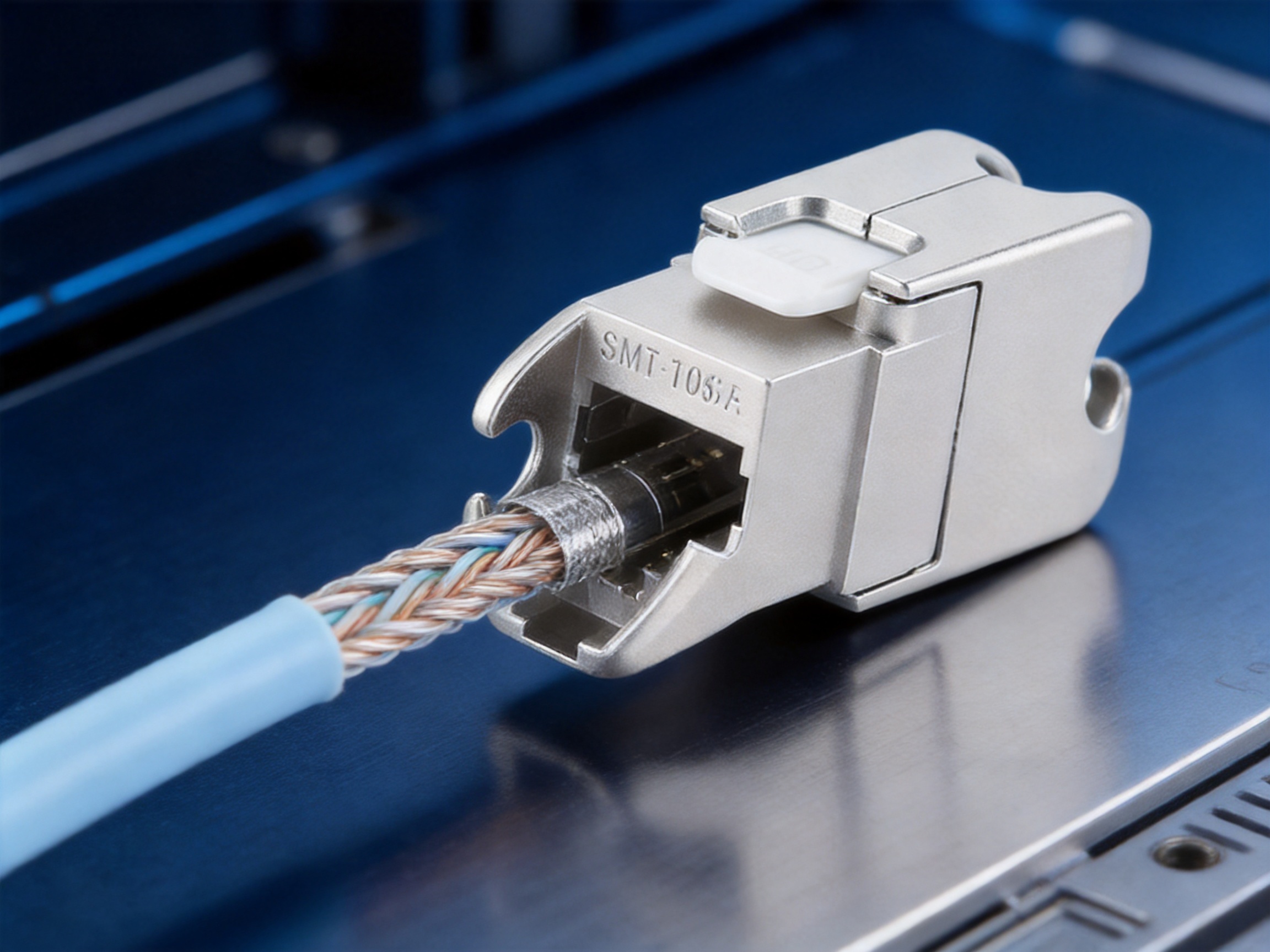
Traditional keystone termination methods may require separate punch-down tools or other specialized equipment. These tools are familiar to experienced installers, but they add steps to the work process and may create variation between technicians. A tool-less design provides an alternative approach by integrating the termination mechanism into the jack assembly.
The tool-less concept of the SMT-1079T8C6A-FTP is intended to simplify field work. The installer prepares the cable, arranges the conductors according to the required wiring pattern, places the conductors into the designated termination positions, and closes or secures the termination assembly. The exact sequence should follow the product instructions and the applicable wiring standard.
Tool-less termination can offer several benefits:
Reduced equipment requirements: Technicians may not need to carry a separate termination tool for every modular connection. This is useful for small service jobs, rapid deployments, and work in locations where tool access is restricted.
Improved installation speed: Fewer tool changes and simpler assembly steps can help reduce the time required for each outlet. The time savings become more significant in large projects with hundreds or thousands of ports.
More consistent workflow: A defined integrated termination structure can guide the installer through the cable preparation and conductor placement process. This may help reduce variation caused by different tools or individual working habits.
Convenience for maintenance: When a termination must be inspected or reworked, a tool-less design may be easier to handle in a crowded cabinet or outlet box.
Tool-less does not mean installation-free. Correct cable preparation remains important. The installer must preserve pair twist as close as practical to the termination point, follow the correct color code, maintain the cable’s jacket support, and avoid excessive conductor strain. The termination should be checked before the outlet is closed or placed into service.
Comparison with Conventional Keystone Jack Designs
Product selection is often based on more than electrical category. Installers and distributors also consider installation time, cabinet space, cable direction, screening requirements, manufacturing consistency, and total project cost. The SMT-1079T8C6A-FTP combines several features that are often purchased separately in conventional designs.
| Evaluation Area | Conventional Basic Jack | SMT-1079T8C6A-FTP | Potential Project Benefit |
|---|---|---|---|
| Cable direction | Often straight entry | 45-degree cable entry | More flexible routing in compact spaces |
| Installation method | May require a separate punch-down tool | Tool-less termination concept | Fewer installation tools and simplified field workflow |
| Space usage | Standard or bulky rear structure | Low-profile construction | Better suitability for dense panels and shallow boxes |
| Interference protection | May be unshielded | FTP-screened structure | Supports screened systems in electrically challenging environments |
| Service access | Can be difficult in crowded locations | Angled and compact arrangement | Potentially easier inspection and cable management |
| System flexibility | Often optimized for general applications | Designed for CAT6A modular systems | Better alignment with high-performance structured cabling projects |
This comparison does not mean that every conventional jack is unsuitable. Different products are appropriate for different applications. However, the combination of screening, low profile, angled entry, and tool-less installation gives this model a strong position where installation conditions are demanding.
Manufacturing Strengths and Engineering Capability
A network connector is a precision component. Its performance depends on dimensional accuracy, material selection, contact quality, housing consistency, shielding assembly, and repeatable production control. For this reason, the manufacturer’s production capability is an important part of product value.
Yuyao Simante Network Communication Equipment Co., Ltd. has nearly two decades of experience serving the network cabling and optical fiber product markets. The company integrates design, development, sales, and service, allowing feedback from customers and installation projects to influence product improvement.
The company reports a mature research and development system supported by more than 10 engineers and more than 30 full-time technical personnel. This technical structure can contribute to product updates, production support, quality improvement, and customized project development. For customers, engineering resources are particularly valuable when the requirement involves a special housing, a modified labeling arrangement, a private mold, a customized color, or an OEM or ODM program.
Manufacturing capacity is supported by 10 regular and customization production lines, 10 fully automatic injection molding machines, 20 semi-automatic injection molding machines, and eight types of automatic assembly machines. The company maintains an annual output of more than nine million units. Such capacity can be important for distributors and system integrators that require stable supply across repeated projects.
Automated injection molding helps improve repeatability in plastic housing production. Consistent dimensions are important because the jack must fit securely into modular openings, face plates, patch panels, and other compatible components. Dimensional stability also supports reliable alignment of the internal contact and termination structures.
Automatic assembly equipment can assist with repeatable positioning of small components. In a keystone jack, contact alignment, conductor termination, cover closure, and shielding assembly all require controlled handling. Automation can reduce variation and support a more consistent production rhythm.
Semi-automatic production lines provide flexibility for product families with different structures, configurations, and order quantities. They can also support customization requirements that may not be practical on a highly dedicated automatic line. The combination of automatic and semi-automatic resources allows the manufacturer to balance efficiency with product adaptability.
Quality Control from Design to Shipment
Quality begins before production. During design, engineers consider the relationship between the housing, contact system, termination structure, cable support, shielding components, and the intended installation environment. A design that is difficult to assemble or inspect can create quality challenges later, so design-for-manufacturing principles are essential.
At the molding stage, the housing must be produced with stable dimensions and a clean finish. The material should be suitable for the expected mechanical and environmental conditions. The molded parts must support accurate assembly without excessive looseness, deformation, or interference between components.
During contact and terminal assembly, the manufacturer must control positioning and retention. The contact elements need to remain properly aligned so that the mating plug can engage correctly and maintain a stable electrical connection. The termination area must also retain conductors securely after installation.
Screening components require additional attention. The conductive parts must be fitted correctly and should maintain the intended electrical continuity. Assembly workers and automated equipment must avoid damage, distortion, or contamination that could compromise the screening path.
Finished-product inspection may include visual checks, dimensional verification, mechanical inspection, contact evaluation, termination verification, and performance testing. The exact test program depends on the product design, customer requirements, applicable standards, and project specifications.
The company emphasizes performance testing as part of its quality approach. This is important because visual appearance alone cannot confirm the complete performance of a CAT6A connection. Testing and inspection help identify production variation and provide confidence that products are suitable for integration into structured cabling systems.
For customers with special requirements, documented inspection criteria and sampling plans can be established during project communication. OEM and ODM customers may also request packaging changes, labeling, color adjustments, private branding, or customized product configurations, subject to technical evaluation and production feasibility.
Application Areas
The SMT-1079T8C6A-FTP can be used in a wide range of modular copper cabling environments. Its final suitability should be confirmed according to the project’s cabling standard, performance requirements, environmental conditions, and compatibility with the other system components.
Commercial Buildings
Office buildings often require many network outlets within limited wall and furniture spaces. The low-profile, 45-degree design can support orderly routing behind face plates and modular outlets. The tool-less installation method may help contractors complete large numbers of connections efficiently during construction or renovation.
Data Rooms and Network Cabinets
Data rooms require careful cable organization because high port density can quickly create congestion. The angled entry can guide cables toward horizontal or vertical managers, while the screened structure may support installations where interference control is a design consideration.
Industrial and Automation Environments
Industrial locations may include motors, control systems, power equipment, and other sources of electrical noise. A screened copper connection can be considered where the network design calls for additional protection. The installation team should also verify grounding, cable separation, environmental protection, and connector compatibility.
Smart Homes and Building Automation
Smart building systems increasingly depend on structured data connectivity for controllers, access systems, sensors, audiovisual equipment, and security devices. Compact keystone jacks can be useful in residential and commercial wall outlets where the available installation depth is limited.
Education, Hospitality, and Public Facilities
Schools, hotels, hospitals, and public buildings often require durable and serviceable network outlets distributed throughout many rooms. A modular jack can simplify replacement and reconfiguration, while the low-profile form helps maintain a clean finished appearance.
OEM and Customized Equipment
Equipment manufacturers may integrate keystone modules into communication cabinets, control panels, furniture systems, and specialized enclosures. The manufacturer’s customization capability can support project-specific requirements involving packaging, labeling, configuration, or production quantity.
Installation Guidance
Although the product is designed for tool-less installation, good workmanship remains essential. The following general procedure can help installers achieve a reliable result. The product documentation and the applicable wiring standard should always take priority over general guidance.
Begin by confirming that the cable type, jack, plug, patch panel, and other accessories are compatible. For a screened CAT6A system, verify that the cable and mating components provide the required screening arrangement. Inspect the jack before installation to ensure that the housing, termination cap, shield, and contact area are intact.
Prepare the cable by removing only the necessary amount of jacket. Excessive jacket removal can reduce mechanical support and expose more of the twisted pairs than necessary. The cable should be routed without excessive tension or crushing.
Arrange the conductors according to the selected wiring scheme. The same wiring scheme must be used consistently throughout the installation. Maintain the twists of each pair as close to the termination point as the product design and installation instructions allow. Avoid crossing conductors unnecessarily or forcing them into the wrong channels.
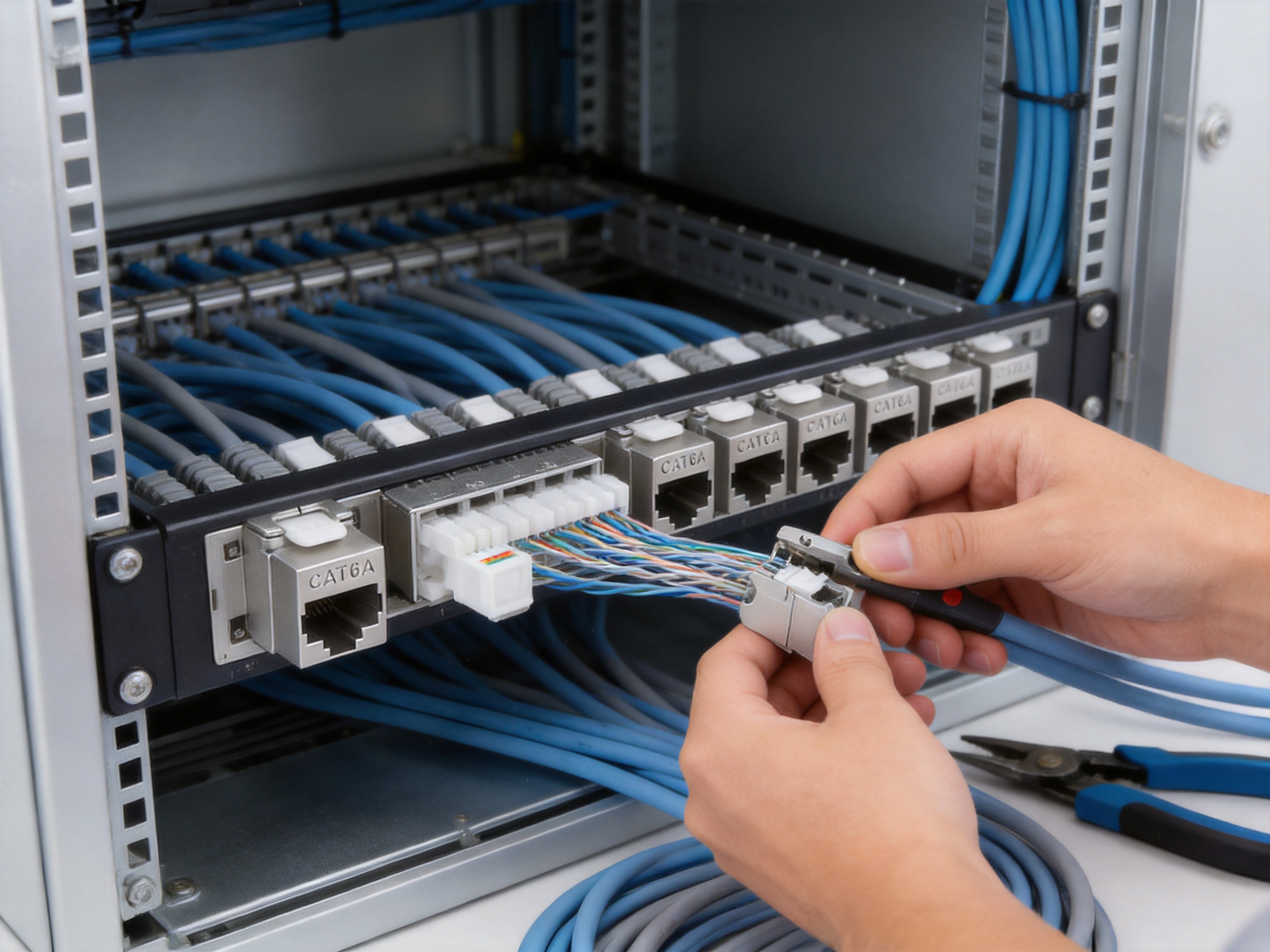
Place the conductors into the designated termination positions. Confirm that every conductor reaches the correct position and that no wire is partially inserted. Secure the termination mechanism according to the specified procedure. Because the product is tool-less, the closure or cap should be fully engaged rather than pressed only halfway.
Ensure that the cable jacket is retained by the jack’s support structure. The cable should not be held only by the individual conductors. Check that the screened elements are correctly positioned and that the shield path is not interrupted by an improperly fitted component.
After termination, inspect the assembly visually and mechanically. The cable should leave the jack at a controlled 45-degree angle without a sharp forced bend. The completed module should fit securely into the face plate or patch panel. Finally, test the link using suitable certification or verification equipment.
Testing and System Verification
Testing is necessary because a connector may appear correctly assembled while still containing a wiring error, an intermittent contact, excessive pair untwist, or a problem in the screening path. The test method should match the required level of project assurance.
Basic verification can identify open circuits, short circuits, reversed pairs, split pairs, and incorrect conductor sequences. More advanced certification testing evaluates the permanent link or channel against the relevant performance requirements. Test results should be recorded and retained as part of the project documentation.
For screened systems, the installer should also confirm continuity of the screen where required by the system design. Grounding and bonding must be handled according to applicable regulations and engineering practice. A screened connector should never be treated as a substitute for a properly designed grounding system.
Mechanical inspection is equally important. The jack should remain firmly seated in the modular panel, and the cable should not move excessively at the termination point. Patch cords should be inserted and removed without unusual resistance. Labels should be applied in a way that does not obstruct the jack’s locking features or cable entry.
Testing provides advantages beyond initial acceptance. A complete record makes future troubleshooting easier and helps maintenance teams determine whether a fault is related to the outlet, patch cord, horizontal cable, patch panel, or active equipment.
Advantages for Distributors and System Integrators
Distributors need products that are easy to explain, easy to stock, and suitable for multiple project types. The SMT-1079T8C6A-FTP offers a clear feature combination: CAT6A category, FTP screening, low-profile construction, 45-degree cable entry, and tool-less termination.
These features create a practical product position between basic general-purpose keystone jacks and more specialized high-density screened modules. The product can be proposed for contractors who need efficient installation as well as customers who require better cable organization in compact spaces.
System integrators can also benefit from the manufacturer’s ability to support OEM and ODM projects. Customization may be useful when a project requires private labeling, special packaging, dedicated product identification, or coordinated supply across several related components.
Stable manufacturing capacity is another important consideration. Large structured cabling projects can be delayed when a small component becomes unavailable. A manufacturer with multiple production lines, molding equipment, assembly resources, and technical personnel is better positioned to support repeat orders and project continuity.
Simante’s experience in both copper and optical fiber products may also help customers coordinate broader structured cabling requirements through one supplier. While the SMT-1079T8C6A-FTP is a copper connectivity product, network projects often require a combination of copper outlets, patch panels, fiber products, wall plates, data sockets, and related accessories.
Advantages over Less Specialized Alternatives
A basic unshielded jack may be adequate in a simple office installation, but it may not address the needs of a screened system or a high-density cabinet. A standard straight-entry jack may also require more space behind the outlet. A tool-dependent termination design may increase installation time when the project includes a large number of ports.
The SMT-1079T8C6A-FTP brings these considerations together in one modular component. Its screened structure supports the requirements of compatible FTP systems. Its low-profile housing is directed toward space-constrained applications. Its 45-degree entry encourages more organized cable routing. Its tool-less construction is intended to make field termination more convenient.
The product’s advantage is therefore based on combined design value rather than on one isolated feature. In real installations, efficiency, space, screening, serviceability, and manufacturing consistency often matter at the same time. A jack that addresses several of these requirements can reduce the need to compromise during product selection.
Compared with very low-cost alternatives, a more carefully engineered product may also provide better consistency from one production batch to another. This is especially important for professional installers, distributors, and integrators that need predictable fit, appearance, and termination behavior across multiple projects.
Procurement and Project Selection Considerations
Before ordering, customers should confirm the required category, screening type, cable construction, wiring scheme, mounting format, and application environment. The face plate or patch panel should be compatible with the selected keystone dimensions and retention features.
Customers should also confirm the required order quantity and delivery schedule. For larger projects, it is useful to define sample approval, packaging requirements, inspection standards, labeling, and documentation before mass production begins. These steps reduce the possibility of confusion during project delivery.
For customized products, the technical team should review drawings, samples, material requirements, colors, markings, packaging, and testing criteria. The manufacturer’s engineering and production departments can then evaluate the project and determine the appropriate process route.
For standard orders, customers can focus on the product model, quantity, packaging, delivery destination, and requested documentation. The manufacturer can be contacted by email at ting@smartyy.com or by telephone at +86-13958305758 and +86-574-62495827 for product and project communication.
Company Manufacturing and Service Profile
Yuyao Simante Network Communication Equipment Co., Ltd. is located at No. 2, Fumin Road, Moushan Town, Yuyao, Ningbo City, Zhejiang, China. The company specializes in network cabling solutions and optical fiber products and serves customers in structured cabling, network communication, smart home, automation, and related fields.
The company’s product range includes keystone jacks, patch panels, wall face plates, data sockets, and other connectivity products. Its technical and production resources are organized to support both regular product manufacturing and customized development.
Simante maintains export activity in Europe, Australia, Africa, the Middle East, and Southeast Asia. This international customer base requires attention to product consistency, communication, packaging, delivery coordination, and technical support. The company also undertakes OEM and ODM projects, giving customers the option to develop products for specific market or brand requirements.
The manufacturer’s stated objective is to create value for customers through product quality, production capability, engineering support, and responsive service. For the SMT-1079T8C6A-FTP, this means customers can evaluate not only the jack’s physical design but also the manufacturing system behind it.
Frequently Asked Questions
What type of product is the SMT-1079T8C6A-FTP?
It is a screened CAT6A keystone jack designed for modular copper structured cabling installations. It features a low-profile body, a 45-degree cable entry, and a tool-less termination concept.
What does FTP screening mean?
FTP generally refers to an overall foil-screened cabling structure. The screened jack is intended to support continuity of the screening path when used with compatible screened cable, patch panels, plugs, grounding, and other system components.
Does the jack require a separate punch-down tool?
The product is designed for tool-less termination, so a separate punch-down tool is generally not required for the intended termination process. Installers should follow the manufacturer’s instructions and use suitable testing equipment after installation.
Why is the cable entry angled at 45 degrees?
The angled entry helps guide the cable in a controlled direction and can reduce abrupt bends directly behind the jack. It is useful in compact outlets, dense patch panels, shallow boxes, and installations with defined cable-management pathways.
What is the benefit of the low-profile construction?
The low-profile structure occupies less space behind the modular opening. This can simplify cable routing and improve suitability for high-density cabinets, shallow wall boxes, furniture outlets, and multi-port face plates.
Can the product be used with unshielded cable?
The jack is designed as an FTP-screened product. Customers should confirm compatibility with the complete cabling system before combining it with unshielded cable or unshielded connecting hardware. A screened system should be designed as a compatible end-to-end configuration.
Is the product suitable for CAT6A network projects?
It is categorized as a CAT6A keystone jack and is intended for CAT6A structured cabling applications. The final performance depends on correct installation, compatible components, proper cable management, and testing of the completed link or channel.
Where can the jack be installed?
Typical applications include patch panels, wall face plates, data sockets, furniture outlets, floor boxes, network cabinets, commercial buildings, smart-home systems, automation networks, and other modular copper cabling environments.
Does the jack support OEM or ODM projects?
The manufacturer undertakes OEM and ODM projects. Customers should provide their technical, packaging, labeling, quantity, and delivery requirements for engineering and production evaluation.
How should the completed connection be tested?
The connection should be visually inspected and tested using appropriate verification or certification equipment. The test should check conductor mapping and, when required, the performance of the permanent link or channel. Screen continuity should also be checked in screened installations.
What information should be included in a quotation request?
A quotation request should include the product model, estimated quantity, application, cable type, screening requirement, packaging preference, destination, required delivery schedule, and any customization requirements. Drawings or reference samples are helpful for OEM and ODM inquiries.
Conclusion
The SMT-1079T8C6A-FTP is designed for network installations where cable organization, screening, space efficiency, and installation convenience are all important. Its CAT6A keystone format supports modern copper structured cabling applications, while the FTP-screened construction is intended for compatible systems that require additional interference control.
The low-profile body helps address the limited space available in dense cabinets, shallow boxes, and modular outlets. The 45-degree cable entry promotes a more controlled cable path and can reduce stress caused by abrupt routing. The tool-less termination concept simplifies the installer’s workflow and may improve productivity on large projects.
The product is further supported by the manufacturing capabilities of Yuyao Simante Network Communication Equipment Co., Ltd. The company combines engineering resources, automated and semi-automated production equipment, multiple manufacturing lines, performance testing, and experience in copper and optical fiber products. Its OEM and ODM capabilities provide additional flexibility for distributors, integrators, and equipment manufacturers.
For customers seeking a screened CAT6A modular jack that is compact, installation-friendly, and suitable for professional structured cabling systems, this product offers a balanced solution. Its strongest value comes from the combination of electrical design, mechanical layout, production consistency, and manufacturer support.
References
1. ANSI/TIA-568 Series, Telecommunications Cabling Infrastructure Standards.
2. ISO/IEC 11801 Series, Information Technology — Generic Cabling for Customer Premises.
3. IEC 60603-7 Series, Connectors for Electronic Equipment and Communication Applications.
4. IEC 60512 Series, Connectors for Electronic Equipment — Tests and Measurements.
5. General engineering practices for screened balanced copper cabling systems.
6. General installation practices for CAT6A structured cabling, cable management, grounding, bonding, and field testing.
7. Manufacturer product information for the SMT-1079T8C6A-FTP screened low-profile 45-degree cable entry keystone jack.