Español
 عربى
عربى русский
Content
- 1 Understanding the Role of a Two-Port Faceplate
- 2 Product Overview
- 3 Key Specifications and Functional Characteristics
- 4 Embedded Face-Frame Design
- 5 Spring-Type Dust-Proof Door
- 6 Port Identification and Management
- 7 ABS Engineering Plastic Construction
- 8 Environmental and Operating Conditions
- 9 Compatibility with Type 86 Back Boxes
- 10 Module Capacity and Application Flexibility
- 11 Advantages Compared with Basic Faceplates
- 12 Manufacturing Strengths Behind the Product
- 13 Quality Control and Product Stability
- 14 Installation Recommendations
- 15 Packaging, Storage, and Logistics
- 16 OEM, ODM, and Customer-Specified Packaging
- 17 Applications in Copper Structured Cabling
- 18 Applications in Fiber and Mixed-Media Systems
- 19 Use in Smart Homes and Automation Systems
- 20 Why Manufacturing Integration Matters to Buyers
- 21 Selection Guidance for Distributors and System Integrators
- 22 Maintenance and Service Considerations
- 23 Frequently Asked Questions
- 23.1 What is the SMT-4320AP-86-2P?
- 23.2 How many modules can the faceplate hold?
- 23.3 What type of back box is compatible with the product?
- 23.4 Are the mounting screws included?
- 23.5 Does the faceplate have visible screws on the front?
- 23.6 What is the purpose of the spring-type dust-proof door?
- 23.7 Can the ports be labeled?
- 23.8 What material is used?
- 23.9 Does the product meet RoHS requirements?
- 23.10 What is the operating temperature range?
- 23.11 Can the faceplate be used for fiber connections?
- 23.12 Is the product suitable for OEM or ODM projects?
- 23.13 How is the product packaged?
- 23.14 How should the product be stored?
- 23.15 Why choose a two-port faceplate instead of a single-port model?
- 23.16 What should be checked before placing a large order?
- 24 Conclusion
- 25 References
- 26 Product: SMT-4320AP-86-2P 86 Type Dual Port Panel

Reliable network infrastructure begins with components that are often overlooked. A wall faceplate may appear to be a simple finishing accessory, yet it has a direct influence on installation quality, port organization, user safety, long-term maintenance, and the visual consistency of a structured cabling system. The SMT-4320AP-86-2P 86 Type Dual Port Panel is designed to provide a practical and durable interface between concealed or exposed back boxes and information or telephone modules.
As a two-port faceplate for copper and fiber structured cabling applications, this product is intended for offices, commercial buildings, residential projects, smart-home installations, automation environments, and other locations where network and communication outlets must be installed neatly and managed efficiently. Its Type 86 format, embedded face frame, spring-type dust-proof doors, detachable identification plates, and ABS engineering plastic construction combine to address many of the common weaknesses found in basic wall plates.
The product supports up to two compatible modules and is supplied with two standard M4 bolts. It is compatible with common Type 86 exposed and concealed back boxes and information or telephone modules using the applicable Amp interface. This compatibility allows installers to create a clean two-port outlet without changing the surrounding wall-box system.
More than a cosmetic cover, the SMT-4320AP-86-2P is an organized termination and access point. It protects unused openings, supports port identification, simplifies installation and removal, and contributes to the professional appearance of a completed cabling project. Its design is also supported by the manufacturing capabilities of Yuyao Simante Network Communication Equipment Co., Ltd., a specialized producer of network cabling solutions and optical fiber products.
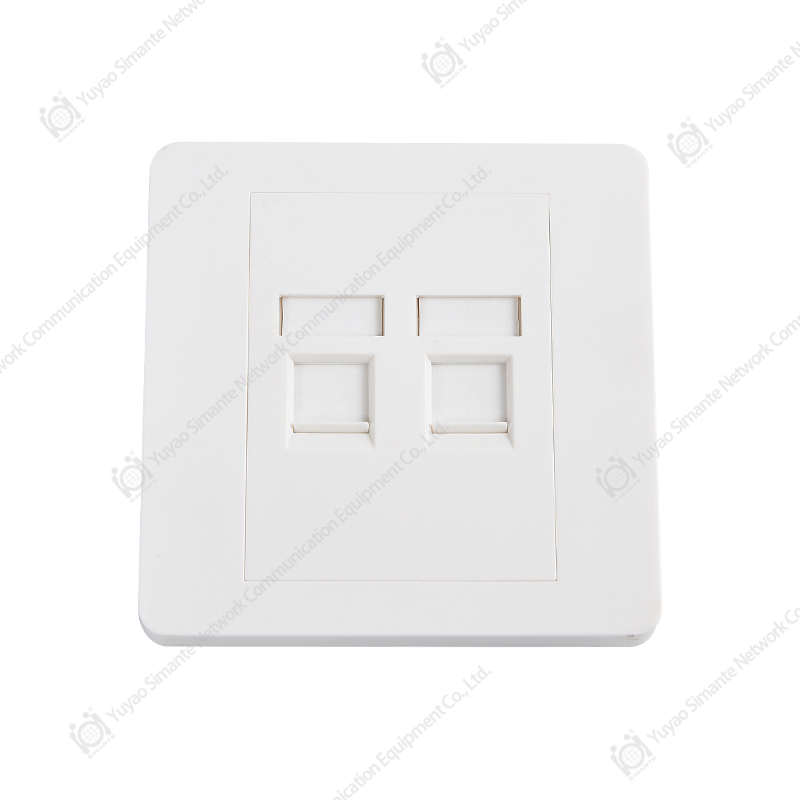
SMT-4320AP-86-2P 86 Type Dual Port Panel
Understanding the Role of a Two-Port Faceplate
In a structured cabling system, faceplates are installed at the user outlet, work area, equipment location, or service point. They provide the visible interface where network, telephone, or other communication modules are mounted. The faceplate must remain aligned with the back box, support the installed modules, protect the connection area, and allow future maintenance without unnecessary disruption.
A two-port model is especially useful when an outlet needs to serve more than one communication function. For example, one port may be assigned to a data connection while the second port is used for telephone service, a second network connection, a fiber adapter, or another compatible module. The exact configuration depends on the selected modules and the requirements of the project.
Using a two-port faceplate also provides capacity for future expansion. A single-port outlet may be sufficient for a basic installation, but it can become restrictive when users later require another network connection, a separate voice line, or an additional service. A two-port panel offers a compact way to reserve connection capacity without installing a larger wall outlet.
The faceplate must therefore balance several requirements. It needs to be compact enough for standard wall-box installation, strong enough to withstand routine use, easy to clean, visually consistent, and simple for technicians to remove when a module requires inspection or replacement. It should also provide a way to identify ports, particularly in offices, server rooms, classrooms, hotels, apartment buildings, and other multi-outlet environments.
Product Overview
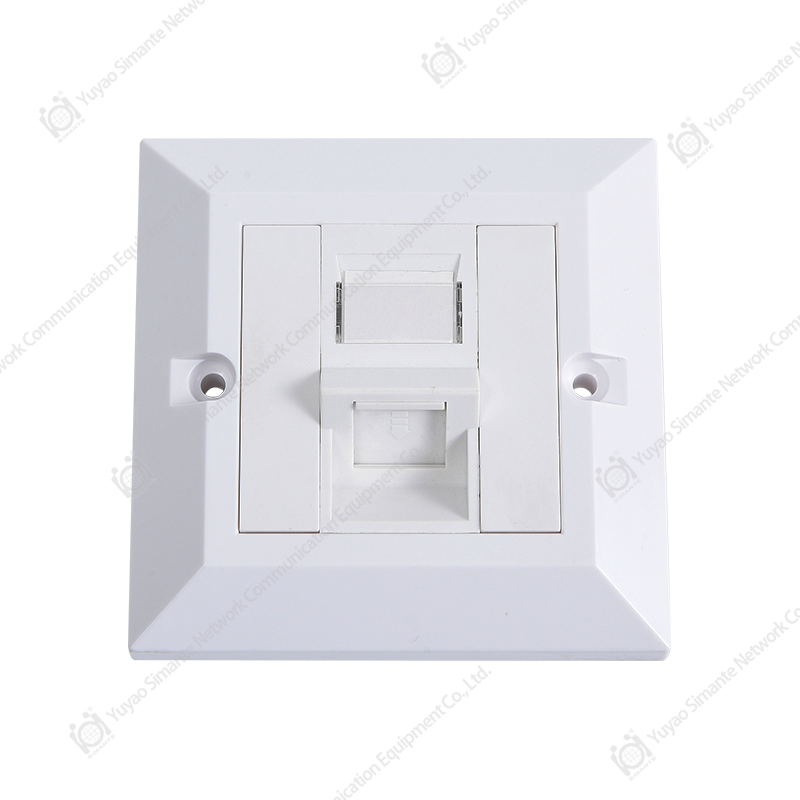
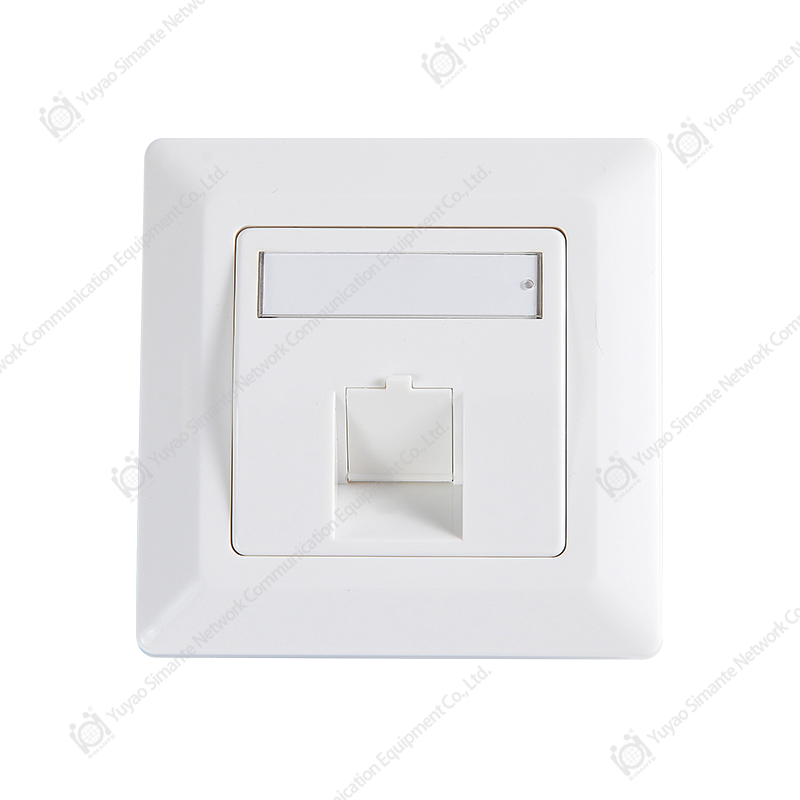
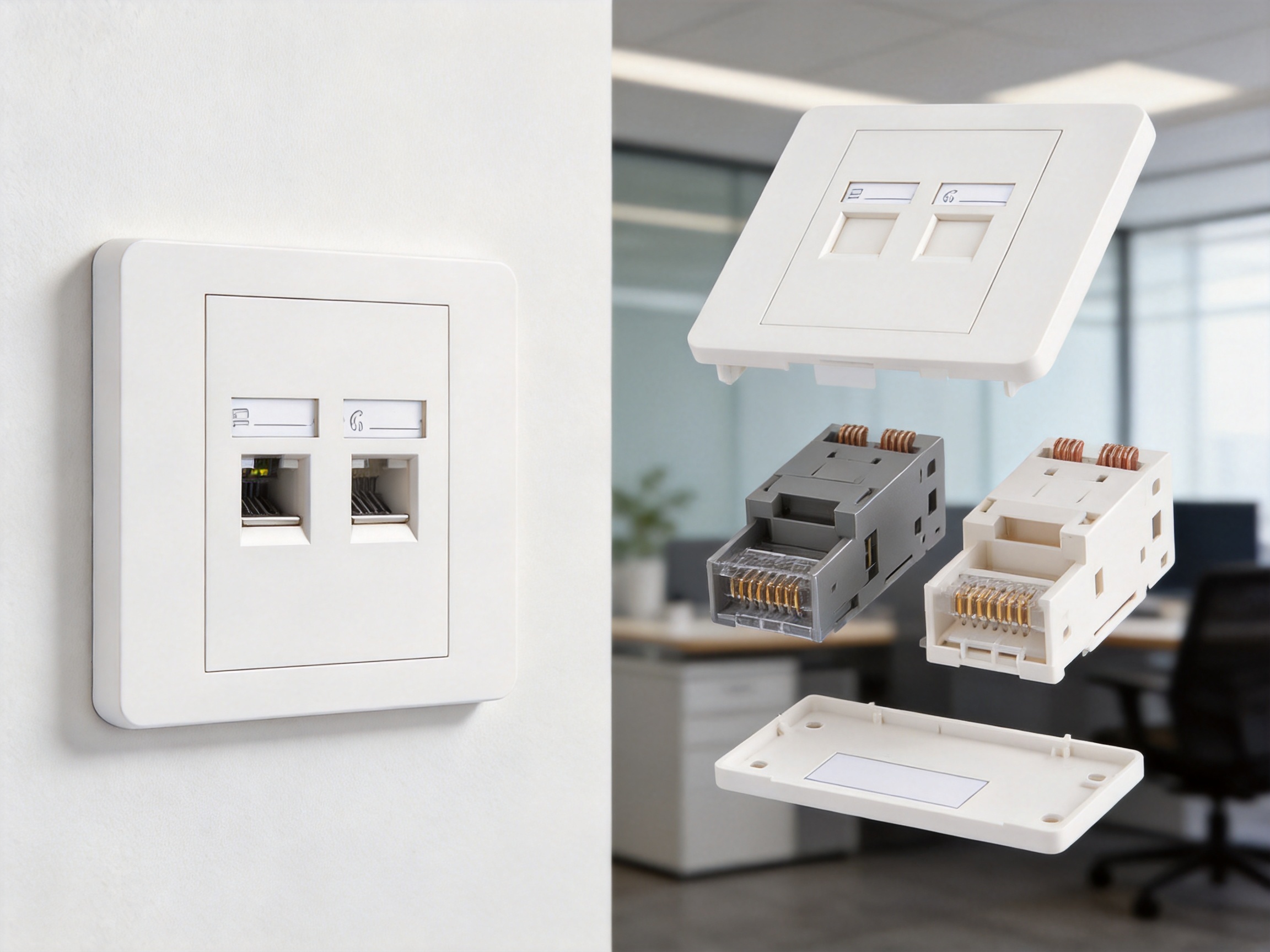
The SMT-4320AP-86-2P is an 86 Type dual-port panel intended for wall-mounted structured cabling applications. It is categorized as a two-port faceplate and can accommodate up to two information or telephone modules compatible with the applicable Amp interface. The product is suitable for common Type 86 exposed or concealed back boxes.
The product uses an embedded face-frame structure. Unlike designs that leave visible mounting screws on the front surface, the embedded construction helps create a cleaner appearance after installation. This is valuable in modern commercial and residential projects where communication outlets are expected to integrate with the surrounding wall finish, switch plates, furniture, and interior design.
A spring-type dust-proof door is provided for the port area. The door helps reduce the accumulation of dust and foreign particles when a port is not in use. It also contributes to a more finished appearance by covering the opening between active connections. The front includes a logo window for identification, while the detachable logo plate supports more flexible port management.
Two standard M4 bolts are supplied with the product. Providing the necessary fasteners together with the faceplate helps simplify installation preparation and reduces the risk of using unsuitable screws. The final mounting method should always be checked against the selected back box and the requirements of the project.
The product is molded from high-quality ABS engineering plastic. This material is selected for its practical combination of impact resistance, dimensional stability, low weight, and suitability for injection molding. The resulting faceplate is designed to resist routine collision and impact while remaining easy to handle during installation.
Key Specifications and Functional Characteristics
| Item | Specification or Feature | Practical Benefit |
|---|---|---|
| Product type | 86 Type dual-port wall faceplate | Provides two organized connection positions in a compact outlet |
| Port capacity | Up to two compatible information or telephone modules | Supports data, voice, fiber, or other suitable module arrangements |
| Back-box compatibility | Common Type 86 exposed or concealed back boxes | Helps integrate with widely used installation formats |
| Face-frame design | Embedded frame with no visible front screws | Creates a cleaner and more professional appearance |
| Protection | Spring-type dust-proof door | Helps protect unused openings from dust and debris |
| Identification | Front logo window and detachable logo plate | Supports port labeling and future outlet management |
| Material | High-quality ABS engineering plastic | Provides impact resistance and dimensional stability |
| Environmental compliance | Designed to meet RoHS requirements | Supports projects requiring restricted-substance compliance |
| Operating temperature | -25°C to +70°C | Suitable for a broad range of indoor installation conditions |
| Fasteners | Two standard M4 bolts | Helps simplify mounting preparation |
Embedded Face-Frame Design
One of the most visible advantages of the SMT-4320AP-86-2P is its embedded face-frame design. Traditional wall plates may expose their mounting screws on the front, creating visible points that interrupt the appearance of the outlet. Exposed screws may also collect dust, become scratched, or be removed during unauthorized handling.
The embedded structure places the mounting arrangement behind the visible front surface. Once installed, the faceplate presents a smoother and more integrated appearance. This makes it suitable for areas where architectural details matter, including executive offices, hotels, conference rooms, serviced apartments, education facilities, and high-quality residential projects.
A clean front surface is not only an aesthetic advantage. It can also make routine cleaning easier because there are fewer external recesses and protruding hardware elements. In high-use environments, the absence of visible screws may reduce the likelihood of accidental contact or snagging during cleaning and maintenance.
For installers, the embedded face frame can help produce a consistent visual result across many outlets. When several faceplates are installed in the same corridor, office, or room, alignment and surface uniformity become important indicators of workmanship. A carefully manufactured faceplate supports that consistency when the back boxes and wall surfaces have been correctly prepared.
Spring-Type Dust-Proof Door
Unused communication ports can collect dust, fibers, and small particles. In some environments, construction dust or airborne debris can be especially problematic. The spring-type dust-proof door on this faceplate is designed to cover the port area when a connection is not being used.
The door provides a physical barrier between the internal module area and the surrounding environment. It does not replace proper cleaning, sealing, or maintenance procedures, but it can reduce direct exposure during normal service. Keeping an unused opening covered also helps the outlet maintain a more orderly appearance.
The spring action allows the door to return toward its closed position after access. This is more convenient than a loose removable cap that can be misplaced or forgotten. It also supports faster daily use in offices and other installations where users may connect and disconnect equipment regularly.
Compared with a completely open faceplate, a dust-proof-door design offers an additional layer of protection. Compared with a manually removable cover, a spring-return mechanism is more convenient for repeated use. These practical details can contribute to lower maintenance effort over the service life of the outlet.
The door should be operated carefully and should not be forced beyond its intended movement. Installers should also ensure that the selected module is seated correctly so that the cover can move freely after installation. Proper alignment is essential for preserving the intended protective and visual functions.
Port Identification and Management
Network outlets are often installed in groups, and identical faceplates can make it difficult to determine the destination of a particular port. This issue becomes more significant in large offices, data centers, education facilities, hotels, hospitals, and multi-unit residential buildings. Clear identification helps technicians and users understand the function or destination of each connection.
The SMT-4320AP-86-2P includes a logo window on the front and a detachable logo plate. These features allow the outlet to be marked according to project requirements. A port can be identified by room number, workstation number, network designation, telephone extension, service type, or another approved labeling system.
A detachable plate is useful when the configuration of a room changes. Instead of replacing the entire faceplate, a technician may update the identification element when a port is reassigned. This supports better asset management and reduces unnecessary replacement of otherwise serviceable components.
Identification also supports structured cabling documentation. A label on the outlet can correspond with a patch-panel port, cable identifier, floor plan, or network-management record. When labeling is consistent from the work area to the telecommunications room, fault finding and moves, adds, and changes become more efficient.
Clear labels are especially valuable where copper and fiber services are installed close together. Even when the faceplate itself is the same, a visible identification system can help distinguish a data port from a voice port, an optical service, or a reserved connection. The specific labeling format should follow the customer’s documentation and installation standards.

ABS Engineering Plastic Construction
The faceplate is made from high-quality ABS engineering plastic. ABS, or acrylonitrile butadiene styrene, is widely used for equipment housings, electrical accessories, communication components, and other products that require a balance of strength and manufacturability.
For a wall-mounted faceplate, impact resistance is important because the product may be exposed to contact from furniture, cleaning equipment, bags, tools, or users. A brittle material may crack around screw areas or module openings, while an excessively soft material may deform under pressure. ABS provides a practical balance for this type of application.
Dimensional stability is also important. The faceplate must maintain the geometry of its module openings and mounting points so that the connected modules remain aligned. Stable molded dimensions contribute to easier assembly and a more consistent visual finish across production batches.
The low weight of an injection-molded ABS faceplate benefits installation and transport. Installers can handle multiple units efficiently, while distributors and project suppliers can pack products in economical cartons. Lower component weight does not mean that quality can be ignored; the material formulation, mold precision, wall thickness, and quality-control process all influence the final result.
ABS is also suitable for producing integrated details such as the face frame, door supports, logo-window features, and module openings. This reduces the number of separate parts required and can improve consistency when the molding process is properly controlled.
Environmental and Operating Conditions
The product is designed to meet RoHS requirements. Restriction of Hazardous Substances compliance is an important consideration for international procurement and for projects that require controlled material content. Buyers should request the applicable compliance documentation and confirm that the product version supplied matches the requirements of the project.
The stated temperature range is -25°C to +70°C. This broad range allows the faceplate to serve many indoor and semi-protected installation conditions. It may be suitable for environments that experience seasonal temperature changes, unconditioned service areas, utility spaces, and other locations within the specified limits.
The temperature specification should not be interpreted as permission to install the faceplate in every outdoor or harsh industrial environment. Direct sunlight, water exposure, chemical vapors, excessive humidity, ultraviolet radiation, and mechanical abuse may require additional product evaluation. Installation should follow the environmental conditions specified by the project and the relevant technical documentation.
Material performance is affected by the complete installation environment. A sound back box, correct mounting pressure, suitable cable routing, and proper module selection are all necessary to obtain reliable service. The faceplate is one part of a larger structured cabling system and should be evaluated together with the modules, cables, connectors, and enclosure.
Compatibility with Type 86 Back Boxes
The Type 86 format is widely used for wall-mounted electrical and communication accessories in many markets. Compatibility with common Type 86 exposed and concealed back boxes helps simplify design and installation planning. Contractors can use a familiar wall-box footprint while adding a dedicated communication outlet.
Concealed back boxes are typically installed inside the wall, creating a more integrated finish. Exposed back boxes may be used where the wall cannot be chased, where surface-mounted installation is preferred, or where access to the cabling route is important. The faceplate is designed for use with both common arrangements, subject to the exact dimensions and mounting requirements of the selected box.
Before installation, the technician should verify the back-box condition, screw spacing, wall level, available depth, and cable bend radius. A faceplate can only achieve a professional result when the supporting box is correctly positioned. If the box is tilted or set too deeply, the finished plate may not sit flush even when the product itself is manufactured correctly.
Compatibility with a standard installation format also makes replacement easier. When an existing outlet is damaged or a project requires a new module arrangement, a Type 86-compatible dual-port panel can often be integrated without major changes to the wall opening. This can reduce disruption during renovation and upgrade work.
Module Capacity and Application Flexibility
The panel can accommodate up to two information or telephone modules compatible with the applicable Amp interface. This allows the installer to select modules according to the communication requirements of the building rather than committing to a single fixed port type.
In a conventional office, two modules may be configured as two copper data outlets. In a mixed-service area, one position may be used for a network connection and the other for telephone service. In a residential project, the same faceplate may support a data outlet and a spare position for future use.
For fiber-related applications, the suitability of the exact module must be confirmed before ordering. The faceplate provides the mounting platform, while the module determines the connection technology, adapter type, fiber-management arrangement, and termination method. This modular approach allows the visible outlet to remain consistent even when the internal service changes.
The two-port capacity also supports redundancy and service separation. A user may require separate connections for a business network and a building-management system, or a workstation may need two independent data paths. The faceplate itself does not define the network architecture, but it provides a compact and organized interface for the selected design.
Installers should avoid overfilling or forcing modules into the openings. Each module must be compatible with the faceplate geometry and should be installed according to the module manufacturer’s instructions. Correct fit protects the faceplate, maintains door movement, and supports reliable connector alignment.
Advantages Compared with Basic Faceplates
Cleaner Appearance
Basic faceplates with exposed screws may be functional but can look unfinished in high-visibility areas. The embedded face-frame structure of the SMT-4320AP-86-2P conceals the primary mounting hardware from the front, producing a cleaner appearance that is better suited to professional interiors.
Better Protection for Unused Ports
An open port can accumulate dust and may appear untidy. A spring-type dust-proof door helps cover unused openings and returns toward the closed position after access. This is a practical improvement over designs that provide no cover or rely on separate caps.
Improved Outlet Identification
Many low-cost wall plates provide little or no space for meaningful identification. The logo window and detachable logo plate support more systematic labeling. This can reduce confusion and make future maintenance more efficient.
More Flexible Service Planning
A single-port faceplate limits the outlet to one connection position. The dual-port configuration provides two module locations in the same Type 86 footprint, offering a better balance between compactness and capacity.
Impact-Resistant Material
Some basic covers are made from materials that crack or deform easily during installation or daily use. High-quality ABS engineering plastic is selected to provide better resistance to routine impact and handling, while preserving the molded details needed for accurate module installation.
Support for Professional Production
Product performance is strongly influenced by manufacturing consistency. The supplier’s experience in injection molding, automated installation, product testing, and custom production provides a stronger foundation than a faceplate produced without a mature quality system.
Manufacturing Strengths Behind the Product
Yuyao Simante Network Communication Equipment Co., Ltd. is a professional manufacturer integrating design, development, sales, and service. Its product range includes keystone jacks, patch panels, wall faceplates, data sockets, and other components used in structured cabling, network communication, smart-home, and automation applications.
The company has nearly two decades of service experience in the network cabling and optical fiber product field. This experience supports a practical understanding of how components are designed, installed, connected, labeled, packaged, and maintained in real projects.
A mature research and development system is important for molded communication accessories. The quality of a faceplate begins before production, with decisions regarding material selection, dimensional tolerance, module compatibility, door movement, labeling space, mounting geometry, and appearance. Design control at this stage helps prevent problems that would otherwise appear during assembly or field installation.
The company has more than ten engineers and over thirty full-time technical personnel. These employees contribute to product development, production improvement, testing, process control, and customer support. A technical team of this kind can help translate project requirements into practical product specifications, especially for customers requiring OEM or ODM services.
The factory operates ten regular and customization production lines. This combination allows the manufacturer to support standard product production while also addressing customer-specific requirements. Customization may involve packaging, labeling, color, product marking, module arrangements, or other project details, subject to technical review and production feasibility.
Production equipment includes ten fully automatic injection molding machines and twenty semi-automatic injection molding machines. Injection molding equipment is central to the production of ABS faceplates because it influences repeatability, surface finish, dimensional accuracy, cycle efficiency, and material handling.
The factory also has eight types of automatic installation machines. Automated or semi-automated assembly equipment can improve consistency in repetitive operations and reduce variation caused by manual handling. For a faceplate with doors, logo components, fasteners, and other small parts, controlled assembly is important for ensuring that each unit operates as intended.
The reported annual output exceeds nine million pieces. Such capacity is valuable for distributors, system integrators, contractors, and brand owners that require stable supply across multiple projects. Capacity also supports production planning for standard items and helps the manufacturer manage larger orders without relying entirely on small-batch manual assembly.
Quality Control and Product Stability
Quality control for a wall faceplate should extend beyond visual inspection. A reliable manufacturing process considers raw-material control, mold condition, dimensional accuracy, surface finish, assembly performance, fastening points, dust-door movement, identification components, packaging, and final quantity verification.
Material control is particularly important for ABS products. Variations in resin quality, colorant, additives, moisture, or processing conditions can affect strength, appearance, and dimensional stability. A disciplined production system helps ensure that the selected engineering plastic performs consistently from batch to batch.
Mold maintenance is another important factor. Faceplate openings and mounting features need to remain accurate over repeated production cycles. Wear, contamination, or improper adjustment can create burrs, flash, misalignment, or inconsistent fitting. Regular equipment and mold management supports the quality expected by installers and distributors.
Assembly inspection should confirm that the spring-type dust-proof door moves properly and returns toward its intended position. It should also verify that the logo window and detachable logo plate are correctly installed. These features are small, but they have a direct effect on the usability and appearance of the finished product.
Performance testing may include impact-related evaluation, dimensional checking, environmental review, material compliance verification, and customer-specific testing. The precise test plan should be agreed upon for the application. Projects with special requirements may require additional inspection records, samples, or acceptance criteria.
The manufacturer states that it meets comprehensive testing requirements for products. This reflects an approach in which quality is supported by both production management and performance verification. For international buyers, it is advisable to request current technical files, declarations, sample approvals, and inspection documentation before placing a large order.
Installation Recommendations
Prepare the Wall Box
Confirm that the Type 86 exposed or concealed back box is securely fixed and correctly aligned. The box should not move when the faceplate is pressed or when a module is connected. The front of the box should be positioned to accommodate the final wall finish and the intended flush appearance.
Inspect the Cable Route
Before mounting the faceplate, verify that the cable has sufficient length for termination and that the bend radius is not exceeded. Avoid placing excessive pressure on copper or fiber cables behind the module. A neat cable route reduces stress on the connection and makes future service easier.
Install the Modules
Select modules that are compatible with the faceplate and the Amp interface requirement. Install up to two modules in the available positions. Check that each module is fully seated and that the connector opening is aligned with the faceplate.
Secure the Faceplate
Use the supplied M4 bolts or the approved mounting hardware for the selected back box. Tighten the bolts evenly and avoid excessive force, which may damage the plastic or distort the plate. The faceplate should sit flat against the wall surface without visible gaps caused by uneven mounting.
Check the Dust Door
After installation, operate the spring-type dust-proof door several times. Confirm that it opens smoothly, does not interfere with the module, and returns toward the closed position. Any obstruction should be corrected before the outlet is placed into service.
Apply Identification
Use the logo window and detachable logo plate to mark the port according to the project labeling plan. The label should correspond with patch-panel records and cable identifiers whenever applicable. Clear, durable, and consistent identification is more valuable than decorative marking alone.
Packaging, Storage, and Logistics
Packaging protects the faceplate from contamination, scratches, impact, and component loss during transportation and storage. The product is placed in a special blister bag and then packed into a cardboard box. Product accessories are placed together with the faceplate, helping keep the small components associated with the correct product.
A label indicating the product model and quantity is applied to the upper-left area of the carton front. Clear external identification assists warehouse staff, distributors, and project teams in locating the correct item without opening every carton. It also supports stock counting and order verification.
The regular packing quantity is described as ten boxes per carton, twenty pieces per box, and two hundred pieces per carton. Buyers should confirm the exact packing configuration before shipment because packaging may be adjusted for customer-specified requirements, export standards, or private-label orders.
Packaged products should be stored in a warehouse with an ambient temperature of -5°C to +30°C and relative humidity not exceeding 70 percent. The storage area should be free from acid, alkali, and other corrosive gases. These conditions help protect the plastic, labels, metal hardware, and packaging materials during inventory storage.
The stated storage period is three years under the specified conditions. Even within the stated period, stock should be managed according to the first-in, first-out principle where practical. Cartons should remain dry, protected from heavy compression, and away from direct heat or strong sunlight.
For export and project logistics, packaging consistency is particularly important. Stable carton labeling and component grouping reduce the possibility of mixed models, missing accessories, or incorrect quantities at the installation site. Customers requiring specified packaging or product-use marks should provide the requirements before production.
OEM, ODM, and Customer-Specified Packaging
Different markets and projects may require different product marks, labels, packaging formats, or documentation. The product information includes a note concerning customer-specified packaging, indicating that customized packaging can be considered for qualifying orders.
OEM projects may involve supplying a standard product under a customer’s approved brand or packaging system. ODM projects may involve adapting the design, appearance, module arrangement, or labeling to meet a defined application. The feasibility of each project depends on order volume, mold requirements, compliance needs, and technical specifications.
Customer-specified packaging may include carton artwork, blister-bag labels, quantity arrangements, model references, barcodes, instruction sheets, and product-use marks. Early approval of artwork and labeling is important because packaging errors can delay shipment even when the product itself is ready.
A manufacturer with its own design, engineering, molding, assembly, testing, and packaging resources can coordinate these stages more efficiently than a trading company that must outsource every operation. This integrated structure can simplify communication and provide clearer responsibility for product quality.
Applications in Copper Structured Cabling
In copper structured cabling, the dual-port faceplate can support outlets using compatible data or telephone modules. Typical environments include offices, classrooms, hotels, retail spaces, apartments, homes, meeting rooms, and small commercial facilities.
A two-port outlet may be used for two Ethernet connections, a combination of Ethernet and telephone, or a primary connection and a spare connection. The faceplate does not determine cable category or transmission performance; those characteristics depend on the installed cable, module, termination quality, patching equipment, and system design.
Nevertheless, the faceplate contributes to the physical organization of the system. A stable module opening, clear identification area, and protected unused port make the outlet easier to operate and maintain. A neat work-area outlet also helps communicate that the overall cabling installation has been completed professionally.
In office renovation projects, an existing Type 86 wall box may already be available. A compatible dual-port faceplate can provide a practical upgrade path while avoiding extensive wall modification. This is particularly useful when additional service capacity is required in a room that previously had only one communication outlet.
Applications in Fiber and Mixed-Media Systems
Fiber systems often require careful management of adapters, connectors, bend radius, and protective components. A Type 86 faceplate can serve as the visible mounting platform for an appropriate optical module, provided the module is compatible with the product and the installation space is adequate.
In a mixed-media installation, a two-port panel may present copper and fiber services in a coordinated wall outlet. The use of a common faceplate style can improve visual consistency throughout a building, even when different rooms use different communication technologies.
Fiber installation requires special attention to cleanliness. Dust control is especially relevant around optical connectors, where contamination can affect insertion loss and link performance. The spring-type dust-proof door can help cover an unused port, while technicians must still follow approved fiber-cleaning and inspection procedures.
The faceplate should not be treated as a substitute for fiber-management hardware. Optical modules must provide suitable protection and bend control, and the cable route behind the wall must be planned carefully. When the correct module is used, the faceplate can contribute to a clean and accessible fiber outlet.
Use in Smart Homes and Automation Systems
Smart homes and automation systems increasingly depend on structured communication infrastructure. Data outlets may be installed near control panels, televisions, workstations, access points, sensors, or building-management equipment. A compact two-port faceplate can provide a professional interface for these services.
In automation environments, one outlet may support a local network connection while another is reserved for a control or monitoring function. Clear labeling becomes important when several low-voltage services are installed in the same room or cabinet area.
The ABS construction and concealed mounting style are useful in residential and commercial interiors where exposed screws and oversized enclosures may be undesirable. The faceplate can help low-voltage communications integrate with the appearance of other wall accessories.
As smart-building installations develop, modularity becomes increasingly valuable. A faceplate that accepts compatible modules allows the visible outlet to remain useful even when the internal service is upgraded. This can reduce the need to replace the wall plate whenever a project changes from one connection type to another.
Why Manufacturing Integration Matters to Buyers
Buyers of network accessories are not purchasing only a molded plastic cover. They are purchasing predictable dimensions, consistent assembly, dependable supply, suitable packaging, and technical support. These factors become more important when the product is used across a large project or sold through a distribution network.
Integrated manufacturing can shorten the communication path between product design and production. If an installer reports a fitting issue or a distributor requests a labeling change, an integrated technical team can evaluate the matter directly. This may support faster improvement than a supply chain divided among unrelated design, molding, assembly, and packaging companies.
Production capacity also affects project continuity. A structured cabling project may require thousands of identical outlets delivered according to a construction schedule. A factory with multiple molding and assembly lines can plan production more effectively and may be better positioned to support repeat orders.
At the same time, capacity must be accompanied by quality control. High output alone does not guarantee product performance. The combination of engineering personnel, injection molding equipment, automated installation capability, testing, and process management is what makes manufacturing capacity meaningful to a professional buyer.
Yuyao Simante’s experience in structured cabling and optical fiber products provides sector-specific knowledge. This is relevant because faceplates are not isolated consumer items; they form part of a system that includes modules, cables, racks, patch panels, cabinets, back boxes, and installation practices.
Selection Guidance for Distributors and System Integrators
Distributors should evaluate whether the faceplate matches the module families commonly requested by their customers. Compatibility with the intended Amp interface and Type 86 back boxes should be confirmed before stock is purchased. Sample testing can help verify the fit of the modules used in the local market.
System integrators should review the product’s appearance, labeling method, mounting arrangement, environmental range, packaging, and documentation. If the project requires RoHS compliance, customer-specific identification, or private-label packaging, these requirements should be included in the purchasing specification.
Project managers should consider the installation environment. The product is designed for the stated temperature range, but special locations may require additional evaluation. Areas exposed to moisture, chemical contamination, outdoor conditions, or unusual mechanical loads should not be approved solely on the basis of standard indoor use.
Procurement teams should also review delivery quantities and carton configuration. The regular packaging information can help estimate warehouse space, shipping volume, and installation-site handling. For large projects, shipment schedules should be aligned with floor-by-floor or building-phase requirements.
Finally, buyers should request samples when visual finish, module fit, label style, or custom packaging is critical. A sample approval process can reduce the risk of discrepancies between the expected product and the final project installation.
Maintenance and Service Considerations
Routine maintenance of the faceplate is straightforward. The visible surface can generally be cleaned with a soft, dry, or lightly damp cloth suitable for the surrounding installation. Abrasive materials, aggressive solvents, and excessive liquid should be avoided because they may damage the surface, labels, or plastic components.
Technicians should inspect the faceplate if it has been struck, pulled, or exposed to unusual heat or chemicals. Cracks around the mounting points, deformed module openings, loose components, or a malfunctioning dust door may indicate that replacement is appropriate.
When a module must be replaced, the faceplate can be removed using the mounting bolts. The technician should support the cable and module during removal to prevent unnecessary strain. After replacement, the faceplate should be reinstalled evenly and the port identification should be updated if the service has changed.
Port labels should be reviewed during moves, adds, and changes. An accurate label is part of the maintenance record, not merely a decorative feature. The detachable logo plate can make updates more convenient when the outlet assignment changes over time.
Frequently Asked Questions
What is the SMT-4320AP-86-2P?
It is a wall-mounted 86 Type dual-port faceplate designed to accept up to two compatible information or telephone modules. It is used in copper, fiber, and mixed structured cabling applications when the selected modules match the applicable interface requirements.
How many modules can the faceplate hold?
The faceplate can accommodate up to two connectors or modules. The exact connection type depends on the modules selected for the project.
What type of back box is compatible with the product?
The product is designed for common Type 86 exposed or concealed back boxes. Installers should still verify the exact box dimensions, screw positions, depth, and module requirements before installation.
Are the mounting screws included?
Two standard M4 bolts are supplied as part of the product arrangement. The installer should confirm that the supplied fasteners are suitable for the specific back box and wall construction.
Does the faceplate have visible screws on the front?
The embedded face-frame design is intended to keep mounting screws from being visible on the front surface, creating a cleaner finished appearance.
What is the purpose of the spring-type dust-proof door?
It helps cover an unused port opening and reduce direct exposure to dust and debris. The spring mechanism allows the door to move away when the port is accessed and return toward the closed position afterward.
Can the ports be labeled?
Yes. The front includes a logo window and a detachable logo plate for port identification and management. The customer’s preferred labeling method should be confirmed for each project.
What material is used?
The faceplate is made from high-quality ABS engineering plastic, selected for its low weight, impact resistance, and dimensional stability in normal installation conditions.
Does the product meet RoHS requirements?
The product information states that the faceplate meets RoHS standards. Buyers requiring formal compliance evidence should request the current declaration or supporting documentation for the supplied product version.
What is the operating temperature range?
The stated environmental temperature range is -25°C to +70°C. Installation conditions involving water, chemicals, direct sunlight, or unusual mechanical stress should be evaluated separately.
Can the faceplate be used for fiber connections?
It can be considered for fiber applications when a compatible optical module is selected. The module must provide appropriate connector support and fiber management, and the installation must follow fiber-cleanliness and bend-radius requirements.
Is the product suitable for OEM or ODM projects?
The manufacturer supports standard and customized production lines and undertakes OEM and ODM projects. Specific customization, minimum quantities, artwork, product markings, and technical requirements should be discussed before production.
How is the product packaged?
The product is placed in a special blister bag, packed in a cardboard box, and supplied with its accessories. The carton carries model and quantity identification. Standard packing quantities should be confirmed with the supplier before ordering.
How should the product be stored?
It should be stored in a warehouse at -5°C to +30°C, with relative humidity not exceeding 70 percent, away from acid, alkali, corrosive gases, direct heat, and excessive pressure. Under the stated conditions, the storage period is three years.
Why choose a two-port faceplate instead of a single-port model?
A two-port faceplate provides additional connection capacity in the same compact Type 86 format. It can support two active services, a combination of technologies, or a current connection plus a future expansion position.
What should be checked before placing a large order?
Buyers should confirm module compatibility, back-box dimensions, color and appearance, labeling requirements, compliance documents, packaging quantities, custom marks, delivery schedule, and sample approval requirements.
Conclusion
The SMT-4320AP-86-2P 86 Type Dual Port Panel is designed to provide a clean, organized, and durable interface for structured cabling outlets. Its two-port capacity supports flexible copper, fiber, telephone, and mixed-media configurations when compatible modules are selected. Type 86 back-box compatibility helps simplify installation, while the embedded face frame improves the finished appearance by concealing front mounting screws.
The spring-type dust-proof door offers a practical way to cover unused openings, and the logo window with detachable logo plate supports clear port identification. High-quality ABS engineering plastic contributes to impact resistance, dimensional stability, and manageable installation weight. RoHS-related environmental compliance and a stated operating range of -25°C to +70°C further support its use in a broad range of projects.
Compared with basic faceplates, the product combines more complete port protection, improved labeling, cleaner visual integration, and greater two-port flexibility. These advantages are strengthened by the supplier’s manufacturing resources, including engineering personnel, injection molding equipment, automated installation machines, multiple production lines, product testing capabilities, and support for OEM and ODM requirements.
For distributors, contractors, and structured cabling system integrators, the product offers a practical balance between appearance, compatibility, installation convenience, and long-term outlet management. When the faceplate is matched with suitable modules, correctly installed in an appropriate Type 86 back box, and maintained under the specified conditions, it can contribute to a more professional and serviceable communication infrastructure.
References
1. Product specification and application information for the SMT-4320AP-86-2P 86 Type Dual Port Panel.
2. Manufacturer-provided information concerning ABS engineering plastic construction, RoHS requirements, environmental temperature range, packaging, and storage.
3. Manufacturer profile and production capability information for Yuyao Simante Network Communication Equipment Co., Ltd.
4. General principles of structured cabling design, work-area outlets, telecommunications labeling, and modular connectivity.
5. General material and processing information concerning acrylonitrile butadiene styrene engineering plastics and injection-molded communication accessories.
6. General installation practices for Type 86 exposed and concealed back boxes, copper modules, fiber modules, and wall-mounted communication outlets.