Español
 عربى
 русский
Content
- 1 Product Overview
- 2 Key Product Specifications
- 3 Embedded Face Frame for a Cleaner Installation
- 4 Spring-Type Dust-Proof Door
- 5 Port Identification and Cable Management
- 6 ABS Engineering Plastic Construction
- 7 Operating Temperature and Environmental Suitability
- 8 Applications in Structured Cabling Systems
- 9 Comparison with Basic Keystone Adapters
- 10 Manufacturing Strengths of the Supplier
- 11 Injection Molding and Process Control
- 12 Design and Development Capabilities
- 13 Quality Assurance and Product Testing
- 14 Packaging, Storage, and Logistics
- 15 Installation Recommendations
- 16 Benefits for Different Buyers
- 17 Why Manufacturing Capability Matters
- 18 Frequently Asked Questions
- 18.1 What is the primary purpose of the SMT-4310-50P(B)?
- 18.2 Can the adapter be used for both copper and fiber systems?
- 18.3 Does the product have visible screws on the front?
- 18.4 What protects an unused port from dust?
- 18.5 How can ports be identified?
- 18.6 What material is used to make the adapter?
- 18.7 What is the operating temperature range?
- 18.8 Does the product meet environmental requirements?
- 18.9 How should the product be stored?
- 18.10 What is the regular packing quantity?
- 18.11 Can the supplier provide OEM or ODM services?
- 18.12 Where can the adapter be used?
- 19 Procurement Considerations
- 20 Conclusion
- 21 References
- 22 Product: SMT-4310-50P(B) Flat Keystone Adapter
Modern structured cabling systems depend on more than high-quality cable and network equipment. The final connection point at the wall is equally important because it affects installation efficiency, appearance, port protection, identification, maintenance, and long-term reliability. The SMT-4310-50P(B) Flat Keystone Adapter is designed to provide a practical and professional mounting solution for copper and fiber structured cabling systems. As a panel-mounted adapter for British 86/140 panels, it supports organized installations in offices, residential buildings, commercial facilities, communication rooms, and other low-voltage environments.
This adapter is developed for applications in which a clean faceplate appearance, secure module positioning, convenient port identification, and effective dust protection are required. Its embedded face frame eliminates visible surface screws, while its spring-type dust-proof door helps protect unused openings from dust and other contaminants. The front logo window and detachable identification plate also support systematic port management, making the product suitable for installations that may need regular expansion, inspection, or reconfiguration.
Manufactured from high-quality ABS engineering plastic, the adapter combines a lightweight structure with useful resistance to impact, collision, and deformation. Its operating temperature range of -25°C to +70°C allows it to be used in a broad range of indoor installation environments. In addition, the product is designed to meet RoHS requirements, supporting customers who need materials and manufacturing processes aligned with environmental compliance expectations.
Product Overview
The SMT-4310-50P(B) Flat Keystone Adapter is a panel-mounted accessory intended to accommodate compatible keystone modules within British 86/140 panel systems. Its primary function is to create a stable and visually integrated interface between the communications module and the faceplate or wall panel. By supporting a standardized modular approach, the adapter can be used in flexible cabling solutions where different types of network, telephone, audio, video, or optical modules may be installed according to project requirements.
A keystone-based installation makes it easier for contractors and system integrators to select the appropriate connector type without redesigning the entire wall outlet. This modularity is especially useful when a building contains multiple communication services or when a customer expects future technology upgrades. Instead of replacing a complete faceplate assembly, the installer can typically manage the module and adapter configuration more efficiently.
The flat design is particularly appropriate for clean wall-mounted installations. It helps maintain a neat appearance and reduces unnecessary protrusion from the panel surface. In commercial interiors, offices, hotels, educational facilities, healthcare buildings, and smart-home projects, the appearance of the wall outlet can be an important part of the overall installation quality. A well-finished adapter contributes to a professional result while retaining the practical benefits of modular structured cabling.
Key Product Specifications
| Item | Specification |
|---|---|
| Product model | SMT-4310-50P(B) |
| Product type | Flat keystone adapter |
| Application category | Faceplate and panel-mounted structured cabling accessory |
| Compatible panel format | British 86/140 panels |
| Material | High-quality ABS engineering plastic |
| Protection feature | Spring-type dust-proof door |
| Identification feature | Front logo window and detachable logo plate |
| Surface design | Embedded face frame with no visible screws on the surface |
| Environmental compliance | Designed to meet RoHS requirements |
| Operating temperature | -25°C to +70°C |
| Packaging | Special blister bag, cardboard box, product accessories, and identification label |
| Regular packing quantity | 10 boxes per carton, 20 units per inner box, 200 units per carton |
The listed specifications show that the product is intended to balance practical installation needs with professional appearance and environmental durability. The material, enclosure design, panel compatibility, and identification features work together as part of a complete mounting solution rather than as isolated product characteristics.

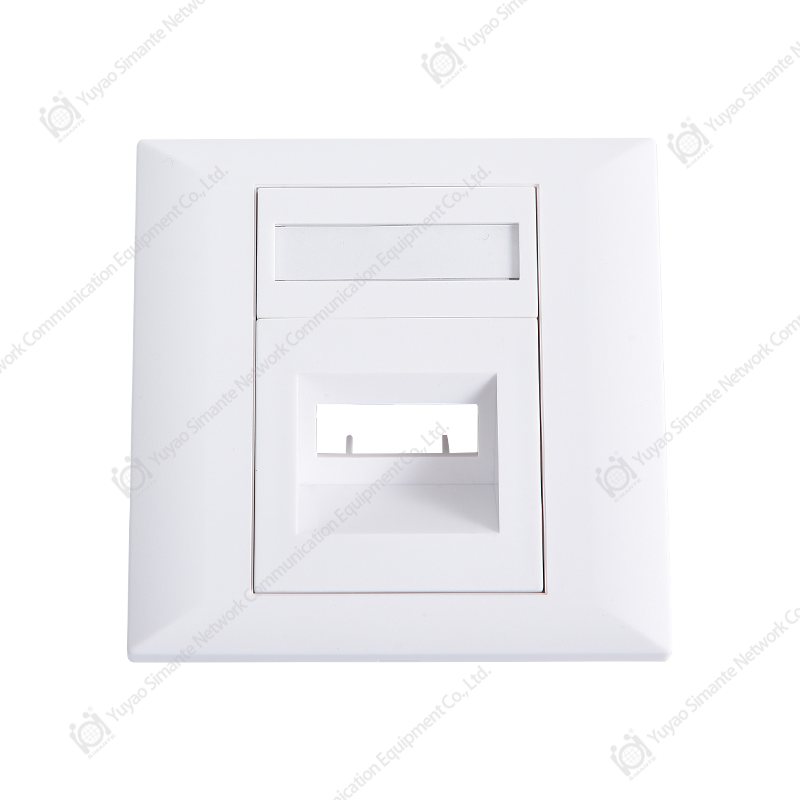
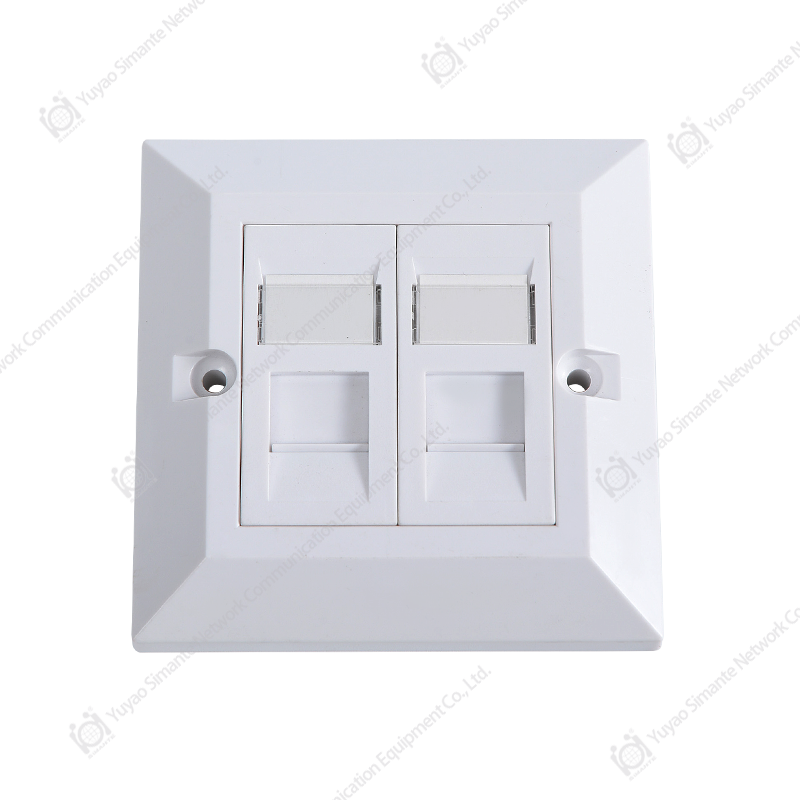
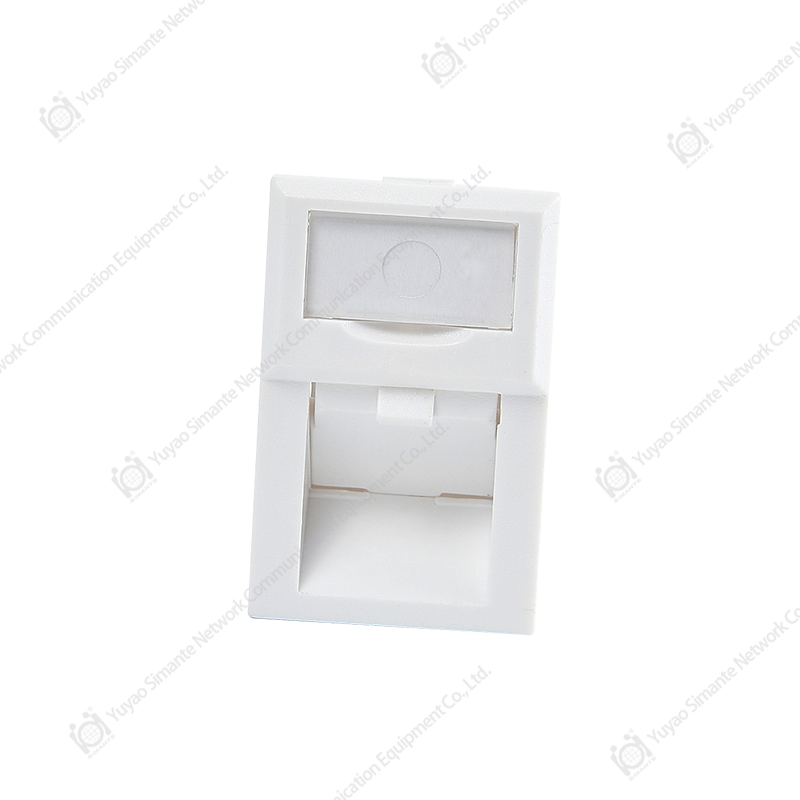
SMT-4310-50P(B) Flat Keystone Adapter
Embedded Face Frame for a Cleaner Installation
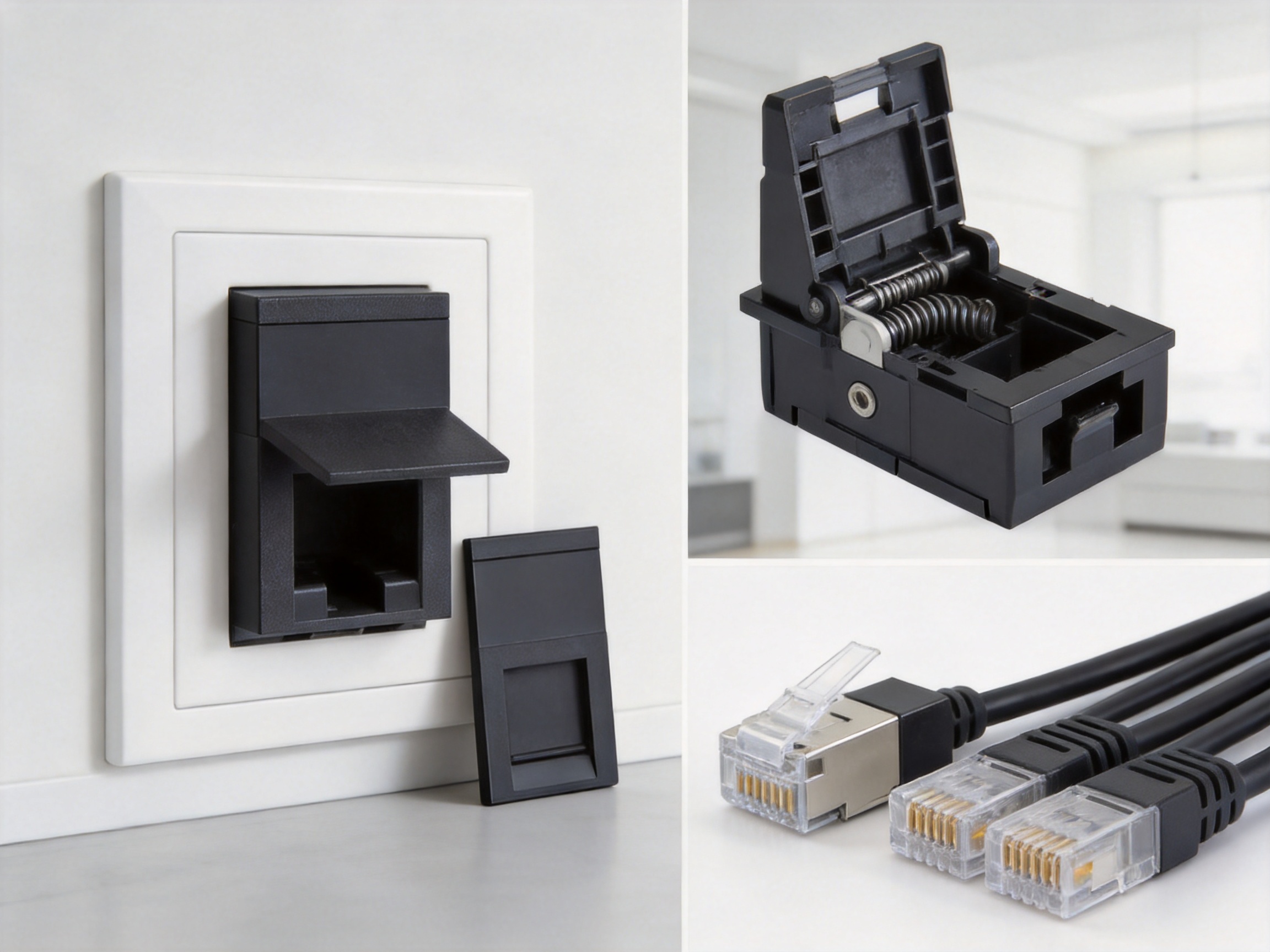
One of the most visible advantages of the adapter is its embedded face frame. In many conventional wall outlet designs, fixing screws remain visible on the front surface. Although visible screws can provide a basic method of attachment, they may reduce the visual quality of the finished installation. They can also collect dust around the screw head, create an uneven appearance, and make the faceplate look less integrated with the wall.
The embedded face frame used in this product conceals the fixing structure from the front. As a result, the visible surface presents a cleaner and more uniform appearance. This is valuable in office environments, hotel rooms, conference areas, public buildings, and residential projects where network outlets are expected to blend with the interior design.
The design also supports easier installation and disassembly. Technicians can access the mounting structure when needed without permanently compromising the visible surface. This is beneficial during initial installation, troubleshooting, replacement, and future system upgrades. A product that can be installed and removed efficiently may reduce labor time, particularly when a project includes a large number of outlets.
Compared with basic adapters that rely on exposed screws or less integrated mounting structures, the embedded face frame provides a more refined balance of appearance and serviceability. It helps contractors deliver a finished installation that looks organized while retaining access for maintenance.
Spring-Type Dust-Proof Door
The adapter is equipped with a spring-type dust-proof door. This door is designed to cover the module opening when the port is not in use. Dust and airborne particles can accumulate in unused communication outlets, especially in construction environments, workshops, warehouses, utility rooms, and buildings where cleaning conditions vary. By helping close the opening, the spring-type door supports a cleaner interface and helps limit unnecessary contamination.
The spring mechanism allows the door to return to its protective position after the connected plug or module is removed. This automatic closing action is more convenient than a loose removable cap, which can be misplaced during maintenance. It also reduces the need for users or technicians to manually replace a separate cover every time a port is disconnected.
Protection from dust is not a substitute for proper cable management, cleaning, or equipment-room maintenance. However, it is a useful additional design feature. The door helps protect the front portion of an unused outlet and contributes to the overall service life and visual condition of the installation.
Compared with open adapters that leave the module cavity permanently exposed, this design offers a more complete approach to port protection. It is particularly useful in areas where outlets may remain unused for long periods or where the environment contains construction dust, textile fibers, paper particles, or other airborne contaminants.
Port Identification and Cable Management
Structured cabling systems are easier to operate when each port is clearly identified. The SMT-4310-50P(B) includes a logo window on the front and a detachable logo plate. These features allow installers and facility managers to identify outlets according to room number, workstation, service type, rack position, or network designation.
Clear labeling is important during both installation and maintenance. When a technician needs to trace a connection, a readable identification system can reduce the time required to locate the correct outlet. In offices, labels can identify individual desks or departments. In hotels and residential projects, they can identify internet, telephone, television, or automation services. In industrial and smart-building applications, labels can be connected to equipment names, control zones, or network segments.
The detachable logo plate supports flexibility. A port label may need to be changed when a room is renovated, a workstation is reassigned, or the function of a connection changes. A replaceable identification component is more practical than a permanently printed label that becomes inaccurate over time.
Compared with unmarked adapters, the product provides a better foundation for organized documentation. Identification should still be coordinated with the project’s cable schedule, patch-panel records, and network diagrams. Nevertheless, the front label area makes the physical outlet easier to associate with the broader cabling management system.
ABS Engineering Plastic Construction
The adapter is manufactured using high-quality ABS engineering plastic. ABS is commonly used for communication accessories because it can provide a useful combination of strength, dimensional stability, processability, and attractive surface finish. For a faceplate accessory, these characteristics are important because the product must withstand handling during installation and remain stable in normal service.
The material is described as anti-collision and impact-resistant, with resistance to deformation. These properties are valuable during transportation, storage, installation, and maintenance. Wall outlets are often handled by installers wearing gloves or carrying tools, and the product may be exposed to incidental knocks before it is finally mounted. A suitably robust plastic structure helps reduce the risk of damage caused by ordinary handling.
Dimensional stability is also important for modular adapters. If a plastic component deforms excessively, the module may not sit correctly, the front surface may become uneven, or the mounting fit may be compromised. Proper material selection and controlled molding help the adapter maintain its intended shape across normal operating conditions.
The use of engineering plastic also allows the product to remain lightweight. Lower weight can make transportation and installation more convenient without requiring a heavy metal structure for an application that does not normally demand one. At the same time, the smooth molded surface supports a professional appearance and is easy to wipe during routine cleaning.
Operating Temperature and Environmental Suitability
The stated operating temperature range is -25°C to +70°C. This range covers many indoor structured cabling environments, including offices, homes, commercial buildings, schools, hotels, communications spaces, and service areas. It also provides useful tolerance for seasonal temperature changes and temporary exposure to warmer or cooler conditions during transportation and installation.
Temperature performance depends on the complete installation environment. The adapter should be used within the specified range and protected from conditions that exceed the product design, such as direct exposure to fire, high-energy heat sources, aggressive chemicals, prolonged water immersion, or unsuitable outdoor locations. Correct storage and installation practices remain important even when a product has a broad operating range.
The product is designed to meet RoHS standards. This environmental requirement addresses the restriction of certain hazardous substances in electrical and electronic products and related components. Compliance-conscious buyers may require RoHS-oriented materials and production controls as part of their procurement procedures, particularly for international projects and supply chains serving regulated markets.
Environmental performance is not limited to a compliance label. It also includes responsible material selection, stable manufacturing, reduced product failure, and packaging practices that support safe delivery. By combining ABS material, controlled production, and specified storage conditions, the manufacturer provides a product intended for reliable use throughout its expected service environment.
Applications in Structured Cabling Systems
The flat keystone adapter can be used in a variety of structured cabling environments. Its panel compatibility and modular format make it suitable for projects that require a consistent wall outlet design while supporting different communication services.
Commercial Offices
In office buildings, wall outlets are often used for computers, telephones, wireless access points, printers, conference equipment, and other network-connected devices. The adapter’s identification features can help users and maintenance teams distinguish ports by desk, department, or function. Its concealed mounting design also supports the clean appearance expected in professional workspaces.
Residential and Smart-Home Projects
Residential structured cabling increasingly supports internet access, home offices, entertainment systems, security equipment, and automation devices. A modular wall outlet allows the installer to configure the connection according to the requirements of each room. The flat design is suitable for living spaces where a visible communications outlet should remain discreet and visually integrated.
Hotels and Hospitality Facilities
Hotels need durable and easy-to-identify outlets for guest rooms, reception areas, meeting rooms, and service spaces. The dust-proof door helps maintain the appearance of outlets that may not be used continuously, while the logo window can support room-specific or service-specific identification.
Education and Public Buildings
Schools, training centers, libraries, and public buildings often have a large number of similar outlets. Consistent port identification can help facility teams manage these installations. The impact-resistant ABS structure is also useful in areas where equipment may be handled frequently.
Network and Communication Rooms
Although wall adapters are generally installed at user endpoints rather than inside racks, they form an important part of the complete link between a device and the communications room. Consistent outlet design, clear labeling, and modularity help maintain the relationship between work-area outlets, horizontal cabling, patch panels, and active network equipment.
Comparison with Basic Keystone Adapters
Not all keystone adapters provide the same level of installation convenience or user-facing protection. Basic products may offer only a mounting opening with limited attention to labeling, dust protection, or concealed fixing. They may be adequate for simple installations, but they can create additional work when a project requires a refined appearance or systematic port management.
| Evaluation area | Basic open adapter | SMT-4310-50P(B) Flat Keystone Adapter |
|---|---|---|
| Front appearance | May show fixing points or have a less integrated finish | Embedded face frame with no visible surface screws |
| Unused port protection | Opening may remain exposed | Spring-type dust-proof door helps cover the opening |
| Port identification | May provide limited or no label area | Front logo window and detachable logo plate |
| Material performance | Varies according to plastic grade and molding control | High-quality ABS engineering plastic with impact and deformation resistance |
| Serviceability | May be difficult to remove without damaging the finish | Designed for convenient installation and disassembly |
| Panel compatibility | Depends on individual product design | Designed for British 86/140 panels |
| Environmental positioning | Compliance information may be unclear | Designed to meet RoHS requirements |
This comparison does not mean that every competing adapter has the same limitations. Product quality varies by supplier and specification. However, the comparison illustrates the areas in which this adapter is designed to create additional value. Its advantages are concentrated in the details that affect installation appearance, protection, identification, and long-term management.
For contractors, these details can improve installation consistency. For distributors, they provide a clearer product proposition than an adapter that offers only a basic opening. For end users, they can support a cleaner and easier-to-manage communications outlet.
Manufacturing Strengths of the Supplier
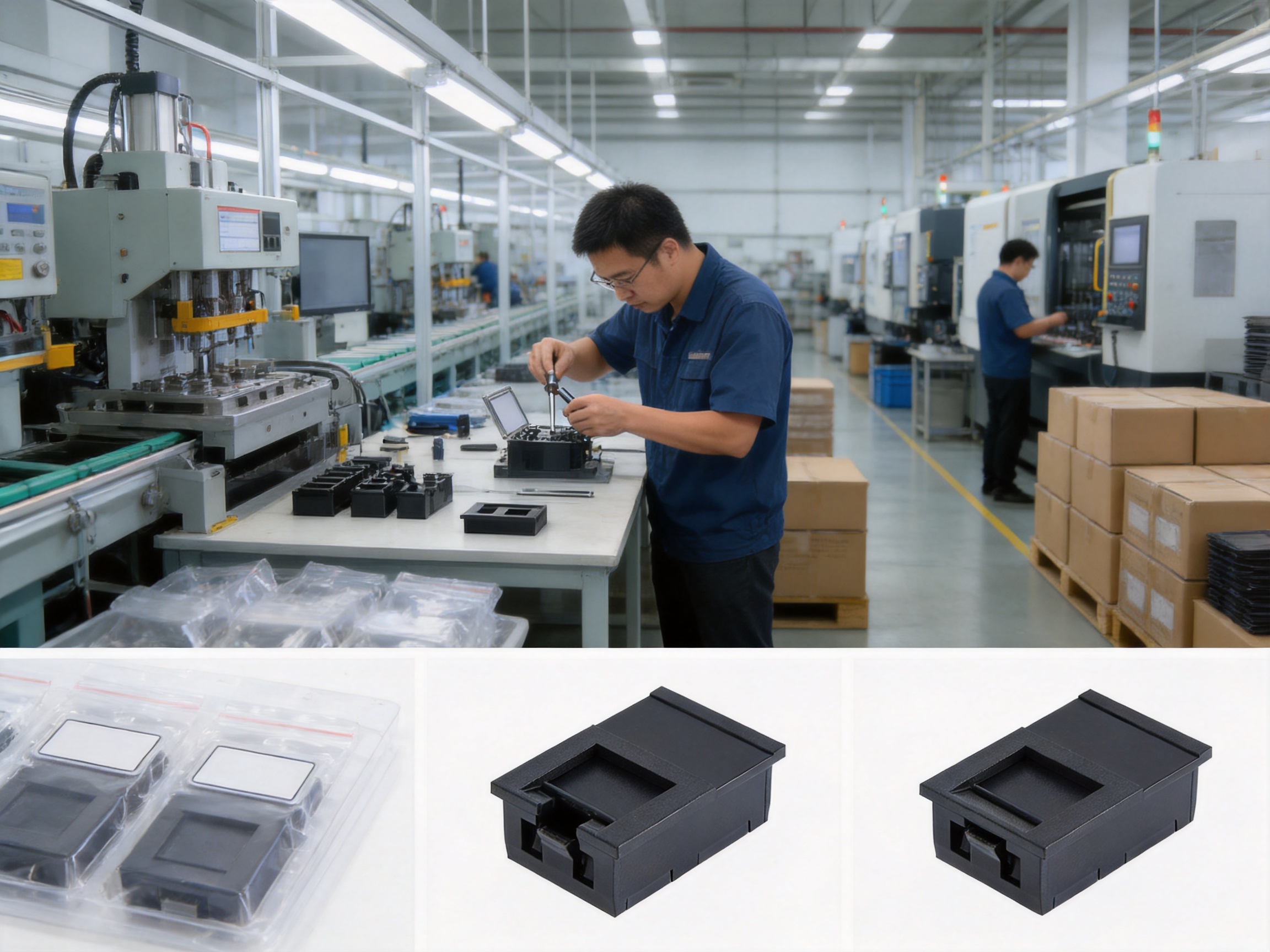
Yuyao Simante Network Communication Equipment Co., Ltd. is a professional manufacturer of network cabling solutions and optical fiber products. The company integrates design, development, sales, and service. This integrated structure allows product requirements to be reviewed across multiple stages, from initial concept and tooling through production, inspection, packaging, and customer support.
The company has nearly 20 years of service experience in the network communication and structured cabling field. This experience is relevant to products such as faceplates, data sockets, keystone jacks, patch panels, and related accessories because these products must meet both technical and installation-oriented requirements. Understanding how products are used in real projects helps the manufacturer focus on practical details such as module fit, surface appearance, labeling, assembly, and packaging.
The manufacturer has more than 10 engineers and more than 30 full-time technical personnel. This technical organization supports product development, process improvement, quality control, and product updates. Engineering resources are especially important for injection-molded communication accessories because dimensional accuracy, material selection, mold design, and assembly consistency all influence the final product.
Injection Molding and Process Control
The company operates 10 regular and customization production lines. It also has 10 fully automatic injection molding machines and 20 semi-automatic injection molding machines. In addition, eight automatic installation machines support assembly-related operations. This equipment base provides production flexibility for standard products and customized orders.
Injection molding is a critical process for ABS faceplate accessories. The quality of the finished adapter depends on resin preparation, mold design, injection parameters, cooling control, ejection, trimming, and inspection. A stable production process helps maintain consistent dimensions and surface quality from one batch to the next.
Automatic and semi-automatic equipment can support different production requirements. Automatic machines are useful for repeatable high-volume production, while semi-automatic equipment can provide flexibility for product variations, small batches, or customization. The combination allows the manufacturer to respond to diverse customer requirements without relying on a single production method.
Automatic installation equipment can also improve assembly consistency. Features such as the dust-proof door, spring mechanism, logo window, and detachable plate require controlled assembly to ensure that parts are correctly positioned and operate as intended. Proper equipment and work instructions can reduce variation between units and improve production efficiency.
For customers purchasing in volume, production capacity is an important consideration. The factory maintains a stable annual output of more than nine million units across its product range. This capacity indicates that the company has experience managing large orders, regular production schedules, material planning, and quality processes for network communication components.
Design and Development Capabilities
A mature research and development system can improve product quality from the design source. Faceplate accessories may appear simple, but effective design requires attention to mounting geometry, module compatibility, spring performance, plastic wall thickness, snap-fit structures, labeling areas, and overall appearance.
The manufacturer’s engineering team can evaluate these details before mass production. Design reviews may consider whether the product is easy to assemble, whether the surface is visually consistent, whether the adapter remains stable after repeated handling, and whether the packaging protects the product during transportation. These considerations help convert a basic concept into a product that is practical for installers and users.
The company also undertakes OEM and ODM projects. OEM production allows customers to order products according to their own branding and packaging requirements. ODM cooperation can involve product adaptation or development based on customer specifications. For distributors and system solution providers, these services may support differentiated product offerings and market-specific requirements.
Customization may include product markings, packaging labels, colors, configuration details, or other agreed requirements. Any customization should be confirmed through technical drawings, samples, specifications, and approval procedures before mass production. Clear communication helps ensure that the final product meets both functional and commercial expectations.
Quality Assurance and Product Testing
Quality assurance begins with design and continues through material control, molding, assembly, inspection, and packaging. For a molded flat adapter, quality checks may include visual inspection, dimensional verification, surface finish evaluation, panel fit, module fit, door movement, logo plate installation, and packaging condition.
The company emphasizes performance testing and can meet comprehensive customer testing requirements. Testing procedures should be matched to the product specification and customer application. For example, a project may require checks for material compliance, temperature suitability, mechanical handling, appearance consistency, or repeated opening and closing of the protective door.
Consistent inspection is valuable because structured cabling products are often installed in large quantities. A small defect rate can become a major issue when hundreds or thousands of outlets are deployed across a building. Stable manufacturing and inspection help reduce installation interruptions, rework, and inconsistent appearance.
Quality also includes accurate model identification and packaging. Correct labels help distributors and installers distinguish products within a larger shipment. The stated packaging method includes a special blister bag, a cardboard box, product accessories, and a carton label indicating the model and quantity. These procedures support order accuracy and reduce confusion during warehouse handling.

Packaging, Storage, and Logistics
The product is placed in a special blister bag and then packed in a cardboard box. Accessories are included at the same time, and a label identifying the product model and quantity is applied to the upper left corner of the front of the carton. The packaged products are then placed in the carton according to the regular packing arrangement.
The regular packing quantity is 10 boxes per carton, 20 units per box, and 200 units per carton. This arrangement is useful for distributors and project purchasers because it provides a clear unit structure for inventory control. Buyers should confirm the final packing configuration with the supplier when ordering customized packaging or special quantities.
For storage, the packaged products should be kept in a warehouse where the ambient temperature is -5°C to +30°C. Relative humidity should not exceed 70 percent. The surrounding air should be free from acid, alkali, and other corrosive gases. Under the stated conditions, the storage period is three years.
Appropriate storage protects the product before installation. Excessive humidity may affect packaging and surface condition, while corrosive gases may damage materials or metal components. Products should remain in their original packaging until they are needed, and cartons should be handled carefully to avoid crushing or impact.
Good logistics management is particularly important for structured cabling projects because installation schedules may extend over several months. Clearly labeled cartons and stable storage conditions help contractors receive the correct product at the right stage of construction.
Installation Recommendations
Before installation, technicians should verify the product model, panel compatibility, quantity, accessories, and project drawings. The British 86/140 panel format should be confirmed before work begins. The installation surface should be clean, stable, and suitable for the intended mounting method.
The adapter should be handled carefully during unpacking. Although the ABS engineering plastic is designed to resist impact and deformation, unnecessary force, sharp tools, and excessive bending should be avoided. The protective door and detachable logo plate should be checked to ensure that they move and fit correctly before final installation.
Installers should route and terminate the cable according to the specifications of the selected keystone module. The adapter itself is a mounting component, so the performance of the complete link also depends on the cable, connector, termination technique, patch panel, and active equipment. Correct cable bend radius, strain relief, separation from power wiring, and labeling should be maintained throughout the installation.
After the module is installed, the front surface should be checked for alignment. The logo window or detachable plate can then be labeled according to the project documentation. Labels should be legible, durable, and consistent with the naming system used at the patch panel and network cabinet.
Finally, the installer should inspect the dust-proof door and ensure that it can close correctly when the port is not in use. A final visual and functional inspection helps confirm that the outlet is ready for service and that the completed installation meets the expected appearance standard.
Benefits for Different Buyers
Benefits for Contractors
Contractors can benefit from a product that is designed for convenient installation and disassembly. The concealed surface fixing, modular format, and identification area can help improve work efficiency and finished quality. A standardized adapter also simplifies the appearance of multiple outlets across a project.
Benefits for Distributors
Distributors can offer a product with several clear selling points: British 86/140 panel compatibility, embedded mounting, a spring-type dust-proof door, ABS engineering plastic construction, and flexible labeling. The packaging structure and model identification also support warehouse management.
Benefits for System Integrators
System integrators can incorporate the adapter into copper and fiber structured cabling solutions where modular work-area outlets are required. The product’s identification features support documentation and service procedures, while the supplier’s OEM and ODM capabilities may help integrators develop project-specific solutions.
Benefits for Building Owners
Building owners benefit from a professional-looking outlet that can be managed over time. Clear labeling makes future maintenance easier, while the protective door helps preserve the appearance of unused ports. The product’s material and temperature specifications support use in a broad range of indoor environments.
Why Manufacturing Capability Matters
A structured cabling accessory may be small, but its reliability depends on the manufacturer’s ability to control many details consistently. A poorly controlled molding process can lead to uneven edges, inaccurate dimensions, weak snap structures, or inconsistent color and surface finish. In large installations, these issues can increase labor costs and affect customer satisfaction.
Manufacturing capability provides confidence that the supplier can support both standard orders and larger project requirements. The combination of engineering personnel, injection molding equipment, automatic assembly machines, multiple production lines, and testing experience creates a stronger foundation for dependable supply.
Experience with international markets is also valuable. The company maintains stable export volume in Europe, Australia, Africa, the Middle East, and Southeast Asia. These markets may involve different packaging expectations, documentation requirements, project standards, and customer approval procedures. Export experience can help the supplier communicate more effectively with overseas buyers.
Manufacturing strength should not be judged only by production volume. It also includes responsiveness, process stability, customization support, product development, quality documentation, and after-sales communication. Yuyao Simante Network Communication Equipment Co., Ltd. presents itself as a supplier that combines these capabilities with network cabling and optical fiber product expertise.
Frequently Asked Questions
What is the primary purpose of the SMT-4310-50P(B)?
The product is a flat keystone adapter used to mount compatible communication modules in British 86/140 panels. It provides a stable and organized interface for structured cabling outlets.
Can the adapter be used for both copper and fiber systems?
The adapter belongs to a modular faceplate solution and may support compatible copper or fiber keystone modules, depending on the module dimensions and project design. Buyers should confirm the exact module compatibility with the supplier before placing an order.
Does the product have visible screws on the front?
No. The product uses an embedded face frame designed so that fixing screws are not visible on the surface. This supports a cleaner and more integrated appearance.
What protects an unused port from dust?
A spring-type dust-proof door covers the opening when the port is not in use. The door is designed to return to its protective position after the connected component is removed.
How can ports be identified?
The front includes a logo window and a detachable logo plate. These areas can be used for room numbers, workstation references, service descriptions, or other project-specific identification.
What material is used to make the adapter?
The adapter is made from high-quality ABS engineering plastic. The material is selected for its useful combination of strength, impact resistance, lightweight construction, and resistance to deformation.
What is the operating temperature range?
The stated operating temperature range is -25°C to +70°C. The product should be used within this range and protected from conditions that exceed the specification.
Does the product meet environmental requirements?
The product is designed to meet RoHS requirements. Customers with specific compliance documentation needs should confirm the applicable documents and testing records with the supplier.
How should the product be stored?
It should be stored in a warehouse with an ambient temperature of -5°C to +30°C, relative humidity of no more than 70 percent, and no acid, alkali, or other corrosive gases in the surrounding air. The stated storage period is three years under these conditions.
What is the regular packing quantity?
The regular packing arrangement is 10 boxes per carton, 20 units per box, and 200 units per carton. Customized packaging quantities should be confirmed with the supplier before production.
Can the supplier provide OEM or ODM services?
Yes. The manufacturer undertakes OEM and ODM projects. Custom requirements should be reviewed through technical specifications, drawings, samples, packaging instructions, and approval procedures.
Where can the adapter be used?
Typical applications include offices, residential buildings, hotels, schools, public facilities, smart-home systems, network communication projects, and other structured cabling installations using compatible British 86/140 panels.
Procurement Considerations
When selecting a flat keystone adapter, purchasers should review more than the unit price. Important factors include panel compatibility, module fit, surface appearance, dust protection, labeling, material quality, operating temperature, environmental compliance, packaging, and supplier production capability.
Buyers should request technical drawings or samples when the product will be used in a large project. A sample evaluation can confirm the fit with the selected faceplate and keystone module. It can also help the project team review the appearance, logo plate, dust-proof door, and installation method before placing a production order.
For customized orders, the purchasing specification should identify the required model, color, marking, packaging, logo treatment, quantity, delivery schedule, and inspection requirements. Clear specifications reduce the risk of misunderstandings and help the supplier prepare appropriate tooling, materials, and production planning.
Customers should also consider long-term supply. A faceplate accessory may need to be reordered during later construction phases or future expansion. Working with a manufacturer that has stable production lines, engineering support, and international supply experience can help maintain product consistency across multiple orders.
Conclusion
The SMT-4310-50P(B) Flat Keystone Adapter is designed to provide a cleaner, more manageable, and more protective interface for structured cabling installations. Its embedded face frame removes visible surface screws, the spring-type dust-proof door helps protect unused openings, and the front logo window with detachable logo plate supports practical port identification.
The use of high-quality ABS engineering plastic provides a lightweight yet durable structure with resistance to collision, impact, and deformation. A temperature range of -25°C to +70°C and RoHS-oriented design further support its suitability for a broad range of indoor applications. Compatibility with British 86/140 panels makes it relevant to projects using this panel format.
The product is supported by a manufacturer with nearly 20 years of industry experience, an engineering and technical team, multiple production lines, automatic and semi-automatic injection molding equipment, automatic assembly machines, and a stable annual output exceeding nine million units across its product range. These capabilities support standard production, customization, OEM, ODM, quality testing, and international supply.
For contractors, distributors, system integrators, and building owners, the adapter offers value in the details that influence installation quality and long-term maintenance. It is not simply a mounting opening; it is a practical component that contributes to the appearance, protection, identification, and serviceability of a complete network cabling solution.
References
1. Product specification information for SMT-4310-50P(B) Flat Keystone Adapter, including material, design features, temperature range, packaging, and storage requirements.
2. Manufacturer-provided company profile and production capability information for Yuyao Simante Network Communication Equipment Co., Ltd.
3. General structured cabling installation principles concerning modular outlets, port identification, cable management, and maintenance documentation.
4. General engineering guidance for ABS injection-molded communication accessories and dimensional stability considerations.
5. General RoHS compliance principles for electrical and electronic products and related components.