Español
 عربى
عربى русский
Content
- 1 Product Overview
- 2 Designed for Structured Cabling Systems
- 3 Key Product Features
- 3.1 Two-Port Configuration
- 3.2 Embedded Screwless Appearance
- 3.3 Easy Installation and Disassembly
- 3.4 Red and Blue Identification Blocks
- 3.5 Spring-Type Dust-Proof Door
- 3.6 Larger Frontal Identification Space
- 3.7 Detachable Signboard for Port Management
- 3.8 ROHS Compliance
- 3.9 High-Quality ABS Engineering Plastic
- 3.10 Wide Temperature Performance
- 4 Technical Summary
- 5 Advantages Over Ordinary Faceplates
- 6 Application Scenarios
- 7 Installation and Maintenance Value
- 8 Material and Environmental Performance
- 9 Packaging, Storage, and Project Logistics
- 10 Manufacturing Strength Behind the Product
- 11 Quality Control and Market Orientation
- 12 How the Faceplate Supports Network Reliability
- 13 Comparison with Common Market Alternatives
- 14 Role in a Complete Cabling Product Ecosystem
- 15 Design Details That Matter in Daily Use
- 16 Procurement Considerations
- 17 Q&A Section
- 17.1 Q1: What is the main purpose of the 86 Type 2-port rotary faceplate?
- 17.2 Q2: Why is a 2-port faceplate useful?
- 17.3 Q3: What makes the screwless embedded design valuable?
- 17.4 Q4: How do the red and blue identification blocks help users?
- 17.5 Q5: What is the function of the spring-type dust-proof door?
- 17.6 Q6: What material is used for the faceplate?
- 17.7 Q7: Is the product environmentally compliant?
- 17.8 Q8: What temperature range can the product support?
- 17.9 Q9: Is the faceplate suitable for large cabling projects?
- 17.10 Q10: Can the product support customized packaging?
- 18 Conclusion
- 19 References
- 20 Product: SMT-4323AP-86-2P 86 Type 2 Ports Rotary Faceplate
In modern buildings, every network connection begins with a simple but important point of access: the wall outlet. The SMT-4323AP-86-2P 86 Type 2 Ports Rotary Faceplate is designed for this purpose, providing a neat, durable, and practical interface between structured cabling infrastructure and the devices used in offices, homes, control rooms, schools, hotels, and communication facilities. As part of a complete copper and fiber system environment, this 2-port faceplate supports stable cabling organization, convenient port identification, and long-term installation reliability.
This article focuses on the product’s structure, application value, technical advantages, installation convenience, competitive strengths, and the manufacturing capabilities behind it. It also explains how the faceplate contributes to professional network cabling solutions and why selecting a well-designed outlet component can improve the quality of an entire data cabling system.
SMT-4323AP-86-2P 86 Type 2 Ports Rotary Faceplate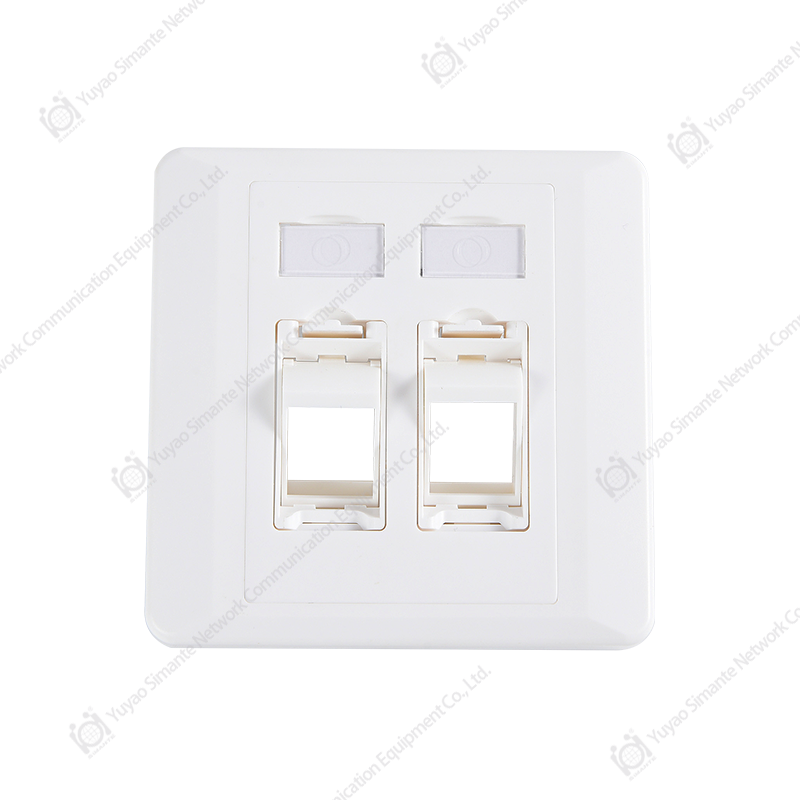
Product Overview
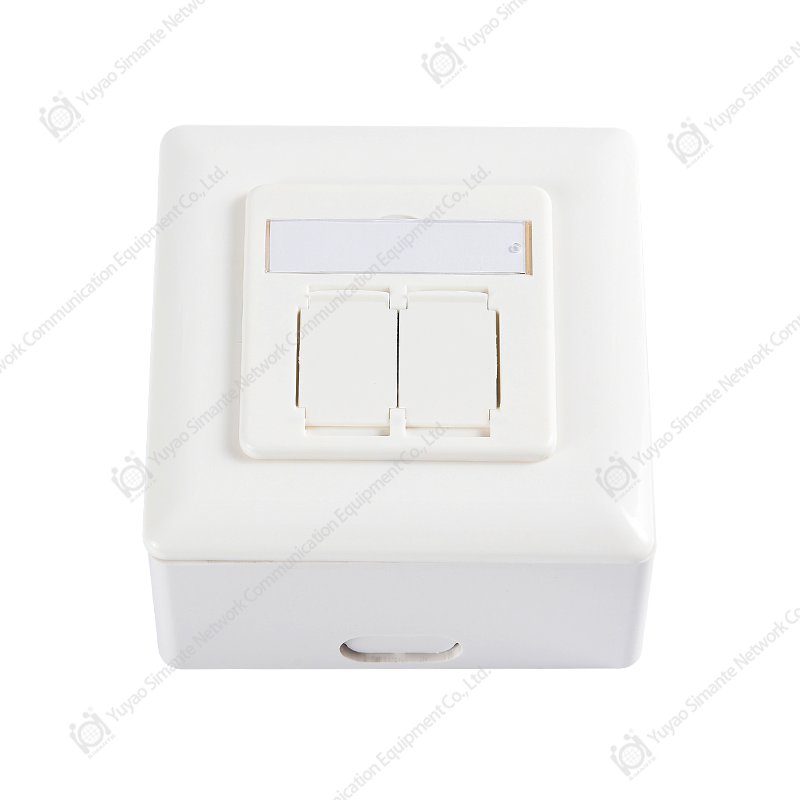
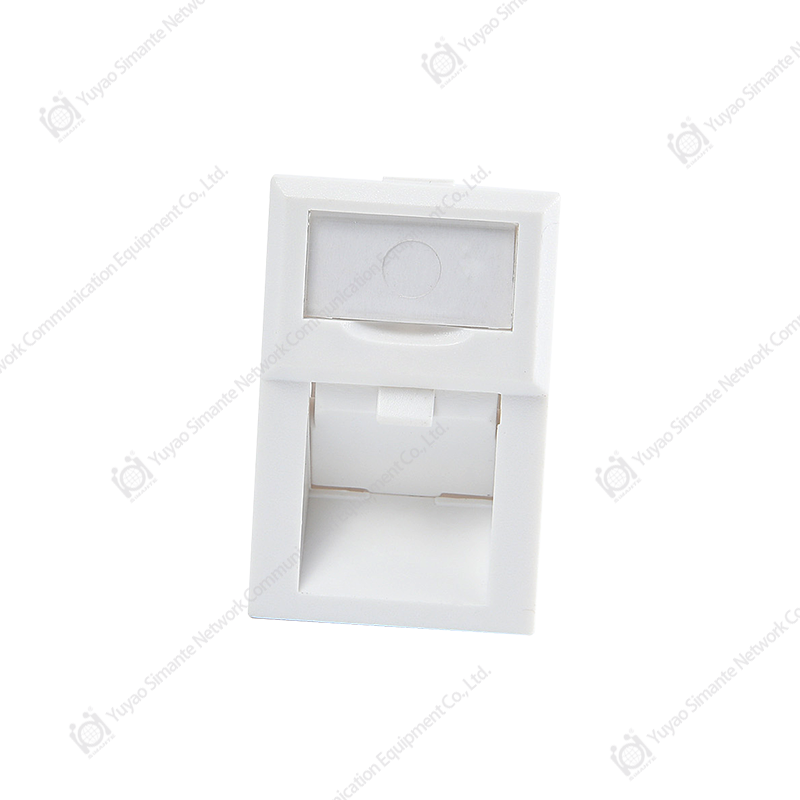
The SMT-4323AP-86-2P 86 Type 2 Ports Rotary Faceplate is a wall-mounted faceplate designed for Type 86 exposed and concealed back boxes. Type 86 wall boxes are widely used in building wiring systems, especially in network communication, telephone distribution, smart home systems, office automation, and structured cabling installations. Because the faceplate is compatible with common Type 86 mounting environments, it can be used in both new projects and renovation projects where standardized outlet dimensions are required.
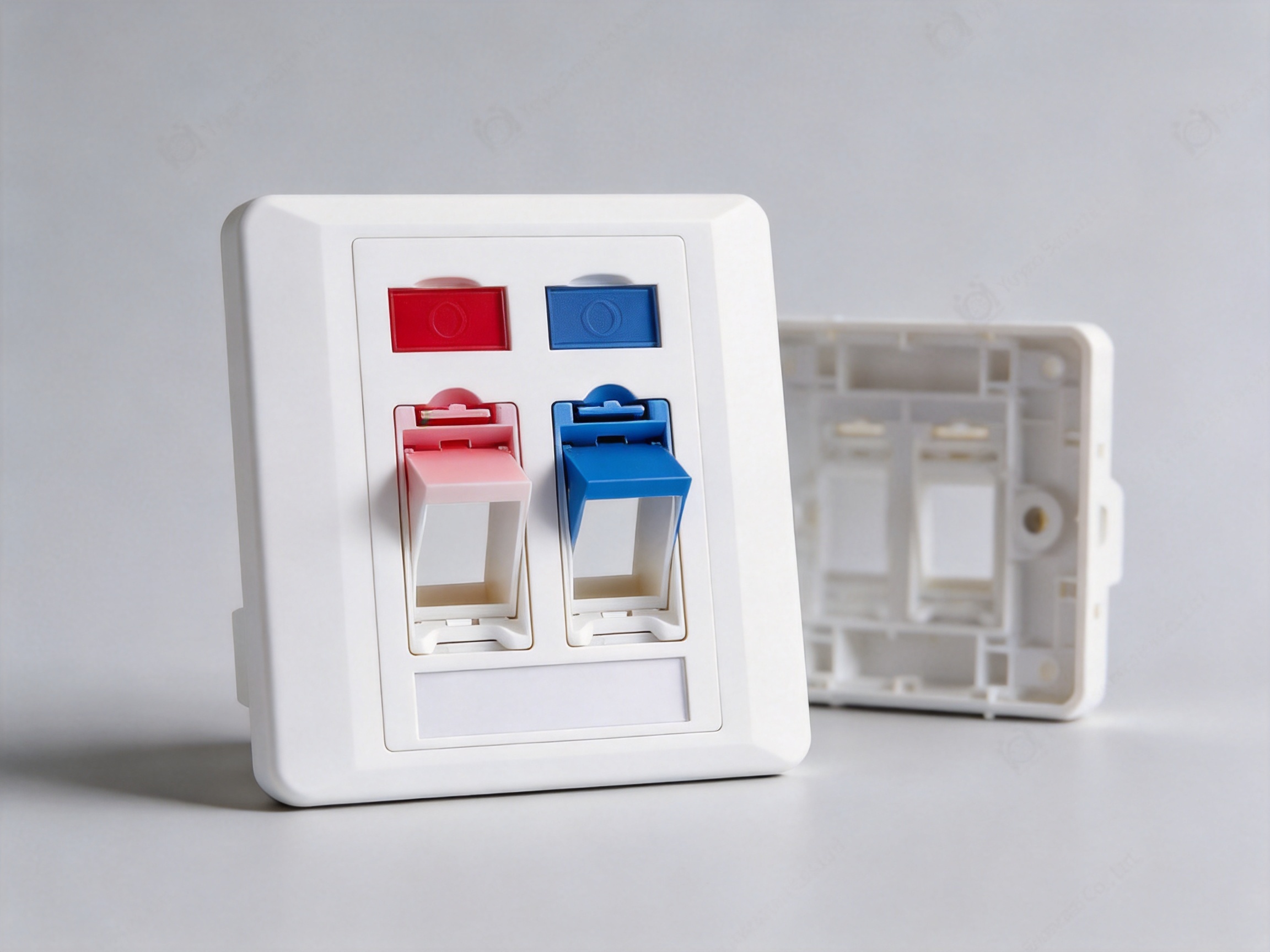
The product belongs to the 2 Port Faceplate category. Its dual-port configuration allows two information or telephone modules to be installed in one wall outlet position. This makes it suitable for data and voice cabling, dual network ports, or mixed applications depending on project requirements. The front of the product is equipped with red and blue identification blocks, which help users and maintenance personnel quickly distinguish between telephone and data ports. This simple visual design reduces confusion during installation, testing, daily use, and future maintenance.
The faceplate uses high-quality ABS engineering plastic. ABS is valued in communication accessories because it provides a good balance of impact resistance, dimensional stability, and surface finish. For a wall-mounted product that may be touched frequently, exposed to furniture impact, or installed in busy commercial environments, anti-collision and anti-deformation performance are important. A strong faceplate helps protect the modules and cables behind it while maintaining a clean appearance over time.
Another key feature is its embedded face frame design. The surface has no visible screws, giving the outlet a clean, professional look. Screwless appearance is not only aesthetically pleasing but also practical because it reduces the risk of exposed screws becoming loose, scratched, corroded, or visually inconsistent with interior decoration. The embedded design also makes installation and disassembly more convenient for technicians.
Designed for Structured Cabling Systems
Structured cabling is the physical foundation of modern communication networks. It includes cables, patch panels, keystone jacks, faceplates, distribution frames, and related accessories. Although a faceplate may appear to be a small part of the system, it performs several essential functions. It holds modules securely, protects cable terminations, provides user access, identifies ports, and contributes to the professional appearance of the installation.
The SMT-4323AP-86-2P faceplate is designed to work within copper system applications and can also be used in broader environments where fiber and copper structured cabling components coexist. In many buildings, copper cabling supports Ethernet access, telephone systems, security devices, wireless access points, and terminal equipment, while fiber cabling handles backbone transmission. A reliable wall faceplate ensures that end-user copper connections remain organized and accessible.
The 2-port layout is especially useful in office workstations, meeting rooms, hotel rooms, classrooms, hospital wards, residential smart home panels, and equipment control points. One port may be dedicated to data while the other may be assigned to telephone, IPTV, access control, or a second data line. The red and blue identification blocks create a clear distinction between different services, which supports fast troubleshooting and accurate port management.
For installers, a structured cabling project is judged not only by transmission performance but also by consistency, neatness, labeling, and maintainability. When outlets are easy to identify and service, the entire system becomes more manageable. This product supports that goal by combining modular compatibility, easy access, and visible service identification.
Key Product Features
Two-Port Configuration
The faceplate provides two module positions in one Type 86 outlet. This configuration is a practical choice for locations where users require more than one service connection. Compared with a single-port faceplate, a 2-port unit improves outlet efficiency and reduces the number of wall openings needed. Compared with larger multi-port plates, it remains compact and suitable for standard work areas.
Embedded Screwless Appearance
The embedded face frame hides screws from the surface. This gives the faceplate a clean and refined appearance suitable for modern interior spaces. In business environments, outlet appearance can influence the perceived quality of the entire installation. A screwless faceplate looks more integrated with walls and furniture and is less likely to collect dust around exposed screw heads.
Easy Installation and Disassembly
Installation convenience is one of the major practical advantages of the product. The embedded design supports quick assembly and removal, which helps technicians during initial deployment and later maintenance. In large projects with hundreds or thousands of outlets, small improvements in installation speed can reduce labor time and improve project efficiency.
Red and Blue Identification Blocks
The faceplate includes red and blue identification blocks on the front. These blocks help distinguish connector types or service categories, such as telephone and data. Visual identification is important because incorrect use of ports may lead to user complaints, network faults, or unnecessary troubleshooting. Clear color identification reduces the risk of confusion.
Spring-Type Dust-Proof Door
The product is equipped with a spring-type dust-proof door. This feature helps protect unused ports from dust and contamination. Dust can affect connector cleanliness, appearance, and long-term reliability. A spring-type door automatically returns to a closed position when the port is not in use, improving protection without requiring extra user action.
Larger Frontal Identification Space
The faceplate provides a larger front identification area. This space is convenient for port labels, room numbers, service numbers, network IDs, or management codes. Good labeling is a core principle of professional structured cabling. It enables technicians to match wall outlets with patch panel ports and documentation records.
Detachable Signboard for Port Management
The detachable signboard adds flexibility to labeling and maintenance. When port assignments change, the signboard can be removed or replaced without changing the whole faceplate. This is useful in offices where seating layouts, network segments, or device assignments may be updated regularly.
ROHS Compliance
The environmental requirements of the product meet ROHS standards. ROHS compliance reflects attention to restricted hazardous substances, which is important for international markets and environmentally responsible procurement. For projects that require compliant components, this feature supports specification approval.
High-Quality ABS Engineering Plastic
The use of ABS engineering plastic gives the product resistance to collision, impact, and deformation. This is important for a wall-mounted communication accessory that may experience daily contact, accidental hits, or long-term stress. A stable material helps the faceplate remain aligned and functional after installation.
Wide Temperature Performance
The product’s environmental performance covers a temperature range from -25°C to +70°C. This range supports use in many indoor environments and some controlled semi-harsh locations. Temperature stability is important because plastics can expand, contract, become brittle, or deform if the material and design are not suitable.
Technical Summary
| Item | Description | Practical Value |
|---|---|---|
| Product Name | SMT-4323AP-86-2P 86 Type 2 Ports Rotary Faceplate | Provides a dual-port wall outlet solution for structured cabling |
| Product Category | 2 Port Faceplate | Suitable for data, telephone, and mixed service outlet applications |
| Mounting Type | Wall-mounted, compatible with Type 86 exposed and concealed back boxes | Supports standard installation in many building projects |
| Port Quantity | 2 ports | Allows two modules or services in one wall outlet position |
| Material | High-quality ABS engineering plastic | Improves impact resistance, collision resistance, and dimensional stability |
| Surface Design | Embedded face frame with no visible screws | Creates a clean appearance and supports convenient disassembly |
| Identification | Red and blue blocks, larger frontal identification area, detachable signboard | Improves port distinction, labeling, and management |
| Port Protection | Spring-type dust-proof door | Helps protect unused ports from dust and contamination |
| Environmental Requirement | Meets ROHS standards | Supports environmentally responsible procurement |
| Operating Temperature | -25°C to +70°C | Provides stable performance across varied installation environments |
| Packaging | Special blister bag, cardboard box, accessories included, label on carton | Protects products during storage and transportation |
| Regular Packing Quantity | 10 boxes per box, 20 pieces per box, 200 pieces per carton | Supports bulk project supply and inventory management |
Advantages Over Ordinary Faceplates
Not all wall faceplates are designed with the same attention to durability, installation efficiency, and maintenance convenience. The SMT-4323AP-86-2P provides several advantages that help it stand out from ordinary faceplates used in low-cost or short-term installations.
Cleaner Appearance Compared with Visible-Screw Designs
Traditional faceplates often use visible screws on the front surface. While this is simple, it can affect appearance and may expose screw heads to dust, scratches, and corrosion. The embedded screwless surface of this faceplate provides a more modern appearance. For offices, hotels, apartments, and public buildings where interior design matters, this is a meaningful advantage.
Better Port Identification Than Plain Plates
Some basic faceplates provide little or no port identification area. This can cause confusion when multiple outlets are installed in the same room. The red and blue identification blocks, larger labeling space, and detachable signboard make this product better suited for managed cabling systems. Technicians can label ports clearly and update information when service assignments change.
Improved Dust Protection
Ordinary open-port faceplates may leave unused modules exposed to dust. The spring-type dust-proof door helps keep ports cleaner. This is especially useful in environments such as schools, workshops, public buildings, and construction sites where dust exposure may be higher. Cleaner ports support better long-term reliability and appearance.
Stronger Material Selection
Low-grade plastic faceplates may become brittle, deform, or discolor under daily use. The use of high-quality ABS engineering plastic provides better anti-collision and impact-resistant performance. This gives the faceplate a stronger service life and helps reduce replacement costs caused by physical damage.
Professional Fit for Type 86 Systems
The product is common to Type 86 exposed and concealed back boxes. This broad compatibility improves project flexibility. Installers can use the same faceplate model across different wall construction types, reducing inventory complexity and improving installation consistency.
Better Suitability for Project-Scale Deployment
In large cabling projects, the quality of small accessories can affect the final result. A faceplate that is easy to install, label, protect, and package can reduce work time and improve quality control. The product’s regular packing quantity and labeled carton packaging also support bulk procurement and project logistics.
Application Scenarios
Office Workstations
Office workstations often require at least one data port and one telephone or secondary data port. The 2-port design provides a compact solution for desk areas, meeting rooms, reception counters, and shared office zones. Color identification and labeling help IT teams quickly locate and manage port assignments.
Commercial Buildings
Commercial buildings require stable structured cabling components that look professional and support long-term maintenance. The screwless appearance blends well with modern interiors, while the detachable signboard supports tenant changes and network reconfiguration.
Hotels and Apartments
Hotels and apartments need wall outlets that are durable, attractive, and easy for users to understand. The spring-type dust-proof door keeps unused ports clean, while the red and blue identification blocks help distinguish services such as telephone and network access.
Schools and Training Centers
Educational environments often experience frequent use and physical contact. ABS engineering plastic provides impact resistance, while clear labeling supports IT maintenance in classrooms, laboratories, libraries, and administrative offices.
Healthcare and Public Facilities
In hospitals, clinics, and public service buildings, network outlets must be easy to identify and maintain. A stable faceplate reduces downtime and helps staff distinguish communication services quickly. The clean screwless design also supports neat installation in professional environments.
Smart Home and Automation Systems
Smart homes often combine data, telephone, control, security, and entertainment systems. A 2-port faceplate can support flexible terminal access points throughout the building. Its Type 86 compatibility is useful in residential projects that use standardized wall boxes.
Installation and Maintenance Value
Installation efficiency is one of the most important cost factors in structured cabling projects. Even if a faceplate is inexpensive, poor design may increase labor time, cause repeated adjustments, or create future maintenance issues. The SMT-4323AP-86-2P is designed to simplify installation and disassembly. Its embedded face frame supports a neat surface without visible screws, while the Type 86 compatibility makes it suitable for standard wall boxes.
The product also supports maintenance after installation. When a network port must be tested, relabeled, or replaced, easy disassembly reduces technician time. The detachable signboard allows port labels to be updated without replacing the faceplate. The larger frontal identification space helps technicians confirm port identity before testing or patching. These practical details reduce mistakes and support professional cable management.
During daily use, the spring-type dust-proof door helps protect ports that are not continuously connected. This feature is especially useful in spaces where users frequently plug and unplug cables. By helping reduce dust accumulation, the door supports cleaner connectors and a more professional appearance.

Material and Environmental Performance
The faceplate is manufactured using high-quality ABS engineering plastic. ABS is commonly used in network cabling accessories because it offers excellent moldability, impact resistance, and surface stability. For a wall plate, the material must support precise dimensions so that modules fit securely and the plate aligns correctly with the back box. It must also resist deformation caused by installation pressure, wall surface irregularities, or external impact.
Anti-collision and impact-resistant performance are especially valuable in commercial and public buildings. Wall outlets may be hit by chairs, carts, cleaning tools, equipment cases, or user movement. A weaker product may crack, loosen, or deform. A stronger ABS faceplate reduces these risks and supports longer service life.
The product’s temperature performance range of -25°C to +70°C demonstrates its suitability for varied environments. While most wall outlets are used indoors, building conditions may differ significantly during construction, storage, shipment, and operation. A broad temperature range supports stable handling and use.
The product also meets ROHS environmental requirements. This is increasingly important for international procurement, government projects, corporate sustainability policies, and electrical or electronic component compliance. Using ROHS-compliant accessories helps project owners align with environmental and safety expectations.
Packaging, Storage, and Project Logistics
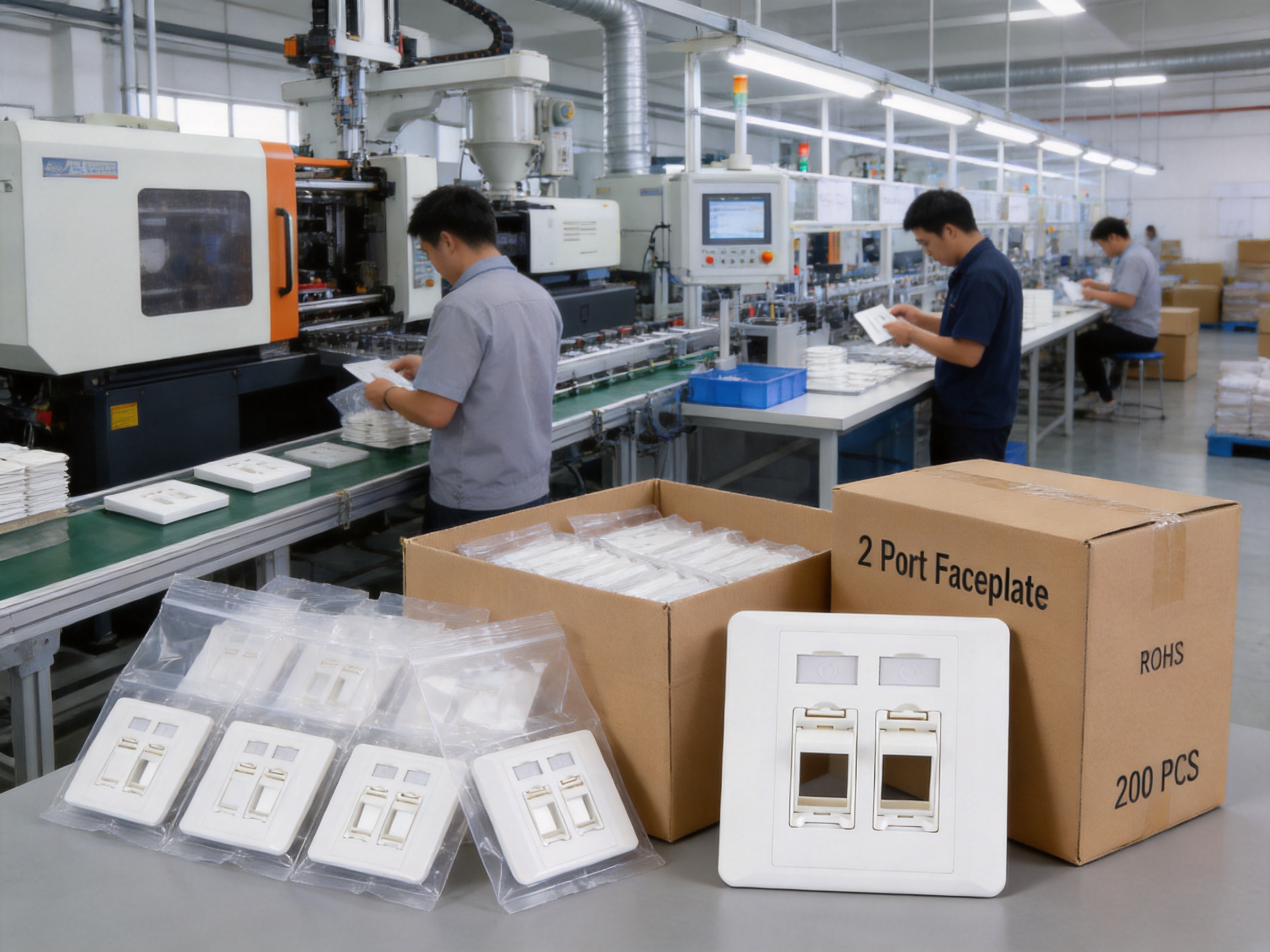
Packaging is an often-overlooked factor in product quality. A well-made faceplate can still be damaged if packaging does not protect it during transportation and storage. The SMT-4323AP-86-2P is placed in a special blister bag and then packed into a cardboard box. Product accessories are placed at the same time, helping ensure that installers receive the required components together.
A label indicating the product model and quantity is affixed to the upper left corner of the front of the carton. This supports warehouse identification, inventory control, and jobsite distribution. In large projects, clear packaging labels reduce the risk of using the wrong model at the wrong installation location.
The packaged products should be stored in a warehouse where the ambient temperature is -5°C to +30°C, relative humidity is not more than 70%, and the surrounding air does not contain acid, alkali, or other corrosive gases. Under these conditions, the storage period is three years. These storage requirements help protect material quality, appearance, and accessory condition before installation.
The regular packing quantity is suitable for project supply: 10 boxes per box, 20 pieces per box, and 200 pieces per carton. Bulk packing makes it easier for distributors, contractors, and project managers to calculate quantities, control stock, and arrange delivery schedules.
Manufacturing Strength Behind the Product
The product is supported by a manufacturer with nearly 20 years of experience in network cabling solutions and optical fiber products. Long-term industry experience matters because structured cabling components require consistency, precision, and practical understanding of installation conditions. A manufacturer that has served global cabling markets for many years is more likely to understand the needs of contractors, distributors, system integrators, and end users.
The company integrates design, development, sales, and service. This integrated structure helps connect customer feedback with product improvement. When technical teams understand actual installation challenges, they can improve faceplate structure, material selection, labeling design, packaging, and compatibility. This is important because even small design details can affect large-scale installation results.
The manufacturer has more than 10 engineers and over 30 full-time technical personnel. This technical team supports product development, process improvement, quality control, and customization. For structured cabling accessories, engineering strength helps ensure that products are not merely copied but optimized for fit, function, and reliability.
Production capacity is another major strength. The factory has 10 regular and customization production lines, 10 fully automatic injection molding machines, 20 semi-automatic injection molding machines, and 8 automatic installed machines. This equipment base supports stable mass production and flexible order handling. With an annual output of more than 9 million units, the manufacturer can supply large projects while maintaining consistency.
Advanced injection molding capability is particularly important for faceplates. The dimensional precision of molded parts affects how modules fit, how the face frame locks, how the dust-proof door moves, and how the finished plate aligns with the wall box. Fully automatic and semi-automatic molding equipment allows production to balance efficiency, volume, and customization.
Automatic installation machines also support consistent assembly quality. Features such as spring-type dust-proof doors and identification parts require accurate assembly. Automation helps reduce variation, improve speed, and support stable output. For customers, this means more consistent product quality across batches.
Quality Control and Market Orientation
The manufacturer is based on the high-end market and maintains higher requirements for product quality. This approach is important because structured cabling systems often remain in buildings for many years. A low-cost product that fails early can lead to labor costs, customer dissatisfaction, and system downtime. Quality-focused manufacturing reduces these risks.
The company emphasizes strict production management and good performance testing. Testing is essential for confirming product appearance, fit, material behavior, assembly quality, and packaging reliability. Although a faceplate is not an active electronic device, its mechanical reliability affects the entire user connection point. A loose module, weak clip, poor label window, or unstable door can create service problems.
Stable export volume in Europe, Australia, Africa, the Middle East, and Southeast Asia indicates that the company is familiar with diverse market expectations. Different regions may have different project standards, packaging preferences, installation practices, and procurement requirements. Experience across these markets helps the manufacturer respond to customer needs more effectively.
The company also undertakes OEM and ODM projects. This is a valuable advantage for distributors and system brands that require customized packaging, labeling, colors, configurations, or product adjustments. The product note indicates that customer-specified packaging can be supported, which is useful for private-label programs and project-specific supply requirements.
How the Faceplate Supports Network Reliability
Network reliability depends on many components working together. Cables must be properly routed, patch panels must be organized, connectors must be terminated correctly, and wall outlets must protect and present the connection points. A well-designed faceplate contributes to reliability in several ways.
First, it holds modules in a stable position. A stable module reduces stress on terminations and prevents movement during cable insertion or removal. Second, it protects the connection from dust and accidental contact. The spring-type dust-proof door supports this function. Third, it improves identification. Clear labels reduce incorrect patching, wrong device connections, and time-consuming troubleshooting. Fourth, it supports future maintenance because technicians can access and relabel ports efficiently.
In real-world projects, network faults are not always caused by cable performance. Many problems come from poor management, unclear labeling, damaged outlets, and careless installation. This faceplate addresses these practical issues through its physical design and user-friendly features.
Comparison with Common Market Alternatives
When selecting faceplates, buyers often compare price, appearance, compatibility, material, packaging, and supply reliability. The SMT-4323AP-86-2P offers a balanced value proposition. It is not merely a decorative cover; it is a structured cabling accessory designed for professional deployment.
Compared with basic screw-type plates, it offers a cleaner screwless appearance and easier front management. Compared with unlabeled plates, it offers color identification and a detachable signboard. Compared with plates made from lower-grade plastics, it uses high-quality ABS engineering plastic for better resistance to collision and deformation. Compared with suppliers that lack production capacity, the manufacturer behind this product provides extensive injection molding equipment, assembly equipment, engineering support, and annual output capacity.
For project buyers, these advantages can translate into fewer installation problems, better appearance consistency, easier maintenance, and more dependable delivery. For distributors, the stable packing quantity, labeling, OEM/ODM capability, and broad product ecosystem make inventory planning and customer support easier.
Role in a Complete Cabling Product Ecosystem
The faceplate is part of a broader product ecosystem that includes keystone jacks, patch panels, wall face plates, data sockets, and other structured cabling components. This matters because compatibility between components improves project quality. When faceplates, modules, and related accessories are designed with structured cabling use in mind, installers can build systems more efficiently.
The company’s main products are widely used in structured cabling, network communication, smart home, automation equipment, and other fields. This broad application background helps ensure that the faceplate is designed for practical installation conditions rather than only for appearance. The product must work with modules, back boxes, cables, labels, and user access patterns.
In a copper system, the faceplate serves as the final outlet point for network or telephone service. In buildings that also use fiber systems, copper outlets remain essential for device-level access. Workstations, phones, cameras, access points, displays, and control terminals often connect through copper data outlets. Therefore, a reliable faceplate remains important even in networks with fiber backbones.
Design Details That Matter in Daily Use
Users usually notice a network wall outlet only when they need to plug in a cable or when something goes wrong. For this reason, good design should make the outlet easy to understand, reliable, and unobtrusive. The SMT-4323AP-86-2P achieves this through practical details.
The red and blue blocks help users identify service types at a glance. The dust-proof door keeps the outlet looking clean when unused. The screwless embedded surface makes the wall installation appear neat. The label space supports clear management codes. The ABS material resists common physical damage. Each detail may seem small, but together they create a better user and maintenance experience.
For building owners, these details reduce complaints and improve the perceived quality of the communication infrastructure. For installers, they reduce mistakes and make the final installation look more professional. For network administrators, they support easier documentation and troubleshooting.
Procurement Considerations
When choosing a 2-port faceplate for a project, buyers should consider more than price. Important factors include compatibility with back boxes, module fit, material quality, labeling convenience, dust protection, appearance, packaging, storage conditions, supplier capacity, and customization support. The SMT-4323AP-86-2P performs well across these areas.
Its compatibility with Type 86 exposed and concealed back boxes makes it suitable for common wall installations. Its high-quality ABS material supports durability. Its screwless embedded face frame improves appearance. Its spring-type dust-proof door and detachable signboard improve long-term usability. Its ROHS compliance supports environmental requirements. Its packaging and storage instructions support bulk supply and quality preservation.
Buyers should also consider the manufacturer’s capabilities. A factory with experienced engineers, multiple production lines, automatic equipment, and stable annual output can better support large and repeat orders. OEM and ODM capabilities are also useful when customers require private labeling or special packaging.
Q&A Section
Q1: What is the main purpose of the 86 Type 2-port rotary faceplate?
Its main purpose is to provide a neat and reliable wall-mounted outlet for structured cabling systems. It holds two information or telephone modules and allows users to access data, voice, or other low-voltage communication services from a standard Type 86 wall box.
Q2: Why is a 2-port faceplate useful?
A 2-port faceplate allows two services to be installed in one wall outlet position. For example, one port can be used for data and the other for telephone, or both can be used for network connections. This improves outlet efficiency and supports flexible cabling design.
Q3: What makes the screwless embedded design valuable?
The screwless embedded design gives the product a cleaner appearance and reduces exposed hardware on the surface. It also supports convenient installation and disassembly, which is helpful during project deployment and future maintenance.
Q4: How do the red and blue identification blocks help users?
The red and blue identification blocks help distinguish port types, such as telephone and data. This makes it easier for users, installers, and maintenance personnel to identify the correct port and avoid connection mistakes.
Q5: What is the function of the spring-type dust-proof door?
The spring-type dust-proof door helps protect unused ports from dust and contamination. It closes automatically when the port is not being used, helping keep the outlet cleaner and supporting long-term reliability.
Q6: What material is used for the faceplate?
The faceplate is made from high-quality ABS engineering plastic. This material is resistant to collision, impact, and deformation, making it suitable for daily use in office, commercial, residential, and public environments.
Q7: Is the product environmentally compliant?
Yes. The product meets ROHS environmental requirements, which supports procurement for projects that require restricted hazardous substance compliance.
Q8: What temperature range can the product support?
The product supports an environmental performance temperature range of -25°C to +70°C. This range helps it remain stable in many storage, transportation, and installation environments.
Q9: Is the faceplate suitable for large cabling projects?
Yes. Its standard Type 86 compatibility, practical labeling features, durable material, and bulk packaging make it suitable for large structured cabling projects. The manufacturer’s production capacity also supports project-scale supply.
Q10: Can the product support customized packaging?
Yes. The product information notes that customer-specified packaging can be supported. This is useful for OEM, ODM, distribution, and project-specific requirements.
Conclusion
The SMT-4323AP-86-2P 86 Type 2 Ports Rotary Faceplate is a practical and well-designed wall outlet component for structured cabling systems. It combines a 2-port layout, Type 86 compatibility, embedded screwless appearance, red and blue identification blocks, spring-type dust-proof protection, larger label space, detachable signboard, ABS engineering plastic construction, ROHS compliance, and wide temperature performance.
Its advantages are clear when compared with ordinary faceplates. It offers better appearance, stronger material performance, clearer identification, improved dust protection, easier maintenance, and better suitability for professional project deployment. These advantages help installers, distributors, network administrators, and building owners achieve more reliable and manageable cabling infrastructure.
Behind the product is a manufacturer with nearly 20 years of experience, an engineering and technical team, multiple production lines, automatic and semi-automatic injection molding equipment, automatic installation machines, stable annual output, and OEM/ODM capability. These manufacturing strengths support consistent quality, flexible customization, and reliable supply for global markets.
For projects that require a durable, clean-looking, and installation-friendly 2-port wall faceplate, this product provides a strong solution. It demonstrates how a small cabling accessory can contribute significantly to the performance, appearance, and maintainability of an entire communication system.
References
1. Structured Cabling System Design Guidelines for Commercial Buildings.
2. Telecommunications Industry Practices for Work Area Outlets and Cable Management.
3. General Engineering Properties and Applications of ABS Thermoplastic Materials.
4. ROHS Compliance Principles for Electrical and Electronic Components.
5. Network Cabling Installation and Maintenance Handbook.