Español
 عربى
 русский
Content
- 1 Introduction
- 2 Product Overview
- 3 Key Product Advantages
- 4 Applications Across Network Infrastructure
- 5 Comparison with Conventional Fixed Patch Panels
- 6 Manufacturing Strengths and Quality Management
- 7 Design and Installation Considerations
- 8 Advantages for OEM, ODM, and Customized Projects
- 9 Why Manufacturing Experience Matters to Buyers
- 10 Testing and Performance Verification
- 11 Environmental and Operational Benefits
- 12 Recommended Installation Workflow
- 13 Q&A
- 13.1 What is a blank keystone patch panel?
- 13.2 How many ports does the SMT-2052-24P-FTP provide?
- 13.3 What is the benefit of the angled design?
- 13.4 Does the panel support fiber connections?
- 13.5 Is the panel suitable for shielded copper cabling?
- 13.6 Can unshielded modules be installed?
- 13.7 Where can this patch panel be used?
- 13.8 Why choose a blank panel instead of a fixed patch panel?
- 13.9 What should be considered when selecting keystone modules?
- 13.10 How does the manufacturer support large orders?
- 13.11 Does the manufacturer provide OEM and ODM services?
- 13.12 What information should buyers provide when requesting a quotation?
- 14 Conclusion
- 15 References
- 16 Product: SMT-2052-24P-FTP 24 Port Blank Angled Keystone Shielded Patch Panel

Introduction
Modern data networks require more than high-quality cable. They also depend on organized termination hardware that can accommodate changing technologies, simplify installation, protect connections, and support long-term maintenance. The 24-Port Blank Angled Keystone Shielded Patch Panel is designed for this role. It provides a practical and adaptable platform for copper and fiber structured cabling environments by allowing installers to select and populate compatible keystone modules according to the requirements of each project.
Unlike fixed-configuration patch panels, a blank keystone patch panel does not limit the installation to one connector type or one cabling standard. Its open port design gives network integrators the flexibility to install shielded copper keystone jacks, unshielded data modules, fiber adapters, audio and video modules, or other compatible inserts. This makes the panel suitable for office networks, server rooms, telecommunications closets, smart buildings, industrial communication systems, educational facilities, security systems, and customized data cabling projects.
The angled design adds another important advantage. By directing installed modules and patch cords toward the cabinet or rack management area, it can reduce sharp cable bends, improve port visibility, and help create a cleaner and more serviceable installation. The shielded construction further supports applications where electromagnetic interference control, grounding continuity, and mechanical protection are important considerations.
This product is manufactured by Yuyao Simante Network Communication Equipment Co., Ltd., a professional supplier of network cabling solutions and optical fiber products. With experience in design, development, manufacturing, testing, OEM, and ODM services, the company provides structured cabling components for customers seeking dependable products and customized solutions.

SMT-2052-24P-FTP 24 Port Blank Angled Keystone Shielded Patch Panel
Product Overview
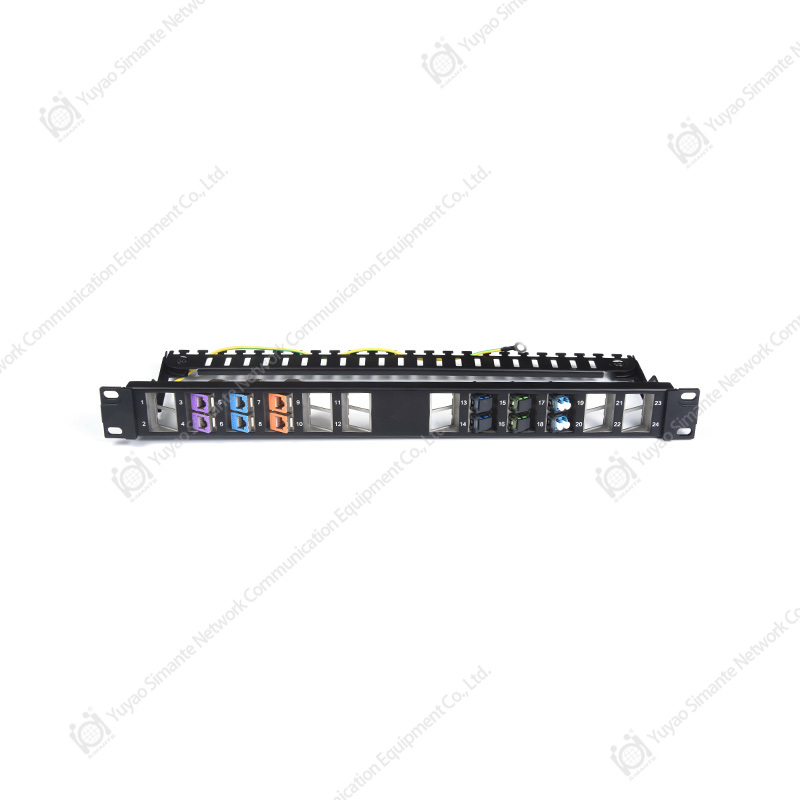
The SMT-2052-24P-FTP is a 24-port blank angled keystone shielded patch panel intended for installation in structured cabling systems. It is classified as a blank patch panel because the panel body is supplied with open module positions rather than permanently installed data jacks. Installers can therefore configure the panel according to the project’s technical requirements.
The 24-port format offers a useful balance between density and accessibility. It provides enough capacity for common distribution zones while leaving the panel compact enough for standard rack and cabinet installations. In a small network, the panel can serve as a central termination point for work-area outlets. In a larger system, it can be used as one panel within a structured rack arrangement containing several copper and fiber distribution components.
The panel’s angled port layout is designed to make connections easier to identify and manage. Straight patch panels can require patch cords to extend directly outward before being routed horizontally or vertically. Angled ports can guide cords toward the side or cable-management pathway, helping reduce congestion in front of the rack. This can be particularly beneficial when many ports are populated and frequent moves, adds, and changes are expected.
The shielded format is intended for applications that use shielded connectivity components or require additional protection against electromagnetic interference. When used with compatible shielded keystone jacks, shielded patch cords, suitable cable, and a properly bonded rack system, the panel can contribute to end-to-end shielding continuity. The result is a more controlled cabling environment for locations affected by motors, power equipment, industrial machinery, radio-frequency sources, or dense electrical infrastructure.
Because the panel is blank, it can be used beyond a single category of copper cabling. A project may begin with Category 6 modules and later incorporate higher-performance modules, fiber couplers, coaxial adapters, or specialty connectivity inserts, provided the selected modules match the panel’s dimensions and mechanical interface. This adaptability helps reduce the need to replace the entire panel when a network evolves.
Key Product Advantages
Flexible Port Configuration
The most significant advantage of a blank keystone patch panel is configuration flexibility. Fixed patch panels are normally designed with a specific number and type of permanently mounted ports. If a project changes from one connector format to another, the fixed panel may need to be replaced. A blank panel avoids this limitation by accepting individual keystone modules.
For example, an installer may use shielded Category 6A modules in one section, fiber adapter modules in another section, and specialized communication inserts in remaining positions. The final configuration can be based on the building layout, equipment requirements, transmission medium, and future expansion plans. This makes the panel useful for mixed-media installations and phased network upgrades.
Flexibility also supports inventory management. Contractors and distributors can keep blank panels in stock and select compatible modules when a project is confirmed. Instead of maintaining a large inventory of every possible fixed-port configuration, they can use a smaller set of panel types together with the modules most frequently required by their customers.
Efficient 24-Port Density
Twenty-four ports are widely used in network cabinets because this size provides practical density without making cable access unnecessarily difficult. The SMT-2052-24P-FTP can support a range of applications, from a small office distribution point to a dedicated copper termination panel in a larger data room.
A 24-port panel can be assigned to one floor, one department, one equipment zone, or one group of outlets. Port numbering and labeling can be organized according to the site’s documentation system. When several panels are installed together, each unit can be allocated to a separate cable group or service type, improving traceability during troubleshooting and maintenance.
The panel also supports orderly rack planning. By combining it with horizontal cable managers, vertical managers, switches, fiber enclosures, and power distribution equipment, installers can build a structured cabinet layout in which each service has a logical location. This reduces the risk of patch cords crossing unnecessarily in front of active equipment.
Angled Access and Improved Cable Routing
The angled arrangement is intended to improve the practical handling of patch cords. When cords leave the ports at a more organized angle, they can be routed into nearby management channels with less crowding. This helps maintain a cleaner cabinet appearance and can make individual connections easier to follow.
Improved routing is not only an aesthetic benefit. Excessive bending, twisting, and compression can place mechanical stress on cables and connectors. A well-planned angled layout can help maintain appropriate bend paths and reduce strain near the module and plug. It can also make it easier for technicians to remove one cord without disturbing adjacent connections.
In high-density installations, accessibility has a direct effect on maintenance time. Technicians may need to identify a service, replace a patch cord, test a port, or move a connection while other equipment remains active. A panel that offers clear port access can support faster and more controlled work.
Shielded Construction for Demanding Environments
Shielding is an important consideration in environments where electromagnetic interference may affect signal integrity or equipment operation. Common sources of interference include high-current electrical systems, motors, variable-frequency drives, generators, welding equipment, industrial control systems, and closely routed power cables.
The shielded panel is designed to work with a compatible shielded cabling channel. The performance of a shielded system depends on every component, including the cable, keystone jack, patch cord, patch panel, rack, grounding conductors, and installation practices. When these elements are correctly selected and bonded, the panel can help preserve the continuity of the cable shield across the termination point.
Shielding should not be viewed as an automatic replacement for good network design. Cable separation, grounding, bonding, routing, and installation discipline remain essential. However, a shielded patch panel provides an appropriate foundation for projects that require a more robust approach to interference control than an unshielded system can provide.
Support for Structured Cabling Standards
Blank keystone patch panels are commonly used within structured cabling architectures because they separate the panel body from the termination module. This approach allows the installer to choose modules that correspond to the intended cabling category and application.
For copper installations, the selected keystone jacks should match the cable category, conductor type, termination method, and performance requirements. For fiber installations, suitable adapter modules can be selected according to the connector type and fiber configuration. A modular panel can therefore support the design principles of structured cabling, where standardized components are arranged into a clear and maintainable distribution system.
Project managers should confirm the precise compatibility of each insert before installation. Module dimensions, locking features, shield contact design, port spacing, and applicable performance requirements should be reviewed as part of the engineering process. This ensures that the blank panel is used with modules that are mechanically secure and electrically appropriate.
Applications Across Network Infrastructure
Enterprise Offices
Corporate offices often require flexible connectivity because workstations, meeting rooms, wireless access points, printers, telephones, cameras, and other devices may be relocated over time. A 24-port blank patch panel can provide a central and organized termination point for horizontal cables running from telecommunications outlets to the network cabinet.
When an office expands, the modular panel allows additional compatible modules to be installed without redesigning the entire rack. Different departments can be identified through labeling, port numbering, or carefully planned color coding. This supports efficient moves, adds, and changes while helping technicians understand the physical relationship between outlets and switch ports.
Data Centers and Server Rooms
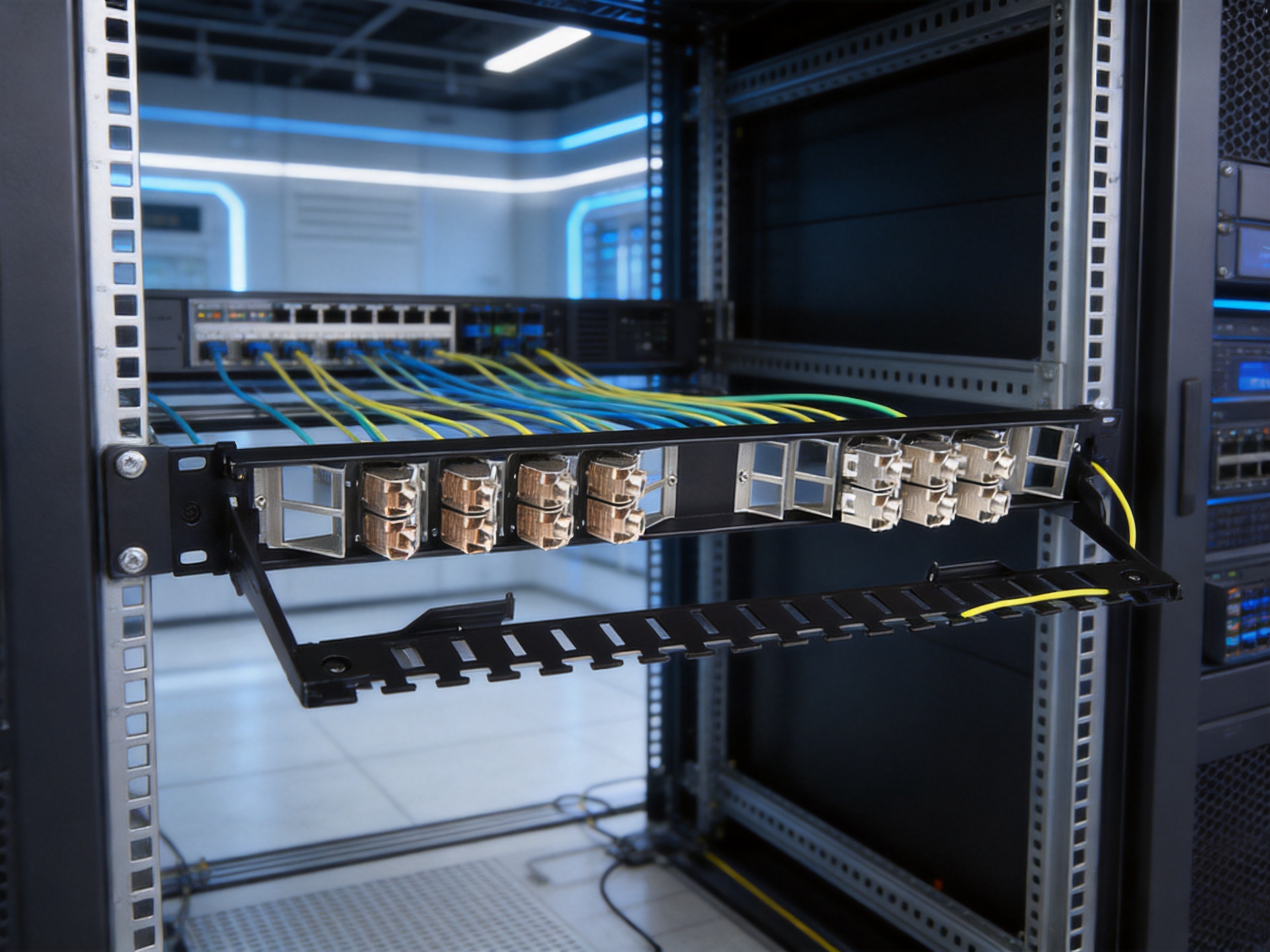
Server rooms require disciplined cable management because a large number of connections may be concentrated in a small area. The angled design can assist with patch cord routing between the panel and active network equipment. It may also make it easier to distinguish copper connections from fiber connections when both media types are installed in the same cabinet.
In a data center, the panel can be assigned to a specific rack, row, tenant, network segment, or equipment group. It can be integrated with server cabinets, network switches, cable managers, fiber distribution units, and labeling systems. The blank format is useful where the final port mix may change as equipment is deployed in phases.
Industrial Facilities
Industrial sites frequently contain sources of electromagnetic noise and mechanical vibration. Manufacturing lines, control panels, motors, drives, and automated equipment may be installed close to communication pathways. In such environments, shielded structured cabling can be selected as part of a broader interference-management strategy.
The shielded patch panel provides a suitable termination platform when used with shielded cable and shielded keystone modules. Installers should pay close attention to bonding and grounding, cable separation from power circuits, enclosure design, and environmental conditions. In a properly engineered system, the panel can support reliable communications between industrial controllers, monitoring devices, switches, and supervisory systems.
Educational Institutions
Schools, universities, libraries, and training centers often have diverse connectivity requirements. Classrooms may need data outlets, wireless access points, security devices, audiovisual equipment, and administrative workstations. A modular patch panel can help network administrators adapt cabinet configurations as buildings and teaching spaces change.
The 24-port format can be useful for individual floors, buildings, laboratories, or communication rooms. Because modules can be replaced or rearranged, the same panel design may be used across multiple facilities, simplifying installation practices and spare-parts planning.
Hotels, Hospitals, and Public Buildings
Large public and commercial buildings may combine data, voice, security, building automation, and service-management systems. Their network infrastructure needs to remain organized even when multiple contractors and technology platforms are involved.
A blank keystone panel provides a common mechanical platform for compatible modules. Installers can allocate ports according to a structured labeling plan and maintain separation between different services where required. The resulting rack layout can be easier to document, inspect, and modify during building renovations or technology upgrades.
Smart Homes and Building Automation
Smart homes and intelligent buildings depend on reliable communication between sensors, controllers, access systems, lighting equipment, surveillance devices, and network gateways. Although many of these installations are smaller than enterprise networks, they still benefit from professional termination and cable organization.
The panel can be installed in a compact cabinet or communications enclosure and populated with the modules appropriate for the project. Its blank format allows a single enclosure to support multiple connection types, while the angled layout can help technicians work in areas where space is limited.
Comparison with Conventional Fixed Patch Panels
A fixed patch panel generally includes permanently installed ports that are selected at the time of manufacture. This design can be convenient when a project has a stable and clearly defined configuration. However, it can become less practical when the network requires mixed media, future expansion, or replacement of individual port types.
The blank keystone approach offers a different set of benefits. Instead of replacing the whole panel when a port type changes, the installer can usually replace or rearrange the relevant module. This can reduce material waste and shorten modification work. It also permits a more tailored solution for each rack.
| Evaluation Area | Blank Angled Keystone Shielded Panel | Conventional Fixed Patch Panel |
|---|---|---|
| Port configuration | Selected by the installer using compatible modules | Usually predetermined at manufacture |
| Support for mixed applications | High flexibility for compatible copper, fiber, and specialty modules | Often limited to the installed port type |
| Future changes | Individual modules may be changed or rearranged | May require panel replacement for major changes |
| Cable routing | Angled access can support organized patch cord paths | Depends on the fixed port layout |
| Shielding option | Suitable for shielded modules and bonded systems | Depends on the permanently integrated design |
| Inventory strategy | Blank panels can be stocked with separate modules | Multiple complete panel configurations may be needed |
| Customization | Well suited to project-specific port combinations | Less adaptable after purchase |
The comparison does not mean that one format is appropriate for every installation. Fixed panels can be efficient for standardized deployments with identical ports throughout. However, the SMT-2052-24P-FTP offers clear advantages when adaptability, mixed connectivity, serviceability, and future expansion are priorities.
Manufacturing Strengths and Quality Management
The performance of a patch panel begins with its design and manufacturing process. Mechanical dimensions, material selection, port alignment, module retention, surface finish, and assembly consistency all affect the final installation. A well-designed panel must be stable in a rack, accurately formed, and suitable for repeated handling during installation and maintenance.
Yuyao Simante Network Communication Equipment Co., Ltd. integrates design, development, sales, and service within its business operation. The company has operated in the network cabling and optical fiber product field for nearly two decades. This experience supports a practical understanding of installer requirements, distributor expectations, product consistency, and the changing needs of structured cabling markets.
The company maintains a research and development system supported by more than ten engineers and over thirty full-time technical personnel. This technical organization provides resources for product improvement, design verification, production support, and customer-specific development. In a product category built around precise mechanical interfaces, engineering knowledge is particularly important because small dimensional variations can affect module fit, alignment, and installation reliability.
Injection Molding Capability
The manufacturer operates automatic and semi-automatic injection molding equipment, including ten fully automatic injection molding machines and twenty semi-automatic machines. Injection molding capability is valuable for producing repeatable plastic components such as module holders, insulation parts, cable-management elements, and other structured cabling accessories.
Automated molding can help improve production consistency by controlling material flow, cycle timing, pressure, and part formation. It can also support efficient volume manufacturing while reducing variation between production batches. For network components, consistent molding is important because mounting interfaces and retention features must maintain reliable dimensions.
Production equipment alone does not guarantee quality. It must be supported by appropriate tooling maintenance, material control, process monitoring, inspection, and operator training. The company’s combination of equipment and technical personnel provides a foundation for managing these requirements across regular and customized products.
Automated Assembly and Installation Equipment
The company also operates multiple automatic installation machines, supporting efficient assembly of network communication products. Automated or semi-automated assembly can improve repeatability in operations such as component insertion, positioning, fastening, and production-line testing.
For patch panels and related modules, consistent assembly helps ensure that ports remain aligned and that components are securely retained. It can also help support stable output when large customer orders require thousands of components with uniform appearance and mechanical performance.
At the same time, experienced technical and production personnel remain important for process adjustment, customized orders, quality verification, and handling of product variations. The combination of automation and human expertise allows the manufacturer to balance production efficiency with project-specific requirements.
Production Capacity
The factory maintains ten regular and customization production lines and has an annual output of more than nine million units. This capacity is significant for distributors, system integrators, and OEM customers that require dependable supply over extended periods.
Stable production capacity can provide several commercial advantages. Customers may be able to plan larger deployments with greater confidence, reduce the risk of delayed installations caused by component shortages, and maintain consistent product specifications across different batches. Customization lines also provide support for customers with specific packaging, branding, design, or configuration requirements.
High production capacity must be combined with quality controls to be meaningful. The manufacturer emphasizes product performance testing and customer testing requirements as part of its quality approach. This is especially relevant for network components, where visual quality, dimensional accuracy, mechanical fit, and electrical continuity may all be evaluated by the customer.

Design and Installation Considerations
Selecting Compatible Keystone Modules
Before installation, the project team should confirm that the selected keystone modules are mechanically compatible with the panel. Compatibility includes the module width, locking mechanism, body dimensions, shield contact arrangement, and intended installation orientation.
For copper networks, the module category should match the cable and performance target. A higher-category cable cannot automatically deliver higher-category performance if the jack, patch cord, panel, and installation practices are not also appropriate. In the same way, the use of a shielded panel does not create a shielded channel unless the connected modules and cables are also designed for shielding.
For fiber applications, the installer should verify the adapter type, connector format, fiber mode, polishing style, and bend-management requirements. The panel’s blank format can make it suitable for fiber modules, but the specific adapter must be selected according to the optical design.
Planning Port Assignments
A clear port assignment plan improves installation efficiency and future troubleshooting. Ports can be allocated according to room number, outlet identification, device type, service group, or cable route. The same scheme should be reflected in rack labels, floor plans, test records, and network documentation.
Color coding can supplement written labels, but it should not replace them. Durable labels are recommended because patch panels may remain in service for many years. The documentation should identify both ends of each permanent link and indicate the switch or equipment port to which the patch panel is connected.
Managing Patch Cords
Angled ports can help direct cords toward cable-management pathways, but the installer should still avoid excessive cord length, crossing, and tension. Patch cords should be routed with appropriate bend radius and secured without over-tightening cable ties.
In a dense cabinet, cords should be grouped logically and separated where practical by equipment, service, or destination. Excess cord should not be tightly coiled against active equipment or obstruct ventilation openings. Organized routing makes it easier to identify a connection and reduces the risk that maintenance on one port will disturb neighboring services.
Grounding and Bonding
Shielded installations require careful consideration of grounding and bonding. The panel should be installed in a rack or cabinet that forms part of the building’s approved bonding system. Shielded modules, cable shields, patch cords, and equipment interfaces should be selected and connected according to the project design and applicable standards.
Grounding practices vary according to the building, equipment, local regulations, and network architecture. For this reason, installers should follow the requirements of the project engineer, facility owner, and relevant standards. A qualified professional should verify continuity and bonding where shielded performance is required.
Advantages for OEM, ODM, and Customized Projects
Network equipment distributors and system integrators often need products that can be adapted for different markets. A modular blank patch panel is well suited to private-label programs, customized rack packages, regional product ranges, and project-specific connectivity solutions.
The manufacturer undertakes OEM and ODM projects, allowing customers to discuss product requirements, packaging, labeling, design modifications, and production arrangements. This can be valuable for customers that need a consistent product family across several categories, such as keystone jacks, wall plates, data sockets, patch panels, and fiber accessories.
Customization may involve cosmetic details, labeling formats, packaging, material choices, port arrangements, mounting features, or accessory combinations. Any modification should be reviewed through technical drawings, samples, compatibility checks, and production approval. This process helps ensure that customized products remain suitable for the intended installation and quality requirements.
The company’s experience across copper and optical fiber products also supports broader structured cabling programs. Customers may be able to source multiple related components from one manufacturing partner, simplifying communication, product coordination, quality review, and supply planning.
Why Manufacturing Experience Matters to Buyers
Buyers of network cabling components are not purchasing only a metal or plastic panel. They are selecting a product that will be installed in infrastructure expected to remain operational for years. Manufacturing experience therefore affects more than price. It influences design maturity, production repeatability, technical support, customization capability, and continuity of supply.
A supplier with integrated design and production resources can respond more effectively when a customer requests a modification or encounters a compatibility question. Engineering staff can review the mechanical interface, production teams can assess manufacturability, and quality personnel can establish appropriate inspection points.
Long-term experience also helps a manufacturer identify common field problems. These may include module retention issues, unclear labeling areas, insufficient cable access, inconsistent surface treatment, difficult assembly procedures, or packaging that does not adequately protect the product during transport. Addressing such details can improve the practical value of the finished panel.
For distributors, production capacity and export experience are also important. Yuyao Simante Network Communication Equipment Co., Ltd. maintains stable export activity in Europe, Australia, Africa, the Middle East, and Southeast Asia. Experience serving different regions can help the company understand varied customer expectations, documentation needs, packaging requirements, and project timelines.
Testing and Performance Verification
A structured cabling component should be evaluated through both appearance and function. Visual inspection may confirm that the panel is correctly formed, clean, aligned, and free from obvious defects. Mechanical checks may verify port dimensions, module retention, mounting-hole accuracy, and the stability of the rack installation.
For shielded products, continuity and bonding-related checks are important when the panel is used as part of a shielded channel. The final installation should be tested using procedures appropriate to the selected cable category, module type, and project specification.
Network testing is normally performed after the permanent links and patch cords have been installed. Depending on the project, testing may include wire mapping, continuity, insertion loss, return loss, crosstalk, length, resistance, and other relevant parameters. The panel itself is one element of this channel, so test results reflect the combined quality of the connected components and installation work.
The company states that it meets comprehensive customer testing requirements through performance testing. Buyers should still define acceptance criteria before ordering and confirm which test records, samples, inspection procedures, and compliance documents are required for their project.
Environmental and Operational Benefits
Adaptability can contribute to more efficient use of materials over the life of a network. If a system changes, replacing individual keystone modules may be more practical than discarding a complete fixed patch panel. This can reduce unnecessary replacement of the panel body and support gradual modernization.
The modular design can also help extend the usefulness of rack space. A customer may initially populate only the ports required for current operations and add modules when new devices are installed. This approach can support phased construction, staged office occupancy, or progressive network expansion.
Operational benefits include easier identification, simpler replacement, and improved access during maintenance. An organized angled panel can reduce the time technicians spend tracing cords through a congested rack. Over the life of a facility, small improvements in maintenance efficiency can produce meaningful savings in labor and service interruption.
These benefits depend on proper planning. Blank ports should be protected or managed appropriately, cables should be labeled, and unused capacity should be documented. A modular panel is most effective when it is included in a complete rack-management strategy rather than installed as an isolated component.
Recommended Installation Workflow
Step One: Confirm the Network Design
Review the number of connections, media types, cable categories, shielding requirements, rack dimensions, and planned expansion capacity. Determine whether the panel will serve copper links, fiber links, or a combination of compatible modules.
Step Two: Verify Component Compatibility
Confirm that the selected keystone modules fit the panel and meet the intended electrical or optical requirements. Check the module’s shield design, termination method, conductor compatibility, and performance category.
Step Three: Prepare the Rack
Verify the available rack space, mounting hardware, cable-management accessories, grounding arrangement, and equipment layout. Leave sufficient working space around the panel for termination and future maintenance.
Step Four: Install and Label the Modules
Insert the modules according to the approved port plan. Ensure that each module is fully seated and securely retained. Apply durable labels that correspond to the cable schedule and building documentation.
Step Five: Terminate the Cables
Terminate each cable according to the module manufacturer’s instructions and the selected wiring scheme. Avoid unnecessary untwisting of balanced-pair conductors and maintain the required bend radius. For shielded systems, preserve shield continuity and follow the approved bonding method.
Step Six: Route Patch Cords
Connect patch cords from the panel to network switches or other equipment. Use the angled port orientation to guide cords toward the appropriate management path. Avoid tension, sharp bends, and unnecessary crossings.
Step Seven: Test and Document
Test each link using the equipment and parameters specified for the project. Record the results and update the rack elevation, port map, cable schedule, and network documentation. A complete record makes future service work faster and more reliable.
Q&A
What is a blank keystone patch panel?
A blank keystone patch panel is a panel body with open port positions designed to accept compatible keystone modules. The installer chooses the module type instead of receiving a panel with permanently integrated ports.
How many ports does the SMT-2052-24P-FTP provide?
The product provides 24 module positions. The final connectivity configuration depends on the type and number of compatible keystone modules installed.
What is the benefit of the angled design?
The angled design can improve port visibility and guide patch cords toward cable-management pathways. It may reduce congestion, simplify access, and support cleaner routing in a busy rack.
Does the panel support fiber connections?
The blank format can support compatible fiber adapter modules where the mechanical interface and dimensions are suitable. The installer should verify module compatibility and select adapters appropriate for the fiber connector and application.
Is the panel suitable for shielded copper cabling?
Yes. It is designed as a shielded patch panel for use with compatible shielded keystone jacks, shielded cable, patch cords, and a properly bonded rack or cabinet. The complete channel must be designed and installed correctly for shielding to be effective.
Can unshielded modules be installed?
Because the panel is modular, compatible unshielded modules may be considered for applications where shielding is not required. The installer should confirm mechanical fit and ensure that the selected configuration meets the project’s performance and safety requirements.
Where can this patch panel be used?
Typical applications include offices, data centers, server rooms, industrial facilities, schools, hospitals, hotels, smart buildings, security systems, and customized structured cabling installations.
Why choose a blank panel instead of a fixed patch panel?
A blank panel provides greater flexibility for mixed configurations, future changes, phased installations, and customized port assignments. Individual modules can often be changed without replacing the entire panel.
What should be considered when selecting keystone modules?
Consider module dimensions, locking structure, cable category, conductor type, shielding, termination method, connector type, performance requirements, and compatibility with the panel. The module must be appropriate for both the panel and the connected cable system.
How does the manufacturer support large orders?
The manufacturer operates regular and customization production lines, injection molding equipment, automated installation equipment, and a technical team. Its stated annual output exceeds nine million units, supporting regular supply and customized manufacturing programs.
Does the manufacturer provide OEM and ODM services?
Yes. The company undertakes OEM and ODM projects and can discuss customized products, packaging, labeling, and related structured cabling requirements with customers.
What information should buyers provide when requesting a quotation?
Buyers should provide the required quantity, destination market, module type, shielding requirements, rack application, packaging expectations, labeling needs, testing requirements, delivery schedule, and any OEM or ODM specifications.
Conclusion
The SMT-2052-24P-FTP 24-Port Blank Angled Keystone Shielded Patch Panel is a flexible component for structured cabling systems that require adaptability, organized routing, and shielded connectivity support. Its blank architecture allows installers to select compatible modules according to the project, while the 24-port capacity provides practical density for many rack and cabinet applications.
The angled layout can improve cable access and serviceability, especially in installations with many patch cords. The shielded construction makes the panel suitable for projects that require a coordinated approach to electromagnetic interference control. When combined with appropriate modules, cables, patch cords, grounding, bonding, labeling, and testing, it can contribute to a reliable and maintainable network infrastructure.
The product is also supported by a manufacturer with substantial experience in network cabling and optical fiber products. Integrated design and development capabilities, a team of engineers and technical personnel, injection molding resources, automated assembly equipment, multiple production lines, performance testing, and OEM and ODM experience provide a strong manufacturing foundation.
For contractors, distributors, system integrators, and infrastructure owners, the main value of this patch panel is not limited to its physical construction. It is the combination of modular flexibility, angled access, shielded design, scalable production, and manufacturing support. These qualities make it a practical choice for present network requirements while preserving the flexibility needed for future changes.
References
1. ANSI/TIA-568 Series, Balanced Twisted-Pair Telecommunications Cabling and Components.
2. ISO/IEC 11801 Series, Information Technology—Generic Cabling for Customer Premises.
3. IEC 60603-7 Series, Connectors for Electronic Equipment—Requirements for 8-Way, Unshielded and Shielded Connectors.
4. Telecommunications Industry Association, Telecommunications Pathways and Spaces Guidelines.
5. International Organization for Standardization, Generic Cabling Design and Installation Principles.
6. Manufacturer-provided product information for the SMT-2052-24P-FTP 24-Port Blank Angled Keystone Shielded Patch Panel.
7. Manufacturer-provided company information concerning network cabling products, optical fiber products, production facilities, engineering resources, testing, OEM, and ODM services.