Español
 عربى
 русский
Content
- 1 Product Overview and Functional Purpose
- 2 Key Product Specifications
- 3 Advantages of the 1U 24-Port Format
- 4 Blank Design for Flexible Connector Deployment
- 5 Shielded Construction for Professional Network Environments
- 6 Front Labeling and Rear Cable Management
- 7 Mechanical Performance and Installation Reliability
- 8 Application Scenarios
- 9 Manufacturing Capabilities Behind the Product
- 10 Quality Management and Product Testing
- 11 Advantages Compared with Basic or Less Flexible Alternatives
- 12 Environmental and Material Considerations
- 13 Installation Recommendations
- 14 Packaging, Storage, and Delivery
- 15 Purchasing and Customization Value
- 16 Company Strength in Network Cabling Manufacturing
- 17 Frequently Asked Questions
- 17.1 What is the SMT-2040-24P-FTP?
- 17.2 What does “blank patch panel” mean?
- 17.3 How many ports does the panel have?
- 17.4 Can the panel be installed in a standard network cabinet?
- 17.5 Is the product suitable for shielded cabling?
- 17.6 Are connectors included with the panel?
- 17.7 What materials are used?
- 17.8 Does the panel provide cable management?
- 17.9 How are the ports identified?
- 17.10 What are the mechanical force requirements?
- 17.11 Does the product meet environmental regulations?
- 17.12 What are the environmental specifications?
- 17.13 How should the product be stored?
- 17.14 What is the regular packing quantity?
- 17.15 Is OEM or ODM service available?
- 17.16 Which applications are suitable for this panel?
- 18 Conclusion
- 19 References
- 20 Product: SMT-2040-24P-FTP 1U24 Port Shielded Blank Patch Panel
Modern communication rooms, equipment cabinets, and structured cabling installations require more than a collection of cables and connectors. A dependable infrastructure also needs a clear termination strategy, effective cable organization, secure rack integration, and enough flexibility to accommodate future changes. The SMT-2040-24P-FTP 1U 24-Port Shielded Blank Patch Panel is designed to support these requirements in copper and fiber structured cabling environments.
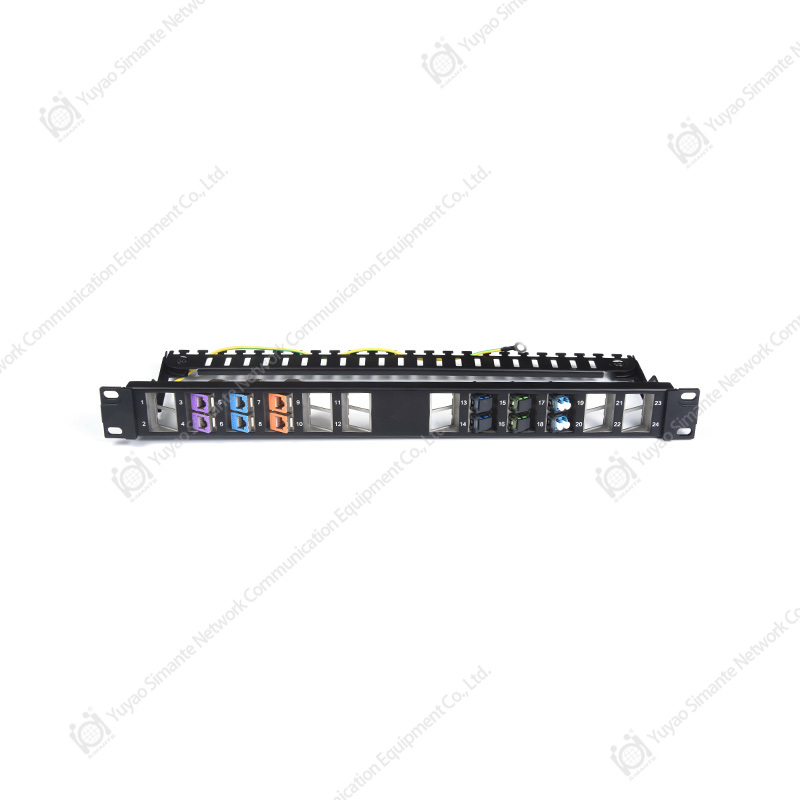
As a blank patch panel, the product provides a practical platform for installing compatible modular connectors of the same standard series. Instead of forcing an installation team to use a fixed port configuration, it allows the panel to be adapted to the required connector arrangement. This makes it suitable for horizontal wiring, equipment termination, and centralized interconnection points where different network services may need to be managed within a single rack unit.
The panel combines a compact 1U rack format, 24 individually identified port positions, a strong metal mounting structure, an ABS non-metallic component, and a rear cable management feature. These elements work together to simplify installation and improve the organization of network connections. Its shielded design is also suitable for applications where a controlled and robust connection environment is required.
For network installers, system integrators, distributors, and original equipment customers, the product offers a balance of installation efficiency, physical durability, identification convenience, and manufacturing consistency. It is intended for professional structured cabling projects in offices, commercial buildings, communication rooms, equipment cabinets, and other network infrastructure locations.
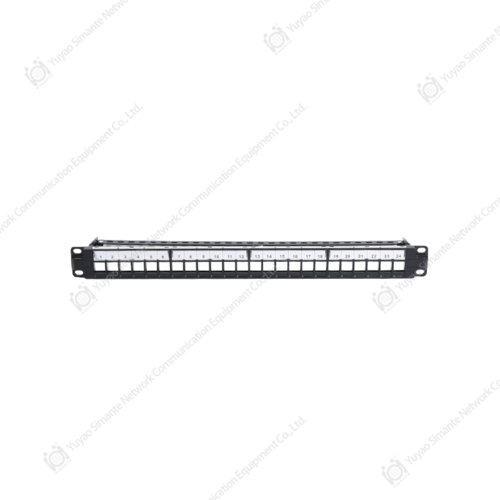
SMT-2040-24P-FTP 1U24 Port Shielded Blank Patch Panel
Product Overview and Functional Purpose
The SMT-2040-24P-FTP is a 1U, 24-port shielded blank patch panel. The 1U format refers to the standard vertical space used in a 19-inch rack system. By occupying only one rack unit, the panel helps preserve cabinet space for switches, routers, fiber distribution equipment, cable managers, power equipment, and other active or passive components.
The 24-port arrangement provides a practical density for many network cabinets. It creates a defined termination area for multiple horizontal cables while keeping connection points aligned in a single rack-mounted assembly. The panel can be used at the distribution end of permanent links, near network equipment, or at a centralized termination point where cable routing and port identification are important.
Unlike a pre-loaded patch panel, a blank patch panel is intended to accept compatible modular connectors. This approach gives installers greater freedom when selecting the appropriate connection modules. Copper data connectors, shielded modules, and other compatible components can be arranged according to the needs of the specific project, provided that the components follow the same standard series and matching requirements.
The blank design can be particularly helpful when a project includes more than one service type or when the final connector configuration may change during installation. It also supports replacement and maintenance because an individual module can be serviced without necessarily replacing the complete metal panel.
Key Product Specifications
| Item | Specification |
|---|---|
| Product model | SMT-2040-24P-FTP |
| Product type | 1U 24-port shielded blank patch panel |
| Application | Horizontal wiring, equipment termination, and centralized termination |
| Rack compatibility | Standard 19-inch equipment racks, cabinets, and wall brackets |
| Port quantity | 24 |
| Port identification | Front labels and large front labeling area |
| Rear organization | Integrated cable manager for guiding cables toward termination points |
| Metal material | Cold-rolled steel with spray coating or cold-rolled steel with nickel plating |
| Plastic material | ABS |
| Insertion force | Not more than 10 N |
| Pull-out force | Not less than 20 N |
| Environmental compliance | RoHS compliant |
| Operating environmental range | Temperature: -25°C to +70°C; humidity: no more than 85%, with the specified high-temperature test condition of 85°C ±3°C |
| Product packaging | Individual PE bag, carton packaging, accessories included |
The specifications describe a panel intended for practical installation rather than purely laboratory use. The rack format, labels, rear cable manager, and material options all address common challenges in a real network cabinet. At the same time, the mechanical insertion and pull-out requirements provide measurable guidance for connector installation and retention.
Advantages of the 1U 24-Port Format
Rack space is an important consideration in structured cabling. A cabinet often contains a mixture of active equipment, power distribution, cable routing accessories, fiber products, and service loops. A 1U patch panel provides a compact termination point without consuming unnecessary vertical space.
The 24-port density is also useful for projects that require organized expansion. Rather than distributing a similar number of connections across several smaller panels, installers can consolidate them into one clearly labeled unit. This can reduce visual clutter and make the relationship between incoming cables and network equipment easier to understand.
Compared with a larger panel, the 1U construction can help the installer maintain a more efficient cabinet layout. Compared with a smaller panel, the 24-port format provides more usable capacity for medium-density installations. The result is a practical compromise between port capacity, rack utilization, and service accessibility.
The standardized 19-inch mounting arrangement further improves compatibility. The panel is designed for use with 19-inch equipment racks, cabinets, and wall brackets. This allows system designers to include it in common cabinet architectures without requiring a special mounting frame. Standard rack compatibility is especially valuable for contractors who need to deploy the same type of component across multiple projects.
The front of the unit provides a clean and accessible area for port identification. When a cabinet contains several patch panels, switches, and cable groups, clear labels can reduce the time required to locate a connection. A large front label area gives the customer or installer room to mark port numbers, service names, room locations, equipment references, or other project-specific information.
Blank Design for Flexible Connector Deployment
The blank patch panel concept is one of the product’s main functional advantages. A fixed patch panel typically arrives with a predetermined group of ports. That configuration may be appropriate for a standard installation, but it can be less adaptable when a project uses different connector types, shielding requirements, or service allocations.
The SMT-2040-24P-FTP provides a structured mounting platform for compatible connectors. The installer can select connectors from the same standard series and arrange them in the required positions. This helps accommodate projects where the final connection plan is defined only after the cabinet layout, cable routes, or equipment list has been confirmed.
Flexibility also supports maintenance. If one connector becomes damaged or must be changed to support a revised connection type, the modular design can make localized replacement more practical than changing an entire pre-terminated assembly. This can reduce material waste and simplify service planning, although the actual replacement procedure should always follow the requirements of the selected connector and the installation standard.
The blank structure is suitable for data cabling systems that require a neat transition between permanent horizontal cables and patch cords. It can also be used in centralized termination zones where the installer needs to group connections by room, department, equipment type, or network function.
Because the panel is intended to work with connectors of the same standard series, component compatibility should be confirmed before installation. The connector dimensions, retention method, shielding arrangement, and termination procedure should correspond to the panel design. Correct matching helps preserve the intended mechanical performance and ensures that the finished assembly remains orderly and serviceable.
Shielded Construction for Professional Network Environments
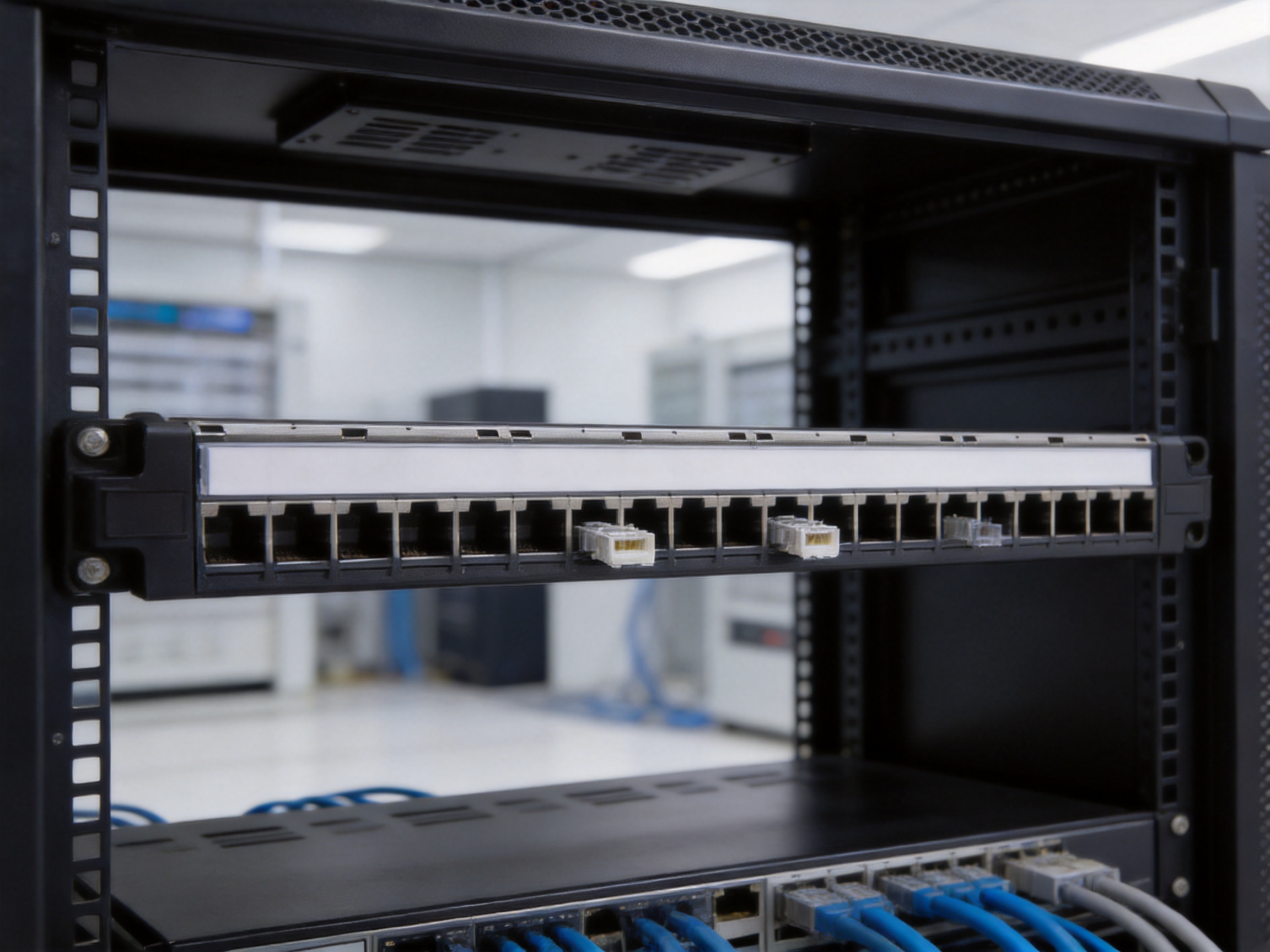
The shielded structure makes the product suitable for network environments where the physical arrangement of cabling and connection hardware must be carefully controlled. A metal support panel provides a stable mounting surface and contributes to the professional construction of the rack assembly.
Shielded network components are commonly selected when a project requires a more controlled cable system, particularly when the installation includes shielded connectors and compatible shielded cable. The patch panel should be used as part of a complete compatible system. The panel itself should not be considered a substitute for correct cable selection, connector termination, grounding practice, or installation workmanship.
The panel’s material options include cold-rolled steel with spray coating and cold-rolled steel with nickel plating. Both choices provide a metal structural base for rack mounting and modular connector installation. The specific surface treatment can be selected according to the customer’s product requirement, project appearance, and procurement specification.
A stable metal body offers several practical benefits during installation. It helps maintain the alignment of the 24 port positions, supports secure rack fastening, and provides a solid surface for repeated service activity. Network cabinets are frequently opened, modified, and inspected, so a rigid mounting structure can improve the experience of technicians who need to connect or disconnect patch cords.
The use of ABS for the plastic component provides a lightweight, moldable material for the non-metallic parts of the assembly. ABS is widely used for technical housings and structured cabling accessories because it can support precise molded features while maintaining a practical balance between weight and strength.
Front Labeling and Rear Cable Management
Port identification is a basic requirement that strongly affects the long-term serviceability of a network installation. Without a clear labeling system, technicians may need to trace cables manually, disconnect equipment to identify a route, or spend additional time checking documentation. The SMT-2040-24P-FTP addresses this issue through labels on the front of all 24 ports and a large front identification area.
The front labeling area can be used during initial installation and updated when the system changes. Depending on the customer’s documentation method, the label may include a port number, cable destination, patching reference, room code, rack location, or equipment identifier. A large label is particularly useful in cabinets where panels are mounted close together and small markings may be difficult to read.
Labeling also supports structured troubleshooting. If a user reports a connection problem, a technician can refer to the panel label and identify the relevant cable path more quickly. This can reduce disruption to other services and make the maintenance process more systematic.
The rear cable manager complements the front labeling system. It helps guide cables toward the termination point and assists with maintaining a cleaner rear working area. When cables enter the panel from different directions, the cable manager can help control their position and reduce random movement around the termination zone.
Good cable management is important for several reasons. It can reduce strain on connector terminations, preserve bending conditions, improve airflow around adjacent equipment, and make future changes easier. The rear manager is not intended to replace all cabinet-level routing accessories, but it provides a dedicated organizing feature directly behind the panel.
Compared with a basic flat blank plate, the addition of both front identification space and rear cable guidance creates a more complete installation solution. The installer receives not only a mounting surface, but also features that support documentation, routing, and ongoing service.
Mechanical Performance and Installation Reliability
The supplied mechanical specification identifies an insertion force of no more than 10 N and a pull-out force of no less than 20 N. These values provide a measurable reference for the engagement and retention behavior of the compatible connection components.
A controlled insertion force is useful during assembly because the installer should be able to seat a compatible connector without excessive effort. Excessive force can make installation uncomfortable and may increase the possibility of damaging a component or misaligning the connector. The specified maximum provides a target for a manageable connection process.
A defined minimum pull-out force helps ensure that a properly installed connector remains retained during normal handling. Patch panels may experience movement when technicians route cables, install patch cords, or perform cabinet maintenance. Adequate retention helps reduce the likelihood of accidental disconnection caused by routine handling.
These values should be interpreted together with the selected connector, installation method, and applicable technical standard. Mechanical performance depends on correct compatibility and proper installation. A connector that does not belong to the same standard series may not provide the expected fit or retention characteristics.
The sturdy design also contributes to installation efficiency. A panel that mounts securely in a rack gives the technician a stable reference while inserting modules and terminating cables. This can reduce the need to hold or support the panel during assembly and can help keep the finished port layout aligned.
The product is intended to reduce installation and operation time through a combination of standard rack mounting, modular blank construction, front labeling, and rear cable management. These features do not eliminate the need for professional workmanship, but they help make the work more organized and repeatable.
Application Scenarios
Commercial Office Networks
In a commercial office, the patch panel can provide a centralized termination point for cables serving work areas, meeting rooms, access points, telephones, and network devices. The 24-port layout is suitable for a cabinet serving a department, a floor zone, or a compact office area. Front labels can identify room outlets and simplify future moves or additions.
Communication Rooms
Communication rooms often contain multiple cable groups and different categories of equipment. A rack-mounted blank panel can organize incoming horizontal cables before they connect to switches or other network devices. The rear cable manager supports a more orderly termination area, while the 1U design preserves valuable rack capacity.
Equipment Cabinets
In equipment cabinets, a patch panel can establish a clear separation between permanent cabling and short patch cords. This can improve the appearance of the cabinet and make connection changes easier to manage. The shielded metal construction is suitable for installations that specify compatible shielded cabling components.
Data Center Edge and Distribution Areas
Smaller distribution areas may require a high-density, space-efficient termination point without using a large preconfigured panel. The 24-port format can be used to organize connections in edge cabinets, remote equipment rooms, and intermediate distribution points. Its blank arrangement allows the installer to select compatible modules for the specific connection plan.
Smart Home and Automation Infrastructure
Structured cabling products are also used in smart home, building automation, security, and control systems. Where multiple low-voltage communication connections converge in a cabinet, a labeled modular panel can provide a neat transition between field wiring and active equipment. The exact connector and cable selection should be determined by the requirements of the system.
OEM and Custom Projects
Customers purchasing network components for their own system or product line may benefit from the panel’s adaptable structure and customer-specified packaging option. The product can be included in a customized bill of materials for structured cabling solutions, communication cabinets, or network installation kits.

Manufacturing Capabilities Behind the Product
The product is manufactured by Yuyao Simante Network Communication Equipment Co., Ltd., a professional producer of network cabling solutions and optical fiber products. The company integrates design, development, sales, and service, allowing product requirements to be considered across the complete development and supply process.
The company reports nearly 20 years of service experience in the network communication field. This length of practical involvement supports a useful understanding of structured cabling components, installation conditions, customer customization, and the demands of export markets.
A mature research and development system is used to support product quality from the design stage. This is important for a patch panel because its performance depends on the relationship between metal dimensions, plastic molding, port alignment, connector retention, labeling space, and rack mounting geometry. Design accuracy helps reduce problems that might otherwise appear during assembly or field installation.
The company has more than 10 engineers and more than 30 full-time technical personnel. These teams contribute to product development, production support, quality improvement, and product updates. A dedicated technical workforce can help maintain continuity between customer requirements, tooling, manufacturing, inspection, and final delivery.
The reported production infrastructure includes 10 regular and customization production lines. It also includes 10 fully automatic injection molding machines, 20 semi-automatic injection molding machines, and eight types of automatic installation machines. This combination of automation and flexible production equipment supports both standard products and customer-specific requirements.
Injection molding capability is especially relevant to the ABS components used in structured cabling products. Controlled molding equipment can help maintain consistent shape and fit across repeated production batches. Automatic installation equipment can support repeatable assembly operations, helping reduce variation in the placement and installation of product components.
The company states that its annual output remains above 9 million units. A production scale of this level indicates the ability to support regular supply programs while continuing to manufacture multiple categories of communication components. For distributors and project purchasers, production capacity can be an important factor when planning recurring orders or larger installations.
Quality Management and Product Testing
Consistent production is not based on machinery alone. It also requires process control, inspection, testing, and communication between technical and production teams. The manufacturer emphasizes performance testing to meet comprehensive customer requirements and to support product quality.
For the SMT-2040-24P-FTP, relevant quality checks may include visual inspection of the metal surface, verification of the rack mounting dimensions, port position and label alignment, plastic component quality, cable manager assembly, and compatibility of the modular openings. Mechanical testing can also be used to verify the specified insertion and pull-out performance for the applicable connection system.
Surface treatment is another important quality consideration. Spray-coated cold-rolled steel and nickel-plated cold-rolled steel require controlled preparation and finishing. A consistent surface supports product appearance, handling, and long-term use in a professional cabinet environment. The selected finish should correspond to the customer’s order specification.
The company’s stated emphasis on quality beginning at the design source is valuable for products that combine multiple materials and manufacturing processes. A patch panel is not simply a stamped metal plate. It depends on the coordinated performance of the frame, plastic parts, connector openings, labels, cable manager, and mounting points.
Testing and inspection should be supported by clear product specifications. The defined mechanical force values, RoHS requirement, environmental range, material information, and packaging instructions give customers a reference for purchasing and quality acceptance. They also support communication between the manufacturer, distributor, installer, and end user.
Advantages Compared with Basic or Less Flexible Alternatives
The product’s advantages become clearer when it is compared with a basic flat plate or a less adaptable fixed panel. A flat plate may cover an opening, but it generally does not provide 24 modular port positions, front port labeling, or a rear cable management feature. The SMT-2040-24P-FTP is designed as a functional termination platform rather than a simple blank cover.
Compared with a fixed pre-loaded panel, the blank configuration provides more choice in connector selection and port allocation. This is useful for projects where the customer wants to define the connector arrangement at installation time or where the network design may be modified in the future.
Compared with a panel without a rear manager, the integrated cable guidance feature helps create a more controlled termination area. While installers may still use additional horizontal or vertical cable managers, the rear feature provides local support immediately behind the port field.
Compared with products that provide only small port marks, the large front label area improves identification potential. This can be especially valuable in commercial environments where multiple technicians may service the same cabinet over several years.
Compared with non-standard mounting products, the 19-inch rack-compatible format allows integration into widely used cabinets and wall-mounted rack structures. Standard dimensions reduce the need for special mounting solutions and make the product easier to include in a structured bill of materials.
These advantages are practical rather than merely visual. They can contribute to faster installation, cleaner cable routing, simpler maintenance, more flexible component selection, and better documentation of network connections.
Environmental and Material Considerations
The product is specified as meeting RoHS requirements. This supports customers who need components aligned with restrictions on certain hazardous substances in electrical and electronic products. Project purchasers should still confirm the applicable regulatory documentation and market requirements for their destination region.
The stated environmental temperature range is -25°C to +70°C. The supplied humidity requirement is no more than 85%, with a specified high-temperature condition of 85°C ±3°C. Because environmental specifications can be interpreted differently depending on whether they refer to operation, storage, or testing, customers should confirm the exact qualification conditions required for their application.
The combination of cold-rolled steel and ABS provides a practical material structure for rack-mounted communication hardware. The steel supports the mechanical frame, while ABS is used for non-metallic components that require molded details. Material selection should be considered together with the installation location, cabinet environment, and expected service conditions.
For long-term performance, the panel should be installed in a clean and suitable indoor environment unless the complete system has been specifically designed for harsher conditions. It should be protected from corrosive gases, excessive moisture, chemical exposure, and physical abuse. Proper rack installation and cable routing are also important to avoid unnecessary stress on the panel and connected modules.
Installation Recommendations
Before installation, verify that the cabinet or wall bracket uses a compatible 19-inch rack format and that sufficient 1U space is available. Confirm the selected connectors belong to the same standard series as the panel and check that the required cable type and shielding arrangement are compatible with the complete network design.
Installers should prepare the cable route before loading the panel. Horizontal cables should be brought toward the rear termination area with appropriate bend control. Avoid pulling cables sharply or allowing excessive weight to rest on individual connectors. The rear cable manager should be used to guide the cable group toward the termination points without creating unnecessary pressure.
After inserting the compatible connectors, verify that each module is fully seated and retained. Use the front label area to record a consistent identification scheme. The labeling method should match the project drawings, cable schedules, and equipment documentation.
Rack screws or mounting hardware should be tightened securely but without damaging the panel or cabinet rails. The panel should remain level and aligned with nearby equipment. After installation, inspect the front and rear sides to confirm that labels are readable, cable routing is controlled, and no connector is exposed to abnormal strain.
Testing should be performed according to the requirements of the complete cabling system. A patch panel cannot compensate for an improperly terminated cable, an incompatible connector, or inadequate grounding and shielding practice. The finished installation should be checked as an integrated system.
Packaging, Storage, and Delivery
Each product is placed in a special PE bag and then packed in a cardboard box. Product accessories are placed in the packaging at the same time. A label identifying the product model and quantity is attached to the upper-left area of the front of the carton, supporting warehouse identification and order management.
The supplied packing information states a regular packing quantity of one unit per inner box and ten units per outer carton. Customers with different logistics requirements can discuss customer-specified packaging with the manufacturer.
Packaged products should be stored in a warehouse with an ambient temperature of -5°C to +30°C and relative humidity of no more than 70%. The surrounding air should be free from acid, alkali, and other corrosive gases. Under the stated conditions, the storage period is three years.
Appropriate storage helps preserve the metal finish, plastic components, labels, and packaging materials before installation. Cartons should be kept dry, protected from crushing, and handled in a way that avoids unnecessary impact. During transportation, the products should remain secured so that the panels and accessories do not shift excessively inside the carton.
Customer-specified packaging is available as a product use mark or packaging requirement. This can help distributors and OEM customers coordinate labeling, order identification, and project-specific delivery procedures.
Purchasing and Customization Value
For distributors, the product offers a clear specification profile that can be presented to customers seeking 1U, 24-port, rack-compatible blank patch panels. Its application across structured cabling, network communication, smart home, and automation fields supports a variety of sales channels.
For system integrators, the blank layout provides freedom to select compatible connector modules based on the project design. This can reduce the need to maintain multiple fixed panel versions for different connector arrangements, although the required inventory strategy will depend on the project portfolio.
For OEM customers, the manufacturer’s combination of design capability, molding equipment, assembly machines, customization production lines, and customer-specified packaging can support private-label or project-specific supply programs. Customers should provide detailed requirements for material finish, port configuration, labeling, packaging, inspection, and documentation during the quotation and approval stages.
Customization should be managed through a controlled technical process. Drawings, samples, specifications, acceptance criteria, and packaging artwork should be reviewed before mass production. This reduces the possibility of misunderstanding between the purchaser and manufacturer and helps establish a repeatable quality standard.
Company Strength in Network Cabling Manufacturing
Yuyao Simante Network Communication Equipment Co., Ltd. focuses on network cabling solutions and optical fiber products. Its product range includes keystone jacks, patch panels, wall face plates, data sockets, and related structured cabling components.
The company serves customers in Europe, Australia, Africa, the Middle East, and Southeast Asia. Its international experience supports communication with customers who may have different packaging, labeling, documentation, and product qualification expectations.
The manufacturer also undertakes OEM and ODM projects. This indicates an ability to work not only with catalog products but also with customers that require modifications or new product development. The combination of engineering personnel, production lines, injection molding resources, automatic installation equipment, and performance testing can provide a foundation for such cooperation.
A broad manufacturing capability is relevant to patch panels because customers often need a complete family of structured cabling products rather than one isolated component. A supplier that can provide related jacks, panels, face plates, sockets, and fiber products may simplify sourcing and improve consistency across a project.
The company’s stated goal is to create customer value through professional expertise, stable quality, continuous product improvement, and service. For buyers evaluating the SMT-2040-24P-FTP, these capabilities provide context for assessing not only the individual panel but also the manufacturer’s ability to support ongoing product supply.

Frequently Asked Questions
What is the SMT-2040-24P-FTP?
It is a 1U, 24-port shielded blank patch panel designed for installation in standard 19-inch racks, cabinets, and wall brackets. It provides a modular platform for compatible connectors used in structured cabling systems.
What does “blank patch panel” mean?
A blank patch panel does not come with a fixed set of pre-installed data connectors. It provides openings and a mounting structure for compatible modular connectors, allowing the installer to determine the required connector configuration.
How many ports does the panel have?
The panel provides 24 port positions in a compact 1U rack format.
Can the panel be installed in a standard network cabinet?
Yes. It is designed for standard 19-inch equipment racks, cabinets, and wall brackets. The cabinet should provide suitable 1U space and compatible mounting rails.
Is the product suitable for shielded cabling?
Yes. It is specified as a shielded blank patch panel. For proper system performance, it should be used with compatible shielded connectors, cables, grounding arrangements, and installation practices.
Are connectors included with the panel?
The supplied product description identifies the item as a blank patch panel and does not state that connectors are pre-installed. Customers should confirm the included accessories and select connectors from the same standard series.
What materials are used?
The metal bracket is made from cold-rolled steel with either a spray coating or nickel plating. The non-metallic plastic material is ABS.
Does the panel provide cable management?
Yes. A cable manager is located on the rear of the panel to help guide cables toward the termination points.
How are the ports identified?
All 24 ports have front labels, and the panel also includes a large front label area for customer-specific port identification.
What are the mechanical force requirements?
The specified insertion force is no more than 10 N, and the specified pull-out force is no less than 20 N. These values apply to compatible connection components installed according to the required standard and procedure.
Does the product meet environmental regulations?
The product is specified as meeting RoHS standards. Customers should request current compliance documentation when required for a particular market or project.
What are the environmental specifications?
The stated temperature range is -25°C to +70°C. The supplied information also specifies humidity of no more than 85%, with a high-temperature condition of 85°C ±3°C. Customers should confirm the exact application and test interpretation for their project.
How should the product be stored?
Packaged products should be stored at -5°C to +30°C, with relative humidity no greater than 70%, in an environment free from acid, alkali, and other corrosive gases. The stated storage period is three years under these conditions.
What is the regular packing quantity?
The stated regular packing arrangement is one unit per inner box and ten units per outer carton. Customer-specified packaging can be discussed for customized orders.
Is OEM or ODM service available?
The manufacturer undertakes OEM and ODM projects. Customers should provide detailed technical, packaging, labeling, and inspection requirements for evaluation.
Which applications are suitable for this panel?
Typical applications include structured cabling, office networks, communication rooms, equipment cabinets, centralized termination points, smart home systems, automation networks, and other professional low-voltage communication installations.
Conclusion
The SMT-2040-24P-FTP 1U 24-Port Shielded Blank Patch Panel is designed to provide a compact, flexible, and organized termination solution for professional structured cabling systems. Its 1U rack format preserves cabinet space, while the 24-port layout provides useful connection density for commercial and technical installations.
The blank design allows compatible connectors to be selected and arranged according to the project requirements. Its shielded metal structure, ABS components, front port labels, large identification area, and rear cable manager address the physical and organizational needs of installers and network technicians.
Defined insertion and pull-out force requirements provide a measurable mechanical reference, while RoHS compliance and stated environmental specifications support procurement and product evaluation. The packaging and storage instructions further assist distributors and project purchasers in managing the product before installation.
The manufacturer strengthens the product offering through engineering resources, injection molding capabilities, automatic installation equipment, customization production lines, performance testing, international supply experience, and OEM and ODM support. Together, these capabilities make the panel suitable not only for individual installations but also for repeat purchasing programs and customized structured cabling solutions.
When combined with compatible connectors, properly selected cables, accurate labeling, correct grounding and shielding practices, and professional installation, the panel can help create a cleaner, more maintainable, and more adaptable network infrastructure.
References
1. Product specification for the SMT-2040-24P-FTP 1U 24-Port Shielded Blank Patch Panel.
2. Manufacturer-provided material and surface-treatment information for cold-rolled steel, spray coating, nickel plating, and ABS components.
3. Manufacturer-provided mechanical performance requirements for insertion force and pull-out force.
4. Manufacturer-provided environmental, RoHS, packaging, transportation, and storage information.
5. General principles of structured cabling design, rack-mounted equipment organization, port identification, and cable management.
6. General engineering practices for modular connector compatibility, shielded cabling installation, and network cabinet maintenance.