Español
 عربى
 русский
Content
- 1 Product Overview
- 2 Why CAT6 Connectivity Matters
- 3 Advantages of a Toolless Termination Design
- 4 Contact Design and Signal Integrity
- 5 Clear Wiring Identification for Faster Installation
- 6 Modular Compatibility and Application Flexibility
- 7 Mechanical and Environmental Performance
- 8 Materials and Surface Treatment
- 9 Quality Control and Testing Considerations
- 10 Manufacturing Strengths Behind the Product
- 11 Competitive Advantages Compared with Basic Keystone Jacks
- 12 Applications in Structured Cabling Systems
- 13 Installation Recommendations
- 14 Packaging, Storage, and Logistics
- 15 OEM, ODM, and Customization Support
- 16 Company Manufacturing and Market Experience
- 17 Purchasing Checklist for Project Buyers
- 18 Q&A
- 18.1 What type of product is the SMT-1049T8C6?
- 18.2 Which wiring standards does the jack support?
- 18.3 Does installation require a punch-down tool?
- 18.4 What cable size can be terminated?
- 18.5 What is the operating frequency range?
- 18.6 How does the contact design help reduce crosstalk?
- 18.7 What materials are used for the contacts?
- 18.8 What materials are used for the housing?
- 18.9 How durable is the connector?
- 18.10 Can it be installed in a modular patch panel?
- 18.11 Is the product suitable for outdoor use?
- 18.12 Does the product meet RoHS requirements?
- 18.13 What are the standard packing quantities?
- 18.14 Can the packaging be customized?
- 18.15 What company manufactures this product?
- 18.16 What manufacturing capabilities does the supplier have?
- 18.17 Can the supplier support OEM and ODM projects?
- 19 Conclusion
- 20 References
- 21 Product: SMT-1049T8C6 180 Degree CAT6 Toolless Keystone Jack

Modern communication networks depend on dependable physical-layer connectivity. Although switches, routers, wireless access points, and software receive much of the attention in a network project, the quality of the cabling interface remains essential to overall performance. A weak, poorly designed, or difficult-to-install jack can increase labor costs, create inconsistent terminations, and make future maintenance unnecessarily complicated. The SMT-1049T8C6 180-Degree CAT6 Toolless Keystone Jack is designed to address these practical requirements with a compact form, a tool-free termination concept, CAT6 performance, universal wiring identification, and compatibility with modular structured cabling systems.
This product is intended for communication socket connections between equipment and work areas. It can be used in horizontal cabling systems, data outlets, modular patch panels, distribution frames, wall plates, and other applications that require a reliable RJ45 interface. Its 180-degree design supports organized cable routing while its toolless construction helps installers complete termination accurately and efficiently without relying on a separate punch-down tool for the primary closure operation.
Manufactured by Yuyao Simante Network Communication Equipment Co., Ltd., the jack is part of a broader range of copper and fiber structured cabling products. The company combines product development, tooling, injection molding, automated assembly, inspection, and customer-specific service in one manufacturing organization. This integrated capability is important for distributors, system integrators, contractors, and original equipment customers seeking stable supply, customization support, and consistent product quality.
Product Overview
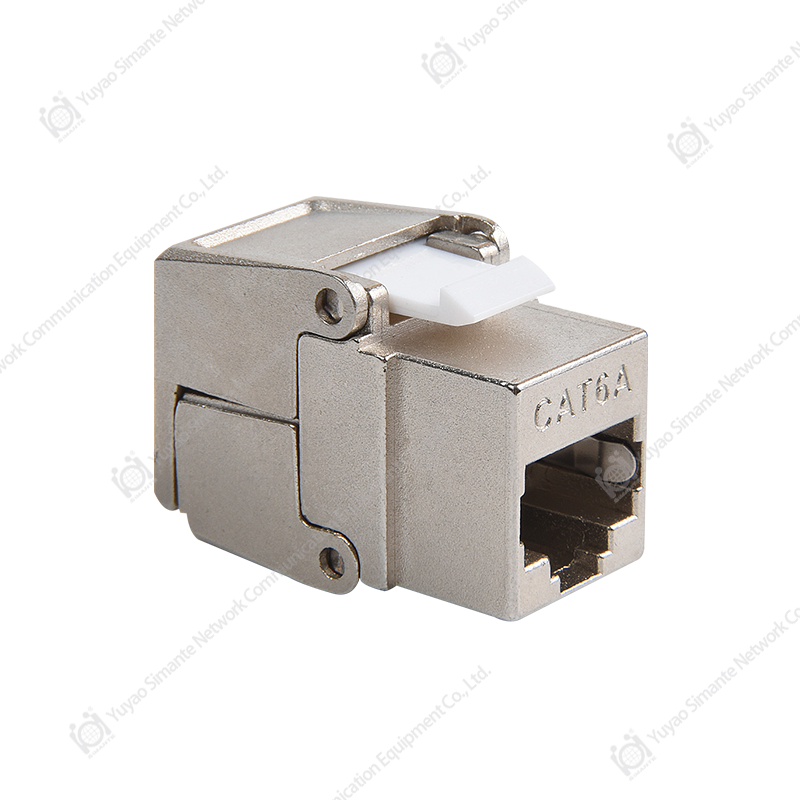
The SMT-1049T8C6 is a Category 6 keystone jack designed for copper twisted-pair network cabling. It supports the T568A and T568B wiring sequences used in structured cabling installations and is suitable for connecting horizontal cables to work-area outlets or modular distribution equipment. The product operates across a frequency range of 1 to 250 MHz and is engineered around the electrical and mechanical requirements associated with CAT6 transmission systems.
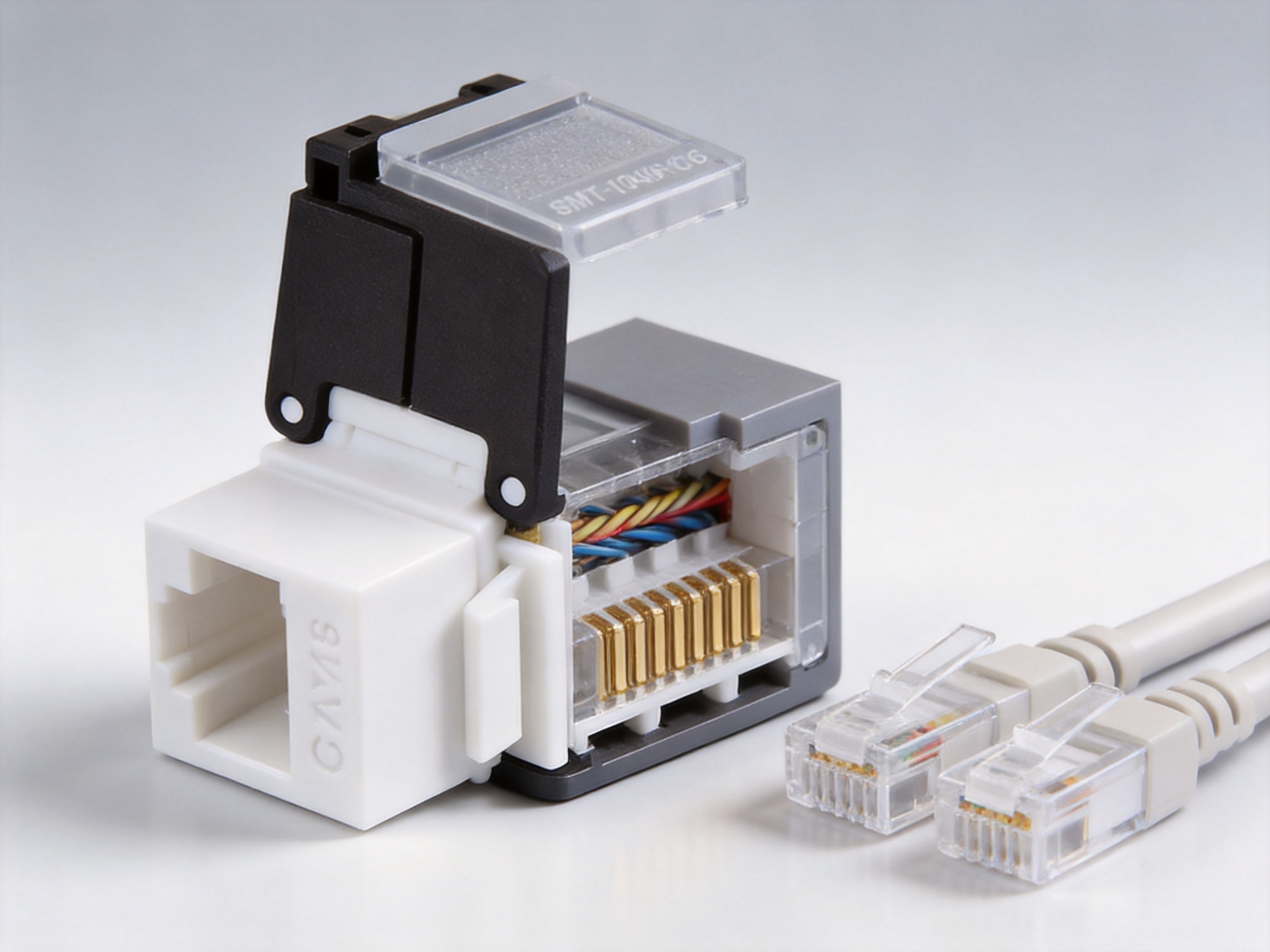
The jack uses an RJ45 interface on the front side and an IDC termination structure on the rear side. The RJ45 side accepts a standard network patch cable, while the rear IDC section accommodates horizontal twisted-pair cable. This arrangement allows the product to function as an intermediate connection point between permanent building cabling and removable equipment cords.
A clearly marked universal wiring label is positioned on the dust-proof wire cover. The label identifies both T568A and T568B sequences, helping installers select the correct termination arrangement during deployment. Clear labeling is particularly valuable in high-volume installations, where technicians may terminate hundreds or thousands of outlets and where a small wiring error can lead to troubleshooting delays.
The compact housing is suitable for modular mounting. The module can be installed on a distribution frame to form a modular distribution system, or it can be integrated into a compatible faceplate or data outlet. This flexibility helps the same basic jack serve different project layouts without requiring a completely different connector platform.
The 180-degree configuration is also useful for cable management. Depending on the orientation of the enclosure and the available rear clearance, the jack can help maintain a cleaner transition between the horizontal cable and the outlet or patching equipment. Better routing reduces excessive bending, limits strain on the termination, and can make inspection and rework easier.
Why CAT6 Connectivity Matters
Category 6 cabling is widely used in commercial buildings, homes, education facilities, industrial offices, security installations, and data communication environments. Compared with lower-category cabling, CAT6 systems are designed to provide improved transmission performance and greater control of crosstalk at frequencies up to 250 MHz. The connector is a critical part of that channel. A high-quality cable connected to an unsuitable jack cannot deliver the expected system performance.
The SMT-1049T8C6 is designed to meet Category 6 transmission requirements when it is installed with compatible CAT6 cable, patch cords, panels, and other system components. Its contact pin arrangement uses high-and-low dislocation technology. This construction helps reduce near-end crosstalk by controlling the physical relationship between contacts and conductors inside the connector.
Near-end crosstalk occurs when a signal traveling through one pair interferes with a signal in an adjacent pair. In a high-speed copper system, excessive crosstalk may reduce signal quality, limit available bandwidth, and create unreliable network behavior. Managing the contact geometry inside the jack is therefore an important design consideration. The specified NEXT performance is at least 4 dB under the stated product requirements.
The jack has a frequency range of 1 to 250 MHz, a working voltage of 125 V, and a dielectric withstand capability of DC 1000 V or AC 750 V for one minute without breakdown or arcing under the specified test conditions. Its initial insulation resistance is at least 100 MΩ, and the same minimum value is required after constant damp-heat testing. These specifications provide a practical electrical foundation for dependable structured cabling installations.
Advantages of a Toolless Termination Design
Traditional IDC termination procedures often require a dedicated punch-down tool. While punch-down tools remain useful for some cabling systems, they introduce an additional item that must be carried, maintained, and used correctly. The toolless approach of this keystone jack simplifies the installation workflow and helps reduce the number of steps required to terminate a cable.
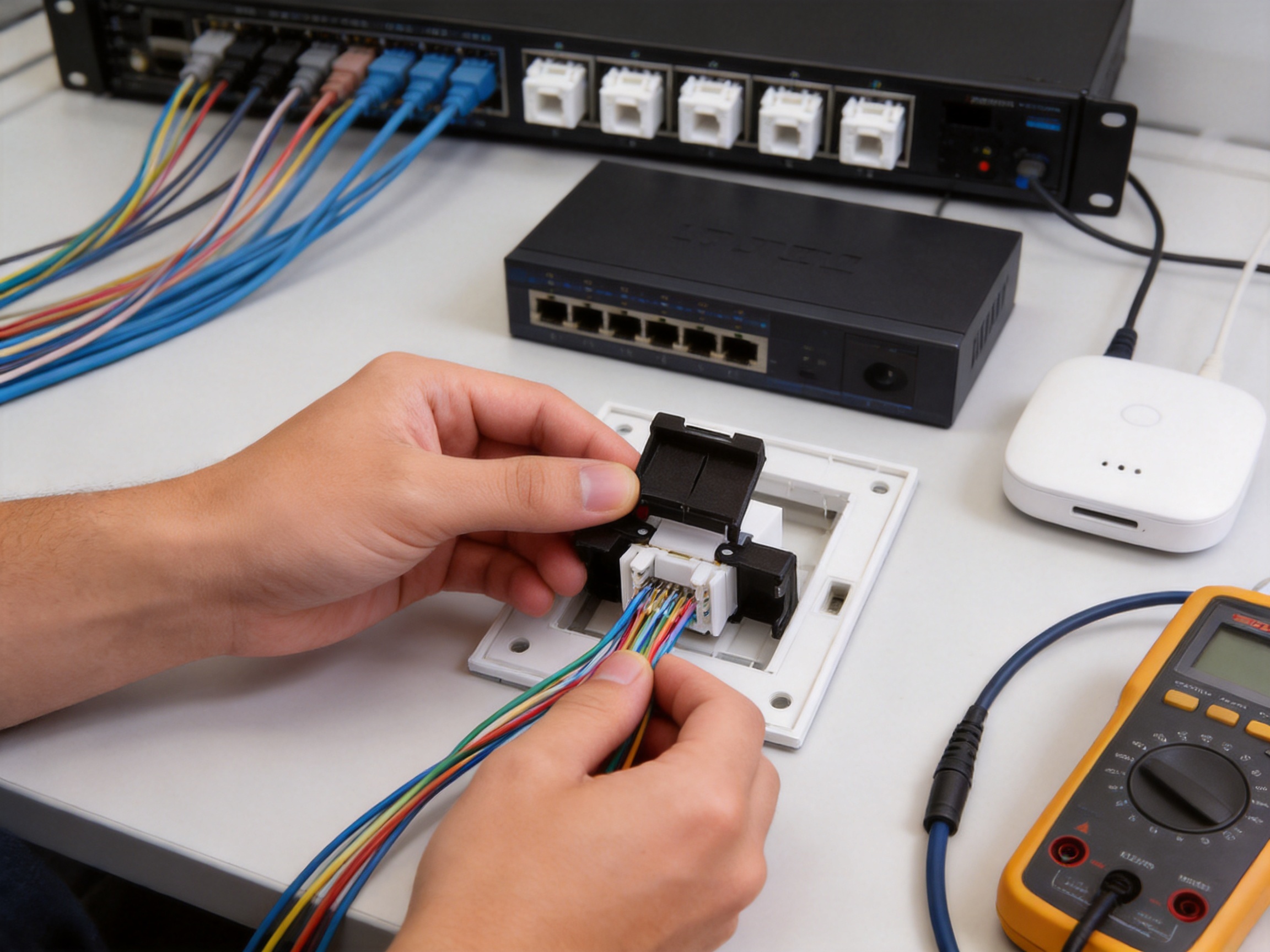
For contractors, the primary benefit is installation efficiency. A technician can prepare the cable, place each conductor according to the clearly printed wiring sequence, close the termination structure, and inspect the connection. The process is especially convenient during retrofit work, office expansion, residential network upgrades, and other projects where time at each outlet is limited.
A tool-free design can also reduce variability between installers. Different technicians may apply different levels of force when using a manual punch-down tool. Excessive force can damage a conductor or connector, while insufficient force may create an unstable termination. A properly engineered toolless closure provides a more consistent mechanical operation when the conductor is prepared and positioned correctly.
Reduced tool dependence is also useful in confined spaces. Data outlets may be installed behind furniture, inside cabinets, above ceilings, or in crowded communication enclosures. A compact jack that does not require a large external tool can be easier to work with in these locations.
Toolless does not mean installation-free. The cable still must be stripped and arranged correctly, the pair twists should be preserved as close as possible to the termination point, and the final connection should be inspected and tested. The principal advantage is that the termination mechanism is integrated into the connector rather than dependent on a separate punch-down operation.
Contact Design and Signal Integrity
Contact construction directly affects the electrical and mechanical reliability of a network jack. The gold needle contacts in this product are made from phosphor bronze and gold plated. Phosphor bronze provides suitable spring characteristics and mechanical resilience for repeated mating cycles, while the gold surface supports stable contact performance at the RJ45 interface.
The IDC card wire terminals are made from phosphor bronze with nickel plating. This combination is intended to provide a robust interface with 22 to 26 AWG twisted-pair conductors. The IDC section must hold each conductor firmly while maintaining a dependable electrical path over the service life of the installation.
The specified insertion force is not more than 20 N, and the pull-out force is not less than 20 N. These requirements balance usability with retention. An installer should be able to insert and remove a compatible plug without excessive effort, while the connection should resist accidental separation during ordinary use.
The connector connection device is tested under a 50 N load for 60 ± 5 seconds. This type of mechanical test evaluates the ability of the assembled connection to withstand an applied force without unacceptable displacement or damage. Such testing is relevant in wall outlets, patch panels, and other installations where cables may be pulled, moved, or placed under incidental stress.
The product is rated for 750 plug-and-socket insertion cycles and 250 wire terminations. These durability values are important for network environments in which patch cords may be changed repeatedly or a termination may need to be reworked during installation and maintenance.
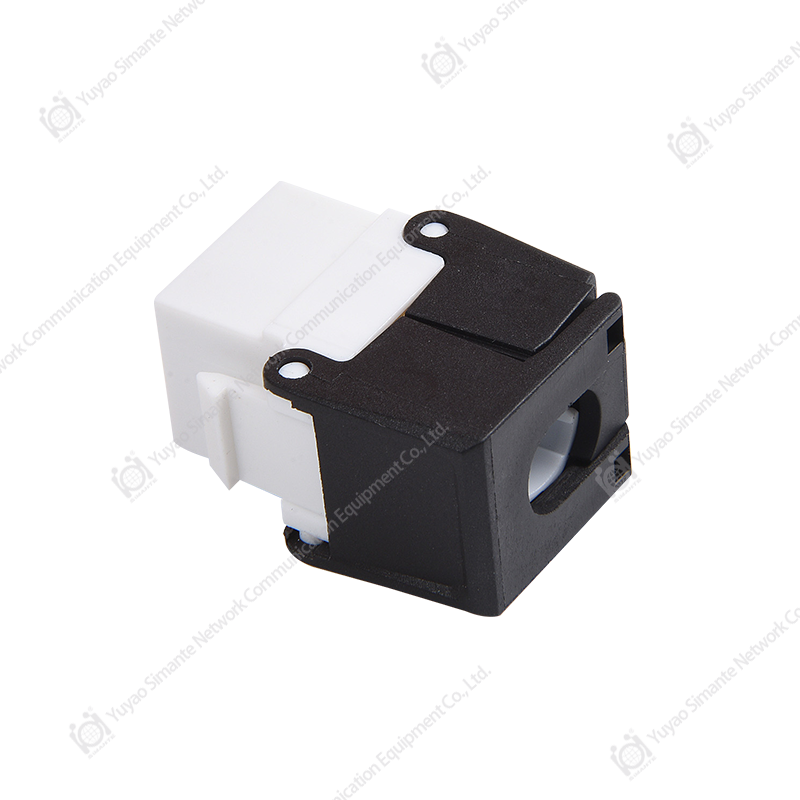
SMT-1049T8C6 180 Degree CAT6 Toolless Keystone Jack
Clear Wiring Identification for Faster Installation
Wiring errors are among the most common causes of network outlet problems. The two widely used termination sequences, T568A and T568B, arrange the conductor pairs differently at the connector. Either sequence may be appropriate depending on the project standard, but consistency throughout a channel is essential.
The universal wiring label on the dust-proof cover presents both sequences in a visible format. This feature supports faster visual confirmation before the cover is closed. It also benefits supervisors and quality inspectors who need to verify that the selected wiring sequence matches the project documentation.
Clear identification can be especially valuable for international projects. Installers may work with different local practices, project specifications, or customer requirements. A dual-sequence label avoids dependence on memory and helps reduce uncertainty when the product is used across different markets.
The cover also helps protect the termination area from dust and accidental contact. In a construction environment, small particles can enter exposed connector structures and complicate installation. A protective cover is not a substitute for proper handling, but it contributes to a cleaner and more controlled termination process.
Modular Compatibility and Application Flexibility
The keystone format is widely recognized for its modularity. A single jack can be installed in a wall faceplate, surface box, patch panel, distribution frame, furniture outlet, or other compatible modular housing. This allows contractors and system integrators to maintain a consistent connector platform across different parts of a project.
The SMT-1049T8C6 uses an embedded design that allows the module to be mounted on a distribution frame and combined with other modules. This is useful for structured cabling systems that require clear separation between copper ports, fiber adapters, telephone connections, audio modules, or other interface types.
In a work-area outlet, the jack connects a permanent horizontal cable to a patch cable used by a computer, access point, printer, telephone, camera, or other networked device. In a patch panel, it provides an organized transition between building cabling and rack-side patch cords. In a modular distribution frame, it supports flexible port planning and easier future changes.
The product is intended to intermatch with connectors from the same standard series. System designers should confirm dimensional compatibility with the selected patch panel, faceplate, or surface box before placing a large order. The use of standardized modular hardware generally simplifies replacement and inventory management, but project-specific mechanical verification remains advisable.
Mechanical and Environmental Performance
Network connectors may be exposed to temperature changes, humidity, handling, vibration, dust, and occasional chemical contamination. The product is specified for an operating temperature range of -25°C to +70°C. The stated humidity requirement is no more than 85%, with the relevant damp-heat condition identified as 85°C ±3°C in the product information.
These conditions make the jack suitable for many indoor commercial, residential, and equipment-room applications. Installation environments should nevertheless be assessed individually. Locations with direct water exposure, corrosive vapors, severe vibration, or temperatures beyond the specified range may require additional protection or a different product category.
The product meets RoHS requirements, supporting applications where restricted substances compliance is part of the purchasing or project qualification process. RoHS-oriented material selection is increasingly important for international supply chains, public infrastructure projects, and customers with environmental procurement policies.
The product information also identifies salt spray testing conditions. The salt solution uses sodium chloride at a concentration of 5 ± 0.1% by mass, with a pH between 6.5 and 7.2 before atomization and a recommended continuous exposure duration of 48 hours. During testing, oil, dust, and unsuitable air temperature or humidity must be controlled so that they do not influence the test environment.
Salt spray testing is typically used to evaluate the corrosion resistance of metallic finishes under an accelerated laboratory environment. It should not be interpreted as a statement that the jack is intended for unprotected outdoor marine deployment. Instead, the test provides useful information about the resistance of the metal surfaces and plating system when compared with defined test requirements.
Materials and Surface Treatment
Material selection affects electrical conductivity, spring force, corrosion resistance, structural strength, and long-term appearance. The jack uses phosphor bronze for the RJ45 contact needles and IDC terminals. The RJ45 contacts receive gold plating, while the IDC terminals use nickel plating.
The specified gold-plated layer thickness is 6 to 50 microinches. Gold plating is commonly used on mating contacts because it provides a stable surface and resists oxidation when properly applied. The actual performance of a plated contact depends on the base material, plating adhesion, thickness distribution, contact force, mating geometry, and manufacturing control.
The non-metallic materials include PC polycarbonate and PA66 nylon 66. Polycarbonate is commonly selected for connector housings because of its dimensional stability and impact resistance. PA66 nylon can provide useful mechanical strength and resistance to heat in suitable connector components. The combination supports a compact housing capable of holding the contact system in the intended alignment.
The PCB material is FR4. This material is widely used in electrical assemblies because of its mechanical stability and insulating properties. In this product, material compatibility and dimensional precision help maintain the position of the electrical elements and support consistent connector performance.
Material choices are only effective when controlled during manufacturing. Plating thickness, molding dimensions, contact alignment, housing fit, and assembly force all require process discipline. This is where an experienced connector manufacturer can provide an advantage over low-cost products with less consistent production control.
Quality Control and Testing Considerations
A structured cabling component should be evaluated as both an electrical product and a mechanical product. Electrical tests may include insulation resistance, dielectric withstand, contact continuity, frequency-related transmission performance, and crosstalk evaluation. Mechanical tests may include insertion and withdrawal force, cable retention, connector retention, repeated mating, repeated termination, and resistance to applied load.
The specified insulation resistance is at least 100 MΩ initially and after constant damp-heat testing. This requirement helps verify that the insulating materials and spacing between conductive elements continue to perform under environmental stress.
The dielectric withstand test of DC 1000 V or AC 750 V for one minute is designed to identify insulation weaknesses that could result in breakdown or arcing under the stated test conditions. Such testing is an important part of product safety and electrical reliability qualification.
Frequency-related testing is equally important for CAT6 products. A connector may pass a simple continuity check while still causing unacceptable crosstalk or transmission loss at higher frequencies. For this reason, CAT6 validation should consider the complete connector structure and its relationship with the twisted-pair cable.
Quality control should begin before final assembly. Incoming materials, molded components, contact parts, plating quality, and packaging should be inspected according to defined procedures. During assembly, automated or semi-automated equipment can help control placement, insertion, and consistency. Final inspection should verify product appearance, model identification, wiring labels, mechanical fit, and packaging quantity.
Customers requiring project approval may also request samples, inspection reports, test records, drawings, packing details, or customized qualification procedures. A manufacturer with engineering and technical personnel can respond more effectively to these requirements than a supplier that only performs basic trading and repackaging.
Manufacturing Strengths Behind the Product
Yuyao Simante Network Communication Equipment Co., Ltd. integrates design, development, sales, and service. This business structure enables the company to manage the product lifecycle from initial concept through tooling, production, inspection, packaging, and customer support.
The company has more than 10 engineers and over 30 full-time technical personnel. This technical base supports product improvement, manufacturing problem solving, process optimization, and the development of customer-specific solutions. For structured cabling products, engineering support is valuable because small changes in contact geometry, mold design, labeling, housing dimensions, or packaging can affect installation performance.
The factory operates 10 regular and customization production lines. It also has 10 fully automatic injection molding machines, 20 semi-automatic injection molding machines, and eight automatic installation machines. This equipment foundation supports both standard product production and selected customized projects.
Injection molding capability is especially important for keystone jacks. The housing must hold contact components precisely while maintaining the correct external dimensions for modular installation. Stable molding conditions help reduce variation in wall thickness, snap-fit features, alignment surfaces, and connector retention features.
Automatic installation equipment can improve assembly repeatability and production capacity. It can also reduce dependence on manual handling for repetitive operations. Semi-automatic lines provide flexibility when products have different configurations, packaging quantities, or customer-specific requirements.
The factory maintains a stable annual output of more than nine million units. Such capacity is relevant to distributors and large system integrators that require continuity of supply. It also allows the manufacturer to support standard orders while reserving production capability for customized packaging, labeling, color, configuration, or project requirements.
High production capacity alone does not guarantee quality. The advantage comes from combining capacity with engineering control, process monitoring, material management, testing, and experienced technical staff. The company emphasizes product quality from the design source and maintains testing procedures to support customer performance requirements.
For customers comparing suppliers, these capabilities can represent a meaningful advantage over factories that have limited molding equipment, heavily manual assembly, or no internal engineering support. A stronger production system can help reduce delivery risk, improve batch consistency, and provide a clearer path for product customization.
Competitive Advantages Compared with Basic Keystone Jacks
One advantage of the SMT-1049T8C6 is the combination of CAT6 performance and toolless installation. Some basic keystone jacks may offer a modular form factor but require separate punch-down tools or provide less detailed installation guidance. The integrated termination concept and dual wiring label can help reduce installation time and error risk.
A second advantage is its attention to crosstalk control. The high-and-low contact arrangement is designed to reduce near-end crosstalk. This feature is more significant than appearance alone because the internal contact relationship influences high-frequency signal behavior.
A third advantage is the balance between modular flexibility and compact construction. The jack can be used in distribution frames and other modular housings while maintaining a form suitable for structured cabling outlets. Customers can standardize on one compatible jack across multiple installation environments.
A fourth advantage is the specified durability. Support for 750 plug-and-socket cycles and 250 wire terminations provides useful service-life information for projects that expect repeated patching, maintenance, or reconfiguration. Customers can compare these figures with products that provide little or no published durability data.
A fifth advantage is material and process transparency. The product information identifies contact materials, plating types, polymer materials, PCB material, electrical ratings, mechanical requirements, environmental conditions, and packaging details. This level of information assists engineers and purchasing teams in evaluating the product for formal projects rather than relying only on a general product photograph.
A sixth advantage is manufacturing scalability. The supplier can support regular production and OEM or ODM projects. This is valuable when customers need special branding, packaging, labels, colors, product combinations, or other adaptations while maintaining a stable supply of standard components.
Applications in Structured Cabling Systems
Commercial Offices
In commercial offices, the jack can be installed in wall outlets, floor boxes, furniture modules, and patch panels. It supports connections for computers, IP phones, wireless access points, printers, cameras, and other Ethernet devices. The toolless design can be helpful when many outlets must be completed during a short construction schedule.
Residential and Smart Home Networks
Residential networks increasingly require wired connections for entertainment systems, security devices, home offices, wireless access points, and automation controllers. A modular CAT6 jack provides a clean and serviceable connection point. It can be combined with faceplates and structured media enclosures to create an organized home communication system.
Education Facilities
Schools, universities, libraries, and training centers often need flexible network outlets in classrooms, laboratories, offices, and common areas. Modular jacks make it easier to plan outlets across different room types. Clear T568A and T568B identification can support installation teams working across a large campus.
Security and Building Automation
Network cameras, access control systems, environmental sensors, and building automation devices may use structured copper cabling. Although the final application must be evaluated according to the equipment requirements, the jack can provide a suitable CAT6 interface for many indoor low-voltage installations.
Data and Equipment Rooms
In equipment rooms, modular patch panels allow technicians to organize incoming horizontal cables and connect them to active network equipment through patch cords. The ability to replace or rearrange modules supports easier maintenance and future changes.
Hospitality and Retail
Hotels, restaurants, retail stores, and entertainment venues require network connections for point-of-sale equipment, guest services, access points, digital signage, surveillance, and administrative systems. A standardized CAT6 keystone jack helps simplify installation across different areas of a property.
Installation Recommendations
Before installation, confirm the cable category, conductor gauge, project wiring sequence, compatible patch panel or faceplate, and required environmental conditions. The jack is designed for 22 to 26 AWG twisted-pair cable. Using cable outside this range may affect termination reliability or mechanical retention.
Select either the T568A or T568B sequence according to the project standard. The selected sequence should remain consistent across the relevant channel unless the design specifically requires a crossover arrangement. Mixing wiring sequences without a defined reason can create connectivity problems.
Prepare the cable carefully. Remove only the necessary amount of jacket, avoid nicking the insulation, and preserve the pair twists as close as practicable to the IDC termination. Excessive untwisting can reduce the performance margin of the completed link, especially at higher frequencies.
Place each conductor in the corresponding position shown on the universal label. Verify the order before closing the toolless termination cover. The conductors should be fully seated, and the cover should be closed according to the connector’s intended mechanism without forcing it at an angle.
After termination, install the jack into the selected modular housing and confirm that the retention features are fully engaged. Connect a suitable patch cord and check the physical fit. Finally, test the completed link using an appropriate cable qualification or certification instrument.
Testing should verify more than continuity when the installation is intended to meet CAT6 performance. Depending on the project, relevant measurements may include wire map, length, insertion loss, return loss, delay, delay skew, and crosstalk-related parameters. The final test method should follow the project specification and applicable cabling standards.
Packaging, Storage, and Logistics
The product is placed in a special blister bag and then packed in a cardboard box. Product accessories are packed at the same time, and a label identifying the model and quantity is affixed to the upper-left area of the carton front. The packaged products are then placed in the outer carton for transport and storage.
The regular packing quantity is 50 pieces per box, with 10 boxes per carton, for a total of 500 pieces per carton. This configuration supports warehouse counting, distribution planning, and project-based inventory control. Customers requiring customer-specified packaging can discuss the requirement with the manufacturer.
Recommended storage conditions are an ambient temperature of -5°C to +30°C and relative humidity not exceeding 70%. The storage area should be free from acid, alkali, and other corrosive gases. Under the stated conditions, the storage period is three years.
Proper storage helps protect plating, plastic components, labels, packaging materials, and contact surfaces before installation. Cartons should be kept away from water, direct heat, heavy compression, and chemical exposure. Stock rotation is recommended even when products have a stated storage period.
OEM, ODM, and Customization Support
Different customers may require different packaging, labeling, colors, carton quantities, documentation, or product configurations. The company undertakes OEM and ODM projects, allowing customers to discuss requirements beyond the standard product specification.
Customization may include customer-specified packaging, private labels, product markings, packaging language, accessory combinations, or project-specific delivery arrangements. Any modification should be reviewed by engineering and quality personnel to ensure that it does not compromise electrical performance, mechanical fit, regulatory compliance, or traceability.
ODM support can be particularly useful when a distributor or system brand needs a connector with a specific housing shape, cover design, mounting feature, or installation method. An established manufacturer with injection molding and automated assembly capabilities can evaluate such requests more efficiently than a supplier that relies entirely on external factories.
For large projects, customers should provide technical drawings, cable requirements, packaging specifications, annual demand estimates, target markets, and qualification criteria as early as possible. Early communication allows the manufacturer to assess tooling, materials, production capacity, testing, and delivery schedules accurately.
Company Manufacturing and Market Experience
Yuyao Simante Network Communication Equipment Co., Ltd. has nearly 20 years of service experience in network cabling solutions and optical fiber products. Its product range includes keystone jacks, patch panels, wall faceplates, data sockets, and related components for structured cabling, network communication, smart home systems, and automation equipment.
The company serves customers in Europe, Australia, Africa, the Middle East, and Southeast Asia. This export experience exposes the organization to different market expectations, documentation practices, packaging requirements, and project standards. It also supports the development of processes suitable for international customers and long-distance supply chains.
The company describes its business as a combination of product design, research and development, sales, service, and manufacturing. This integrated model supports communication between customer-facing teams, engineers, production staff, and quality personnel. For technical products, fast and accurate communication can be as important as production equipment when addressing application questions or resolving project issues.
The company’s emphasis on design-source quality is relevant to connector manufacturing. Many product problems begin before production, such as insufficient contact spacing, weak housing features, unsuitable material selection, unclear labeling, or difficult assembly procedures. Engineering review during the design phase can reduce such problems before mass production begins.
Purchasing Checklist for Project Buyers
When evaluating the SMT-1049T8C6 or a similar CAT6 keystone jack, buyers should confirm the required connector category, cable gauge, wiring sequence, mounting format, operating temperature, humidity conditions, and expected service environment.
It is also useful to confirm whether the product will be installed in a faceplate, patch panel, distribution frame, furniture outlet, or another modular enclosure. Mechanical compatibility should be checked before volume procurement, especially when the project uses a specialized panel or a compact high-density enclosure.
Buyers should review electrical performance requirements rather than selecting solely on price. Frequency range, crosstalk behavior, insulation resistance, dielectric withstand, contact plating, and durability all contribute to long-term system value.
Packaging and logistics should also be considered. Confirm the number of pieces per box and carton, labeling requirements, storage conditions, lead time, production capacity, and whether customer-specified packaging is available. For international shipments, documentation and carton markings may require advance approval.
Finally, buyers should ask about samples, quality inspection, test documentation, replacement policy, technical support, and customization capabilities. A supplier’s ability to provide complete technical information is often a useful indicator of its readiness to support professional projects.
Q&A
What type of product is the SMT-1049T8C6?
It is a 180-degree CAT6 toolless keystone jack for copper structured cabling systems. It provides an RJ45 interface on the front and an IDC termination interface for horizontal twisted-pair cable on the rear.
Which wiring standards does the jack support?
The jack supports both T568A and T568B wiring sequences. The selected sequence should match the project specification and be applied consistently throughout the relevant cabling channel.
Does installation require a punch-down tool?
The product uses a toolless termination design intended to simplify the IDC termination process. Installers still need to prepare the cable correctly, arrange the conductors according to the wiring label, close the termination mechanism, and test the completed link.
What cable size can be terminated?
The IDC terminal is specified for 22 to 26 AWG twisted-pair cable. Cable construction and category should also be compatible with the intended CAT6 installation.
What is the operating frequency range?
The specified frequency range is 1 to 250 MHz, which corresponds to the frequency range commonly associated with CAT6 transmission performance.
How does the contact design help reduce crosstalk?
The contact pins use a high-and-low dislocation arrangement. This geometry is intended to improve pair separation and reduce near-end crosstalk within the connector.
What materials are used for the contacts?
The RJ45 contact needles are made from phosphor bronze with gold plating. The IDC card wire terminals are made from phosphor bronze with nickel plating.
What materials are used for the housing?
The product uses PC polycarbonate and PA66 nylon 66 among its non-metallic materials. The PCB material is FR4.
How durable is the connector?
The stated durability is 750 plug-and-socket insertion cycles and 250 wire terminations. Actual service life also depends on correct installation, compatible cable, environmental conditions, and handling practices.
Can it be installed in a modular patch panel?
Yes. The embedded design allows the module to be installed on a compatible distribution frame or modular patch panel. Compatibility should be verified with the selected panel before ordering.
Is the product suitable for outdoor use?
The product information specifies temperature, humidity, and salt spray test conditions, but it should not automatically be treated as an unprotected outdoor product. Outdoor applications require an appropriate enclosure and confirmation that all environmental conditions are within the complete system design limits.
Does the product meet RoHS requirements?
The product is specified as meeting RoHS requirements. Customers with specific regulatory or project documentation needs should request the applicable compliance documents from the supplier.
What are the standard packing quantities?
The regular packing quantity is 50 pieces per box and 10 boxes per carton, for a total of 500 pieces per carton.
Can the packaging be customized?
Customer-specified packaging is available as a stated product option. Packaging artwork, labeling, carton quantity, and other requirements should be confirmed before production.
What company manufactures this product?
The product is manufactured by Yuyao Simante Network Communication Equipment Co., Ltd., a supplier of network cabling solutions, optical fiber products, and structured cabling components.
What manufacturing capabilities does the supplier have?
The company operates regular and customization production lines, fully automatic and semi-automatic injection molding machines, and automatic installation equipment. It also has engineering and technical personnel supporting product development, process control, and customization projects.
Can the supplier support OEM and ODM projects?
Yes. The company undertakes OEM and ODM projects. Customers should provide technical, packaging, branding, and delivery requirements for engineering and production evaluation.
Conclusion
The SMT-1049T8C6 180-Degree CAT6 Toolless Keystone Jack combines the practical advantages of modular connectivity, CAT6 transmission capability, simplified termination, clear wiring identification, and durable contact construction. Its support for T568A and T568B sequences, 1 to 250 MHz frequency performance, high-and-low contact arrangement, 22 to 26 AWG IDC compatibility, and defined mechanical and environmental specifications makes it suitable for a broad range of structured cabling applications.
Compared with basic keystone jacks, the product offers a stronger combination of installation convenience, crosstalk-conscious design, published technical parameters, modular flexibility, and durability information. The 180-degree format can also support organized cable routing in outlets, patch panels, and distribution frames.
The product’s value is reinforced by the manufacturer’s broader capabilities. Engineering personnel, injection molding capacity, automated and semi-automated production equipment, testing procedures, high annual output, international market experience, and OEM or ODM support provide a foundation for stable supply and customer-specific service.
For contractors, distributors, system integrators, and structured cabling brands, this keystone jack can serve as a practical component for commercial, residential, educational, industrial, security, hospitality, and communication infrastructure projects. When correctly installed with compatible CAT6 cabling and tested as part of a complete channel, it can contribute to an organized, maintainable, and dependable network connection system.
References
1. Product technical information for the SMT-1049T8C6 180-Degree CAT6 Toolless Keystone Jack, including electrical, mechanical, material, environmental, packaging, and storage specifications.
2. YD/T 926.1-2009, General Specification for Communication Cables and Connecting Hardware.
3. YD/T 926.3-2009, Applicable Sub-Standard for Communication Connecting Hardware.
4. TIA-568 structured cabling principles for balanced twisted-pair cabling and T568A/T568B termination practices.
5. General engineering practices for CAT6 channel design, connector crosstalk control, IDC termination, and structured cabling installation.
6. RoHS-oriented material selection and restricted-substance compliance practices for electronic and communication components.