Español
 عربى
عربى русский
Content
- 1 Product Overview
- 2 Four-Port Capacity in a Compact Wall Outlet
- 3 45-Degree Orientation for Practical Cable Management
- 4 Concealed Fixing for a Cleaner Finish
- 5 Spring-Type Dust Protection
- 6 Logo Window and Detachable Identification Plate
- 7 ABS Engineering Plastic Construction
- 8 Temperature and Environmental Performance
- 9 Installation and Maintenance Advantages
- 10 Applications in Structured Cabling Systems
- 11 Advantages Compared with Conventional Faceplates
- 12 Manufacturing Capability and Process Control
- 13 Engineering and Technical Strength
- 14 Quality Assurance and Performance Testing
- 15 Packaging, Storage, and Logistics
- 16 Support for OEM and ODM Projects
- 17 Designing a Professional Outlet Layout
- 18 Benefits for Contractors and System Integrators
- 19 Benefits for Building Owners and Facility Managers
- 20 Benefits for Distributors and International Buyers
- 21 Responsible Product Selection
- 22 Recommended Inspection Points
- 23 Why Integrated Faceplate Design Matters
- 24 Frequently Asked Questions
- 24.1 What is the SMT-4306-140P-4X faceplate?
- 24.2 How many connectors can be installed?
- 24.3 Is the faceplate suitable for both data and telephone services?
- 24.4 What does the 45-degree design provide?
- 24.5 Are the fixing screws visible after installation?
- 24.6 Does the faceplate protect unused ports?
- 24.7 Can the ports be labeled?
- 24.8 What material is used?
- 24.9 What is the operating temperature range?
- 24.10 Does the product meet RoHS requirements?
- 24.11 What fixing hardware is supplied?
- 24.12 Where can the product be used?
- 24.13 What are the storage requirements?
- 24.14 How long is the stated storage period?
- 24.15 Can packaging be customized?
- 24.16 Does the manufacturer support OEM and ODM projects?
- 24.17 What should be confirmed before placing a large order?
- 25 Conclusion
- 26 References
- 27 Product: SMT-4306-140P-4X Two Gang 45°Flat Frame UK Type Faceplate
Modern buildings depend on structured cabling systems that are organized, accessible, safe, and visually consistent. Although the faceplate is one of the most visible components in a network installation, it is also one of the most frequently overlooked. A well-designed faceplate does more than cover a wall opening. It protects installed modules, supports accurate port identification, simplifies maintenance, improves the appearance of the installation, and helps preserve the long-term performance of copper and fiber communication systems.
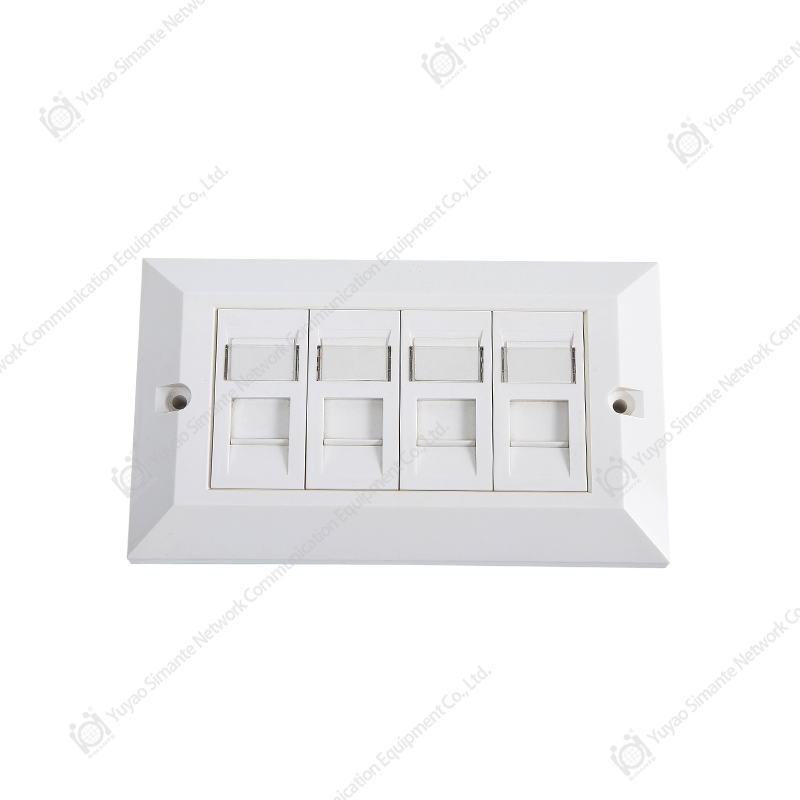
The SMT-4306-140P-4X Two Gang 45° Flat Frame UK Type Faceplate is designed for these practical requirements. It is a wall-mounted four-port faceplate intended for information and telephone modules using the Amp interface. Its two-gang UK-style format, 45-degree flat-frame configuration, concealed fixing arrangement, dust protection, and flexible module capacity make it suitable for structured cabling, office networks, commercial buildings, residential data systems, smart-home installations, and automation environments.
With capacity for up to four connectors, this faceplate provides a compact way to combine multiple communication services in a single wall location. It can support network, telephone, data, and other compatible information modules while maintaining a neat and professional finish. The product is manufactured from high-quality ABS engineering plastic and is designed to resist everyday impact, deformation, and handling stress.
For installers, system integrators, distributors, and project purchasers, the product offers a balance of installation convenience, protection, identification, packaging efficiency, and production consistency. These characteristics are particularly important when many outlets must be installed across offices, hotels, schools, apartments, factories, or data communication projects.
Product Overview
The SMT-4306-140P-4X is a two-gang, 45-degree flat-frame UK-type faceplate with four-port capacity. It is a wall-mounted front plate that accepts compatible information and telephone modules through the Amp interface. The faceplate is supplied with standard M3.5/M4 bolts and is intended to accommodate up to four connectors.
The two-gang configuration gives the installer more usable module space than a single-gang plate while retaining a clean, familiar wall-outlet appearance. The 45-degree orientation helps direct connected cables toward the installation space and can make patching more convenient in locations where cable bend management is important. The flat-frame structure also supports a modern appearance that blends into commercial and residential interiors.
| Item | Specification |
|---|---|
| Product model | SMT-4306-140P-4X |
| Product type | Two-gang 45-degree flat-frame UK-type faceplate |
| Port capacity | Up to four connectors |
| Application | Wall-mounted information and telephone module installation |
| Interface compatibility | Amp interface modules |
| Fixing hardware | Standard M3.5/M4 bolts |
| Material | High-quality ABS engineering plastic |
| Protection feature | Spring-type dust-proof doors |
| Identification feature | Front logo window and detachable logo plate |
| Environmental compliance | RoHS requirements |
| Operating temperature | -25°C to +70°C |
| Storage environment | -5°C to +30°C, relative humidity not exceeding 70% |
The product is not simply a decorative cover. It is a functional interface between the installed cabling infrastructure and the end user. Its construction addresses the needs of installation teams that require a reliable mounting platform, as well as facility managers who need clear labeling and easy access for future service work.
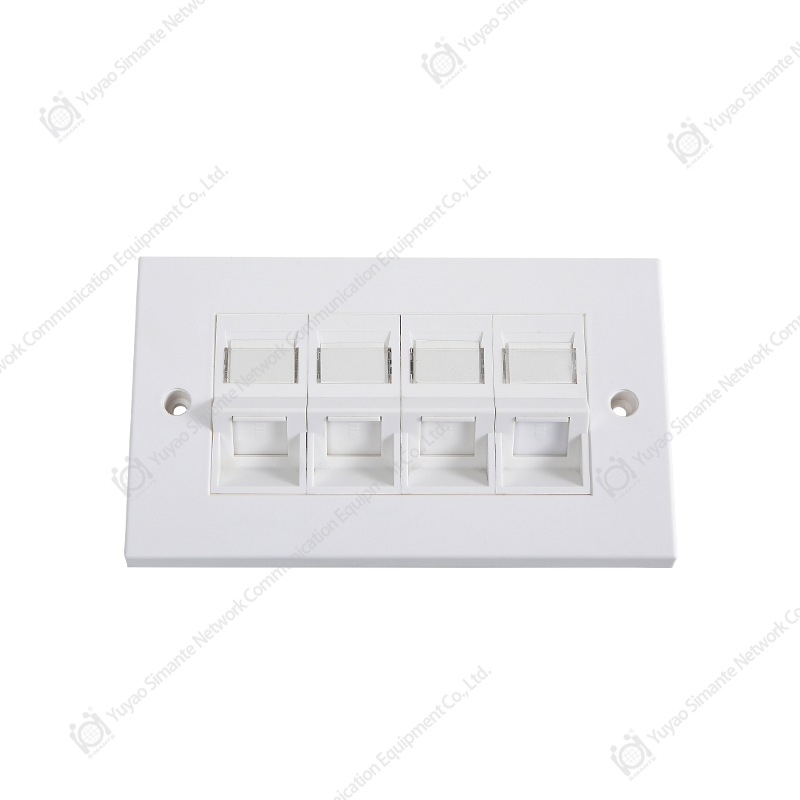
SMT-4306-140P-4X Two Gang 45°Flat Frame UK Type Faceplate
Four-Port Capacity in a Compact Wall Outlet
One of the main advantages of this faceplate is its ability to accommodate up to four connectors in a single two-gang wall position. Network requirements are becoming more diverse. A modern room may require connections for computers, wireless access points, telephones, printers, security equipment, audio-visual devices, building automation, or smart-home controllers.
Installing separate single-port or two-port outlets for each service can increase wall clutter and consume additional installation space. A four-port faceplate provides a more organized alternative. It allows several compatible modules to be grouped together while preserving a consistent outlet design.
In commercial offices, the four-port arrangement can support a combination of data and voice services at a workstation. In hotel rooms, it can provide connectivity for guest internet access, telephone services, television systems, and other low-voltage equipment. In residential applications, it can serve home offices, entertainment areas, study rooms, or central communication points.
The capacity also supports future planning. Even if only two ports are used during the initial installation, the remaining positions may be available for later expansion. This can reduce the need to open walls or replace the entire outlet when the communication requirements of the room change.
45-Degree Orientation for Practical Cable Management
The 45-degree faceplate configuration is intended to improve the practical relationship between the outlet and the connected cable. Angled module positions can help guide patch cords downward or sideways, depending on the installation orientation and surrounding wall space. This may reduce sharp cable bends and help maintain a more orderly connection area.
Cable bend management is important in structured cabling. Excessive bending, compression, or pulling can place stress on connectors and cable assemblies. A faceplate that supports a natural cable exit direction can help installers create a cleaner transition from the wall outlet to the connected device.
The angled format may also be valuable in furniture installations. Desks, cabinets, wall-mounted screens, and equipment panels can make a straight connection difficult. A 45-degree port orientation may provide additional clearance and reduce the chance that a connected plug will be forced against nearby surfaces.
Compared with a basic flat outlet that exposes all connectors in a straight-forward arrangement, the angled format offers a more considered approach to cable access. The exact benefit depends on the module and cable type used, but the design gives installers more flexibility when working within limited spaces.
Concealed Fixing for a Cleaner Finish
The faceplate uses an embedded face-frame design in which screws are not visible on the front surface. This feature improves the visual finish of the completed installation and removes exposed fixing points from the most visible part of the outlet.
Visible screws can make a wall outlet look unfinished, especially in offices, hotels, retail spaces, and modern residential interiors. They may also collect dust or become marked during cleaning. By placing the fixing arrangement behind the embedded frame, the faceplate presents a smoother and more integrated appearance.
The concealed structure is also practical for installation and service. The front frame can be installed and disassembled without requiring the installer to work around prominent external screws. This can make module replacement, inspection, and maintenance more convenient over the service life of the system.
For large projects, small installation details can have a significant effect on overall labor efficiency. A faceplate that is easy to mount, remove, and reinstall can help reduce the time required for each outlet. Across hundreds or thousands of outlets, these time savings may become meaningful for contractors and project managers.
Spring-Type Dust Protection
Each port position is equipped with a spring-type dust-proof door. The door helps reduce the entry of dust and other airborne contaminants when a port is not in use. This is particularly useful in environments where outlets may remain unused for extended periods or where construction dust, office dust, or household particles are present.
A dust-proof door also creates a more finished appearance when no cable is connected. Instead of leaving an open module position exposed, the spring mechanism returns the cover toward its closed position. This supports a cleaner wall installation and provides an additional physical barrier around the connector opening.
Dust protection can be valuable in commercial buildings, educational facilities, workshops, warehouses, and residential properties. While a faceplate is not a substitute for proper environmental protection of the connector itself, limiting unnecessary exposure can support better outlet cleanliness and easier routine maintenance.
The spring-type design is intended for repeated everyday use. Users can open the cover when connecting a cable, while the cover can move back toward its protective position after the cable is removed. This is more practical than a loose removable cap that may be misplaced during use.
Logo Window and Detachable Identification Plate
Effective port identification is essential in structured cabling. When several data, telephone, or information services are installed in the same area, clear labels help users and technicians understand the purpose of each connection. The faceplate includes a logo window on the front and a detachable logo plate for port management.
The front logo window gives the installer a designated location for identification information. Ports may be assigned according to room number, workstation number, service type, rack position, or another project-specific labeling system. This is especially useful in offices and commercial buildings where many outlets must be documented and maintained.
The detachable logo plate provides additional flexibility. Identification requirements can change when a room is renovated, a tenant changes, or a network is reorganized. A removable plate can make it possible to update labeling without replacing the complete faceplate.
Compared with an unmarked wall outlet, the inclusion of a dedicated identification area reduces ambiguity. It can help technicians trace connections, identify service faults, and perform moves, adds, and changes more efficiently. Good labeling also supports structured cabling documentation and can reduce the risk of accidental disconnection.
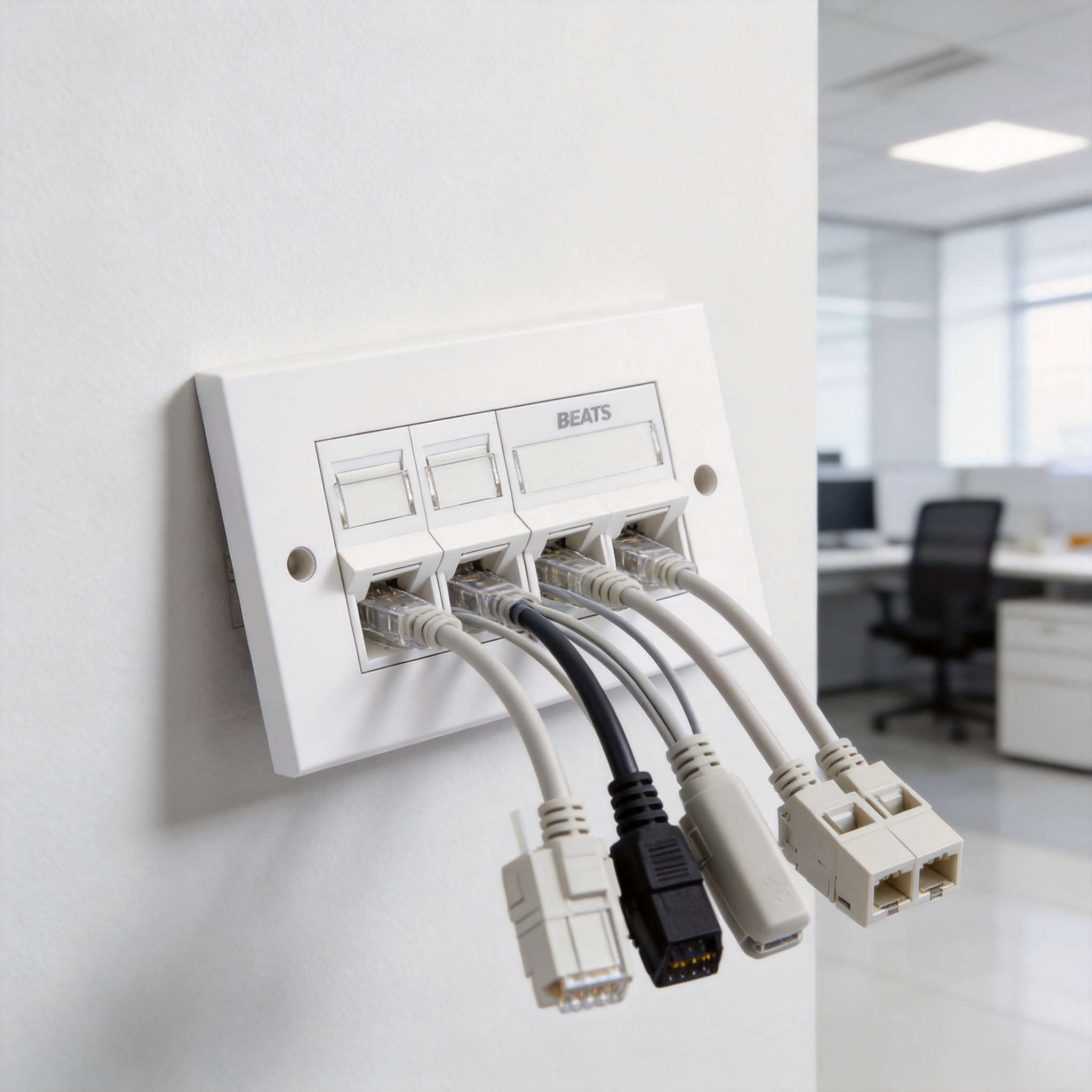
ABS Engineering Plastic Construction
The faceplate is manufactured using high-quality ABS engineering plastic. ABS is widely used for electrical and communication accessories because it can provide a useful combination of rigidity, impact resistance, processability, and dimensional stability.
The material is designed to resist everyday collision and impact. Wall outlets may be exposed to contact from furniture, equipment, cleaning tools, luggage, chairs, and routine user activity. A faceplate that is too brittle may crack around the screw area or module openings, while a faceplate that is too flexible may deform and fail to maintain a proper fit.
The use of engineering-grade ABS supports a stable housing structure. It helps the faceplate retain its shape during installation and normal service. Stable dimensions are important because the frame must align with compatible modules and the wall box or mounting location.
The plastic surface also provides a practical finish for indoor applications. It can be cleaned as part of normal building maintenance, and its light weight makes handling easier for installers compared with heavier metal assemblies. At the same time, the material gives the faceplate sufficient structural support for its intended wall-mounted use.
Material selection is only one part of product quality. Consistent molding conditions, accurate tooling, appropriate cooling, and inspection are also important. A high-quality polymer component requires controlled production to reduce problems such as warping, flash, sink marks, uneven edges, and inconsistent module fit.
Temperature and Environmental Performance
The specified operating temperature range is -25°C to +70°C. This range allows the product to be used across a wide variety of indoor and protected installation environments. It covers typical offices, homes, commercial buildings, classrooms, hotels, and many industrial spaces.
Temperature performance is relevant during transportation, installation, and normal operation. Wall outlets may be exposed to seasonal temperature changes, localized heating, or conditions near equipment rooms. The specified range gives project designers a clear reference when evaluating the product for a particular application.
The product is also designed to meet RoHS environmental requirements. Compliance with restrictions on certain hazardous substances is increasingly important for international purchasing, environmental documentation, and responsible product selection. RoHS-oriented manufacturing supports the needs of contractors, distributors, and system integrators serving regulated markets.
Environmental performance should always be considered together with the actual installation conditions. The faceplate is intended for suitable indoor or protected locations, and project engineers should verify whether additional requirements apply in environments with high humidity, corrosive chemicals, direct outdoor exposure, or unusual mechanical stress.
Installation and Maintenance Advantages
A faceplate must be easy to install correctly. The SMT-4306-140P-4X is supplied with standard M3.5/M4 bolts and is designed for straightforward wall mounting. Its embedded frame helps conceal the fixing points after installation, while the modular design allows compatible information and telephone modules to be arranged according to project needs.
Before installation, the technician should confirm the wall box dimensions, mounting position, module compatibility, cable routing, and service identification plan. The cable should be prepared according to the requirements of the selected connector or module. The module should then be installed securely, with attention given to conductor placement, strain relief, bend radius, and separation between different service types where applicable.
After the modules are fitted, the faceplate can be positioned and fixed to the mounting box using the appropriate standard bolts. The installer should avoid excessive tightening, which could damage the plastic frame or distort the assembly. The finished faceplate should sit evenly against the wall surface, with the port doors operating freely.
Maintenance is simplified by the removable front frame and detachable identification plate. If a module requires replacement, the technician can access the assembly without removing the entire wall box. If the service assignment changes, the identification information can be updated without discarding the complete plate.
These design features can provide a practical advantage over basic faceplates that require visible screws, lack labeling provisions, or provide limited access for future service work.
Applications in Structured Cabling Systems
The four-port faceplate is suitable for many structured cabling environments. Its primary role is to provide a professional endpoint for compatible copper or information modules, but the same organizational benefits apply across various communication applications.
Office and Commercial Workspaces
Workstations frequently require several connections. A single location may include data networking, voice communication, a dedicated device connection, and a spare port for future use. A four-port faceplate can consolidate these services into one organized outlet.
In open-plan offices, consistent faceplate layouts make workstation planning easier. In private offices and meeting rooms, the faceplate can support networked computers, conferencing systems, telephones, and presentation equipment. The label window can identify each port according to room or equipment function.
Hotels and Hospitality Buildings
Hotels require attractive and durable wall outlets that can withstand frequent guest use. A concealed-fixing faceplate provides a cleaner appearance, while dust-proof doors help keep unused ports covered. Multiple ports can support internet, telephone, television, and other low-voltage services within a compact installation footprint.
The detachable label feature may also support maintenance teams that need to revise room service information during refurbishment or system upgrades.
Residential and Smart-Home Installations
Residential users increasingly expect reliable wired connectivity for computers, entertainment systems, network storage, security devices, and home automation equipment. A four-port wall outlet can provide a central connection point without requiring several separate plates.
The faceplate is suitable for home offices, living rooms, media rooms, study areas, and equipment closets where a neat appearance and future expansion are important.
Education and Public Facilities
Schools, libraries, training centers, and public buildings require outlets that are easy to identify and maintain. The impact-resistant ABS construction can help the faceplate withstand routine use, while the identification area supports organized facilities management.
Industrial and Automation Environments
Protected indoor areas of factories, workshops, laboratories, and automation facilities may require multiple communication endpoints. The faceplate can provide a practical connection interface for information, telephone, monitoring, and control-related modules, subject to the environmental requirements of the specific installation.
Advantages Compared with Conventional Faceplates
Product selection should be based on the requirements of the complete installation rather than on appearance alone. In comparison with a conventional basic faceplate, this model offers several integrated functions that may improve the value of a structured cabling project.
| Feature | Basic conventional plate | SMT-4306-140P-4X benefit |
|---|---|---|
| Port capacity | Often limited to one or two positions | Supports up to four compatible connectors |
| Fixing appearance | External screws may remain visible | Embedded frame conceals screws on the surface |
| Port protection | May leave unused openings exposed | Spring-type dust-proof doors help cover unused ports |
| Identification | May require separate labels | Front logo window and detachable logo plate are integrated |
| Cable direction | Straight orientation may restrict clearance | 45-degree orientation supports practical cable routing |
| Material performance | Quality may vary by supplier | High-quality ABS engineering plastic supports impact resistance |
| Maintenance | May require more extensive disassembly | Frame and identification elements are designed for easier access |
The greatest advantage is the combination of these features. A four-port outlet alone may not provide adequate identification or protection. A dust cover alone does not solve cable management. A concealed fixing arrangement does not address future expansion. By integrating capacity, protection, labeling, and installation convenience, the product is better aligned with the needs of complete structured cabling systems.
Compared with low-cost faceplates that focus only on initial purchase price, a more functional design may offer better lifecycle value. Easier installation, clearer identification, reduced replacement needs, and improved appearance can all contribute to lower maintenance effort and a more professional final result.
Manufacturing Capability and Process Control
The manufacturer is an established producer of network cabling solutions and optical fiber products, with experience in design, development, sales, and service. Nearly two decades of industry service have supported the development of production, engineering, and quality-control capabilities for communication accessories.
Product quality begins at the design stage. A mature research and development system helps engineers consider module compatibility, frame strength, assembly requirements, user access, material behavior, and production feasibility before the product enters mass manufacture. This design-source approach is important for faceplates because small dimensional errors can affect module fit, wall alignment, and the appearance of the finished installation.
The manufacturing operation includes regular and customization production lines. This provides flexibility for standard product orders as well as customer-specific requirements. Different projects may require particular colors, packaging formats, labels, logos, module arrangements, or documentation. A production structure that supports both regular and customized work can help distributors and system integrators respond to different market needs.
The facility includes fully automatic and semi-automatic injection molding equipment, as well as automatic assembly machines. Injection molding is central to the production of ABS faceplates. Controlled molding helps form the frame, port openings, dust-door supports, label windows, and fixing structures with repeatable dimensions.
Automatic and semi-automatic equipment can reduce variation between production batches. Automation also supports consistent assembly of small components and can improve output efficiency. For a product installed in large quantities, repeatability is essential. The faceplate must maintain a consistent fit and appearance whether it is installed in a small renovation or a large commercial project.
The manufacturing organization reports an annual output of more than nine million units across its product range. Such production capacity supports stable supply for distributors, contractors, and overseas customers. It also indicates experience in material planning, production scheduling, component management, packaging, and shipment coordination.
Engineering and Technical Strength
The company has more than ten engineers and over thirty full-time technical personnel. This technical team supports product improvement, manufacturing coordination, quality control, and customer service. For communication components, engineering support is valuable because product performance depends on the relationship between mechanical design, connector compatibility, material selection, and installation practice.
Engineering personnel can help evaluate customer requirements and develop suitable adaptations for different projects. OEM and ODM capability is particularly important for distributors and system brands that need private-label products or customized product configurations.
Technical capability also supports continuous product updating. Structured cabling requirements evolve as network speeds, module formats, building systems, and installation standards change. A manufacturer with internal design and production resources can respond more effectively than a trading-only supplier that relies entirely on external factories.
Quality stability is supported when design, tooling, molding, assembly, testing, and packaging are managed within a coordinated manufacturing system. This can improve communication between departments and reduce delays when corrective action or product refinement is required.
Quality Assurance and Performance Testing
Faceplates may appear simple, but reliable quality requires attention to many details. The frame must be dimensionally accurate, the module openings must be correctly formed, the fixing points must align, and the dust doors must operate smoothly. The surface should be free from significant molding defects, and the material must provide appropriate resistance to impact and deformation.
Good performance testing can identify issues before products are shipped. Typical quality-control considerations for this type of product may include visual inspection, dimensional inspection, assembly fit, fixing strength, door operation, label retention, material appearance, and environmental suitability.
The company emphasizes performance testing to meet comprehensive customer requirements. This is important for export projects, where customers may apply their own inspection procedures or require documentation for product acceptance.
Quality control also extends to packaging. A product can be manufactured correctly but damaged during handling if it is not adequately protected. Individual blister packaging helps separate and protect the faceplate, while carton packing supports storage and transport. Labels indicating the product model and quantity help warehouse staff identify shipments quickly.
Packaging, Storage, and Logistics
The product is placed in a special blister bag and then packed in a cardboard box. Accessories are placed with the product, and a label showing the product model and quantity is applied to the upper-left area of the carton front. This packaging arrangement is intended to protect the product while making inventory recognition more efficient.
The regular packing quantity is stated as ten boxes per outer box, twenty pieces per box, and two hundred pieces per outer box. Clear quantity organization is useful for distributors and project warehouses because it simplifies counting, stock rotation, and order preparation.
Packaged products should be stored in a warehouse with an ambient temperature of -5°C to +30°C and relative humidity not exceeding 70 percent. The surrounding air should be free from acid, alkali, and other corrosive gases. Under these stated conditions, the storage period is three years.
Appropriate storage is important for ABS products and small mechanical accessories. Cartons should be protected from crushing, excessive heat, direct sunlight, moisture, and corrosive substances. Products should remain in their original packaging until installation where practical. This helps reduce surface contamination and prevents accessories or identification components from being separated from the main product.
The product use mark is based on customer-specified packaging. This supports customized labeling and packaging programs for distributors, contractors, and private-label customers. Packaging customization may help customers maintain consistent product identification across their own catalog or project supply chain.
Support for OEM and ODM Projects
Network equipment distributors and structured cabling brands often require more than a standard catalog product. They may need custom packaging, specified markings, modified colors, project quantities, or coordinated product families. The manufacturer’s OEM and ODM experience provides a foundation for these requirements.
For an OEM project, the customer may specify the packaging, label design, product identification, or sales presentation while using the established product platform. For an ODM project, the customer may participate in the definition of a new product or adaptation based on a particular market requirement.
A two-gang four-port faceplate can be incorporated into a broader family of keystone jacks, patch panels, data sockets, wall outlets, and other structured cabling components. Consistency across a product family is valuable because installers prefer compatible formats, while distributors benefit from a coherent catalog.
Customization should be evaluated at the beginning of a project. The customer and manufacturer can review technical specifications, module compatibility, artwork, packaging quantities, testing requirements, sample approval, and production schedules. Early communication helps reduce the possibility of changes after tooling or mass production has begun.
Designing a Professional Outlet Layout
A good faceplate installation depends on more than the product itself. The outlet should be positioned at a practical height and in a location that avoids furniture interference, heat sources, water exposure, and unnecessary cable tension. In offices, outlet placement should correspond with workstation layouts. In homes, the installation should consider future furniture changes and equipment upgrades.
When four ports are used, the installer should establish a logical order for the modules. For example, data ports may be grouped together, telephone services may be placed in a consistent position, and spare ports may be clearly identified. The detachable logo plate can then be used to reflect the agreed layout.
Port labeling should correspond with the patch panel, rack schedule, cable test records, and building documentation. Consistent naming reduces troubleshooting time. A label such as “Room 204 – Data 1” is more useful than an unmarked port, particularly when many outlets appear similar throughout a building.
The 45-degree orientation should also be considered when selecting cable lengths. Patch cords should be long enough to reach connected equipment without tension but not so long that they form unnecessary loops. Proper cable routing improves appearance and reduces accidental pulling.

Benefits for Contractors and System Integrators
Contractors need products that can be installed efficiently, accepted by project inspectors, and maintained after handover. This faceplate supports those objectives through its standard fixing method, concealed screw design, module capacity, and labeling provisions.
The ability to install up to four connectors in one faceplate can reduce the number of wall plates needed in areas with multiple services. Fewer separate plates may simplify wall layout and improve visual consistency. The concealed frame can also help the finished installation meet higher aesthetic expectations.
System integrators benefit from the compatibility of the faceplate with information and telephone modules using the Amp interface. They can plan the outlet around the specific modules required for the project rather than being limited to a permanently fixed connector arrangement.
Maintenance teams benefit from the identification window and detachable logo plate. When a structured cabling system is documented and labeled properly, service personnel can identify connections more quickly and reduce unnecessary disruption to other users.
For distributors, the combination of standard product availability, customization support, protective packaging, and high production capacity can make the faceplate suitable for both recurring stock programs and project-based orders.
Benefits for Building Owners and Facility Managers
Building owners typically evaluate products according to service life, appearance, maintenance effort, and adaptability. A durable faceplate can remain functional and visually acceptable through repeated use, cleaning, and equipment changes.
The ABS housing is intended to resist everyday impact and deformation. The spring dust-proof doors help keep unused openings covered, while the concealed fixing arrangement supports a neat appearance. These details contribute to the perceived quality of a building’s communication infrastructure.
Future flexibility is another important benefit. Communication requirements can change as tenants add equipment, workspaces are reorganized, or building systems become more connected. Four-port capacity provides additional room for expansion without requiring a new wall position.
Clear identification can also support asset management. Facility personnel can connect outlet labels with network records, patch-panel documentation, and maintenance histories. This can make fault isolation and system modifications more orderly.
Benefits for Distributors and International Buyers
International buyers require dependable supply, stable quality, suitable packaging, and responsive technical communication. The manufacturer’s export experience across Europe, Australia, Africa, the Middle East, and Southeast Asia demonstrates familiarity with overseas business requirements and varied market conditions.
A broad manufacturing base allows customers to source related network cabling products from one supplier. The company’s product range includes keystone jacks, patch panels, wall faceplates, data sockets, and optical fiber products. Consolidated sourcing may reduce communication complexity and help maintain consistent specifications across a project.
Production capacity is also important for large-volume orders. A manufacturer with multiple production lines and automated equipment can plan regular and customized orders with greater flexibility. Customers should still confirm lead times, sample approval, packaging artwork, inspection arrangements, and shipping schedules before placing an order.
For private-label programs, customer-specified packaging and product marking can help create a consistent market identity. The faceplate’s packaging structure can be adapted according to the agreed requirements, subject to technical review and production confirmation.
Responsible Product Selection
Responsible procurement involves considering product performance, material compliance, manufacturing capability, packaging, and long-term service. The stated RoHS compliance supports environmental and regulatory expectations for many markets. The use of recyclable or recoverable packaging materials should be evaluated according to local requirements and the customer’s sustainability policy.
Purchasers should also confirm whether the product is suitable for the intended location. The specified temperature range and storage conditions provide useful guidance, but special environments may require additional enclosure ratings or specialized materials. Outdoor, chemically exposed, wet, or high-temperature applications should be reviewed separately.
Good procurement practice includes obtaining technical drawings, confirming module compatibility, checking mounting dimensions, and reviewing samples before a large order. These steps help ensure that the faceplate integrates correctly with the project’s wall boxes, modules, and cabling system.
Recommended Inspection Points
Upon receipt, buyers or warehouse personnel can inspect the cartons for damage, verify the product model and quantity, and confirm that accessories are included. Individual faceplates should be checked for cracks, deformation, major surface defects, and correct frame alignment.
The spring-type doors should be opened and released to confirm smooth movement. The logo window and detachable logo plate should be inspected for correct fit. Compatible modules can be used to verify that the four port positions accept the intended components without excessive looseness or interference.
Before project handover, installers should check that the faceplate is level, securely mounted, properly labeled, and free from visible damage. Connected cables should have suitable bend management, and unused ports should remain protected by their dust-proof doors.
These simple checks can prevent small installation issues from becoming repeated defects across a large project. They also provide useful feedback to the supplier if a batch requires review.
Why Integrated Faceplate Design Matters
The faceplate is the point where users interact directly with the structured cabling system. Even when the hidden cable infrastructure is carefully designed, a poorly selected wall outlet can reduce the quality of the final installation. Loose modules, exposed screws, unclear labels, damaged frames, and unprotected openings can all create avoidable problems.
An integrated design addresses several of these risks together. The two-gang format provides capacity, the 45-degree orientation supports cable access, the embedded frame improves appearance, the dust doors protect unused positions, and the label system improves management. The ABS engineering plastic provides a practical housing material, while the stated temperature range and RoHS compliance support wider application requirements.
These features make the product suitable for projects where functionality and presentation must be considered together. It is not limited to a single type of building or network. Instead, it can serve as a flexible endpoint for compatible information and telephone modules in a range of structured cabling environments.
Frequently Asked Questions
What is the SMT-4306-140P-4X faceplate?
It is a two-gang, 45-degree flat-frame UK-type wall faceplate designed to hold up to four compatible information or telephone modules using the Amp interface.
How many connectors can be installed?
Up to four connectors can be installed, provided that the selected modules are compatible with the faceplate and the Amp interface format.
Is the faceplate suitable for both data and telephone services?
Yes. The product description states that it is compatible with information and telephone modules. The final combination should be selected according to the requirements of the structured cabling system.
What does the 45-degree design provide?
The angled arrangement can support more practical cable routing and provide additional clearance for connected cables in areas with limited space or nearby furniture and equipment.
Are the fixing screws visible after installation?
No. The embedded face-frame design is intended to conceal the screws from the front surface, creating a cleaner finished appearance.
Does the faceplate protect unused ports?
Yes. It includes spring-type dust-proof doors that help cover the port openings when they are not in use.
Can the ports be labeled?
Yes. The faceplate includes a front logo window and a detachable logo plate for port identification and management.
What material is used?
The faceplate is made from high-quality ABS engineering plastic, selected for its impact resistance, strength, and resistance to deformation under normal use.
What is the operating temperature range?
The specified operating temperature range is -25°C to +70°C.
Does the product meet RoHS requirements?
The product information states that its environmental requirements meet RoHS standards.
What fixing hardware is supplied?
Two standard M3.5/M4 bolts are supplied as part of the standard faceplate arrangement.
Where can the product be used?
It can be used in offices, homes, hotels, schools, commercial facilities, smart-home systems, network communication installations, and suitable indoor industrial or automation environments.
What are the storage requirements?
Packaged products should be stored at -5°C to +30°C, with relative humidity not exceeding 70 percent. The storage area should be free from acid, alkali, and other corrosive gases.
How long is the stated storage period?
The stated storage period is three years when the packaged products are stored under the recommended conditions.
Can packaging be customized?
The product information indicates customer-specified packaging is available as a product-use mark. Packaging requirements should be confirmed with the manufacturer before production.
Does the manufacturer support OEM and ODM projects?
Yes. The company states that it undertakes OEM and ODM projects and operates regular as well as customization production lines.
What should be confirmed before placing a large order?
Buyers should confirm module compatibility, mounting dimensions, product color, labeling, packaging artwork, inspection requirements, order quantity, lead time, and shipping arrangements.
Conclusion
The SMT-4306-140P-4X Two Gang 45° Flat Frame UK Type Faceplate is a practical component for organized and adaptable structured cabling installations. Its four-port capacity supports multiple communication services in one compact wall location. The 45-degree orientation can assist cable management, while the concealed fixing arrangement gives the completed installation a cleaner appearance.
Spring-type dust-proof doors help protect unused ports, and the front logo window with detachable logo plate supports effective identification and future port management. High-quality ABS engineering plastic provides a lightweight housing with resistance to collision, impact, and deformation. The stated -25°C to +70°C operating range and RoHS compliance further support its use in a broad range of suitable indoor applications.
Behind the product is a manufacturing organization with design, engineering, injection molding, automatic assembly, testing, packaging, and export capabilities. Multiple production lines, experienced technical personnel, and substantial annual output support both standard supply and customized OEM or ODM programs.
For contractors, integrators, distributors, and building owners, the product offers more than a basic wall cover. It provides a combination of capacity, protection, identification, installation convenience, and professional appearance. When matched with compatible modules and correctly installed, it can serve as a dependable endpoint for copper and information communication systems across commercial, residential, hospitality, educational, and automation environments.
References
1. Product specification information for SMT-4306-140P-4X Two Gang 45° Flat Frame UK Type Faceplate.
2. Manufacturer-provided information on ABS engineering plastic construction, dust-proof doors, labeling, temperature range, and RoHS requirements.
3. Manufacturer-provided packaging, storage, and regular packing quantity information.
4. Manufacturer-provided company profile covering network cabling products, optical fiber products, engineering resources, production lines, and OEM/ODM services.
5. General principles of structured cabling design, outlet identification, cable bend management, and telecommunications maintenance practice.
6. General environmental and material-compliance considerations for communication equipment accessories.