Español
 عربى
عربى русский
Content
- 1 Product Overview
- 2 Clean Embedded Face Frame
- 3 45-Degree Orientation and Cable Management
- 4 Spring-Loaded Dust Protection
- 5 Port Identification and Administration
- 6 ABS Engineering Plastic Construction
- 7 Environmental Performance and RoHS Compliance
- 8 Manufacturing Capabilities Behind the Product
- 9 Injection Molding and Dimensional Consistency
- 10 Assembly and Functional Testing
- 11 Advantages Over Basic Competitive Alternatives
- 12 Applications in Structured Cabling
- 13 Installation Considerations
- 14 Maintenance and Long-Term Service
- 15 Packaging, Storage, and Logistics
- 16 Customization and OEM/ODM Support
- 17 Quality and Supply Reliability
- 18 Why Manufacturer Experience Matters
- 19 Selection Guidance for Buyers
- 20 Q&A
- 20.1 What is the SMT-4310-50X(B) used for?
- 20.2 Is it a complete network outlet?
- 20.3 What is the purpose of the 45-degree design?
- 20.4 Does the adapter have visible front screws?
- 20.5 How does the dust-proof door work?
- 20.6 Can the port be labeled?
- 20.7 What material is used?
- 20.8 What temperature range is specified?
- 20.9 Does the product meet RoHS requirements?
- 20.10 Can it be used for fiber installations?
- 20.11 What are the regular packing quantities?
- 20.12 Is customized packaging available?
- 20.13 What should be checked before installation?
- 21 Conclusion
- 22 References
- 23 Product: SMT-4310-50X(B) 45°keystone Adapter
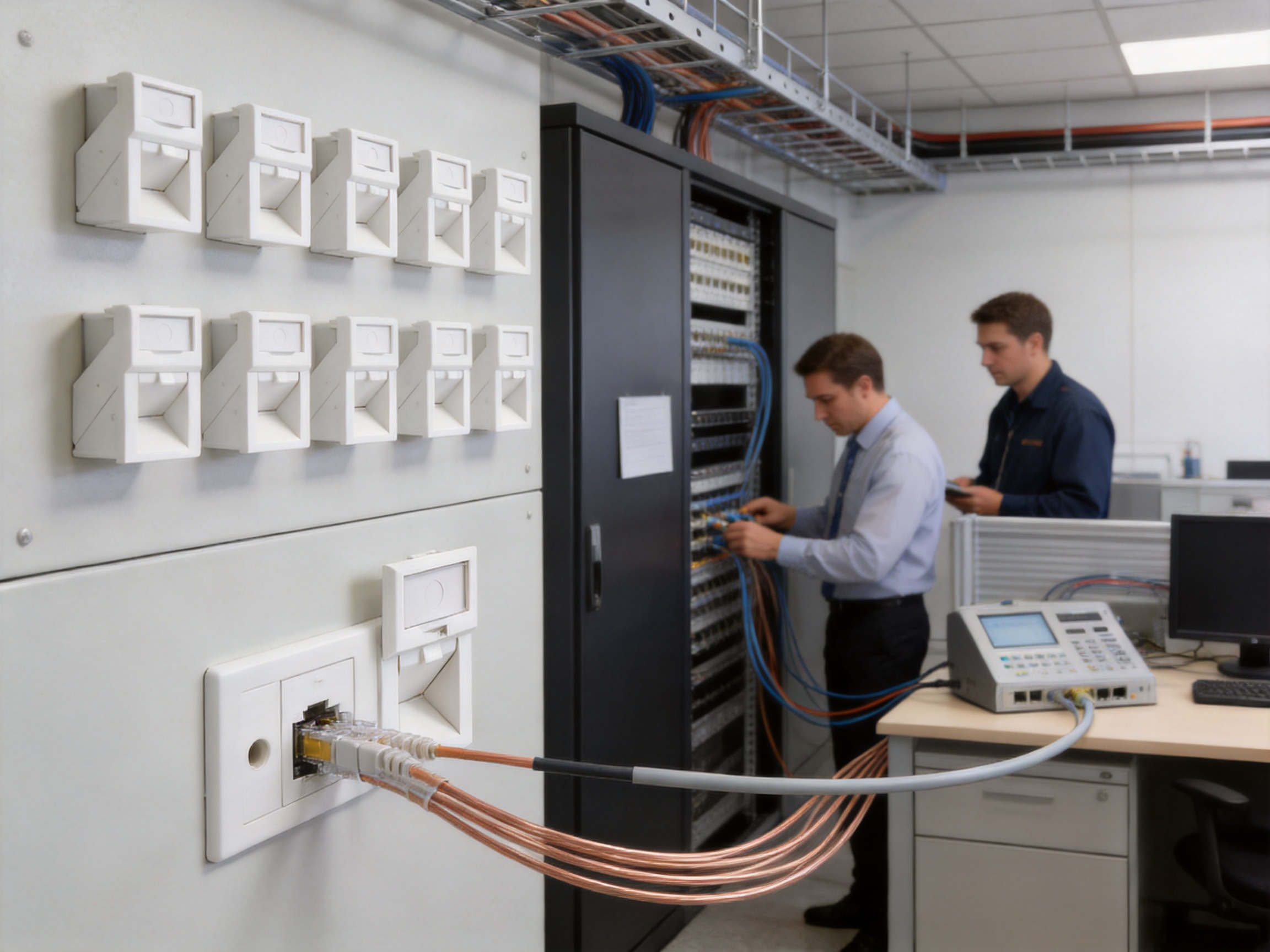
Modern structured cabling systems depend on more than cable performance alone. The quality of the faceplate, adapter, connector interface, labeling system, installation method, and long-term environmental resistance all affect how efficiently a network can be installed and maintained. A well-designed adapter must provide a secure connection point while also supporting neat cable management, clear port identification, easy servicing, and consistent appearance across an installation.
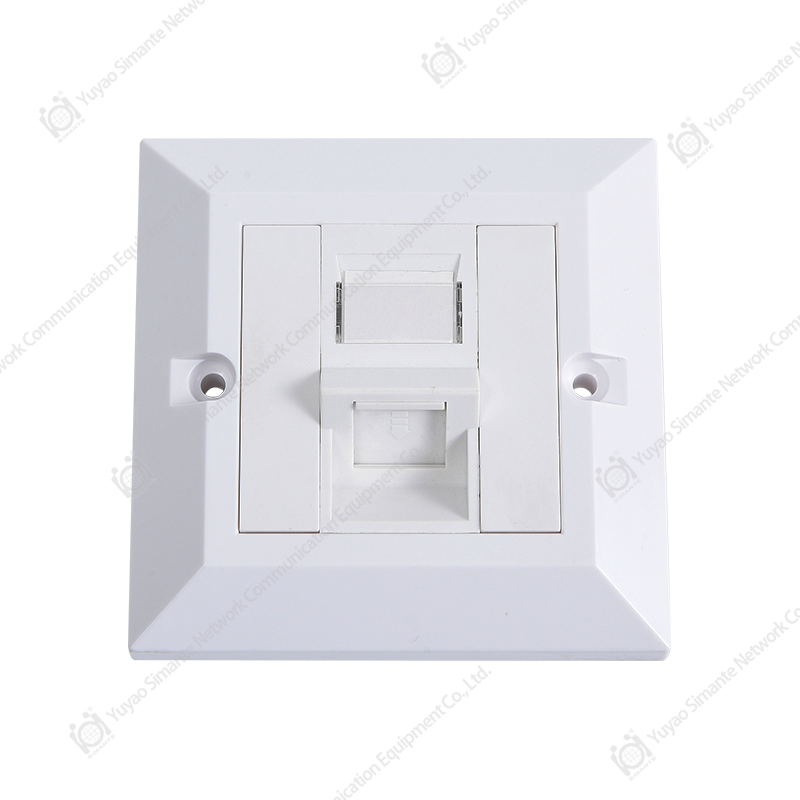
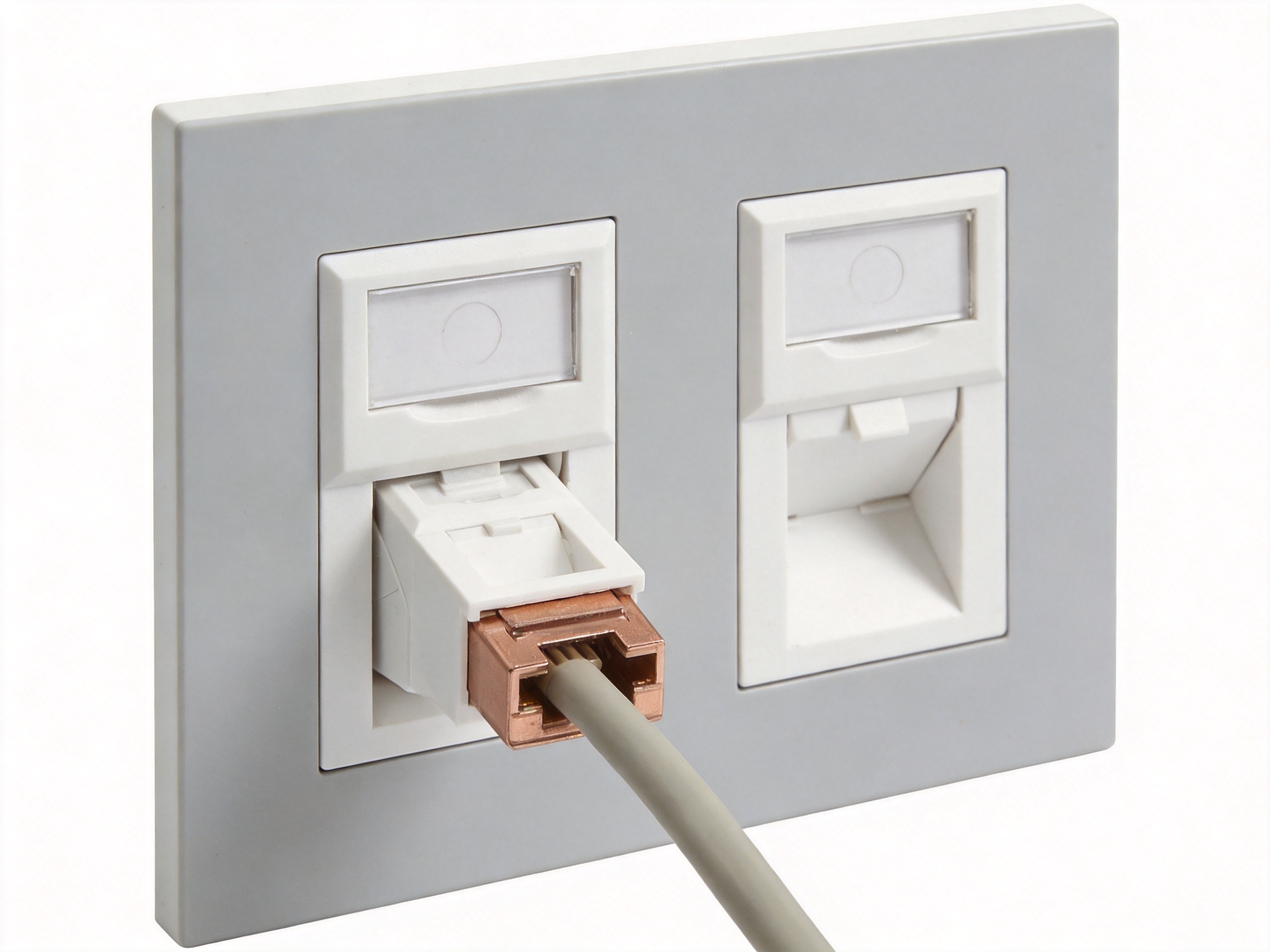
The SMT-4310-50X(B) 45° keystone adapter is designed for panel-mounted applications in copper and fiber structured cabling systems. It is intended for use with British 86/140 panels and provides a practical interface for installing compatible keystone-style modules. Its 45-degree orientation helps organize the connection area and can make patch cord routing more orderly in wall-mounted, workstation, cabinet, and equipment-room installations.
This product combines an embedded face frame, a spring-loaded dust-proof door, a front logo window, a detachable name plate, high-quality ABS engineering plastic, and a broad operating temperature range. These features address several common weaknesses found in basic adapters, including exposed screws, poor identification, limited protection against dust, fragile plastic construction, and difficult maintenance.
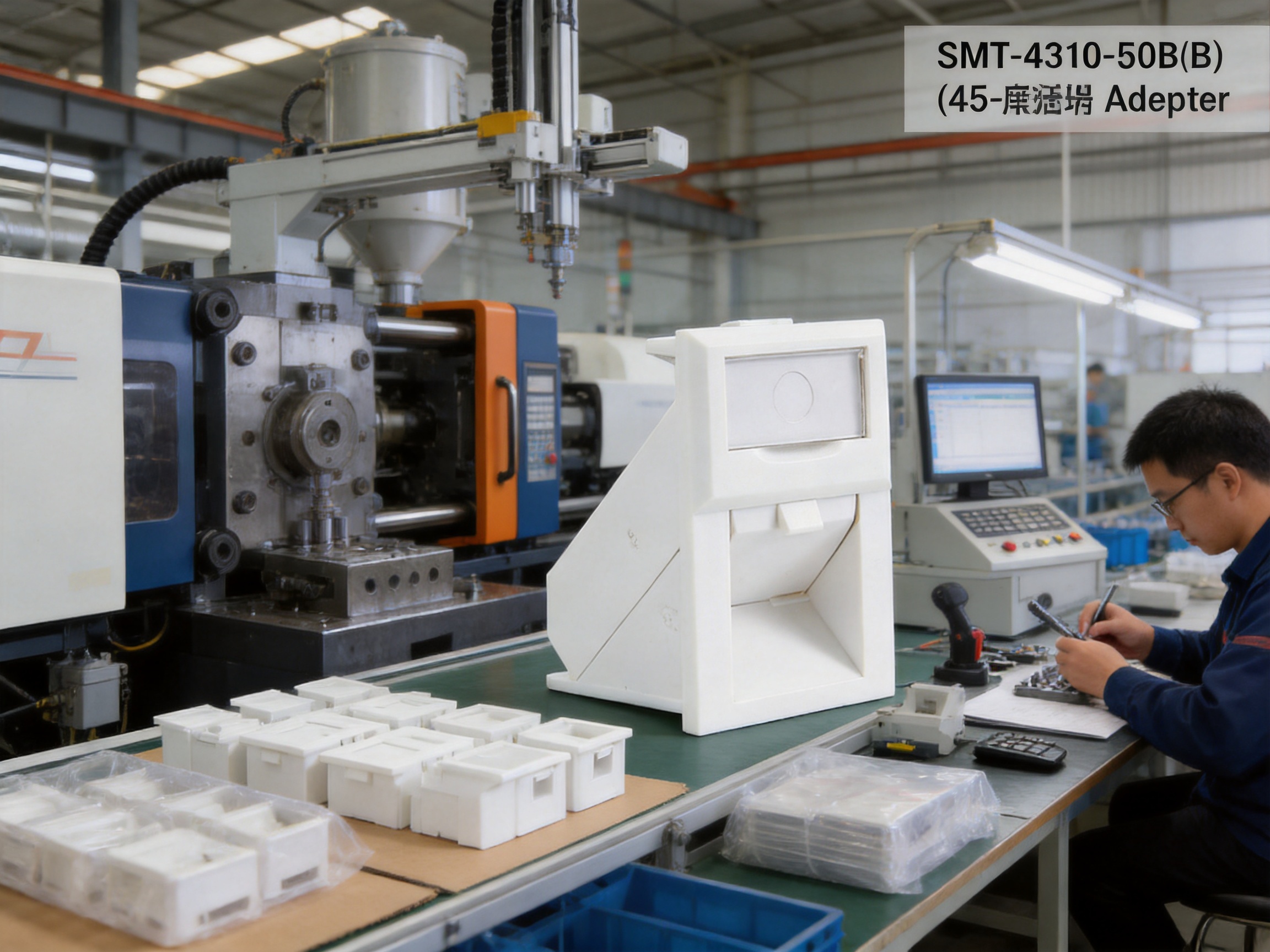
Manufactured by Yuyao Simante Network Communication Equipment Co., Ltd., the adapter is supported by an established production system for network cabling solutions and optical fiber products. The manufacturer integrates product design, development, sales, service, injection molding, assembly, performance testing, and customized production. This integrated approach helps maintain quality from initial design through final packaging.
Product Overview
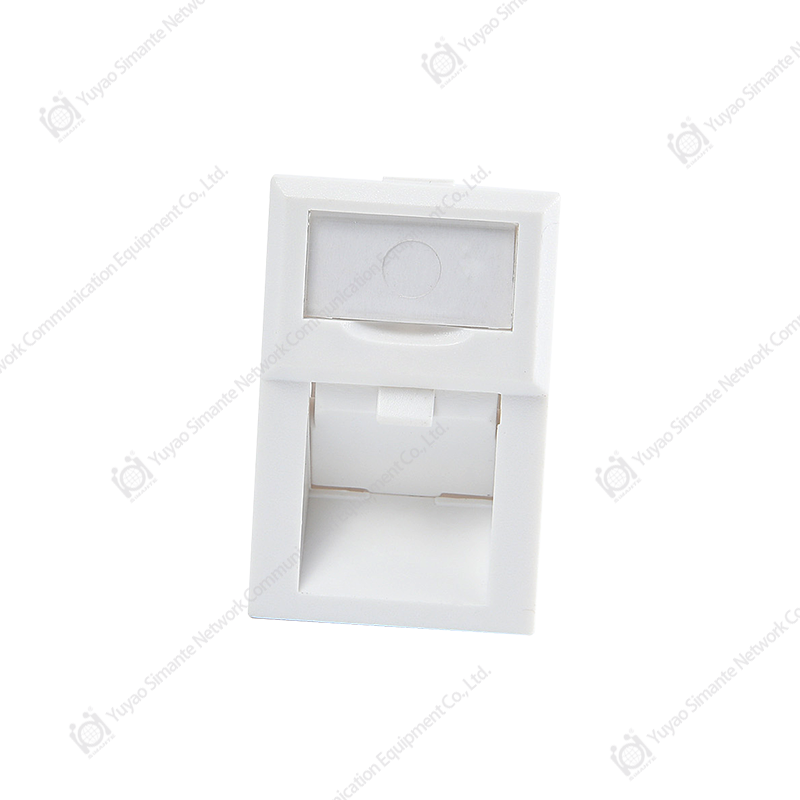
The SMT-4310-50X(B) is a 45-degree keystone adapter categorized as a faceplate component. Its primary role is to hold a compatible keystone module in a panel-mounted position. Instead of requiring a complete proprietary outlet assembly, the adapter can be used as part of a modular system in which the installer selects the appropriate copper or fiber keystone insert for the application.
The product description identifies it as a panel-mounted adapter suitable for universal British 86/140 panels. This makes it appropriate for projects that use common British-format wall boxes, faceplates, outlet frames, and related mounting structures. Before installation, system designers should confirm panel compatibility, module dimensions, orientation, and local installation requirements.
The 45-degree configuration is an important functional detail. A straight, forward-facing outlet can cause patch cords to project directly from the wall or panel. Depending on the installation environment, this may increase bending pressure, obstruct nearby outlets, or create a less organized appearance. An angled adapter redirects the connection path, helping cables leave the outlet in a more controlled direction.
This angled arrangement can be useful in office outlets, communications rooms, modular furniture, cabinets, wall-mounted network points, and other locations where cable routing space is limited. It may also make the connection area easier to view during service work, especially when multiple outlets are arranged beside one another.
| Item | Specification or Feature | Practical Benefit |
|---|---|---|
| Product model | SMT-4310-50X(B) | Provides a defined reference for ordering, installation, and replacement |
| Product type | 45° keystone adapter | Supports angled connection routing and a more organized outlet layout |
| Application | Panel-mounted installation | Suitable for structured cabling outlets and modular panels |
| Panel compatibility | Universal for British 86/140 panels | Supports common British-format panel applications when dimensions are confirmed |
| Face design | Embedded face frame | Creates a clean appearance without visible surface screws |
| Protection | Spring-loaded dust-proof door | Helps protect an unused port from dust and accidental contamination |
| Identification | Logo window and detachable name plate | Improves port identification and administration |
| Material | ABS engineering plastic | Provides impact resistance and dimensional stability for normal use |
| Environmental compliance | RoHS requirements | Supports material compliance expectations for applicable markets |
| Operating temperature | -25°C to +70°C | Allows use across a broad range of indoor and protected installation conditions |
| Standard packing | 20 pieces per box; 10 boxes per carton; 200 pieces per carton | Facilitates stock management and project shipment planning |
Clean Embedded Face Frame
One of the most visible advantages of the adapter is its embedded face-frame design. Traditional surface-mounted products may rely on exposed screws or visible fastening points. Although screws can provide a basic attachment method, they may interrupt the appearance of the finished installation, collect dirt around the mounting area, or require additional steps during removal and replacement.
The embedded frame conceals the fastening structure from the front surface. This produces a cleaner and more integrated appearance when the adapter is installed in a compatible panel. In commercial offices, hotels, educational facilities, residential developments, and public buildings, a neat outlet appearance can be an important part of the overall interior finish.
For installers, the absence of visible surface screws can also simplify visual inspection. A completed installation is easier to evaluate because the front face presents a consistent appearance. When several outlets are installed together, the uniform front surface can help the entire panel look more professional.
The embedded construction does not eliminate the need for proper installation. The panel, adapter, and compatible module should be correctly aligned, and the installer should follow the relevant mounting instructions. The benefit is that the finished front face is less visually cluttered while still allowing the product to be disassembled when service is required.
45-Degree Orientation and Cable Management
In a structured cabling system, cable routing is a practical engineering concern rather than a purely cosmetic issue. Copper patch cords and fiber patch cords have recommended bend radii. Excessive bending, twisting, pulling, or repeated side loading can affect reliability and make future maintenance more difficult.
A 45-degree outlet orientation can help guide patch cords away from the faceplate in a controlled direction. The result depends on the specific module, cord type, installation location, and surrounding equipment, but the angled interface generally provides more routing flexibility than a completely flat forward-facing arrangement.
At a workstation, the angled port may help reduce the amount of cable projecting directly into a user’s space. In a wall outlet, it can make the cable path less intrusive. In a rack or panel, it can provide a more orderly transition between the outlet and patching area. In all cases, the final design should maintain the minimum bend radius specified by the cable and connector manufacturer.
The adapter is especially useful when multiple connection points are installed side by side. Angled outlets can help separate patch cords and reduce the tendency for adjacent cables to overlap at the front of the panel. Better separation can improve visibility during troubleshooting and make port changes easier for technicians.
Compared with low-cost flat adapters, an angled model may offer a more purposeful approach to cable routing. The advantage is not simply the angle itself; it is the way the angle works together with modular installation, labeling, dust protection, and accessible service design.
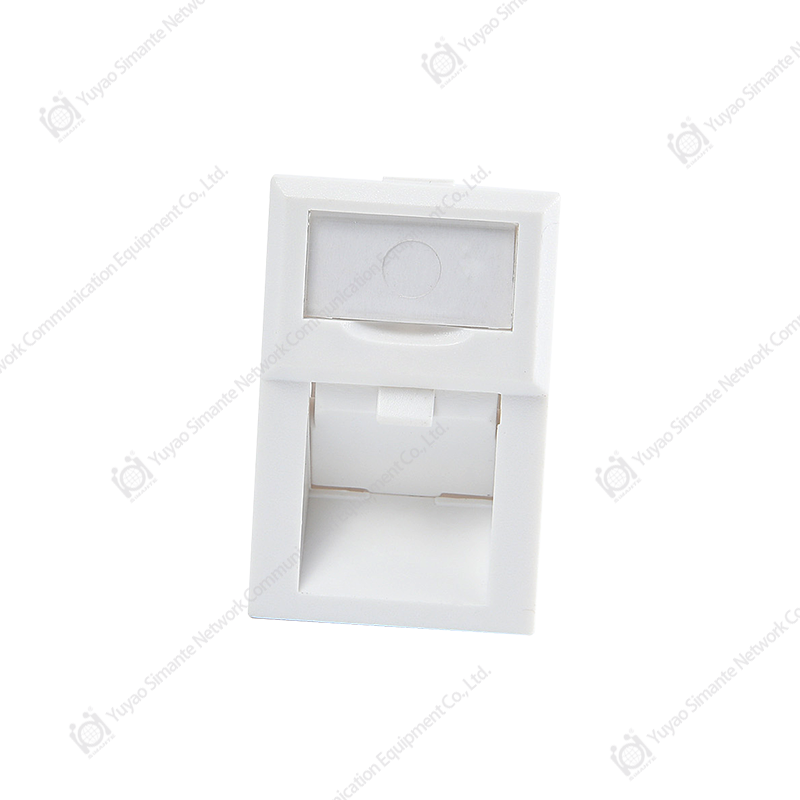
SMT-4310-50X(B) 45°keystone Adapter
Spring-Loaded Dust Protection
Unused communication ports are vulnerable to dust, fibers, airborne particles, and incidental contact. Contamination can be particularly undesirable in environments where outlets remain unused for extended periods before a network is expanded or equipment is connected. The SMT-4310-50X(B) includes a spring-loaded dust-proof door to help cover the front access area when the port is not in use.
The spring-loaded mechanism is designed to return the door toward its closed position after the connection is removed. This is more convenient than a loose removable cap, which can be misplaced during service work. A self-returning door also helps keep the outlet visually consistent when it is not connected.
Dust protection should be understood as a practical protective feature, not as a guarantee that the assembly is completely sealed against all contaminants. Installation conditions, module design, cleaning practices, and the surrounding enclosure all affect the final level of protection. Nevertheless, a door provides a useful barrier in normal indoor and protected panel applications.
The protective door also supports a more orderly appearance. Unused ports do not remain visibly open, and the front panel can maintain a consistent finish whether every position is active or only some positions are populated. This is valuable in offices, data rooms, classrooms, hospitality facilities, and other areas where network outlets may be activated in stages.
Port Identification and Administration
Network infrastructure is easier to operate when every port can be identified quickly. Without clear labeling, technicians may need to trace cables manually, interrupt users, or spend additional time testing connections. The SMT-4310-50X(B) addresses this need with a front logo window and a detachable name plate.
The logo window provides a designated area for visual identification. Depending on the project requirement, it may be used for a customer mark, outlet designation, system reference, or other approved identification method. Because the window is integrated into the front design, the marking can be positioned consistently across a group of outlets.
The detachable name plate provides additional flexibility for port management. Network layouts often change over time. A work area may be reassigned, a switch port may be reorganized, or a building management system may introduce new identification conventions. A removable name plate allows information to be updated without replacing the entire faceplate.
This feature can reduce administrative cost over the life of the installation. The physical adapter remains in place while the label is revised. It also supports staged construction, in which outlets are installed before their final users, room numbers, rack positions, or service assignments have been confirmed.
Clear identification is especially valuable when many connections are installed in one location. It can support structured labeling schemes based on floor, room, cabinet, panel, outlet, and port number. The adapter itself does not replace a complete documentation system, but it provides a practical physical point for applying that system.
ABS Engineering Plastic Construction
The product uses high-quality ABS engineering plastic. Acrylonitrile butadiene styrene is widely used for communication accessories because it can provide a useful balance of rigidity, impact resistance, processability, and appearance. For a faceplate component, the material must retain its shape while also tolerating routine handling during installation and maintenance.
The stated material benefits include resistance to collision and impact, together with resistance to deformation. These properties are important because faceplates can be exposed to accidental knocks, pressure from patch cords, repeated servicing, and handling during transportation. A brittle or poorly molded component may crack, warp, or fail to hold a module securely.
Material selection is only one part of product performance. The quality of the finished component also depends on mold design, injection parameters, material control, cooling, dimensional inspection, and assembly accuracy. The manufacturer’s investment in injection molding and automated assembly equipment supports consistent production of these details.
ABS also allows the adapter to achieve a professional surface finish suitable for visible installation areas. A consistent appearance is valuable in projects where multiple faceplates must match. The final result depends on production control, storage, installation, cleaning, and exposure to environmental conditions.
Installers should avoid using excessive force, sharp tools, incompatible cleaning chemicals, or mounting hardware that is not intended for the panel. Proper handling helps preserve the faceplate, the protective door, and the identification area throughout the service life of the installation.
Environmental Performance and RoHS Compliance
The adapter is specified to meet RoHS requirements. Restrictions on hazardous substances are an important consideration for electrical and electronic products supplied into many international markets. Compliance supports responsible material selection and helps customers align their structured cabling projects with applicable procurement and environmental policies.
The stated operating temperature range is -25°C to +70°C. This broad range gives the product flexibility for indoor, utility, equipment-room, and other protected applications where temperatures may vary significantly. It is important to distinguish operating temperature from storage temperature. The product information specifies a separate storage environment, and customers should apply the appropriate conditions for warehousing.
The recommended storage conditions are an ambient temperature from -5°C to +30°C, relative humidity no higher than 70 percent, and an atmosphere free from acid, alkali, and other corrosive gases. These requirements help protect the plastic component, packaging, labels, and associated accessories during storage.
The stated storage period is three years under the specified conditions. Products should remain in their original packaging where practical, and cartons should be protected from crushing, moisture, direct contamination, and corrosive environments. Good stock rotation practices are recommended for all communication accessories.
Environmental performance does not mean the faceplate is intended for unrestricted outdoor exposure, immersion, chemical processing areas, or extreme industrial environments. Project engineers should review the complete installation environment and select suitable enclosures and protection levels where required.
Manufacturing Capabilities Behind the Product
The manufacturer is a professional supplier of network cabling solutions and optical fiber products, with capabilities spanning design, development, sales, and service. This type of vertical integration can provide important advantages for a modular product such as a keystone adapter because the appearance, dimensions, materials, assembly details, and packaging must work together.
The company reports nearly 20 years of service in the field. Long-term participation in network communication equipment gives a manufacturer the opportunity to understand recurring installation problems, customer expectations, product compatibility concerns, and regional market requirements. This experience can contribute to more practical product improvements than design work performed without direct exposure to installation conditions.
The company has more than 10 engineers and over 30 full-time technical personnel. An engineering and technical team of this kind can support product development, mold design, production engineering, quality control, testing, customization, and technical communication. For buyers, technical depth is particularly valuable when a project involves nonstandard labeling, packaging, product combinations, or OEM and ODM requirements.
The reported production resources include 10 regular and customization production lines, 10 fully automatic injection molding machines, 20 semi-automatic injection molding machines, and eight types of automatic installation machines. These resources indicate the ability to support both repeat production and customized orders while maintaining a stable manufacturing workflow.
The company reports an annual output of more than nine million units. Production scale can benefit customers through better material planning, established process control, improved equipment utilization, and greater capacity for project orders. Large output alone does not guarantee quality, but when combined with engineering oversight and performance testing, it can help support dependable supply.
Injection Molding and Dimensional Consistency
Injection molding is central to the production of ABS faceplate components. The process begins with material preparation and mold setup, followed by controlled injection, pressure holding, cooling, ejection, inspection, and subsequent assembly. Each stage affects the final dimensions, surface finish, strength, and fit of the adapter.
For a keystone adapter, dimensional accuracy is essential. The opening must accept the intended module, the face must align with the panel, the mounting features must engage correctly, and the dust door must operate without excessive friction or looseness. Small inconsistencies can lead to difficult installation, uneven appearance, or unreliable retention.
Automated and semi-automated injection equipment allows production to be matched to order volume and product complexity. Automated equipment can provide repeatability for regular production, while semi-automatic lines can offer flexibility for product variations, assembly requirements, and customized orders.
Quality control should include visual inspection, dimensional checks, material and appearance evaluation, and functional testing of moving or assembled parts. For the adapter, relevant checks may include faceplate alignment, opening dimensions, door movement, label fit, surface defects, and resistance to normal handling.
Effective process control also reduces common molding problems such as warping, sink marks, short shots, flash, color inconsistency, and stress cracking. A disciplined production environment helps ensure that the adapter not only looks consistent but also performs consistently during installation.
Assembly and Functional Testing
The adapter includes multiple functional elements rather than being a simple molded plate. The embedded face frame, dust-proof door, logo window, detachable name plate, and module opening must work together. Assembly accuracy is therefore important to the final customer experience.
Automatic installation machines can improve repeatability during high-volume assembly. Consistent assembly helps control the position of the dust door, the engagement of the name plate, and the overall appearance of the front surface. It can also reduce variation between production batches.
Functional testing may include opening and closing the protective door, checking that the door returns correctly, confirming that the name plate can be installed and removed, and verifying that the adapter accepts the compatible keystone module. Testing should also confirm that no sharp edges, loose parts, or visible assembly defects are present.
For projects requiring customized packaging or private labeling, process control is equally important. Product model, quantity, customer identification, accessory configuration, carton labeling, and documentation must be coordinated. An experienced manufacturer can integrate these requirements into a controlled order process.
Performance testing is described as part of the company’s quality approach. The purpose of testing is to identify deviations before shipment and to provide customers with greater confidence in product stability. Buyers with specific requirements should communicate applicable inspection standards, sampling plans, test reports, and acceptance criteria before production begins.
Advantages Over Basic Competitive Alternatives
Many competing faceplate adapters provide only the basic function of holding a keystone module. A basic adapter may be inexpensive, but it may lack features that influence installation quality and long-term service. The SMT-4310-50X(B) differentiates itself by combining several practical functions in one panel-mounted component.
First, the embedded face frame provides a cleaner front appearance than products with exposed screws. This can be an advantage in visible installations where a professional finish matters. It also reduces visual clutter across a multi-port panel.
Second, the 45-degree orientation can improve patch cord routing compared with a flat forward-facing adapter. The benefit is particularly relevant where space is limited or where several cords must be managed in parallel.
Third, the spring-loaded dust-proof door provides automatic coverage for an unused opening. Basic open adapters may leave ports exposed, while loose removable covers can be misplaced. A built-in return mechanism offers greater convenience during routine operation.
Fourth, the integrated logo window and detachable name plate support more effective port management. A plain adapter may require separate labels or adhesive markings that can be difficult to replace neatly. A dedicated identification area is more suitable for organized cabling documentation.
Fifth, ABS engineering plastic with stated impact and deformation resistance can provide a more durable alternative to fragile low-grade plastic. This is valuable during transportation, installation, and repeated maintenance.
Sixth, the product is designed for British 86/140 panel applications, making it a practical choice for projects that require compatibility with this format. Buyers should still verify the exact panel and module dimensions, but the stated compatibility provides a clear starting point for project selection.
| Evaluation Area | Basic Open Adapter | SMT-4310-50X(B) Advantage |
|---|---|---|
| Front appearance | May show screws or uneven fastening points | Embedded face frame creates a cleaner visible surface |
| Connection direction | Usually straight and forward-facing | 45° orientation supports more controlled cord routing |
| Unused port protection | Opening may remain exposed | Spring-loaded dust-proof door returns toward the closed position |
| Port labeling | May rely on separate adhesive labels | Logo window and detachable name plate support organized identification |
| Material expectations | May vary significantly by supplier | Uses high-quality ABS engineering plastic |
| Panel application | Compatibility may be limited or unclear | Specified for universal British 86/140 panels |
| Serviceability | Simple but may require replacement when labels change | Detachable identification plate supports updates without replacing the adapter |
| Supply support | May be limited to standard production | Manufacturer reports regular and customization production lines |
Applications in Structured Cabling
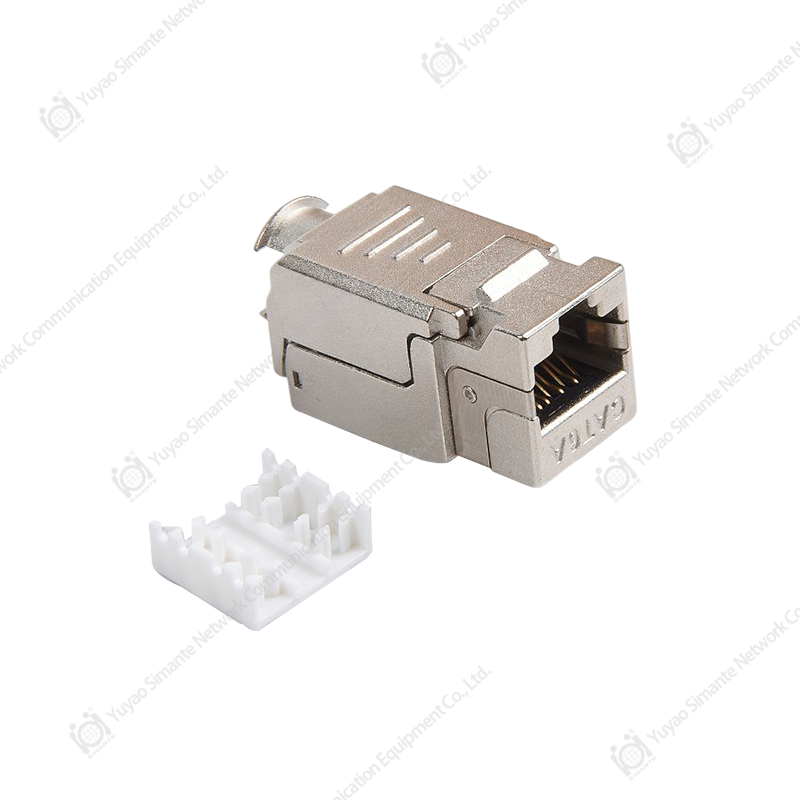
The adapter can be used in copper structured cabling systems when paired with an appropriate copper keystone module. Typical modules may include data, telephone, or other compatible communication interfaces, subject to the module manufacturer’s specifications and the requirements of the installation.
In fiber systems, the adapter may be used with a compatible fiber keystone insert where the design and dimensions are suitable. Fiber installations require special attention to bend radius, connector cleanliness, polarity, insertion loss, and protection from dust. The adapter’s protective door can be useful for keeping an unused interface covered, but it does not replace proper fiber cleaning and inspection procedures.
Office workstations are a common application. A 45-degree outlet can help route a patch cord toward the desk or cable management channel instead of directly outward. The label area can identify the workstation or service, while the embedded design supports a clean interior finish.
Educational buildings can benefit from consistent outlet identification because classrooms and laboratories often contain multiple network points. A detachable name plate allows labels to be changed when rooms are reassigned or equipment layouts are updated.
Hotels, hospitals, and commercial buildings may require a large number of standardized outlets. In these environments, consistent appearance, clear labeling, dust protection, and reliable supply are all important. A manufacturer with large-scale production and customization capabilities can support project-specific packaging and identification requirements.
Residential structured cabling and smart-home installations may also use modular faceplates. The adapter can support a neat appearance in living areas while allowing installers to select different compatible modules as technology needs change.
Equipment rooms and communication cabinets may use the adapter in modular panels or distribution areas. The angled orientation can help with patch cord organization, although rack-level applications should always consider airflow, cable bend radius, port density, and the overall patching architecture.
Installation Considerations
Before installation, confirm that the faceplate or panel is designed for the British 86/140 format and that the selected keystone module is mechanically compatible. Review the module manufacturer’s dimensions and retention requirements. A universal panel description does not remove the need for project-level verification.
Inspect the adapter and panel for damage before assembly. Check that the dust-proof door moves freely, the name plate is present, and the front surface is free from defects that could affect the finished appearance. Damaged components should be separated for evaluation before they are installed.
Prepare the cable according to the requirements of the selected module. For copper modules, preserve pair geometry as required and avoid unnecessary untwisting. For fiber modules, protect connectors from dust and maintain the recommended bend radius. The adapter holds the module; it does not replace correct termination technique.
Route the cable so that it is not forced sharply behind the panel. The 45-degree angle can assist routing, but the installer remains responsible for maintaining cable limits. Avoid excessive tension on the module or adapter, particularly where patch cords are frequently connected and disconnected.
After the module is installed, check the alignment of the faceplate and ensure that the embedded frame is seated correctly. Operate the dust-proof door and verify that it returns smoothly. Attach the label or name plate using the project’s approved identification convention.
Finally, test the completed link using the appropriate copper or fiber test equipment. Confirm continuity, performance, polarity, and labeling accuracy before handover. A visually neat outlet is valuable, but it must also be part of a correctly tested and documented link.
Maintenance and Long-Term Service
Routine maintenance should begin with visual inspection. Check for cracked plastic, loose modules, damaged labels, obstructed dust doors, or signs of excessive mechanical stress. Early identification of these issues can prevent more significant service problems.
Keep the front surface clean using a soft, dry, lint-free cloth or a cleaning method approved for ABS plastic. Avoid abrasive materials, strong solvents, and aggressive chemicals that may dull the surface, remove printed identification, or damage the plastic.
When a port is not in use, allow the spring-loaded door to remain closed. Do not force the door beyond its normal range of movement. If the door does not return correctly, inspect the area for debris or mechanical interference and replace the component if necessary.
Labels should be reviewed as part of network documentation maintenance. If a room, workstation, cabinet, or service assignment changes, update the detachable name plate and the corresponding digital or paper records. Physical and electronic records should match.
During modifications, use suitable patch cords and avoid pulling on the adapter itself. Disconnect cables by holding the connector housing rather than the cable. This reduces stress on both the connector and the faceplate module.
A modular adapter can simplify future upgrades. The faceplate may remain in service while the keystone insert is changed to support a different connection type, provided the replacement module is compatible. This can reduce disruption and avoid unnecessary replacement of the entire outlet assembly.
Packaging, Storage, and Logistics
Packaging is an important part of product quality because faceplate components can be scratched, bent, or contaminated before they reach the installation site. The product is placed in a special blister bag and then packed in a cardboard box. Accessories are placed together with the product, and the carton is labeled with the product model and quantity.
The specified regular packing quantity is 20 pieces per box, 10 boxes per carton, and 200 pieces per carton. This arrangement supports project planning, warehouse counting, and shipment consolidation. Purchasing teams can use the carton quantity to estimate order quantities and reduce partial-carton handling.
Cartons should be stored in a warehouse with an ambient temperature from -5°C to +30°C and relative humidity not exceeding 70 percent. The surrounding air should be free from acid, alkali, and other corrosive gases. Storage areas should also protect the cartons from water, heavy loads, direct contamination, and impact.
Stock should be managed using a sensible rotation system. Older cartons should normally be issued first, provided that packaging remains intact and products have been stored under suitable conditions. The stated storage period is three years under the specified environmental conditions.
Customer-specified packaging is available as a product-use note. This may be relevant to distributors, OEM customers, regional project suppliers, and contractors that require particular carton markings, branding arrangements, accessory combinations, or packing quantities. Custom requirements should be agreed before production and confirmed in the order documentation.
Customization and OEM/ODM Support
Structured cabling projects are not always identical. Customers may require customized labels, packaging, color coordination, accessory combinations, product identification, or specific delivery arrangements. The manufacturer reports support for OEM and ODM projects, which can be valuable for distributors and system suppliers that want a product aligned with their own market presentation.
Customization should be managed through a documented process. The customer and manufacturer should confirm drawings, materials, labeling content, printing methods, packaging artwork, inspection standards, order quantities, and approval samples. Clear documentation helps avoid misunderstandings during mass production.
For the SMT-4310-50X(B), customization may involve the identification area or packaging rather than changing the fundamental mechanical design. Any modification that affects panel compatibility, module retention, dust-door movement, or structural strength should be reviewed by qualified engineers before approval.
OEM and ODM cooperation can also support product family consistency. A customer may need several faceplate types, keystone modules, patch panels, or fiber accessories with matching materials and appearance. A manufacturer experienced in both copper and fiber structured cabling components can help coordinate these product groups.
Quality and Supply Reliability
For contractors and distributors, supply reliability is closely connected to project performance. A delayed or inconsistent faceplate shipment can prevent final installation even when cable and active network equipment are already available. Manufacturing capacity, equipment resources, technical personnel, and established packaging procedures all contribute to supply planning.
The manufacturer reports stable annual output above nine million units and maintains regular as well as customized production lines. This capacity can help support standard replenishment orders and larger project requirements. Buyers should still confirm lead times, order quantities, production schedules, and inspection arrangements for each purchase.
Quality should be evaluated at several stages. Incoming materials should meet the approved requirements. Molding should maintain dimensions and appearance. Assembly should ensure that doors, labels, and module openings function correctly. Finished products should be packed to prevent damage. Documentation should identify the model and quantity accurately.
Customers with strict procurement systems may request samples, inspection reports, factory audits, quality agreements, or pre-shipment checks. These procedures can be incorporated into the purchase process to align the product with project expectations.
The manufacturer’s stated focus on high-end market requirements suggests an emphasis on performance testing and production management. In practical terms, this is important because a faceplate is a small component that must still meet mechanical, visual, environmental, and logistical requirements consistently.
Why Manufacturer Experience Matters
A faceplate adapter may appear simple, but producing a reliable product requires coordination between industrial design, plastics engineering, tooling, assembly, inspection, packaging, and customer support. A manufacturer with experience across these areas is better positioned to identify problems before they affect field installations.
Nearly two decades of industry service can also help a company respond to changes in network technology. Structured cabling continues to evolve, with increasing demand for higher data rates, fiber connectivity, modular outlets, smart-home integration, and compact installation solutions. A mature research and development system supports ongoing product updates.
The company’s technical staff provides another potential advantage. Engineers and full-time technical personnel can communicate with customers about drawings, compatibility, product selection, test requirements, and customization. This is particularly useful for international projects where installation formats and documentation expectations may differ.
Manufacturing integration may shorten communication paths. Instead of coordinating separately with a designer, molding supplier, assembly contractor, and packaging company, a customer can work with one organization responsible for the broader product process. This can make revisions easier to control and reduce the risk of inconsistent specifications.
Selection Guidance for Buyers
When selecting the SMT-4310-50X(B), buyers should begin by identifying the panel standard and confirming that the installation uses a compatible British 86/140 structure. They should then select the keystone module according to the required copper or fiber service, transmission performance, connector type, and termination method.
The physical environment should also be evaluated. The stated operating range is suitable for a broad range of normal indoor and protected applications, but special environments may require additional protection. Exposure to water, corrosive chemicals, direct sunlight, extreme dust, or heavy mechanical impact should be considered during product selection.
Project teams should determine whether port labeling, logo identification, or customer-specified packaging is required. These details should be finalized before production if the order includes customization. For larger projects, sample approval is recommended to confirm appearance, fit, color, label position, and module compatibility.
Purchasers should also consider total installation value rather than unit price alone. A low-cost adapter may create additional labor through difficult routing, unclear labeling, replacement of lost covers, or inconsistent appearance. The SMT-4310-50X(B) combines several service-oriented features that may reduce these indirect costs.
Inventory planners should use the standard packing quantities when preparing purchase orders. If a project needs a quantity that does not align with the standard carton, the supplier should confirm the available packing arrangement and any associated customer-specific requirements.
Q&A
What is the SMT-4310-50X(B) used for?
The SMT-4310-50X(B) is a 45-degree keystone adapter for panel-mounted structured cabling applications. It is designed for use with compatible keystone modules and British 86/140 panels.
Is it a complete network outlet?
It is an adapter or faceplate component rather than a complete active network outlet. A compatible copper or fiber keystone module must be selected and installed according to the requirements of the cabling system.
What is the purpose of the 45-degree design?
The angled design helps direct patch cords away from the outlet in a more controlled direction. This can improve cable organization and reduce congestion in locations where a straight forward-facing connection would be inconvenient.
Does the adapter have visible front screws?
The product uses an embedded face-frame design in which screws are not visible on the surface. This supports a cleaner finished appearance and helps create a more uniform panel layout.
How does the dust-proof door work?
The adapter is equipped with a spring-loaded door that covers the port area when it is not in use. After the connection is removed, the door is designed to return toward its closed position.
Can the port be labeled?
Yes. The front includes a logo window for identification and a detachable name plate for port management. The label system can support room, workstation, cabinet, outlet, or service identification.
What material is used?
The adapter is made from high-quality ABS engineering plastic. The stated material characteristics include resistance to collision and impact and reduced risk of deformation during normal use.
What temperature range is specified?
The specified operating temperature range is -25°C to +70°C. Storage requirements are separate and specify -5°C to +30°C, relative humidity of no more than 70 percent, and an atmosphere without corrosive gases.
Does the product meet RoHS requirements?
The product information states that it meets RoHS requirements. Customers with project-specific compliance procedures should request the documentation required by their procurement or regulatory process.
Can it be used for fiber installations?
It can be considered for fiber applications when paired with a compatible fiber keystone module and installed in a suitable panel. Fiber-specific requirements, including connector cleanliness, polarity, bend radius, and performance testing, must still be followed.
What are the regular packing quantities?
The stated regular packing arrangement is 20 pieces per box, 10 boxes per carton, and 200 pieces per carton.
Is customized packaging available?
The product information notes customer-specified packaging. The manufacturer also reports OEM and ODM project support. Packaging artwork, labels, quantities, and accessory arrangements should be confirmed before production.
What should be checked before installation?
Confirm panel compatibility, keystone module dimensions, outlet orientation, cable bend radius, labeling requirements, and the condition of the adapter. After installation, verify door operation, module retention, link performance, and documentation accuracy.
Conclusion
The SMT-4310-50X(B) 45° keystone adapter is designed to provide more than a basic module-holding function. Its angled orientation supports controlled cable routing, while the embedded face frame creates a cleaner installation without visible surface screws. The spring-loaded dust-proof door helps protect unused ports, and the logo window and detachable name plate make port identification and future administration more practical.
Its ABS engineering plastic construction, stated RoHS compliance, and operating temperature range of -25°C to +70°C support use in a broad selection of indoor and protected structured cabling environments. Compatibility with British 86/140 panels makes it suitable for projects based on that format, subject to confirmation of the exact panel and module dimensions.
The product is further supported by a manufacturer with reported experience in network cabling and optical fiber products, a dedicated engineering and technical team, multiple injection molding and assembly resources, regular and customized production lines, and an annual output of more than nine million units. These capabilities can help customers obtain consistent products, project support, customized packaging, and OEM or ODM cooperation.
For installers, distributors, system integrators, and project designers, the adapter offers a balanced combination of appearance, cable management, protection, identification, material performance, and manufacturing support. When correctly matched with the panel, keystone module, cable, and environmental conditions, it can contribute to a neat, maintainable, and professional structured cabling installation.
References
1. Product specification information for the SMT-4310-50X(B) 45° keystone adapter, including product features, environmental requirements, packaging, and storage conditions.
2. General principles of structured cabling design, installation, labeling, administration, testing, and maintenance.
3. General engineering information concerning ABS plastics, injection molding, dimensional control, and molded component quality.
4. General RoHS material-compliance principles for electrical and electronic products.
5. Manufacturer information concerning network cabling solutions, optical fiber products, engineering personnel, production equipment, OEM services, ODM services, and manufacturing capacity.