Español
 عربى
عربى русский
Content
- 1 1. The Role of a Category 6 Keystone Jack in Structured Cabling
- 2 2. Core Product Overview
- 3 3. Transmission Performance and Category 6 Compatibility
- 4 4. Mechanical Design and Installation Efficiency
- 5 5. Materials and Surface Treatment
- 6 6. Advantages Compared with Basic or Poorly Optimized Keystone Jacks
- 7 7. Manufacturing Capabilities Behind the Product
- 8 8. OEM, ODM, and Customization Support
- 9 9. Installation Recommendations
- 10 10. Applications
- 11 11. Packaging, Storage, and Supply Planning
- 12 12. Why Manufacturing Scale Matters to Buyers
- 13 13. Quality, Compliance, and Project Documentation
- 14 14. Q&A
- 14.1 Q1: What type of product is the SMT-1013H8C6(B)?
- 14.2 Q2: Does the jack support both T568A and T568B?
- 14.3 Q3: What cable conductor sizes are supported?
- 14.4 Q4: Can this jack be used with Category 5e cable?
- 14.5 Q5: What is the operating frequency range?
- 14.6 Q6: How does the contact arrangement help reduce crosstalk?
- 14.7 Q7: How durable is the RJ45 interface?
- 14.8 Q8: How many times can the IDC terminals be terminated?
- 14.9 Q9: What materials are used in the jack?
- 14.10 Q10: Is the product suitable for outdoor installation?
- 14.11 Q11: What standards and environmental requirements are identified?
- 14.12 Q12: Can the manufacturer provide customized packaging?
- 14.13 Q13: What is the standard packing quantity?
- 14.14 Q14: How should the product be stored?
- 14.15 Q15: Who can benefit from this product?
- 15 15. Selecting the Product for a Complete Cabling Solution
- 16 Conclusion
- 17 References
- 18 Product: SMT-1013H8C6(B) 90 Degree Cat6 Keystone Jack 110 Idc
Modern communication networks depend on thousands of small connection points working together with consistency. Although a keystone jack is compact compared with a patch panel, switch, or server, its electrical design, mechanical structure, materials, and termination quality directly influence the performance of an entire structured cabling system. The SMT-1013H8C6(B) 90-degree Cat6 Keystone Jack with 110 IDC termination is designed for dependable horizontal cabling and work-area connectivity in commercial buildings, residential projects, data communication environments, and other low-voltage network installations.
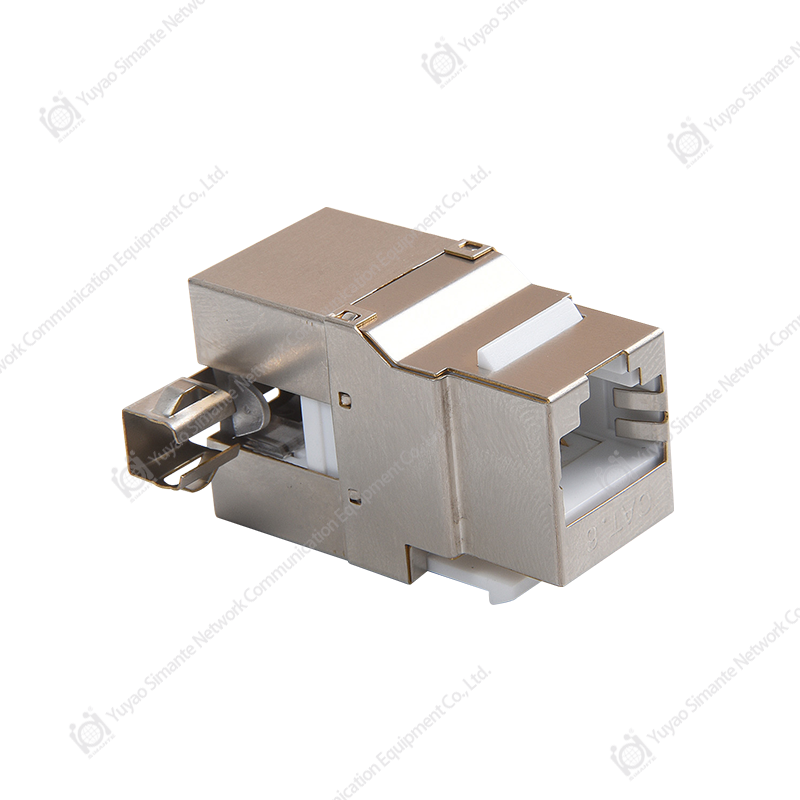
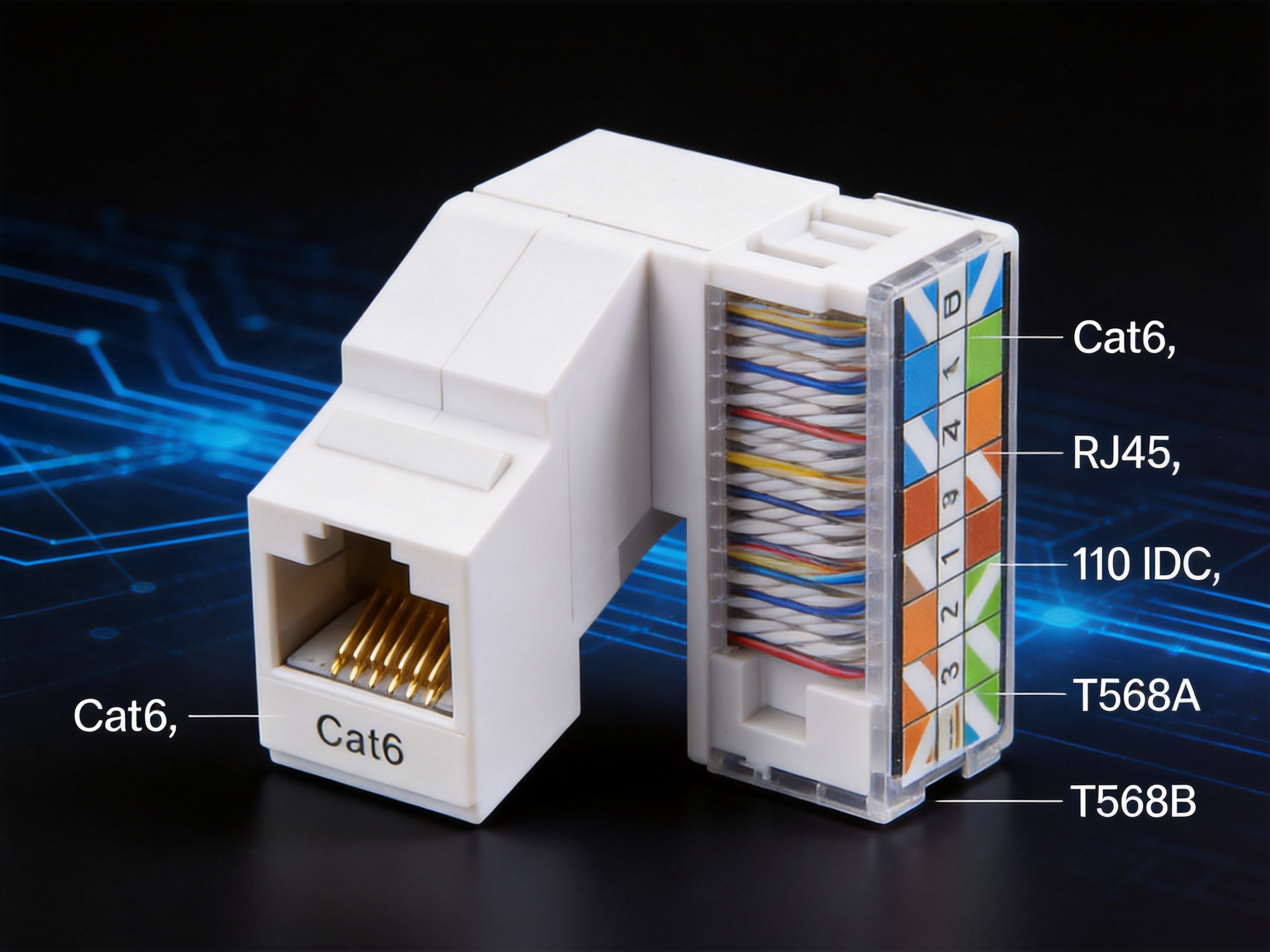
This product is engineered to meet Category 6 transmission requirements over a frequency range of 1 to 250 MHz. It supports both T568A and T568B wiring sequences, incorporates a compact embedded structure, and uses a 90-degree termination arrangement that can simplify installation where space or cable routing is limited. Its RJ45 interface connects with standard patch cords and equipment, while its 110-style IDC termination provides a stable connection to horizontal twisted-pair cabling.
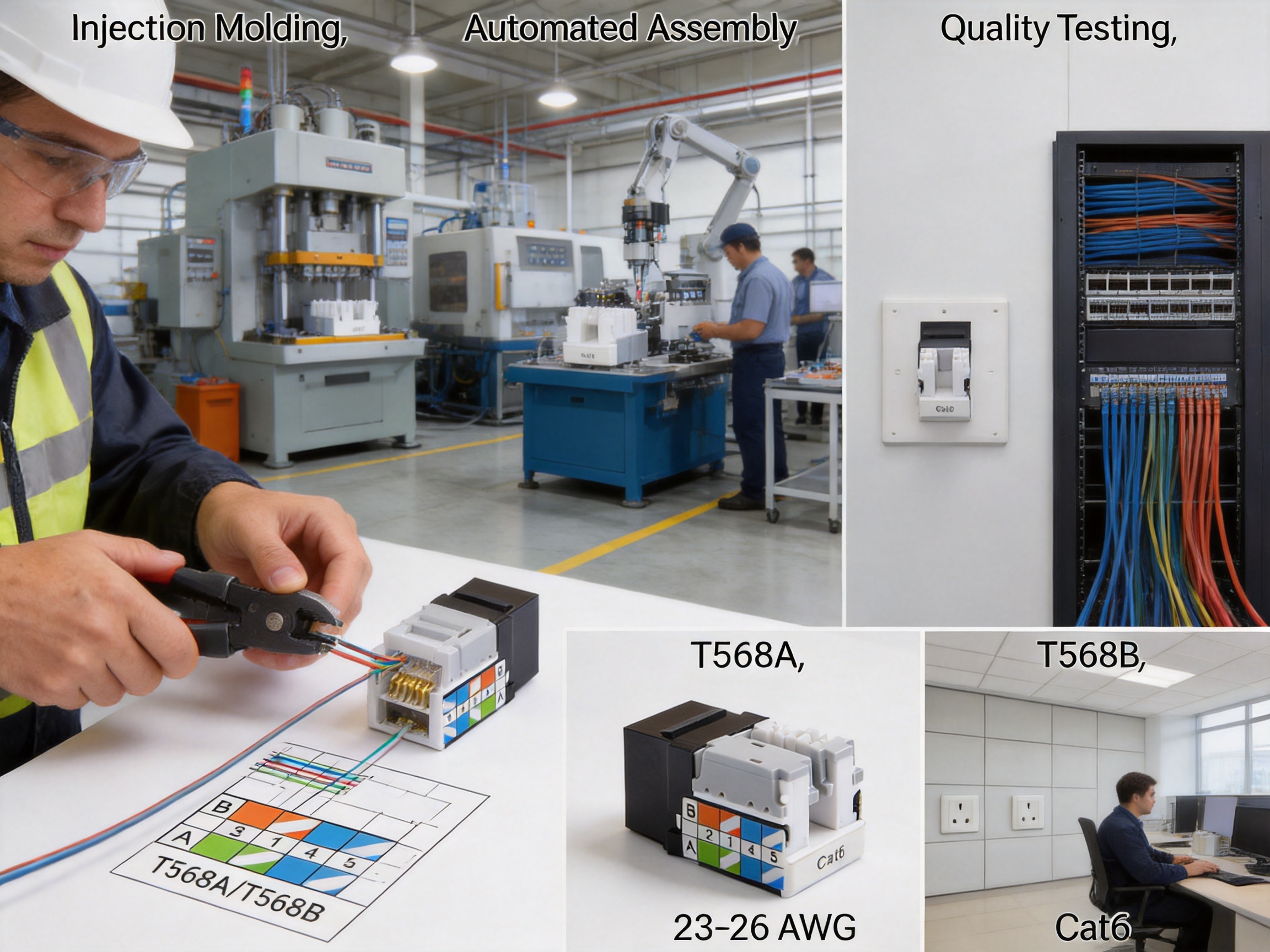
The SMT-1013H8C6(B) is manufactured by Yuyao Simante Network Communication Equipment Co., Ltd., a Chinese manufacturer specializing in network cabling solutions and optical fiber products. The company combines product design, development, sales, service, injection molding, automated assembly, testing, and OEM/ODM support. This vertically coordinated manufacturing capability helps ensure that the product is not merely designed to satisfy a specification, but is also produced with repeatable dimensions, stable materials, and controlled assembly quality.
1. The Role of a Category 6 Keystone Jack in Structured Cabling
A keystone jack forms the transition point between permanent horizontal cabling and a user-facing connection. In a typical structured cabling system, solid copper twisted-pair cable runs through walls, ceilings, floors, or conduits from a telecommunications room to a work area. The cable is terminated at a patch panel, consolidation point, wall plate, or other outlet. The keystone jack is the modular interface that converts the permanent cable into an accessible RJ45 connection.
This connection must perform several functions at the same time. It must accept a standard modular plug, maintain the correct contact geometry, preserve pair separation, support reliable IDC termination, resist mechanical movement, and maintain the electrical balance required for high-frequency data transmission. A poorly designed jack can introduce contact resistance, impedance discontinuity, return loss, insertion loss, or crosstalk that reduces network margin.
Category 6 systems are particularly sensitive to installation quality because they operate at higher frequencies than older Category 5 and Category 5e systems. A suitable Category 6 keystone jack therefore needs more than a convenient housing. It requires carefully arranged contacts, reliable pair management, suitable insulation materials, controlled conductor termination, and repeatable manufacturing tolerances.
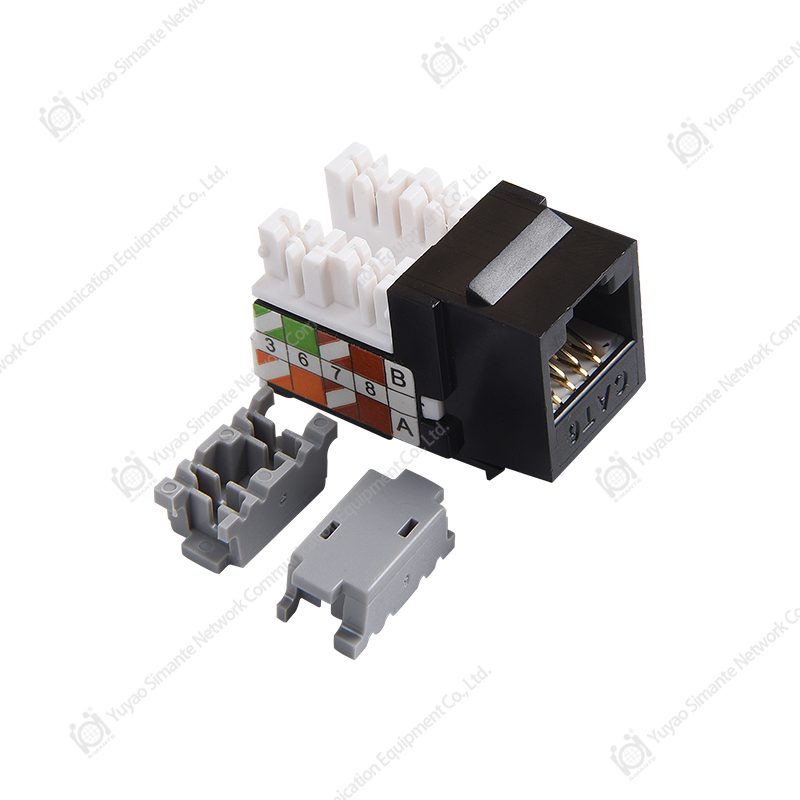
The SMT-1013H8C6(B) addresses these requirements through a combination of a high-frequency RJ45 interface, 110 IDC termination, high-low contact dislocation technology, a compact design, and a clearly marked universal wiring label. These features are intended to make the jack both electrically capable and practical for installers.
2. Core Product Overview
The SMT-1013H8C6(B) is a 90-degree Cat6 Keystone Jack designed for use in modular communication outlets and distribution systems. It is compatible with Category 6 transmission requirements and can also be used in systems based on Category 5e and lower categories when the overall installation is designed accordingly. This backward compatibility makes it useful for replacement, renovation, and mixed-system projects where not every existing cable or component is upgraded at the same time.
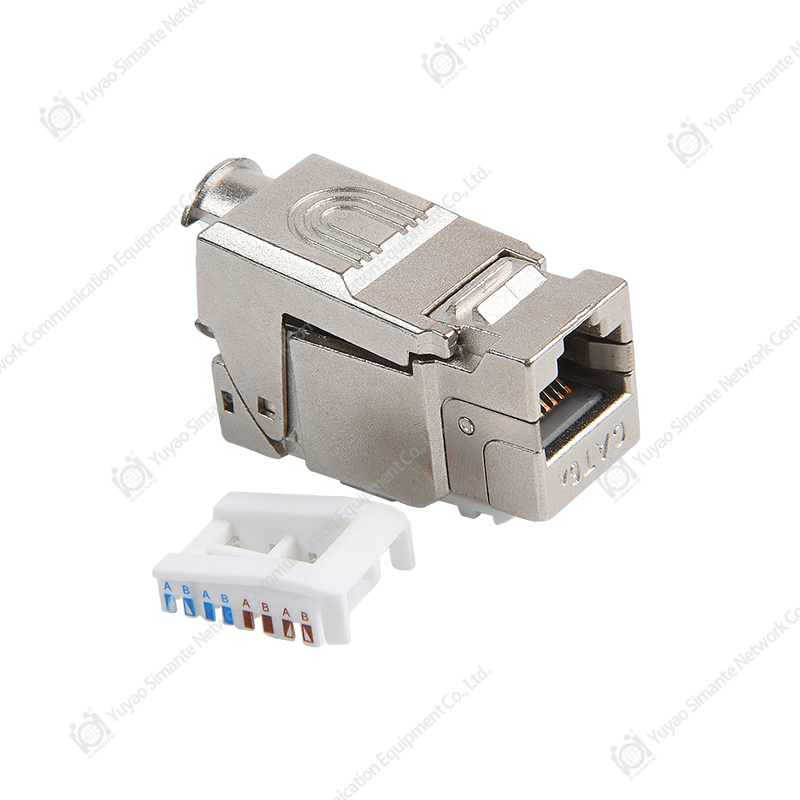
The jack follows both T568A and T568B line sequences. The two wiring schemes are clearly identified on the module card, allowing technicians to select the required termination standard without relying on external references during every installation. Clear labeling can reduce wiring mistakes, improve work speed, and make future maintenance easier.
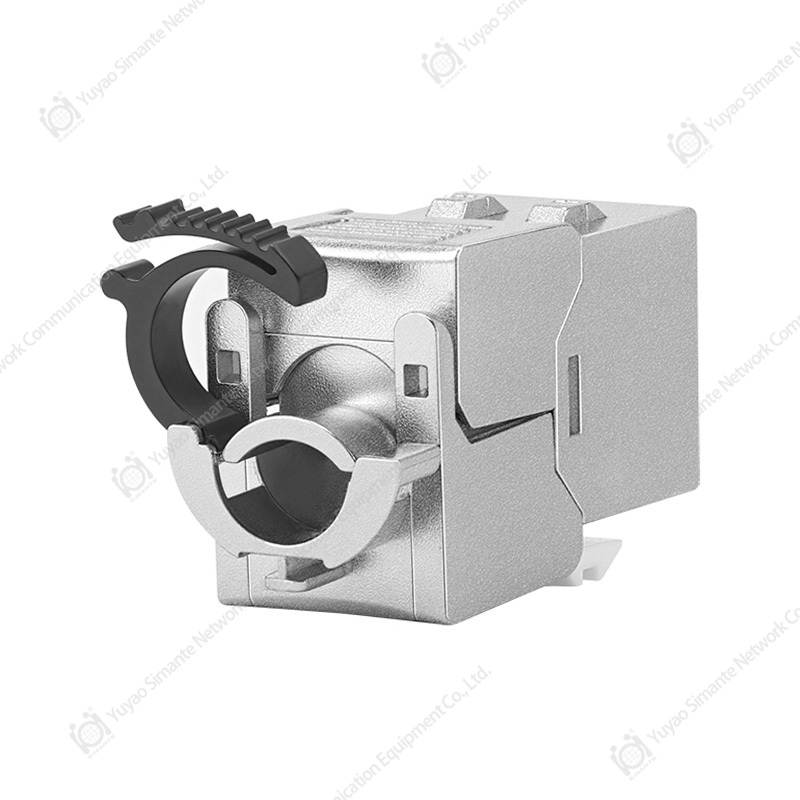
The 90-degree configuration is intended to provide a practical cable entry and termination orientation. Compared with a straight termination arrangement, a right-angle layout can help manage cable bend direction and reduce congestion behind a wall plate, surface box, patch enclosure, or modular distribution frame. The exact benefit depends on the enclosure and installation geometry, but the orientation is especially useful where the cable must turn immediately after entering the module.
The product uses an RJ45 jack for the front connection and a horizontal 110-style IDC termination at the rear. The IDC portion is designed for 23 to 26 AWG twisted-pair conductors. This range covers common horizontal copper cables used in structured cabling systems and supports practical field termination with compatible punch-down tools.
Product Specification Summary
| Item | Specification |
|---|---|
| Product model | SMT-1013H8C6(B) |
| Product type | 90-degree Category 6 Keystone Jack |
| Front interface | RJ45 jack |
| Rear termination | 110-style IDC with horizontal wiring |
| Wiring standards | T568A and T568B |
| Frequency range | 1 to 250 MHz |
| Working voltage | 125 V |
| Withstand voltage | DC 1000 V or AC 750 V for one minute without breakdown or arcing |
| Insulation resistance | At least 100 MΩ initially and after constant damp heat testing |
| Compatible conductor size | 23 to 26 AWG twisted pair |
| Plug insertion and removal durability | 750 cycles |
| IDC termination durability | 250 wire terminations |
| Operating temperature | -25°C to +70°C |
| Plastic material | PC polycarbonate |
| PCB material | FR4 |
| Metal contact material | Phosphor bronze with gold or nickel plating according to contact position |
| Applicable general specification | YD/T 926.1-2009 |
| Applicable sub-standard | YD/T 926.3-2009 |
3. Transmission Performance and Category 6 Compatibility
The specified operating frequency range is 1 to 250 MHz, which corresponds to the transmission bandwidth associated with Category 6 channel and permanent-link applications. Frequency range alone does not guarantee network performance; the cable, patch cords, plugs, patch panels, installation practices, and test configuration must all be compatible. Nevertheless, the jack is designed as a Category 6 component and provides the electrical foundation required for a properly engineered Category 6 system.
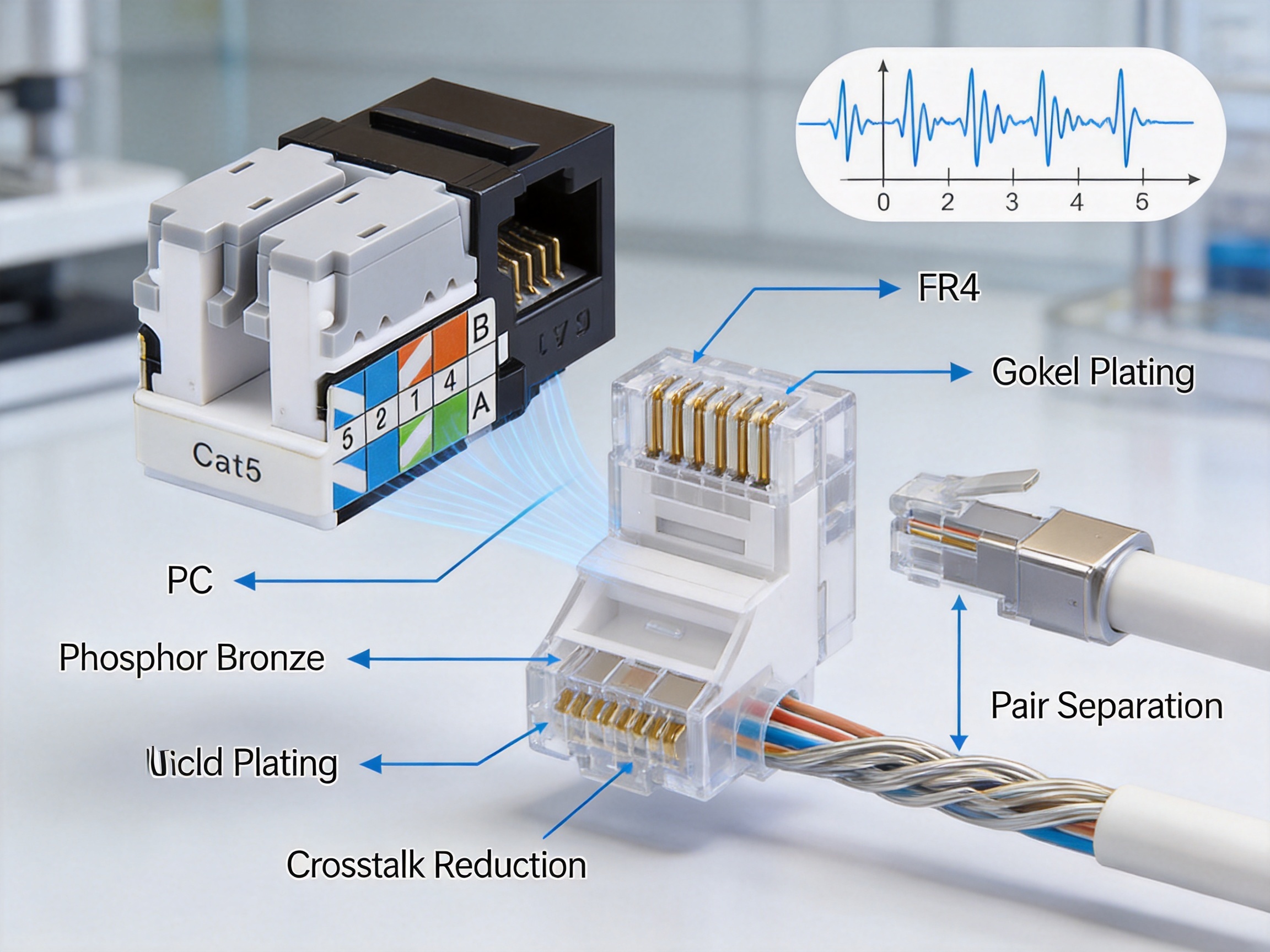
One important design feature is the high-low dislocation arrangement of the contact pins. Contact geometry has a direct effect on near-end crosstalk, commonly abbreviated as NEXT. Crosstalk occurs when the signal traveling through one pair induces unwanted energy in another pair. If crosstalk is excessive, the receiver may have less signal-to-noise margin, particularly at higher data rates and longer channel lengths.
By arranging contact pins with controlled high-low displacement, the product is designed to reduce the coupling effect between adjacent contacts. This does not eliminate the need for correct cable preparation, pair untwisting control, and proper installation. It does, however, provide a more favorable electrical structure than a basic, poorly separated contact layout.
The module’s internal construction also helps maintain a consistent path between the horizontal cable and the RJ45 plug. The connection path should preserve pair identification and reduce unnecessary disturbance to the twisted conductors. When the installer terminates the cable according to the marked T568A or T568B sequence and maintains the cable manufacturer’s recommended pair geometry, the jack can contribute to a stable Category 6 link.
The product’s insulation resistance is specified at a minimum of 100 MΩ in its initial condition and after constant damp heat testing. High insulation resistance helps reduce leakage between conductive elements and supports dependable operation under normal low-voltage communication conditions. The specified withstand voltage of DC 1000 V, or AC 750 V, for one minute without breakdown or arcing provides an additional electrical safety and robustness criterion for the component.
Backward Compatibility Without Unnecessary System Complexity
Many network projects are upgraded in stages. A customer may initially install Category 6 outlets while reusing some Category 5e patch cords, existing wall plates, or earlier distribution hardware. The SMT-1013H8C6(B) offers backward compatibility with Category 5e and lower-category systems, allowing it to serve as a practical replacement or upgrade component.
Backward compatibility does not mean that an older cable becomes a Category 6 channel. The final performance remains limited by the lowest-performing component and by the installation method. The advantage is that the jack can be incorporated into a broader migration plan without requiring every component to be replaced immediately. This reduces unnecessary material waste and helps contractors standardize the physical outlet design across different project phases.
For distributors and system integrators, compatibility also simplifies inventory. A single modular jack family can support multiple customer applications, provided that the complete channel is designed and tested appropriately. This can reduce the need to stock separate products for every legacy and current installation environment.
SMT-1013H8C6(B) 90 Degree Cat6 Keystone Jack 110 Idc
4. Mechanical Design and Installation Efficiency
Installation efficiency is a major consideration in structured cabling. A component that performs well electrically but is difficult to terminate can increase labor time and create more opportunities for errors. The SMT-1013H8C6(B) uses a compact embedded design intended for installation in modular distribution frames, wall outlets, faceplates, and other compatible mounting environments.
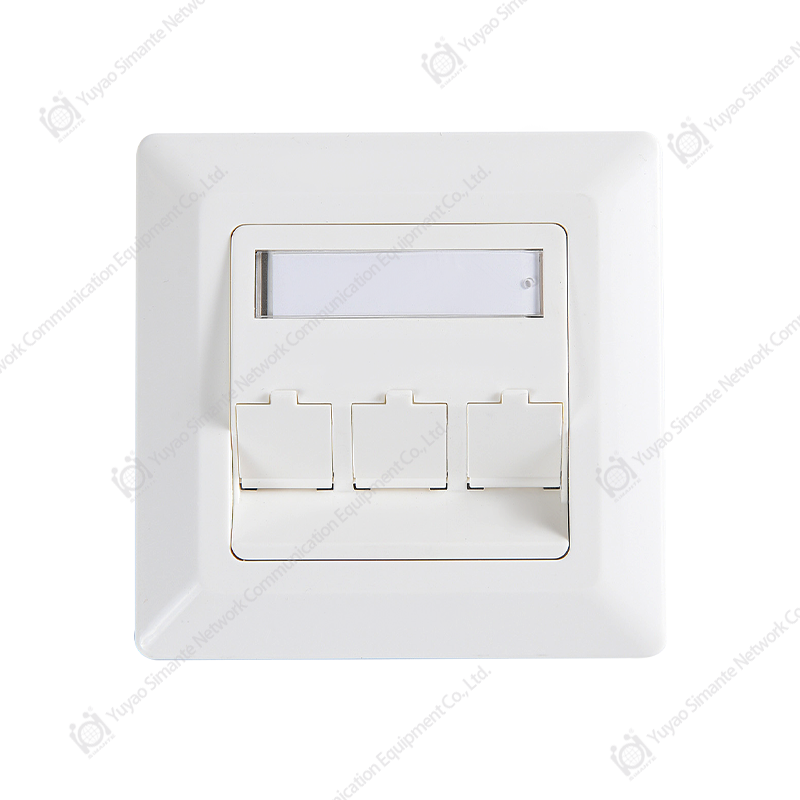
The compact housing allows the jack to be integrated into a modular frame without occupying excessive space. This is particularly useful in high-density installations where multiple ports must be positioned in a limited enclosure. A modular approach also allows damaged or obsolete modules to be replaced individually rather than requiring the entire panel or outlet assembly to be discarded.
The 90-degree orientation supports organized cable routing. Horizontal cable entering from behind or below an outlet can be directed into the IDC area without excessive twisting. Good routing helps preserve the natural geometry of the twisted pairs and can reduce strain on the termination. It also makes it easier to keep the finished cable within the bend-radius recommendations of the cable manufacturer.
The jack is designed for 23 to 26 AWG twisted-pair conductors. These conductors should be prepared carefully before termination. The installer should remove only the amount of jacket necessary, maintain pair twists as close as practical to the IDC contacts, avoid sharply bending the conductors, and ensure that each conductor is fully seated in its assigned slot. The marked wiring diagram helps the installer work consistently under field conditions.
RJ45 Interface Reliability
The front RJ45 interface is the user-accessible portion of the jack. It accepts a compatible modular plug from a patch cord, workstation, access point, telephone adapter, camera, or other network device. The connector must maintain suitable contact pressure and alignment over repeated use.
The specified insertion and removal durability is 750 cycles. This is important for outlets used in offices, laboratories, classrooms, meeting rooms, and equipment areas where patch cords may be moved or replaced regularly. A durable interface reduces the likelihood that routine changes will cause premature degradation.
The specified insertion force is no more than 20 N, while the pull-out force is not less than 20 N. These values seek to balance ease of operation with reliable retention. A plug should be easy enough for a technician or user to insert, yet remain secure against accidental removal during ordinary use.
The connection device is also evaluated under a 50 N force applied for 60 ± 5 seconds. This mechanical test reflects the need for the jack to resist stresses that may occur when cables are pulled, routed, or supported near the outlet. Proper installation remains essential, but a structurally stable module provides a stronger foundation for long-term service.
5. Materials and Surface Treatment
Material selection affects electrical conductivity, mechanical durability, corrosion resistance, dimensional stability, and product life. The SMT-1013H8C6(B) uses phosphor bronze for the gold-plated contact pins and for the IDC card-wire terminals. Phosphor bronze is commonly selected for connector applications because it combines spring properties with suitable electrical conductivity and mechanical resilience.
The RJ45 contact area is gold plated. The supplied material information specifies a gold-plated thickness range of 3 to 50U, depending on the applicable contact specification or production configuration. Gold plating helps provide a stable mating surface and can reduce the effects of oxidation at the contact interface. The actual performance of a connector also depends on plating uniformity, base-metal preparation, contact force, plug compatibility, and environmental exposure.
The IDC terminals are nickel plated phosphor bronze. Nickel provides a durable surface for the insulation displacement region and supports resistance to ordinary environmental exposure. During termination, the IDC contacts cut through the conductor insulation and establish a conductive connection with the metal core. Correct tool use and conductor compatibility are important for achieving a reliable result.
The plastic housing uses PC polycarbonate. Polycarbonate is valued in connector applications for its dimensional stability, impact resistance, electrical insulation characteristics, and ability to support precision injection molding. A stable housing helps hold contacts in the intended position and preserves the alignment required for plug insertion and internal electrical separation.
The product also uses an FR4 printed circuit board material. FR4 is a glass-reinforced epoxy laminate commonly used in electrical and electronic assemblies. Its rigidity and insulation properties help support the internal contact arrangement and maintain a controlled structural platform within the module.
Environmental and Corrosion Considerations
The product is specified for an operating temperature range of -25°C to +70°C. This range is appropriate for many indoor structured cabling applications, including office buildings, commercial facilities, residential developments, and equipment spaces that are not exposed to extreme industrial conditions.
The stated humidity requirement is no more than 85% under the specified environmental test condition. Installation planners should still consider condensation, direct water exposure, chemical vapors, dust, ultraviolet radiation, and other site-specific factors. A jack intended for an indoor outlet should not automatically be treated as suitable for an unprotected outdoor enclosure or a corrosive industrial location.
Salt spray testing is described using a sodium chloride solution with a concentration of 5 ± 0.1% by mass, a pH range of 6.5 to 7.2 before atomization, and a recommended continuous atomization period of 48 hours. The test uses chemically pure or analytically pure sodium chloride and distilled or deionized water. These conditions provide a controlled method for evaluating resistance to corrosive salt-laden exposure.
Salt spray performance is especially relevant for projects near coastlines, ports, marine facilities, or areas where airborne contaminants may accelerate corrosion. It should not replace a complete environmental suitability assessment, but it provides useful evidence that the selected materials and surface treatments have been considered for corrosion resistance.
6. Advantages Compared with Basic or Poorly Optimized Keystone Jacks
Not all products in the keystone jack market provide the same combination of transmission design, installation convenience, durability, and manufacturing consistency. The SMT-1013H8C6(B) offers several practical advantages over basic jacks that use less controlled contact geometry or provide limited installation guidance.
Controlled Crosstalk Design
The high-low dislocation technology used in the contact-pin arrangement is one of the product’s principal technical advantages. In a high-frequency copper channel, the physical relationship between contacts matters. A simple arrangement with insufficient separation may create greater coupling between pairs. The dislocated contact layout is intended to reduce near-end crosstalk and support the electrical margin expected from Category 6 cabling.
Clear Dual-Standard Wiring Identification
Some low-cost modules provide unclear, incomplete, or difficult-to-read wiring marks. The SMT-1013H8C6(B) clearly identifies both T568A and T568B sequences on the module card. This is useful for contractors working on varied projects, maintenance teams troubleshooting existing systems, and distributors supplying products to customers with different wiring policies.
Compact Modular Construction
The embedded modular structure allows the product to be used in distribution frames and compatible modular outlets. This provides more flexibility than a permanently integrated outlet design. If the network needs to be reorganized or a port becomes damaged, a modular jack can often be replaced without removing the complete faceplate or enclosure.
Broad Conductor Compatibility
The IDC termination supports 23 to 26 AWG twisted-pair conductors. This range accommodates common cable sizes used in commercial and residential structured cabling. A broad conductor range can simplify project procurement and reduce the risk of selecting a jack that does not match the installed cable.
Durability for Repeated Service
The product is rated for 750 RJ45 plug insertion and removal cycles and 250 wire terminations. These figures are useful for active work areas and for installers who may need to reterminate a cable during commissioning or maintenance. They also demonstrate that the product is intended for more than one-time, low-use installation conditions.
Material and Process Transparency
The product documentation identifies the main materials used for the contacts, terminals, housing, plating, and PCB. This information helps purchasers evaluate compatibility, environmental considerations, and quality requirements. Transparent technical information is especially important for OEM customers, structured cabling brands, and project contractors that must prepare product submittals or compliance files.
7. Manufacturing Capabilities Behind the Product
A reliable keystone jack depends on more than the engineering drawing. The molding process must produce accurate housings, contacts must be formed and plated consistently, internal parts must be assembled in the correct position, and finished units must be tested before shipment. Yuyao Simante Network Communication Equipment Co., Ltd. combines multiple manufacturing resources to support these stages.
The company reports nearly 20 years of service in network cabling and optical fiber products. Its production organization includes design, development, sales, service, and manufacturing functions. This integrated structure allows design feedback from customers and production teams to be communicated more efficiently. When an installation issue or customization request is identified, the manufacturer can evaluate whether the solution involves the housing, contact structure, labeling, packaging, tooling, or assembly process.
The company has more than 10 engineers and over 30 full-time technical personnel. This engineering and technical foundation supports product development, process improvement, tooling management, quality control, and customer-specific projects. For a precision modular connector, technical staffing is important because small changes in contact geometry, plastic dimensions, or assembly pressure can affect product performance.
Injection Molding
The factory operates 10 fully automatic injection molding machines and 20 semi-automatic injection molding machines. This equipment base supports the production of polycarbonate housings and other molded components. Injection molding is particularly important for keystone jacks because the housing must maintain consistent dimensions around the RJ45 opening, IDC termination area, mounting features, and internal contact supports.
Automatic injection molding can improve repeatability by controlling material feeding, injection parameters, cooling, and part ejection. Semi-automatic equipment can provide flexibility for different tooling arrangements, production volumes, or specialized components. Together, the two equipment categories allow the factory to balance high-volume production with customization and product variety.
For customers, the benefit is more than manufacturing capacity. Stable molding capability supports consistent fit between modules and faceplates, predictable contact alignment, and repeatable assembly conditions. It can also make it easier to develop customized colors, labels, mounting features, or packaging configurations for OEM and private-label projects.
Automated and Semi-Automated Assembly
The factory also reports eight automatic installation machines. Automated assembly equipment can be used for repetitive operations such as positioning contacts, installing internal components, fitting covers, or completing other standardized steps. Automation helps reduce variation caused by manual handling and can improve production efficiency for larger orders.
Manual and semi-automatic operations remain useful for product variants, inspection, rework, and customer-specific configurations. An effective manufacturing system does not rely on automation alone. It combines automated repeatability with trained technical personnel who can verify process conditions, manage exceptions, and inspect finished products.
Testing and Quality Stability
The company states that quality stability is addressed from the design source through a mature research and development system. Product performance testing is used to meet comprehensive customer requirements. For a Cat6 keystone jack, relevant evaluations may include contact continuity, insulation resistance, voltage withstand, mechanical retention, insertion and removal durability, IDC termination performance, dimensional inspection, and environmental testing.
Testing is valuable because connector quality cannot be judged by appearance alone. A housing may look correct while a contact is misaligned, a plating layer is incomplete, or an IDC terminal does not grip the conductor properly. Production testing and inspection help identify such issues before shipment and provide greater confidence for installers and system integrators.
The company reports an annual production capacity of more than 9 million units. This scale can support stable supply for distributors, project contractors, and network equipment brands. It also allows manufacturing processes to be used repeatedly across substantial production runs, which can improve process learning and consistency over time.
8. OEM, ODM, and Customization Support
Different customers may require different product colors, logos, labels, packaging formats, carton quantities, or installation instructions. The SMT-1013H8C6(B) can be supplied for customer-specified packaging, making it suitable for distributors and brands that want a consistent product presentation.
OEM and ODM capability is particularly useful when a customer needs more than a standard catalog item. An OEM project may require the customer’s brand marking, packaging design, or sales-unit configuration. An ODM project may involve changes to the housing, termination arrangement, mounting structure, wiring label, or product family. Because the manufacturer has engineering, molding, assembly, and testing resources, it can evaluate such requirements within a coordinated production system.
Customization should always be managed through controlled drawings, approved samples, material specifications, and inspection criteria. A professional process ensures that changes made for appearance or packaging do not compromise Category 6 transmission performance, mechanical strength, or environmental suitability.
9. Installation Recommendations
Before installation, verify that the jack, cable, patch cord, wall plate, and distribution hardware are compatible. Confirm the conductor size and cable construction. The SMT-1013H8C6(B) is designed for 23 to 26 AWG twisted-pair conductors, but installers should also confirm whether the cable is solid or stranded and whether it is intended for IDC termination.
Select one wiring convention, T568A or T568B, according to the project specification. Use the same convention consistently at both ends of a permanent link unless the system design specifically requires a crossover arrangement. The printed wiring label on the module should be used as the immediate termination reference.
Remove the cable jacket carefully and avoid damaging the insulation of individual conductors. Untwist each pair only as much as necessary to place the conductors into the IDC slots. Excessive untwisting can reduce pair balance and affect high-frequency performance. Maintain the cable’s recommended bend radius and avoid pulling directly on the terminated conductors.
Use a compatible punch-down tool and ensure that every conductor reaches the bottom of the assigned IDC slot. Trim excess conductor ends according to the tool and termination design. Do not substitute conductors outside the supported gauge range, and do not force oversized cables into the module.
After termination, inspect the wiring sequence, conductor seating, cable jacket position, module engagement, and faceplate fit. Confirm that the module is properly retained in the distribution frame or outlet. Complete-link certification testing should be performed with a suitable field tester when the project requires Category 6 compliance documentation.
Testing should be carried out after all components are installed, not only at the individual jack. A jack can pass a basic continuity check while the complete channel fails a high-frequency parameter because of excessive untwist, poor patch cords, incorrect grounding arrangements, damaged cable, or an incompatible mating component.
10. Applications
Commercial Office Networks
In office environments, keystone jacks are installed in work-area outlets, meeting rooms, printer areas, wireless access point locations, and equipment closets. The compact modular housing and clear wiring sequence make the SMT-1013H8C6(B) suitable for installations where technicians need to terminate many ports efficiently and maintain a consistent appearance across the building.
Residential and Multi-Dwelling Projects
Residential structured cabling systems increasingly require reliable Ethernet connections for home offices, media equipment, security systems, smart-home controllers, and wireless access points. A Category 6 jack allows the outlet infrastructure to support current and future network requirements, while backward compatibility provides flexibility where some legacy equipment remains in service.
Educational Facilities
Schools, universities, training centers, and libraries often have changing room layouts and frequent equipment moves. The 750-cycle RJ45 durability rating supports repeated patch cord changes at active outlets. Modular installation also makes maintenance more practical when a room is renovated or a port must be replaced.
Data and Communication Rooms
The jack can be installed in compatible modular distribution frames and panels for organized termination of horizontal cables. Its 90-degree configuration may assist with routing where rear cable space is restricted. Clear labeling and standardized termination make it easier for technicians to maintain port documentation and trace connections.
Smart Home and Automation Systems
Network cabling is used in building automation, access control, security cameras, environmental sensors, and smart-home systems. These systems often require dependable connections in wall outlets, cabinets, and control areas. A Category 6 keystone jack can provide a standardized RJ45 interface for devices and structured cabling assemblies.
11. Packaging, Storage, and Supply Planning
The product is placed in a special blister bag and then packed in a cardboard box. Product accessories are placed together with the unit, and the carton is labeled with the product model and quantity. The standard packing arrangement is 50 pieces per box, with 10 boxes per carton, for a total of 500 pieces per carton.
This packaging format supports inventory control for distributors and project warehouses. Unit-level protection helps reduce scratches, contamination, and handling damage before installation. Carton-level quantity labeling makes it easier to organize bulk orders and verify deliveries.
Packaged products should be stored in a warehouse with an ambient temperature of -5°C to +30°C and relative humidity not exceeding 70%. The storage area should be free from acid, alkali, and other corrosive gases. Under the stated conditions, the storage period is three years.
Storage requirements should be followed throughout the supply chain. Products should remain in their original packaging until needed, and cartons should not be placed directly in areas where condensation, chemical exposure, flooding, or excessive heat may occur. Proper storage protects the plating, plastic housing, labels, and packaging materials before deployment.
12. Why Manufacturing Scale Matters to Buyers
For network infrastructure buyers, manufacturing scale has practical value. Large production capacity can support project schedules, reduce the risk of extended lead times, and make repeat orders more consistent. It also gives the manufacturer a broader base for tooling maintenance, raw-material procurement, process engineering, and quality improvement.
However, scale should be combined with technical control. A large factory without reliable process management can still produce inconsistent results. The advantage of Simante’s reported manufacturing structure is the combination of production lines, injection molding equipment, automatic installation equipment, engineering personnel, technical staff, and product testing.
This combination supports a complete product lifecycle. Engineers can develop the design, tooling teams can create or adjust molds, molding operators can produce housings, assembly lines can install contacts and internal parts, quality personnel can perform inspections, and customer service teams can handle documentation and application questions. Coordination among these stages helps reduce the gap between the product specification and the finished unit.
For OEM and ODM customers, integrated capability also reduces dependence on multiple outside suppliers. A customer can discuss mechanical, electrical, branding, packaging, and delivery requirements with one manufacturing partner. This can simplify communication and support faster evaluation of product changes.
13. Quality, Compliance, and Project Documentation
The product information identifies compliance with RoHS requirements and references YD/T 926.1-2009 as the general specification and YD/T 926.3-2009 as the sub-standard. These references provide a basis for product evaluation and technical documentation. Customers may also require additional declarations, test reports, material records, or inspection documents depending on the destination market and project specification.
RoHS-oriented material control is important because network components are installed in large quantities and may remain in buildings for many years. Control of restricted substances helps manufacturers meet environmental purchasing requirements and supports responsible product procurement.
Project buyers should distinguish between component compliance and complete system certification. The performance of a Category 6 link depends on the entire channel, including cable, patch cords, connectors, installation, and test equipment. The keystone jack is an important part of the system, but it cannot independently guarantee the performance of an incorrectly designed or improperly installed channel.
Good project documentation should identify the model, wiring convention, cable type, installation location, test results, batch information when available, and any customer-specific packaging or labeling requirements. This information helps facility managers maintain the network and supports future expansion.
14. Q&A
Q1: What type of product is the SMT-1013H8C6(B)?
It is a 90-degree Category 6 Keystone Jack with an RJ45 front interface and a horizontal 110-style IDC rear termination. It is designed to connect horizontal twisted-pair cabling with work-area outlets, distribution frames, or compatible modular communication equipment.
Q2: Does the jack support both T568A and T568B?
Yes. The module card provides clearly marked wiring sequences for both T568A and T568B. The installer should select the sequence required by the project and apply it consistently throughout the relevant link.
Q3: What cable conductor sizes are supported?
The IDC terminal is specified for 23 to 26 AWG twisted-pair conductors. The installer should also verify that the cable construction and conductor type are suitable for IDC termination.
Q4: Can this jack be used with Category 5e cable?
Yes. The product has backward compatibility with Category 5e and lower-category systems. The final network performance will be determined by the lowest-category component and the quality of the complete installation.
Q5: What is the operating frequency range?
The specified frequency range is 1 to 250 MHz, corresponding to Category 6 transmission requirements. Complete channel performance depends on the cable, patch cords, mating connectors, installation method, and certification results.
Q6: How does the contact arrangement help reduce crosstalk?
The contact pins use high-low dislocation technology. This controlled arrangement increases electrical separation between relevant contacts and is intended to reduce near-end crosstalk. Correct cable preparation and termination are still necessary to achieve reliable performance.
Q7: How durable is the RJ45 interface?
The product is specified for 750 plug insertion and removal cycles. It is therefore suitable for outlets and communication points that may experience repeated patch cord changes during normal service and maintenance.
Q8: How many times can the IDC terminals be terminated?
The stated durability is 250 wire terminations. Re-termination should be performed with a compatible tool and within the conductor range supported by the product.
Q9: What materials are used in the jack?
The RJ45 contact pins and IDC terminals use phosphor bronze. The RJ45 contact area is gold plated, while the IDC terminals are nickel plated. The housing uses PC polycarbonate, and the internal PCB material is FR4.
Q10: Is the product suitable for outdoor installation?
The product is specified for a temperature range of -25°C to +70°C and is intended primarily for structured cabling applications. Outdoor use requires a suitable weatherproof enclosure and a complete assessment of moisture, condensation, ultraviolet exposure, dust, and corrosion. The jack should not be installed in an exposed environment without appropriate protection.
Q11: What standards and environmental requirements are identified?
The product information identifies RoHS compliance and references YD/T 926.1-2009 and YD/T 926.3-2009. Customers requiring other regional certifications or project-specific documentation should confirm the available records with the manufacturer before ordering.
Q12: Can the manufacturer provide customized packaging?
Yes. Customer-specified packaging is supported. OEM and ODM services are also available for customers requiring branding, labels, packaging changes, or selected product modifications subject to technical evaluation and approval.
Q13: What is the standard packing quantity?
The standard arrangement is 50 pieces per box and 10 boxes per carton, for 500 pieces per carton. Packaging should be confirmed when placing an order because customer-specific packaging may use a different configuration.
Q14: How should the product be stored?
Store the packaged product at -5°C to +30°C with relative humidity not exceeding 70%. Keep it away from acid, alkali, and corrosive gases. Under the stated storage conditions, the storage period is three years.
Q15: Who can benefit from this product?
Distributors, structured cabling contractors, system integrators, building developers, data communication equipment suppliers, and OEM brands can use the product. It is suitable for commercial, residential, educational, communication-room, smart-home, and automation applications where a modular Category 6 RJ45 outlet is required.
15. Selecting the Product for a Complete Cabling Solution
When selecting a keystone jack, buyers should evaluate the entire installation rather than comparing only the external appearance or unit price. Important questions include whether the jack supports the required category, whether it matches the cable gauge, whether the wiring label is clear, whether the module fits the selected faceplate or panel, and whether the product has suitable mechanical and environmental ratings.
The SMT-1013H8C6(B) is particularly appropriate when a project requires a compact right-angle module, 110 IDC termination, dual T568A/T568B identification, Category 6 frequency support, and compatibility with modular frames. Its contact design and material selection provide additional reasons to consider it over a basic, minimally documented jack.
Buyers should also examine manufacturing capability. Reliable supply, repeatable molding, automated assembly, engineering support, testing, and packaging flexibility can be as important as the initial technical specification. A product may be installed in hundreds or thousands of locations, so consistency from one production batch to the next is essential.
Yuyao Simante Network Communication Equipment Co., Ltd. offers these manufacturing strengths through its established network cabling product portfolio, engineering and technical team, injection molding resources, automated installation equipment, multiple production lines, and experience with export, OEM, and ODM projects. Its product range includes keystone jacks, patch panels, wall face plates, data sockets, and related structured cabling products.
Conclusion
The SMT-1013H8C6(B) 90-degree Cat6 Keystone Jack is designed to provide a dependable connection point for structured copper cabling systems. Its key features include Category 6 transmission support from 1 to 250 MHz, compatibility with T568A and T568B wiring sequences, a compact embedded design, RJ45 connectivity, horizontal 110 IDC termination, 23 to 26 AWG conductor compatibility, high-low contact dislocation technology, and backward compatibility with Category 5e and lower systems.
Its advantages are reinforced by material and durability specifications, including phosphor bronze contacts, gold-plated RJ45 contact surfaces, nickel-plated IDC terminals, PC polycarbonate construction, FR4 internal material, 750 plug cycles, 250 wire terminations, high insulation resistance, and defined environmental performance. These characteristics make the jack suitable for a wide range of commercial, residential, institutional, and communication infrastructure projects.
The product is also supported by a manufacturer with substantial production resources. Yuyao Simante Network Communication Equipment Co., Ltd. combines engineering development, technical personnel, injection molding machines, automated installation equipment, testing capability, high annual production capacity, customer-specified packaging, and OEM/ODM experience. This combination enables the company to support both standard product orders and customized structured cabling programs.
For customers seeking a compact and serviceable Category 6 modular outlet component, the SMT-1013H8C6(B) provides a balanced solution that addresses electrical performance, installation efficiency, mechanical durability, material quality, and supply reliability.
References
1. Product technical information for SMT-1013H8C6(B) 90-Degree Cat6 Keystone Jack with 110 IDC termination.
2. YD/T 926.1-2009, General Specification for Integrated Wiring Systems and Related Communication Components.
3. YD/T 926.3-2009, Applicable Sub-Standard for Structured Communication Cabling Components.
4. TIA-568 structured telecommunications cabling principles, including balanced twisted-pair termination and outlet wiring practices.
5. RoHS material-restriction requirements for electrical and electronic products.
6. General engineering practices for RJ45 connector durability, IDC termination, insulation resistance, voltage withstand, and environmental testing.