Español
 عربى
 русский
Content
- 1 Understanding the Role of a 50-Pair 110 Wiring Block
- 2 Key Product Specifications
- 3 Enhanced 110 IDC Termination
- 4 Electrical Performance and Connection Reliability
- 5 Mechanical Durability for Repeated Service
- 6 Flexible Distribution and Cross-Connection
- 7 Advantages in Comparison with Less Organized Solutions
- 8 Manufacturing Strengths and Production Capabilities
- 9 Quality Testing and Process Control
- 10 RoHS and Material Considerations
- 11 Installation and Application Guidance
- 12 Packaging, Storage, and Logistics
- 13 Typical Application Environments
- 14 Why Work with an Experienced Manufacturer?
- 15 Selection Checklist for Buyers
- 16 Frequently Asked Questions
- 16.1 What is the main purpose of the SMT-3009D-50P?
- 16.2 How many pairs can the wiring block accommodate?
- 16.3 What type of termination method does it use?
- 16.4 What wire sizes are supported?
- 16.5 Can the wiring block be used with RJ45 patch panels?
- 16.6 How durable are the IDC terminals?
- 16.7 What materials are used?
- 16.8 What environmental conditions are specified?
- 16.9 Does the product meet RoHS requirements?
- 16.10 What standards are associated with the product?
- 16.11 How should the product be stored?
- 16.12 Can the manufacturer provide customized packaging?
- 16.13 What makes this product suitable for professional installations?
- 17 Conclusion
- 18 References
- 19 Product: SMT-3009D-50P 50 pairs 110 Wiring Block

Modern communication infrastructure depends on organized, reliable, and serviceable connections. As voice, data, security, automation, and other low-voltage systems continue to share structured cabling environments, the quality of the termination and jumper management hardware becomes increasingly important. A properly designed wiring block can improve signal organization, simplify maintenance, reduce installation errors, and help network operators adapt cabling functions as requirements change.
The SMT-3009D-50P 50-pair 110 wiring block is designed for this purpose. It is a compact connection and distribution component for structured cabling systems, particularly applications that require the termination of multi-pair voice cables and flexible interconnection with 110-style or RJ45-based patching equipment. The product supports enhanced 110 IDC termination, accommodates 23–26 AWG twisted-pair conductors, and is engineered for repeated field use.
As an important component of an integrated wiring system, the wiring block provides a practical interface between incoming multi-pair cables, distribution points, jumper connections, and active or passive equipment. Instead of treating every cable as a permanent point-to-point connection, the system can use organized jumper links to change service assignments, isolate faults, expand capacity, and manage information points more efficiently.
The product is manufactured by Yuyao Simante Network Communication Equipment Co., Ltd., a specialist producer of network cabling solutions and optical fiber products. With experience in design, development, sales, and service, the company combines product engineering with injection molding, automated assembly, customization, and quality testing capabilities.
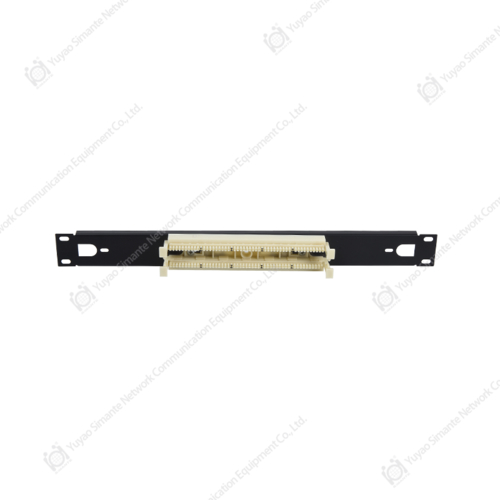
SMT-3009D-50P 50 pairs 110 Wiring Block
Understanding the Role of a 50-Pair 110 Wiring Block
A 110 wiring block is a termination and cross-connection component used in telecommunications and structured cabling environments. Its primary function is to provide an organized method for terminating individual twisted-pair conductors while allowing selected pairs to be connected to other circuits through jumpers. The 110 format has become widely used in voice distribution, horizontal cabling, equipment rooms, telecommunications rooms, and other low-voltage installations.
The SMT-3009D-50P contains 50 pairs, making it suitable for applications where multiple voice or communication circuits must be concentrated in a controlled and accessible location. Rather than terminating each pair in a separate enclosure or relying on loose connections, installers can place the pairs on a clearly structured block. This improves identification, serviceability, and the long-term manageability of the cabling system.
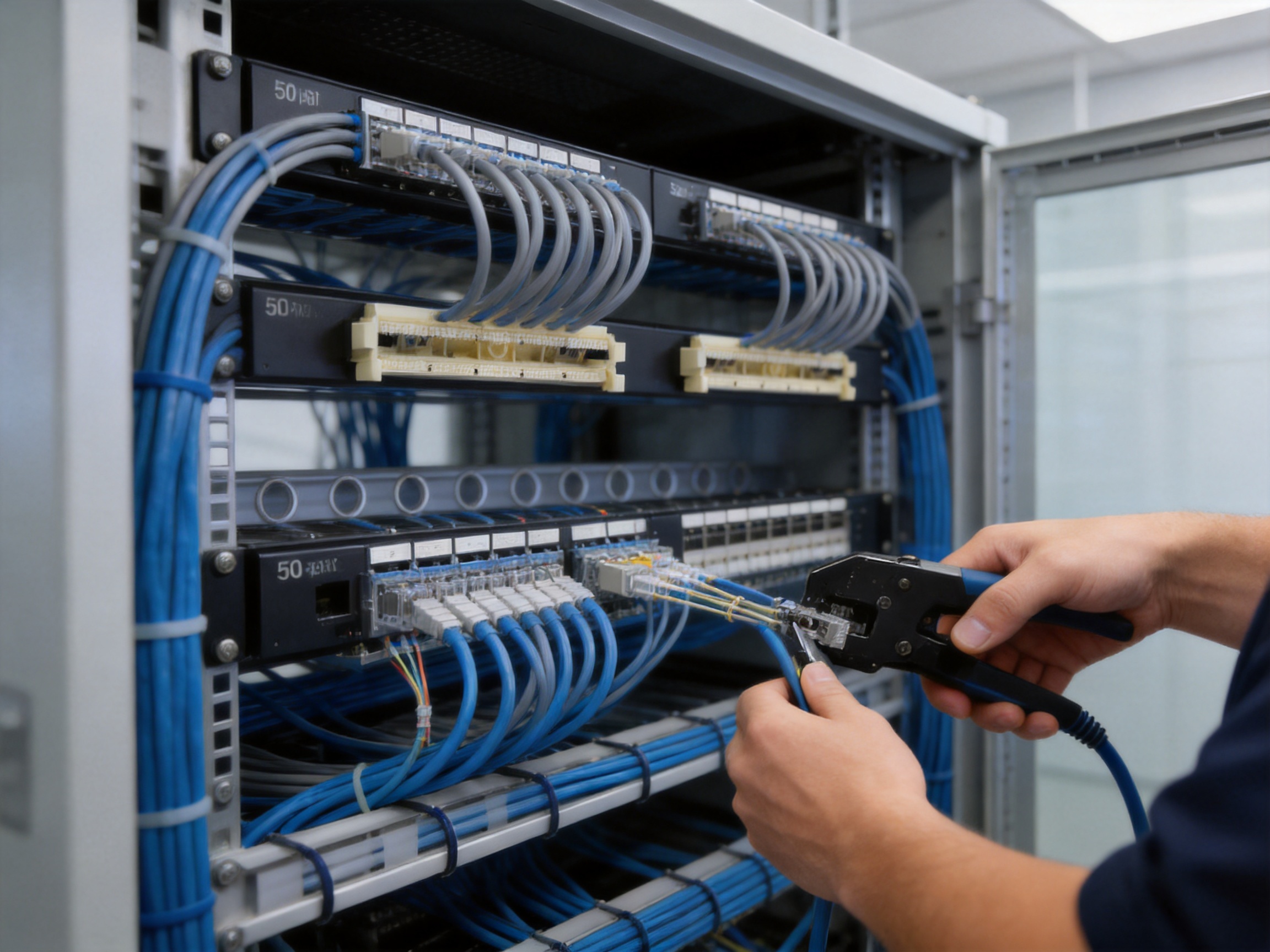
In an integrated structured cabling arrangement, the wiring block may serve as a flexible transfer point between a main telephone room and downstream patching equipment. Multi-pair voice cables can be terminated on the 110 block, while jumpers can be used to connect selected circuits to the appropriate distribution or RJ45 patch-panel ports. This arrangement allows one physical cabling infrastructure to support changing service assignments without repeatedly disturbing the permanent cable terminations.
The product is especially useful in installations where the same general transmission medium must support different information services. A structured cabling system is valuable because it separates the permanent cabling infrastructure from the specific service assigned to each outlet or circuit. The wiring block contributes to this flexibility by allowing the service relationship to be adjusted through jumper connections rather than by replacing the installed cable.
Key Product Specifications
| Item | Specification |
|---|---|
| Product type | 50-pair 110 wiring block |
| Model | SMT-3009D-50P |
| Connection method | Enhanced 110 IDC wiring method |
| Compatible conductor range | 23–26 AWG twisted pair |
| Withstand voltage | DC 1000 V for 1 minute; AC 750 V equivalent specification stated |
| Insulation resistance | Initial value of at least 1000 MΩ |
| Termination durability | 250 wire terminations |
| IDC terminal material | Nickel-plated phosphor bronze |
| Plastic material | PC polycarbonate |
| Operating temperature range | -25°C to +70°C |
| Humidity requirement | Up to 85%, according to the stated environmental specification |
| Environmental compliance | RoHS requirements |
| General standards | YD/T 926.1-2009 |
| Sub-standard | YD/T 926.3-2009 |
The combination of electrical, mechanical, material, and environmental specifications makes the product suitable for professional cabling installations rather than temporary or improvised connections. Its capabilities are intended to support repeated maintenance, organized distribution, and stable operation within an appropriately designed structured cabling system.
Enhanced 110 IDC Termination
The central technical feature of the wiring block is its enhanced 110 insulation displacement connection method. IDC technology allows an insulated conductor to be inserted into a specially shaped contact. The contact displaces the insulation and establishes an electrical connection with the conductive core, eliminating the need to strip each wire individually before termination.
This method offers several practical advantages. First, it can reduce installation time because the conductor preparation process is simplified. Second, it supports a consistent termination geometry when the correct punch-down tool and installation procedure are used. Third, the connection is held within an organized block structure, making it easier for technicians to identify, test, and service individual pairs.
The SMT-3009D-50P is designed for 23–26 AWG twisted-pair conductors. This range covers common telecommunications and structured cabling wire sizes. Compatibility with several conductor gauges provides installation flexibility while maintaining a defined connection range. Installers should still confirm the actual cable diameter, insulation type, conductor construction, and applicable project requirements before deployment.
Compared with less structured connection methods, a 110 IDC block provides a more professional termination solution. Wire nuts, loose soldered connections, or improvised terminal arrangements may be difficult to inspect and may create inconsistent results. A dedicated wiring block presents the termination points in a repeatable layout and allows the connection method to be documented for future maintenance.
The IDC contact is made from phosphor bronze with nickel plating. Phosphor bronze provides a suitable combination of electrical conductivity, spring characteristics, and mechanical resilience. Nickel plating helps protect the contact surface and supports resistance to environmental exposure and repeated handling. These material choices are important because the terminal must maintain reliable contact pressure through installation and subsequent service activity.
Electrical Performance and Connection Reliability
Electrical reliability is fundamental to any wiring block. A component may be easy to install, but it must also maintain insulation, contact integrity, and separation between circuits over its service life. The stated electrical specifications of the SMT-3009D-50P include a withstand voltage of DC 1000 V for one minute without breakdown or arcing, along with an initial insulation resistance of at least 1000 MΩ.
High insulation resistance helps limit unwanted leakage between conductors and between conductive parts. This is particularly important in installations containing many closely arranged pairs. When dozens of pairs are terminated within one compact component, the insulating structure and material quality must prevent unintended electrical paths.
The withstand-voltage requirement provides an indication of the insulation system’s ability to tolerate a controlled high-voltage test. It does not mean that the wiring block should be exposed to such voltage during normal operation. Instead, it represents a verification condition used to evaluate insulation performance and resistance to electrical breakdown.
For network installers and system designers, these characteristics provide greater confidence during commissioning and troubleshooting. A wiring block that has consistent insulation and contact behavior can support clearer test results. Technicians can use appropriate cable testers, continuity testers, insulation testing equipment, and documentation procedures to verify the completed installation.
Actual system performance also depends on factors outside the wiring block itself. Cable quality, pair lay, installation workmanship, grounding, routing, bend radius, electromagnetic conditions, and connected equipment all influence the final result. The product should therefore be considered part of a complete cabling channel rather than an isolated guarantee of network performance.
Mechanical Durability for Repeated Service
Structured cabling systems are often expected to remain in operation for many years. During that time, circuits may be moved, tested, reassigned, or expanded. The SMT-3009D-50P is specified for 250 wire terminations, supporting repeated connection activity in service environments.
Termination durability is valuable in telecommunications rooms, commercial buildings, campuses, data communication facilities, and other locations where service changes are common. A block that tolerates repeated punch-down activity can reduce the need for premature replacement and help maintain a stable distribution platform.
Repeated termination must still be performed correctly. Excessive force, unsuitable tools, incorrect conductor size, damaged insulation, or repeated termination in a single worn contact can reduce reliability. Proper installation practice includes following the designated wire positions, maintaining pair identification, avoiding unnecessary rework, and replacing components when inspection indicates damage.
The mechanical design also benefits from the use of PC polycarbonate for the non-metallic body. Polycarbonate is widely used in electrical and communication components because it can provide dimensional stability, impact resistance, and electrical insulation. Its performance depends on formulation, molding quality, operating temperature, and the surrounding environment, but it is an appropriate engineering plastic for a compact wiring block enclosure or carrier.
Compared with basic low-cost components using less controlled plastics or inconsistent metal contacts, a product with specified materials and a defined durability rating offers a clearer basis for procurement and project quality control. Buyers can evaluate the product according to documented parameters rather than relying only on appearance.
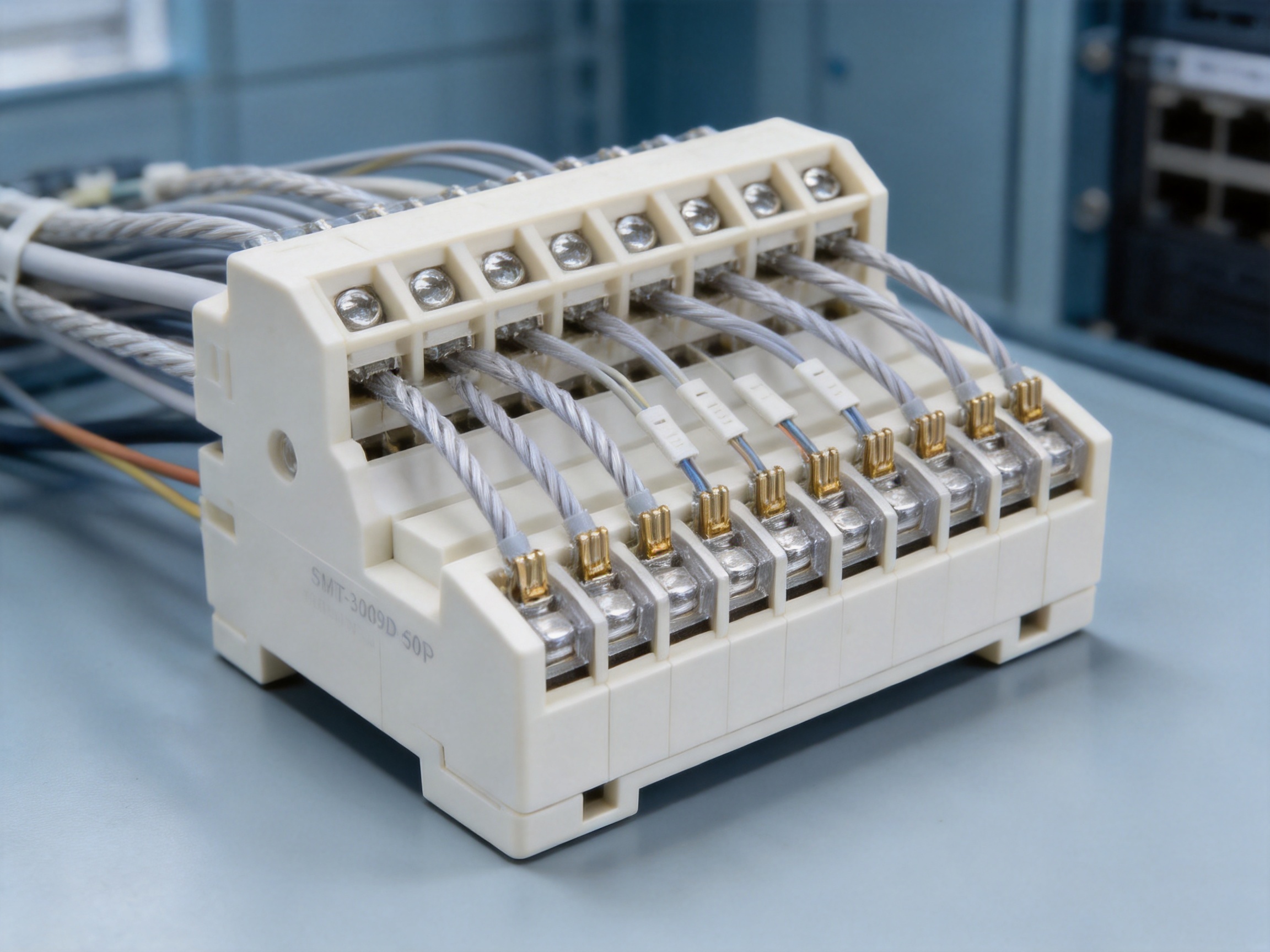
Flexible Distribution and Cross-Connection
The most important system-level advantage of a 50-pair wiring block is flexibility. Permanent cables can be terminated once and then managed through jumper connections. This approach makes it possible to alter the relationship between incoming circuits and outgoing ports while leaving the main cable infrastructure in place.
For example, a multi-pair cable from a main telephone room may be terminated on the 110 block. A technician can then use compatible jumpers to connect selected pairs to a distribution patch panel or to another 110-compatible interface. If a user moves to another office, a service is reassigned, or a circuit is tested, the jumper arrangement can be changed without cutting and reterminating the main cable.
This improves operational efficiency in several ways. Maintenance staff can make controlled changes at a known distribution location. Service records can identify the pair, block position, jumper path, and destination port. Fault isolation can be performed section by section. Spare capacity can be reserved for future expansion. These benefits become increasingly significant as the number of connected information points grows.
The wiring block also supports the principle of unified management. A structured cabling system should not be viewed as a collection of unrelated wires. It is an organized physical infrastructure with defined termination points, distribution paths, labels, and service assignments. The 50-pair format provides a concentrated platform that can be integrated into a larger cabling architecture.
When combined with RJ45 patch panels and other compatible structured cabling components, the wiring block can help bridge voice distribution and general information outlet management. The product information recommends using connectors from the same standard series. Compatibility should always be checked at the physical, electrical, and application levels before connecting components from different manufacturers or product families.
Advantages in Comparison with Less Organized Solutions
Competition in the wiring hardware market includes many products that may appear similar at first glance. A professional buyer should compare more than pair count and exterior dimensions. Material quality, termination durability, electrical specifications, standards alignment, manufacturing consistency, and support for customization can distinguish a dependable product from a basic substitute.
Organized termination instead of loose wiring
The 50-pair design brings multiple connections into a compact and identifiable structure. This is more efficient to document and maintain than a group of loose splices or individually scattered terminals. Clear organization can shorten troubleshooting time and reduce the possibility of connecting the wrong circuit.
Defined conductor compatibility
The stated 23–26 AWG conductor range gives installers a practical selection guide. Products without a clearly stated wire range may create uncertainty during installation. Defined compatibility also helps project managers select cables and accessories that work together as intended.
Repeatable IDC performance
The enhanced 110 IDC connection method provides a consistent termination approach. When supported by appropriate tooling and quality control, repeatable IDC geometry can be more efficient than manual stripping and makes the finished work easier to inspect.
Specified electrical insulation
The stated high insulation resistance and withstand-voltage performance provide measurable criteria for quality evaluation. These parameters support incoming inspection, sample testing, and project documentation.
Service-oriented durability
A specified rating of 250 wire terminations indicates that the product is intended for more than a single installation event. This is particularly useful where circuit changes and maintenance operations are expected.
Professional material selection
Nickel-plated phosphor bronze IDC contacts and a PC polycarbonate body combine conductive reliability with structural insulation. The use of specified materials also supports traceability and more consistent purchasing decisions.
Environmental and regulatory consideration
Compliance with RoHS requirements helps address restrictions on hazardous substances in applicable markets. The stated temperature and humidity conditions also help users determine whether the component is suitable for the proposed installation environment.
These advantages should not be interpreted as a claim that one wiring block is suitable for every project. The correct choice depends on cable type, system architecture, required density, enclosure design, local standards, installation conditions, and service objectives. However, the SMT-3009D-50P provides a balanced combination of capacity, flexibility, durability, and documented performance for many structured cabling applications.
Manufacturing Strengths and Production Capabilities
Product reliability begins before final assembly. It is influenced by the design process, mold quality, raw material control, metal stamping or forming, plating, assembly accuracy, inspection procedures, and packaging. Yuyao Simante Network Communication Equipment Co., Ltd. integrates design, development, sales, and service, giving it a broader view of product performance and customer requirements.
The company has more than 10 engineers and more than 30 full-time technical personnel. This technical organization supports product development, process improvement, quality management, and customer communication. A dedicated engineering team can evaluate design details such as terminal positioning, plastic wall thickness, insertion geometry, dimensional tolerances, and assembly consistency.
The manufacturer operates 10 regular and customization production lines. This production structure supports both standard catalog products and project-specific requirements. Customization may involve packaging, labeling, color, structure, accessories, or other product features, subject to technical review and production feasibility.
The factory is equipped with 10 fully automatic injection molding machines and 20 semi-automatic injection molding machines. Injection molding capability is important for producing communication components with consistent dimensions and repeatable geometry. For a wiring block, molding accuracy affects terminal alignment, conductor entry, retention features, assembly fit, and the overall stability of the finished component.
The company also operates eight automatic installation machines. Automated or semi-automated assembly can improve consistency in repetitive operations and help control production efficiency. Automation does not replace engineering oversight or quality inspection, but it can reduce variation when processes are properly validated and maintained.
The factory maintains an annual output of more than nine million units across its product range. A significant production capacity can support larger projects, recurring orders, and stable supply planning. Buyers should still confirm current production schedules, lead times, quality requirements, and order quantities for each project.
Manufacturing scale is most valuable when combined with quality discipline. High output alone does not guarantee performance. The important advantage is the combination of production equipment, experienced technical personnel, process control, product testing, and customer-specific communication. The company’s stated focus on the high-end market reflects an emphasis on stable quality and comprehensive testing.
Quality Testing and Process Control
A wiring block should be evaluated through multiple quality dimensions. Visual inspection can identify molding defects, burrs, plating issues, contamination, and assembly errors. Dimensional checks can confirm that the product fits the intended connectors, tools, mounting arrangements, and accessories. Electrical tests can verify continuity, insulation, and resistance to specified test voltage.
Mechanical testing can evaluate terminal retention, conductor insertion, pull resistance, repeated termination, and the stability of assembled components. Environmental testing can assess how materials and connections respond to temperature, humidity, corrosion exposure, and other conditions relevant to the intended application.
The product information includes a salt spray test requirement. The stated test conditions include a salt solution pH between 6.5 and 7.2 before atomization, a solution concentration of 5% ± 0.1% using sodium chloride and distilled or deionized water, and continuous atomization for a recommended duration of 24 hours. Testing should also prevent oil, dust, and other impurities from affecting the work conditions.
Salt spray testing is commonly used to evaluate the corrosion resistance of exposed or plated metal surfaces. It is an accelerated laboratory test and should not be treated as a direct prediction of every field environment. Nevertheless, it can help identify weaknesses in plating, surface treatment, or material selection. For IDC terminals, corrosion control is important because the contact interface must remain stable during the service life of the component.
Environmental performance is specified for a temperature range of -25°C to +70°C, with humidity listed at up to 85% under the stated conditions. Installation designers should compare these limits with the actual equipment-room, cabinet, outdoor enclosure, or industrial environment. If the product is installed outside the specified conditions, additional protection or a different product category may be required.
RoHS and Material Considerations
The product is specified to meet RoHS requirements. RoHS compliance is important for manufacturers, distributors, system integrators, and end users operating in markets where restrictions on hazardous substances apply. It can also support corporate environmental policies and procurement requirements.
Compliance should be supported by appropriate supplier declarations, material records, test documentation, and production controls. The exact documentation required may vary according to the destination market, customer contract, and applicable revision of the regulation. Buyers with strict compliance obligations should request the relevant declarations and test reports as part of the purchasing process.
The use of PC polycarbonate for the plastic body provides a non-metallic material with suitable insulating characteristics for the application. The nickel-plated phosphor bronze contact provides the conductive interface. Together, these materials demonstrate the importance of selecting components according to both electrical and mechanical requirements.
Material selection also affects product longevity and manufacturing stability. Plastics must flow correctly during molding, maintain the required shape after cooling, and withstand expected handling. Metal terminals must be formed accurately, plated consistently, and positioned correctly during assembly. Each stage contributes to the performance of the final wiring block.
Installation and Application Guidance
Before installation, confirm that the wiring block matches the project’s cable type, conductor gauge, distribution architecture, mounting method, and applicable standards. Inspect the product and cable for visible damage. Prepare the work area so that dust, moisture, oil, and excessive mechanical stress do not affect the termination.
Route the incoming cable with appropriate support and bend control. Maintain pair identification and avoid unnecessary untwisting near the termination point. Follow the project wiring plan and terminate each conductor in the designated position. Use a compatible 110 punch-down tool and apply controlled pressure. Do not force conductors that fall outside the supported wire range.
After termination, inspect the block for fully seated conductors, excessive exposed conductor length, damaged insulation, displaced contacts, or crossed pairs. Label the block and each relevant circuit according to the project documentation. Where jumpers are used, record both endpoints and the service or function associated with the connection.
Testing should include continuity and pair identification checks. Depending on the system and application, additional tests may include resistance, insulation, polarity, balance, transmission performance, and end-to-end service verification. Any failed result should be investigated before the connection is placed into service.
During maintenance, avoid unnecessary retermination. Use the jumper arrangement to make controlled changes whenever possible. If a contact is damaged or has reached the practical limit of repeated termination, replace the affected component according to the maintenance policy. Keep the wiring area clean and preserve accurate records after every change.
Packaging, Storage, and Logistics
The product is packaged in a special blister bag and then placed in a cardboard box. Accessories are included in the packaging arrangement, and a label indicating the model and quantity is applied to the upper-left area of the carton front. Proper packaging helps protect the product from contamination, impact, and loss of accessories during transportation and storage.
The recommended storage environment is a warehouse with an ambient temperature from -5°C to +30°C and relative humidity not exceeding 70%. The surrounding air should be free of acid, alkali, and other corrosive gases. The stated storage period is three years under these conditions.
Warehouse operators should avoid placing heavy objects on cartons, exposing packages to condensation, or storing them directly against chemical materials. First-in, first-out inventory control can help ensure that products remain within the recommended storage period. Before installation, the packaging should be checked for damage and the product should be inspected for contamination or deformation.
Customer-specified packaging is available as a product-use option. This can be valuable for distributors, system integrators, private-label programs, and projects with special labeling or packing instructions. Packaging requirements should be agreed during the quotation and order-confirmation stages because they may affect materials, lead time, labeling, carton quantity, and inspection procedures.
Typical Application Environments
Telecommunications rooms
The wiring block can be used to terminate and manage multi-pair voice cables in telecommunications rooms. Its 50-pair capacity supports organized distribution while leaving room for labeling and jumper access.
Main telephone rooms
In larger voice systems, incoming cables can be terminated at a central location and connected to downstream services through planned jumper arrangements. This simplifies circuit reassignment and fault isolation.
Commercial buildings
Office buildings often experience tenant changes, workstation moves, and service modifications. A flexible wiring block can help building operators adjust voice or low-voltage connections without replacing permanent cables.
Educational and institutional facilities
Schools, hospitals, government buildings, and similar facilities may contain many information points distributed across different rooms and departments. Centralized termination and clear labeling can improve maintenance efficiency.
Structured cabling distribution systems
The product can form part of a broader copper structured cabling solution that includes horizontal cables, patch panels, faceplates, data sockets, jumpers, cabinets, and related accessories. System compatibility and project standards should be confirmed before installation.
Why Work with an Experienced Manufacturer?
A wiring block is a relatively compact component, but its quality can influence the reliability and maintainability of a much larger communication system. Working with an experienced manufacturer can provide benefits in technical communication, product consistency, engineering support, and supply continuity.
Yuyao Simante Network Communication Equipment Co., Ltd. has served the network communication market for nearly 20 years. Its product range includes keystone jacks, patch panels, wall faceplates, data sockets, optical fiber products, and other structured cabling components. This broader product knowledge can help the manufacturer understand how a wiring block interacts with the rest of an installation.
The company serves customers in Europe, Australia, Africa, the Middle East, and Southeast Asia. International market experience can support familiarity with different packaging expectations, documentation requirements, product configurations, and project communication practices. The company also undertakes OEM and ODM projects, allowing customers to discuss customized products and coordinated product families.
For buyers, the potential value extends beyond the individual component. A manufacturer with injection molding resources, automated installation equipment, engineering personnel, and quality-testing capabilities may be able to support a complete product program. This can reduce the complexity of sourcing multiple related components from unrelated suppliers.
Customers should evaluate the supplier according to their own procurement process. Important questions may include production capacity, quality certifications, material compliance, sample approval, inspection procedures, tooling ownership, packaging control, warranty terms, export experience, and after-sales communication. Clear technical documentation and written approval samples are especially important for customized projects.
Selection Checklist for Buyers
When selecting a 50-pair 110 wiring block, buyers should review the following points:
1. Confirm the required pair capacity and whether 50 pairs are appropriate for the cabinet, rack, wall-mounted enclosure, or distribution area.
2. Confirm that the conductor size falls within the supported 23–26 AWG range.
3. Verify that the project uses an enhanced 110 IDC connection method or another compatible arrangement.
4. Review electrical specifications, including insulation resistance and withstand-voltage requirements.
5. Check mechanical durability, including the number of supported termination operations.
6. Confirm contact and body materials, plating requirements, and environmental protection expectations.
7. Compare the product’s temperature and humidity limits with the actual installation location.
8. Review RoHS documentation and any additional regulatory requirements for the destination market.
9. Confirm compatibility with jumpers, patch panels, RJ45 interfaces, cabinets, and accessories.
10. Request dimensional drawings or approved samples when enclosure fit and mounting geometry are critical.
11. Confirm packaging quantity, labeling, accessories, and customer-specific packaging requirements.
12. Establish inspection, testing, delivery, and replacement procedures with the supplier before mass production or large-scale deployment.
This checklist helps prevent a common procurement problem: selecting a component based only on price or appearance while overlooking compatibility, environmental limits, and long-term service requirements.
Frequently Asked Questions
What is the main purpose of the SMT-3009D-50P?
The product is a 50-pair 110 wiring block used to terminate, organize, distribute, and jumper multi-pair communication cables. It is particularly suited to voice and structured cabling applications where flexible circuit management is required.
How many pairs can the wiring block accommodate?
It accommodates 50 pairs. This capacity makes it suitable for concentrated termination points in telecommunications rooms, main telephone rooms, commercial buildings, and other structured cabling environments.
What type of termination method does it use?
It supports an enhanced 110 IDC wiring method. The insulated conductor is inserted into the IDC contact, which displaces the insulation and establishes the electrical connection.
What wire sizes are supported?
The stated compatible range is 23–26 AWG twisted pair. Installers should confirm the actual cable specification and avoid using conductors outside the supported range.
Can the wiring block be used with RJ45 patch panels?
It can be used as part of a structured cabling arrangement that connects multi-pair voice cables to compatible distribution or RJ45 patch-panel interfaces through jumper connections. The exact connection method and accessory compatibility should be verified for each project.
How durable are the IDC terminals?
The product is specified for 250 wire terminations. Actual service life depends on correct tooling, conductor compatibility, installation technique, and whether the connection is repeatedly disturbed or reworked.
What materials are used?
The IDC card wire terminal is made from nickel-plated phosphor bronze. The non-metallic body is made from PC polycarbonate.
What environmental conditions are specified?
The stated environmental temperature range is -25°C to +70°C, with humidity listed at up to 85% under the specified conditions. The installation environment should be assessed before use, particularly where condensation, chemicals, salt exposure, or extreme temperatures may occur.
Does the product meet RoHS requirements?
The product information states that it meets RoHS requirements. Customers with formal regulatory documentation requirements should request the relevant declarations and test records for the applicable order and market.
What standards are associated with the product?
The stated general specification is YD/T 926.1-2009, with YD/T 926.3-2009 identified as the sub-standard. Project engineers should confirm whether additional regional, customer, or application-specific standards apply.
How should the product be stored?
It should be stored in a warehouse maintained at -5°C to +30°C, with relative humidity not exceeding 70%, and without acid, alkali, or other corrosive gases in the surrounding air. The stated storage period is three years under these conditions.
Can the manufacturer provide customized packaging?
Customer-specified packaging is identified as an available product-use option. Packaging design, carton quantity, labels, accessories, and inspection requirements should be agreed with the manufacturer before the order is finalized.
What makes this product suitable for professional installations?
Its professional application value comes from the combination of 50-pair capacity, enhanced 110 IDC termination, specified conductor compatibility, high insulation resistance, defined withstand-voltage performance, 250-termination durability, corrosion-conscious contact materials, RoHS consideration, and support from an experienced structured cabling manufacturer.
Conclusion
The SMT-3009D-50P 50-pair 110 wiring block provides a practical foundation for organized copper communication distribution. Its enhanced 110 IDC termination method supports efficient installation, while the 50-pair capacity helps concentrate multi-pair voice and low-voltage connections in a manageable location. The ability to use jumper connections adds flexibility, allowing service assignments to change without repeatedly disturbing permanent cable terminations.
Electrical specifications such as a stated DC 1000 V withstand-voltage test and initial insulation resistance of at least 1000 MΩ provide measurable performance criteria. Mechanical durability of 250 wire terminations supports repeated maintenance and circuit changes. Nickel-plated phosphor bronze contacts and a PC polycarbonate body provide a considered material combination for electrical connection, insulation, and structural stability.
The product’s value is further supported by the manufacturer’s engineering personnel, injection molding resources, automated installation equipment, customization capability, international market experience, and stated commitment to testing. These strengths can be important for customers seeking stable production, coordinated structured cabling components, OEM or ODM support, and reliable communication throughout a project.
For best results, the wiring block should be installed as part of a complete, documented structured cabling design. Correct cable selection, compatible accessories, professional termination tools, accurate labeling, appropriate environmental control, and post-installation testing all contribute to system performance. When these factors are managed properly, the SMT-3009D-50P can support flexible distribution, efficient maintenance, and long-term cabling organization.
References
1. TIA/EIA structured cabling performance and installation principles.
2. ISO structured cabling system concepts and administration practices.
3. YD/T 926.1-2009, General Specification for Integrated Wiring Systems.
4. YD/T 926.3-2009, Applicable Sub-Standard for Integrated Wiring Systems.
5. RoHS principles concerning the restriction of hazardous substances in electrical and electronic equipment.
6. Manufacturer technical information for the SMT-3009D-50P 50-pair 110 wiring block.
7. Manufacturer material, packaging, environmental, and product-performance specifications.