Español
 عربى
عربى русский
Content
- 1 Why Cable Management Matters in Structured Cabling
- 2 Product Overview
- 3 Ten-Ring Organization for Better Cable Distribution
- 4 Compact 1U Format for Efficient Rack Planning
- 5 Compatibility with Copper Structured Cabling
- 6 Support for Fiber Structured Cabling Environments
- 7 Advantages Compared with Basic Single-Path Managers
- 8 Design Considerations for Reliable Cable Management
- 9 Manufacturing Strengths and Engineering Capability
- 10 Advanced Production Infrastructure
- 11 Quality Control from Design to Finished Product
- 12 OEM and ODM Support for Project Requirements
- 13 Installation Guidance
- 14 Use in Different Network Environments
- 15 How the Product Supports Total Cost of Ownership
- 16 Comparison with Alternative Cable Management Approaches
- 17 Responsible Selection and Application
- 18 Supplier Capabilities and Market Experience
- 19 Frequently Asked Questions
- 19.1 What is the SMT-3008-10P used for?
- 19.2 What does 1U mean in this product description?
- 19.3 Why does the product have ten rings?
- 19.4 Can it be used with copper patch cords?
- 19.5 Can it be used with fiber patch cords?
- 19.6 Does the product replace a vertical cable manager?
- 19.7 Where should the manager be installed?
- 19.8 Can it be used in a data center?
- 19.9 Is customization available?
- 19.10 How does manufacturing equipment support product consistency?
- 19.11 What other products does the manufacturer produce?
- 19.12 What should be checked before placing an order?
- 20 Conclusion
- 21 References
- 22 Product: SMT-3008-10P 1U 10 ring cable manager

Modern data networks depend on more than switches, patch panels, cables, and connectors. They also require a disciplined method for organizing, routing, protecting, and maintaining those cables inside the rack. As network density increases, cable management becomes a central part of infrastructure performance. Poorly arranged cables can obstruct airflow, complicate maintenance, increase the risk of accidental disconnection, and make future expansion unnecessarily difficult. A well-designed horizontal cable manager provides a practical solution by keeping patch cords and interconnection cables in a controlled, accessible, and visually organized path.
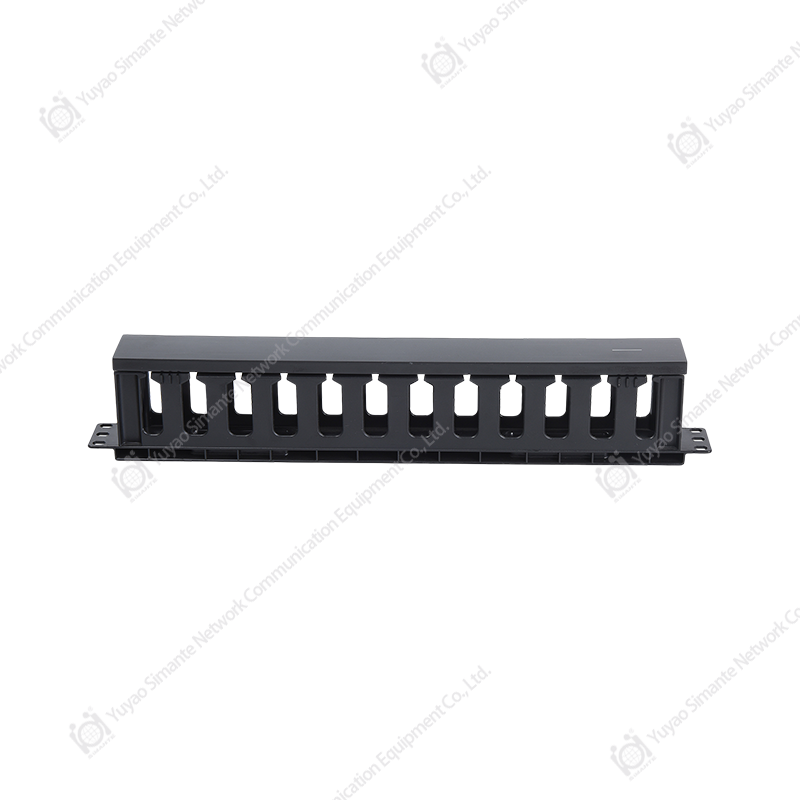
The SMT-3008-10P 1U 10-ring cable manager is designed for this purpose. It is a rack-mounted cable management product with ten cable rings arranged in a compact 1U format. The product is suitable for copper and fiber structured cabling environments, including network cabinets, server racks, distribution frames, telecommunications rooms, data centers, smart building systems, and automation installations. Its principal function is simple: guide cables horizontally across the rack while maintaining separation, order, and accessibility.
Although a cable manager may appear to be a basic accessory, its design has a direct influence on the usability and long-term serviceability of the entire cabling system. A suitable product must balance capacity, accessibility, mechanical stability, compatibility, appearance, and manufacturing consistency. The SMT-3008-10P addresses these requirements through a ten-ring arrangement, a standard 1U rack profile, and a production approach supported by structured design, injection molding, assembly, quality control, and customization capabilities.
Why Cable Management Matters in Structured Cabling
Structured cabling systems are built to support the organized transmission of voice, data, video, control, and other signals. The system may contain horizontal cabling, backbone cabling, patch panels, keystone jacks, fiber enclosures, switches, routers, servers, and power distribution equipment. Each component has a defined role, but the connections between components also need to be managed carefully.
Without suitable cable management, a rack can quickly become crowded with patch cords of different lengths and routing directions. Cables may hang in front of equipment, cross over patch panel ports, press against connectors, or block access to labels and indicators. In a fiber environment, poor routing may also create excessive bends or tension. In a copper environment, disorganized patch cords may be difficult to trace during fault diagnosis or network changes.
A horizontal cable manager helps solve these problems by creating a predictable route between active equipment and patching hardware. It supports cables at a practical height, reduces visual clutter, and allows installers to form consistent cable paths. When properly installed, it also contributes to a more professional rack appearance and more efficient maintenance procedures.
The benefits extend beyond appearance. Organized cabling can help technicians identify ports more quickly, reduce the chance of disconnecting the wrong cable, and improve the process of adding or removing connections. It can also support improved airflow by preventing large bundles from covering ventilation openings on network equipment. In high-density environments, every small improvement in access and organization can reduce service time over the life of the installation.
Product Overview
The SMT-3008-10P is a 1U horizontal cable manager equipped with ten cable rings. Its design is intended for rack and cabinet installations where multiple patch cords must be guided across the front or rear area of a network enclosure. The ten-ring structure provides multiple routing points, allowing cables to be distributed instead of being concentrated into one large bundle.
The 1U height makes the product suitable for standard 19-inch rack architectures. Because it occupies only one rack unit, it can be integrated into structured cabling layouts without consuming excessive vertical space. Installers can position the cable manager between patch panels, switches, fiber equipment, or other rack-mounted devices according to the requirements of the installation.
The product belongs to the cable manager category and can be used in both copper and fiber system environments. Its role is not to terminate or transmit signals. Instead, it supports the physical organization of the cables that connect signal-carrying equipment. This distinction is important: an effective cable manager complements the performance of connectors, patch panels, and active equipment by keeping their interconnections stable and manageable.
| Product Attribute | Specification or Description |
|---|---|
| Product model | SMT-3008-10P |
| Product type | Horizontal rack cable manager |
| Rack height | 1U |
| Ring quantity | 10 cable rings |
| Application systems | Copper structured cabling and fiber structured cabling |
| Typical installation | 19-inch network cabinets, server racks, and distribution frames |
| Primary function | Cable routing, separation, support, and organization |
| Suitable environments | Data centers, telecommunications rooms, offices, smart homes, automation systems, and commercial installations |
| Supply capability | Standard production, OEM projects, and ODM cooperation |
Ten-Ring Organization for Better Cable Distribution
The most distinctive functional feature of the SMT-3008-10P is its ten-ring layout. A single large opening can hold cables, but it does not necessarily provide effective organization. Multiple rings allow the installer to divide cable routes according to equipment position, service type, destination, or installation phase.
For example, one group of rings may be used for connections between a switch and a patch panel, while another group can guide cables toward a fiber enclosure or management area. In a larger rack, individual rings may be assigned to different sections of the patching field. This arrangement helps reduce crossing and makes the final cable path easier to understand.
Dividing cables into smaller groups can also support maintenance. If a technician needs to trace one connection, smaller and more clearly separated bundles are generally easier to follow than a single congested group. The cable manager does not replace labeling and documentation, but it provides the physical structure that makes those practices more effective.
The ring concept is also useful for installations that change over time. Network systems are rarely static. New access points, workstations, surveillance devices, wireless systems, servers, and other endpoints may be added after the original installation. A multi-ring manager provides several routing paths that can accommodate future patch cords without forcing every new cable into an existing bundle.
Compact 1U Format for Efficient Rack Planning
Rack space is a valuable resource. Network cabinets must often accommodate switches, patch panels, fiber distribution equipment, power accessories, servers, cable managers, and blanking panels. A cable management product that is too large may limit the amount of active equipment that can be installed. A product that is too small may fail to provide adequate routing capacity.
The 1U profile of the SMT-3008-10P offers a practical compromise. It provides a dedicated management zone while maintaining a compact vertical footprint. Installers can use one or more units at strategic locations in a rack, depending on the number of cables and the arrangement of the equipment.
A 1U cable manager can be placed directly below a patch panel, above a switch, between two active devices, or at another position that supports a clean horizontal transition. The exact arrangement should be determined by the rack layout, cable length, equipment ventilation requirements, and applicable installation practices.
Compact design is especially valuable in smaller telecommunications rooms and office cabinets. These environments may have less rack capacity than a large data center but still require professional cable organization. The product can help create a more orderly installation without demanding a large amount of additional space.
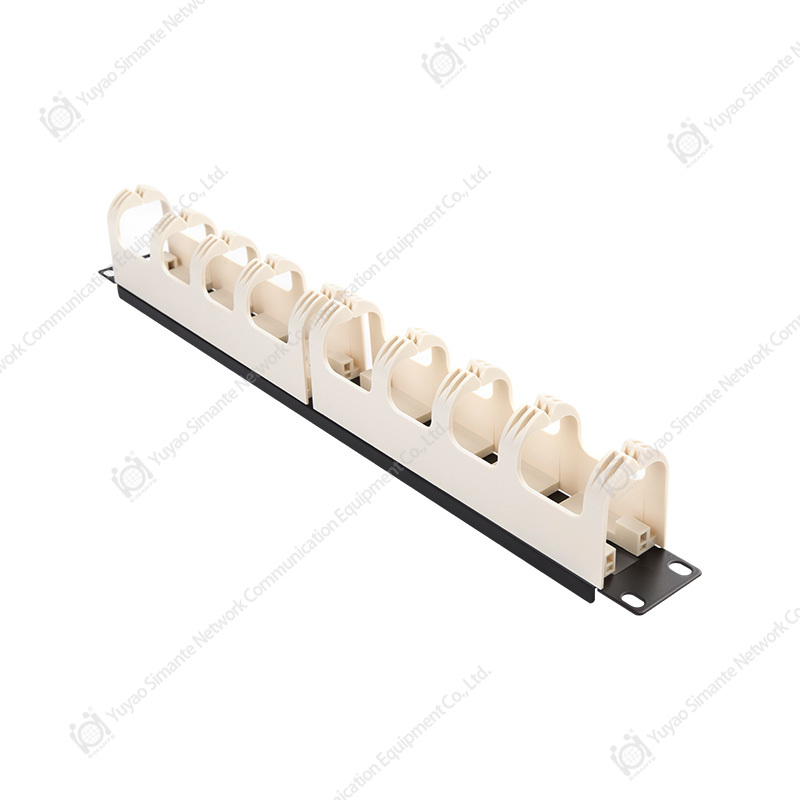
SMT-3008-10P 1U 10 ring cable manager
Compatibility with Copper Structured Cabling
Copper structured cabling remains widely used for enterprise networks, office systems, security installations, building automation, and many other applications. Typical copper systems include category-rated twisted-pair cables, patch panels, keystone jacks, data sockets, patch cords, switches, and network outlets. These components depend on proper routing to preserve accessibility and reduce mechanical stress.
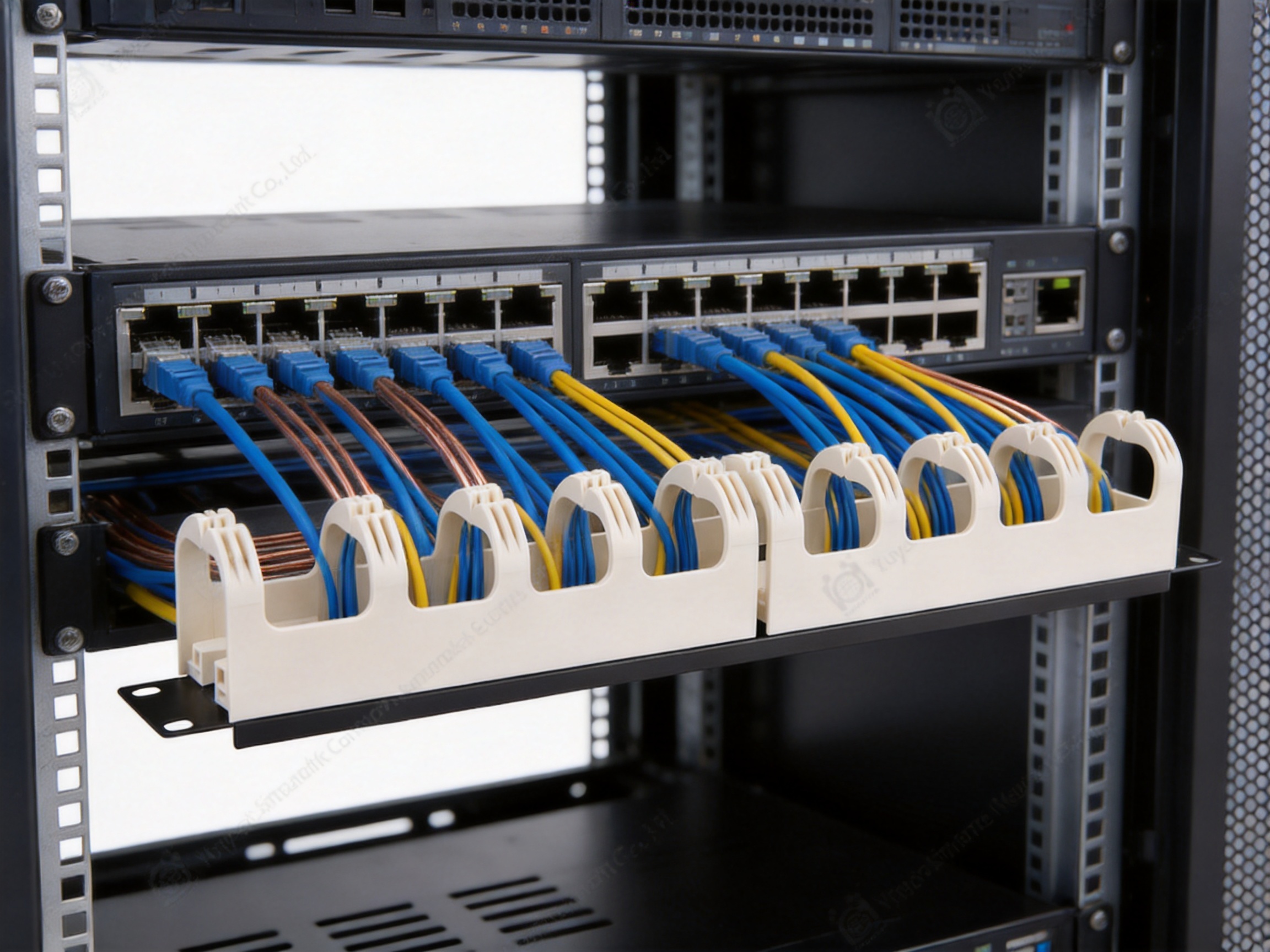
The SMT-3008-10P can be used to manage copper patch cords between patch panels and switches. The rings create a defined path across the rack and help prevent loose cables from obstructing ports. When cables are arranged in a consistent direction, technicians can more readily inspect port connections, verify labels, and perform moves, adds, and changes.
Good copper cable management should also consider bend radius, bundle size, separation from power cables, and the physical position of the active equipment. The cable manager provides the organizational framework, but installers remain responsible for routing cables in accordance with the requirements of the cable manufacturer and the relevant structured cabling standards.
For high-density copper installations, multiple rings can distribute patch cords across the width of the rack. This may reduce the tendency for cables to form one heavy, crowded bundle. A more evenly distributed route can help maintain access to equipment and reduce pressure on connectors and patch panel ports.
Support for Fiber Structured Cabling Environments
Fiber systems require careful physical handling. Optical fiber cables are designed to transmit light through a small core, and their performance may be affected by excessive bending, pulling, crushing, or twisting. Cable management does not replace fiber-specific raceways, trays, bend-radius guides, or protective enclosures, but it can contribute to a more controlled routing environment when used correctly.
The SMT-3008-10P is suitable for organizing fiber patch cords and other optical interconnections where the ring arrangement and installation method are compatible with the cable type. Fiber installers should always observe the minimum bend radius, tensile limits, connector requirements, and routing recommendations provided by the fiber cable manufacturer.
Separating fiber patch cords into organized paths may reduce accidental tangling around adapters, splice closures, fiber panels, and active optical equipment. It can also improve access during inspection and cleaning procedures. In a mixed rack containing both copper and fiber equipment, the manager can help maintain a clearer transition between different cable groups.
Fiber installation planning should include careful consideration of connector polarity, labeling, slack storage, bend control, and protection from pressure. The cable manager is one component of that complete design. Its greatest value is achieved when it is combined with appropriate fiber panels, horizontal or vertical pathways, and disciplined installation practices.
Advantages Compared with Basic Single-Path Managers
Many low-cost cable management products provide only one open channel or a basic metal loop. These products may be adequate for very small installations, but they can become less effective as the number of patch cords increases. The ten-ring arrangement of the SMT-3008-10P offers several practical advantages over a basic single-path design.
More Structured Separation
Multiple rings provide several individual points for cable distribution. This can make it easier to separate cable groups based on equipment, destination, or service type. Instead of placing all cables in one undifferentiated path, installers can create a more deliberate structure.
Improved Accessibility
When cables are divided into smaller groups, the technician may have better access to individual patch cords and ports. This is particularly helpful during troubleshooting, replacement, testing, and system expansion.
Better Use of Rack Space
The 1U design delivers a dedicated management function without requiring a tall accessory. It is suitable for racks where every unit of space must be planned carefully.
Reduced Visual Clutter
A well-organized set of rings can produce a cleaner installation than a loose group of cables hanging between devices. A professional appearance is valuable in commercial facilities, customer-facing equipment rooms, and service areas where clear workmanship supports confidence in the installation.
More Flexible Expansion
Network capacity often grows in stages. Additional rings can provide available routing points for later additions, reducing the need to rebuild the entire cable path when new connections are introduced.
Design Considerations for Reliable Cable Management
A cable manager should be selected according to the actual requirements of the rack. The number of cables, cable diameter, patch cord length, equipment arrangement, access direction, and future expansion plan all influence the best configuration.
The first consideration is capacity. A ring should not be overloaded. Overfilling can make cables difficult to remove and may create unnecessary pressure or sharp bends. Installers should estimate the expected cable count and diameter before selecting the number and placement of managers.
The second consideration is routing direction. Cables should move from the patch panel to the cable manager and then toward the active device in a smooth path. Sudden changes in direction should be avoided. Cable lengths should be selected so that they can be arranged without excessive loops or tension.
The third consideration is service access. A cable manager should improve maintenance rather than make it more difficult. The finished layout should allow technicians to read labels, operate patch panel ports, inspect connectors, and remove individual cables without disturbing unrelated connections.
The fourth consideration is compatibility with the rack. The installer should confirm the rack width, mounting pattern, available 1U position, front or rear access, and the presence of adjacent equipment. The product is intended for standard rack environments, but the complete cabinet layout should always be checked before installation.
The fifth consideration is long-term change. A rack should not be designed only for the cables installed on the first day. Spare capacity and a logical routing plan can make future work faster and less disruptive. The ten-ring layout supports this approach by providing multiple points for organized cable placement.
Manufacturing Strengths and Engineering Capability
The performance of a cable management accessory begins with its design but depends heavily on manufacturing consistency. Small variations in dimensions, surface quality, mounting geometry, ring position, or assembly can affect installation quality. A manufacturer with integrated design, development, production, sales, and service capabilities can control more stages of the product lifecycle.
Yuyao Simante Network Communication Equipment Co., Ltd. has nearly twenty years of experience serving the network cabling and optical fiber product market. Its product development approach is supported by a mature research and development system, with more than ten engineers and more than thirty full-time technical personnel. This engineering team contributes to product design, process improvement, quality stability, customization, and product updates.
Engineering resources are important for cable management products because practical installation requirements may differ between markets and projects. Customers may need a specific ring layout, mounting configuration, material treatment, color, packaging method, or compatibility detail. An established technical team is better positioned to review these requirements and convert them into repeatable manufacturing specifications.
The company’s broader product portfolio includes keystone jacks, patch panels, wall face plates, data sockets, and other components used in structured cabling, network communication, smart home, and automation applications. This product knowledge provides useful context when developing and manufacturing cable management accessories. Understanding how cable managers work alongside patch panels and network outlets can support more coherent system-level solutions.
Advanced Production Infrastructure
Stable output and consistent quality require suitable production infrastructure. The manufacturer operates ten regular and customization production lines, ten fully automatic injection molding machines, twenty semi-automatic injection molding machines, and eight types of automatic installation machines. This combination of regular production and customization resources allows the factory to support both standard product demand and project-specific requirements.
Automatic injection molding equipment can improve repeatability for molded components by controlling key process variables such as material feeding, injection sequence, pressure, cooling, and cycle timing. Consistency in these areas helps maintain dimensional accuracy and appearance from one production batch to another.
Semi-automatic injection molding equipment adds flexibility to the manufacturing system. It can be useful for products with different mold requirements, varied production quantities, or processes that benefit from a combination of machine operation and controlled manual handling. The balance between automatic and semi-automatic equipment allows production planning to respond to different product families.
Automatic installation machines support repeatable assembly operations. For cable management products and related network accessories, consistent assembly can help maintain the position, alignment, and secure fit of product components. Automated operations also reduce reliance on uncontrolled manual variation when the product design is suitable for machine-assisted installation.
Production capacity is not only a question of quantity. It is also a matter of supply continuity, scheduling, process control, and the ability to maintain quality during higher-volume orders. The reported annual output of more than nine million units reflects a manufacturing base designed to support sustained market demand.
Quality Control from Design to Finished Product
Quality control is most effective when it begins before mass production. A product should be evaluated at the design source, during mold development, throughout manufacturing, during assembly, and before shipment. This approach helps identify issues earlier and reduces the risk that problems will be discovered only after installation.
For a 1U cable manager, quality control may include dimensional checks, mounting-hole verification, ring alignment, surface inspection, material confirmation, assembly inspection, and packaging review. The exact inspection program depends on the product specification and customer requirements, but every stage should be connected to a defined quality objective.
Dimensional consistency is especially important for rack-mounted products. A manager must fit correctly within the available rack space and align with the mounting pattern. If the product is distorted or the mounting features are inconsistent, installation may become difficult or unstable.
Surface quality also matters. A cable manager is installed in a visible part of the cabinet, so uneven surfaces, sharp edges, molding defects, or poor finishing can affect both appearance and handling. Proper inspection helps ensure that the finished product is suitable for professional installations.
Performance testing provides another layer of assurance. The company emphasizes product testing and comprehensive customer testing requirements. Depending on the product and order, testing can be used to verify mechanical behavior, assembly consistency, material properties, and other defined characteristics.
A disciplined quality system benefits both standard products and customized products. Standard products require reliable repeatability, while customized products require careful control of new specifications. In either case, the manufacturing process must translate the approved design into a consistent finished item.
OEM and ODM Support for Project Requirements
Network infrastructure projects often involve more than a simple catalog purchase. Contractors, distributors, system integrators, and equipment brands may require private labeling, customized packaging, modified dimensions, special colors, project-specific accessories, or coordinated product families.
The manufacturer undertakes OEM and ODM projects, which can provide an important advantage for customers seeking a long-term supply partner. OEM cooperation generally involves producing according to a customer’s approved design, brand, or specification. ODM cooperation may involve deeper participation in product development, engineering adaptation, and manufacturing implementation.
Customization should be managed through a clear technical process. The customer and manufacturer should confirm drawings, materials, tolerances, colors, markings, packaging, inspection criteria, sample approval, and production quantities before mass production. This reduces misunderstandings and makes the final product easier to integrate into the customer’s distribution or installation system.
For cable management products, customization may include the number or spacing of rings, mounting details, surface treatment, product identification, package configuration, and coordination with other rack accessories. Not every requested change is suitable for every production method, so early engineering review is valuable.
Installation Guidance
Before installation, inspect the product, confirm the required rack position, and review the planned cable routes. The manager should be mounted in a location that supports a smooth transition between the connected equipment and the patching area. If multiple managers are used, their positions should follow a consistent routing strategy.
Use the appropriate rack hardware and tighten the mounting fasteners securely without applying excessive force. The manager should sit evenly against the rack mounting surface. Once installed, confirm that the rings are aligned and free from obstructions.
Route cables through the rings according to their destination and service group. Avoid pulling cables tightly. Leave enough flexibility for maintenance, but avoid unnecessary slack that could form large loops or interfere with equipment access.
For copper cables, follow the cable manufacturer’s bend-radius recommendations and avoid crushing or sharply folding the cable. For fiber cables, observe the specified minimum bend radius and protect connectors from contamination, impact, and excessive movement.
Do not use the cable manager as a handle for lifting equipment or as a support for loads beyond its intended purpose. Its function is to guide and organize cables, not to carry heavy equipment or absorb pulling forces from improperly routed cables.
After routing, check that all ports remain visible and accessible. Confirm that labels can be read and that the cable path does not obstruct ventilation openings, equipment fans, power connectors, or service panels. A final inspection should verify that the arrangement is neat, secure, and consistent with the project documentation.
Use in Different Network Environments
Enterprise Offices
Office networks frequently combine patch panels, Ethernet switches, voice systems, wireless access point connections, security devices, and workstation outlets. A compact 1U cable manager can help maintain an orderly cabinet in a telecommunications room or equipment closet.
Data Centers
Data centers require careful attention to density, airflow, maintenance, and change management. The ten-ring design can assist with the organization of patch cords between network equipment and distribution panels, especially when the installation uses clear labeling and planned rack elevations.
Education and Public Facilities
Schools, universities, libraries, and public buildings often need reliable infrastructure that can be expanded over time. A structured cable manager can make periodic changes easier by keeping connection paths visible and separated.
Security and Surveillance Systems
Video surveillance systems may include network switches, recording equipment, cameras, access control devices, and fiber uplinks. Cable management supports the physical organization of these connections and can simplify troubleshooting when a device or link requires service.
Smart Home and Building Automation
Smart homes and automation systems increasingly use networked controllers, sensors, gateways, and communication panels. The product can support organized cabinet installations where copper and fiber connections share a structured equipment environment.
Industrial and Control Applications
Automation installations may contain communication equipment alongside control systems and power-related hardware. Cable routing should follow the project’s separation and safety requirements. Within the communications portion of the cabinet, a horizontal manager can help create a more controlled connection layout.
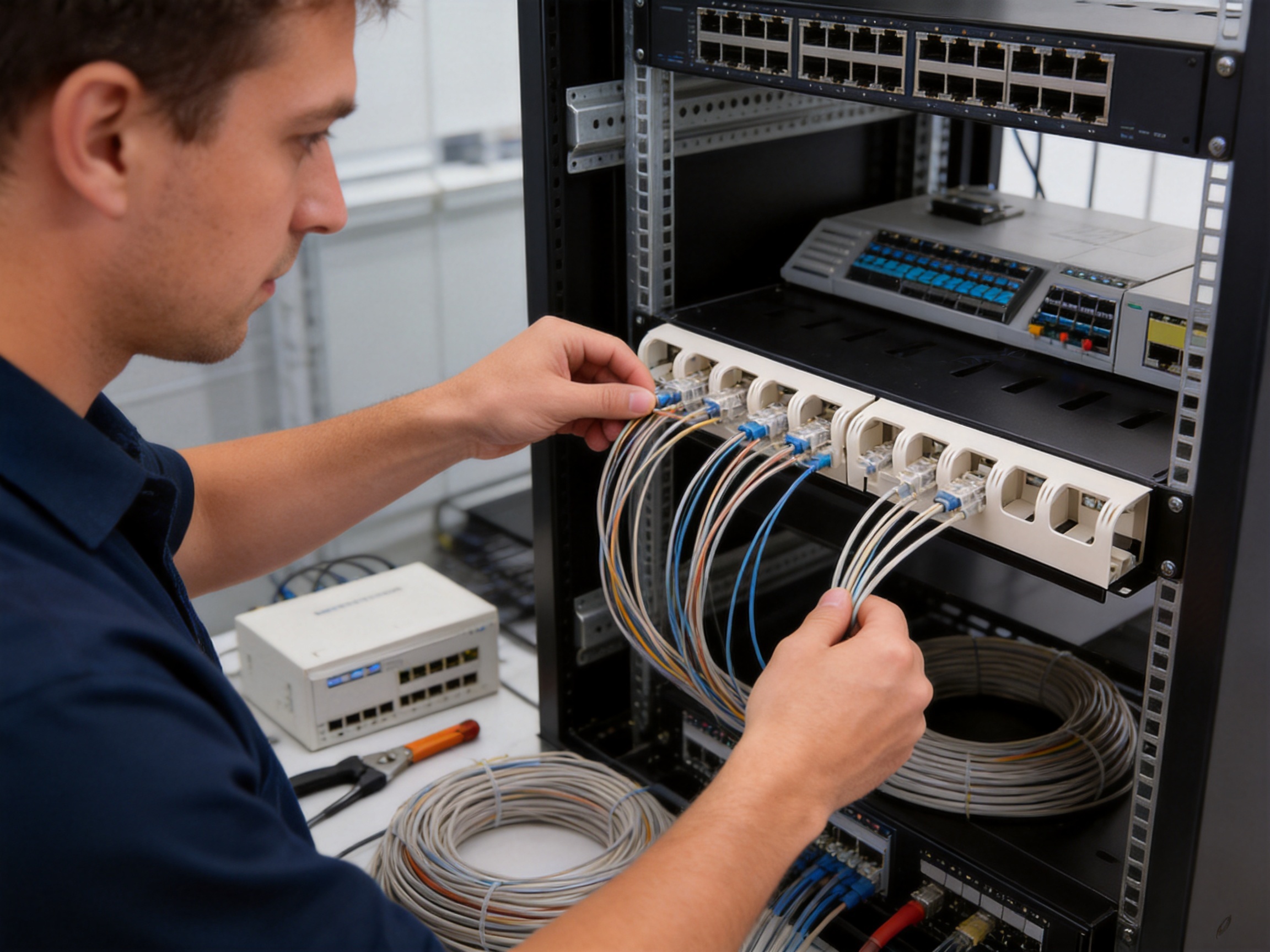
How the Product Supports Total Cost of Ownership
The purchase price of a cable manager is only one part of its value. Total cost of ownership also includes installation time, maintenance effort, system downtime, expansion work, replacement frequency, and the risk of mistakes during service operations.
A product that helps installers route cables more efficiently may reduce the time needed to complete the original rack build. A product that keeps connections accessible may also reduce the time needed for future troubleshooting. These benefits can be especially meaningful in installations where labor costs and service interruptions are significant.
Consistent manufacturing can support lower replacement risk. If each product in a project has stable dimensions and predictable installation behavior, technicians spend less time adapting to variations. OEM and ODM support can also help customers standardize a product family across different projects.
Good cable management may contribute to longer service life by reducing accidental pulls, connector strain, and disorderly cable movement. It cannot eliminate every installation risk, but it provides a physical structure that encourages better routing practices.
Comparison with Alternative Cable Management Approaches
| Management Approach | Typical Strength | Potential Limitation | Role of a Ten-Ring 1U Manager |
|---|---|---|---|
| No dedicated manager | Lowest initial accessory cost | Loose cables, difficult maintenance, poor appearance | Provides a defined routing structure |
| Single large open channel | Simple cable collection | Limited separation and possible congestion | Divides cables among ten routing points |
| Basic single-loop bracket | Compact and inexpensive | Usually offers limited capacity and organization | Provides a more distributed management layout |
| Vertical-only management | Useful for side-to-side routing | Does not directly organize horizontal rack transitions | Supports horizontal patch-cord routing in 1U space |
| Large tray system | Can support substantial cable volume | May require more space and installation planning | Offers a compact option for moderate rack-level management |
| Ten-ring 1U manager | Compact, distributed, and accessible routing | Should not be overloaded or used in place of specialized pathways | Balances rack efficiency with cable separation |
This comparison does not mean that one management method is suitable for every installation. Large data centers may require a combination of ladder racks, overhead trays, vertical managers, horizontal trays, and ring-based accessories. The SMT-3008-10P is best understood as a rack-level component that complements, rather than replaces, a complete cable pathway design.
Responsible Selection and Application
Product selection should be based on application requirements rather than appearance alone. Buyers should consider the cable type, expected cable quantity, rack configuration, environmental conditions, installation direction, and future expansion plans.
For copper patch cords, verify that the ring layout can accommodate the expected bundle without excessive compression. For fiber connections, check bend-radius requirements and determine whether additional fiber-specific management accessories are needed. For mixed systems, separate cable groups according to the project’s design and applicable safety practices.
Customers should also review packaging, labeling, inspection, and documentation requirements with the supplier. These details become important when products are being distributed across multiple projects or incorporated into a standardized installation program.
A reliable supplier should be able to discuss product specifications, production capacity, quality procedures, customization options, and delivery arrangements. Technical communication before ordering can prevent problems during installation and support a more predictable project outcome.
Supplier Capabilities and Market Experience
Yuyao Simante Network Communication Equipment Co., Ltd. serves customers in Europe, Australia, Africa, the Middle East, and Southeast Asia. This international market experience exposes the manufacturer to different installation practices, product expectations, packaging requirements, and project structures.
Export experience can also support more organized communication regarding product specifications, samples, production schedules, documentation, and quality requirements. Customers working across multiple regions may benefit from a supplier that understands the importance of consistent product supply and repeatable manufacturing.
The company’s focus on network cabling solutions and optical fiber products gives it a specialized position within the communications equipment field. Rather than treating cable management as an isolated accessory, it can be considered within the broader context of structured cabling components, connection hardware, and optical infrastructure.
The combination of technical personnel, production lines, automatic and semi-automatic equipment, testing practices, and OEM and ODM experience provides a foundation for supporting both standard orders and customized programs.
Frequently Asked Questions
What is the SMT-3008-10P used for?
The SMT-3008-10P is used to organize and route network cables in a rack or cabinet. It provides ten cable rings in a 1U horizontal format and is suitable for copper and fiber structured cabling environments when installed according to the cable manufacturer’s requirements.
What does 1U mean in this product description?
1U refers to one rack unit, the standard vertical measurement used in equipment racks. A 1U product is designed to occupy one unit of rack height. The exact physical dimensions of the complete installation should be confirmed with the rack and product drawings.
Why does the product have ten rings?
The ten rings provide multiple cable routing points. They allow installers to divide cables into smaller groups based on destination, equipment, service, or future expansion. This can improve organization and accessibility compared with placing all cables in one large bundle.
Can it be used with copper patch cords?
Yes. It is suitable for managing copper patch cords in structured cabling systems. Installers should avoid overfilling the rings, maintain the recommended bend radius, and prevent excessive tension or crushing.
Can it be used with fiber patch cords?
It can be used in fiber structured cabling environments where the routing arrangement is compatible with the fiber cable and connector design. Fiber-specific bend-radius, tensile, slack, and protection requirements must always be observed.
Does the product replace a vertical cable manager?
No. A horizontal 1U manager and a vertical cable manager perform different functions. The SMT-3008-10P manages horizontal rack-level transitions, while vertical managers are generally used for side-to-side or cabinet-edge routing. Larger installations may use both.
Where should the manager be installed?
It may be installed above or below patch panels, switches, fiber equipment, or other rack-mounted devices, depending on the planned cable route. The selected position should maintain equipment access, ventilation, labeling visibility, and a smooth cable path.
Can it be used in a data center?
Yes. It can serve as a rack-level cable management component in data centers and network rooms. High-density installations should evaluate cable volume, airflow, bend radius, pathway capacity, and the need for additional horizontal or vertical management systems.
Is customization available?
The manufacturer undertakes OEM and ODM projects. Potential customization may include product configuration, markings, packaging, color, or other approved technical details. Requirements should be reviewed and confirmed through drawings, samples, and documented specifications before production.
How does manufacturing equipment support product consistency?
Automatic and semi-automatic injection molding equipment can improve repeatability in molded components, while automatic installation machines can support consistent assembly. These resources work together with engineering review, inspection, testing, and process control.
What other products does the manufacturer produce?
The company produces network cabling and optical fiber-related products, including keystone jacks, patch panels, wall face plates, data sockets, and other structured cabling components. This broader product range supports system-level understanding and coordinated supply.
What should be checked before placing an order?
Customers should confirm the product model, rack compatibility, cable application, ring configuration, dimensions, materials, finish, packaging, labeling, inspection requirements, order quantity, delivery schedule, and any OEM or ODM specifications.
Conclusion
The SMT-3008-10P 1U 10-ring cable manager is a compact and practical solution for organizing cable connections in copper and fiber structured cabling systems. Its ten-ring arrangement provides distributed routing points, while the 1U format makes it suitable for efficient rack planning. By creating a clearer path for patch cords and interconnections, the product can support improved accessibility, maintenance, expansion, and installation appearance.
Its value is strengthened by the manufacturing capabilities behind it. Nearly two decades of industry experience, a dedicated engineering and technical team, multiple regular and customization production lines, automatic and semi-automatic injection molding equipment, automatic installation machines, product testing, and OEM and ODM support provide a strong foundation for reliable supply.
For installers and system integrators, the product offers a useful rack-level management option that can complement patch panels, switches, fiber equipment, vertical managers, trays, and other infrastructure components. For distributors and project buyers, the manufacturer’s broader structured cabling portfolio and international market experience can support more coordinated procurement.
As network systems become denser and more service-critical, physical organization is increasingly important. A properly selected and correctly installed ten-ring cable manager helps transform a crowded rack into a more logical, accessible, and maintainable infrastructure environment.
References
1. ISO/IEC 11801, Information Technology — Generic Cabling for Customer Premises.
2. ANSI/TIA-568 Series, Balanced Twisted-Pair and Optical Fiber Cabling Standards.
3. ANSI/TIA-606 Series, Administration Standard for Telecommunications Infrastructure.
4. ANSI/TIA-569 Series, Telecommunications Pathways and Spaces.
5. IEC 61754 Series, Fiber Optic Interconnecting Devices and Passive Components.
6. Manufacturer-provided product information for the SMT-3008-10P 1U 10-ring cable manager.
7. Manufacturer-provided information regarding network cabling products, production equipment, engineering resources, testing practices, and OEM and ODM capabilities.