Español
 عربى
عربى русский
Content
- 1 Product Overview
- 2 Role of the Faceplate in Structured Cabling
- 3 Key Advantages of the Two Port 86 Type Design
- 4 Product Features and Practical Benefits
- 5 Comparison with Common Competing Faceplates
- 6 Manufacturing Strength Behind the Product
- 7 Quality Management and Testing Awareness
- 8 Application Scenarios
- 9 Design Value for Contractors and System Integrators
- 10 Value for Distributors, Wholesalers, and OEM Customers
- 11 Material and Structural Considerations
- 12 Installation Best Practices
- 13 Contribution to Long-Term Network Reliability
- 14 Why the Manufacturer’s Experience Matters
- 15 High-End Market Orientation
- 16 Integration with Copper and Fiber Systems
- 17 Procurement Considerations
- 18 Q&A Section
- 18.1 What is the SMT-4332-86F-2P Two Port 86 Type Faceplate used for?
- 18.2 Why choose a two port faceplate instead of a single port faceplate?
- 18.3 Where can this faceplate be installed?
- 18.4 What does 86 type mean?
- 18.5 Does the faceplate work with copper cabling systems?
- 18.6 Can it be used in fiber-related applications?
- 18.7 What makes this product competitive compared with generic alternatives?
- 18.8 Why is manufacturing capability important for a faceplate?
- 18.9 Can the product support customized orders?
- 18.10 What should installers check before installation?
- 19 Conclusion
- 20 References
- 21 Product: SMT-4332-86F-2P Two Port 86 Type Faceplate
In modern structured cabling, every component contributes to the stability, appearance, serviceability, and long-term performance of a network. The two port 86 type faceplate is a compact but essential interface between the hidden cabling infrastructure inside a wall and the everyday devices that depend on fast, reliable connectivity. Designed for copper and fiber network environments, the SMT-4332-86F-2P Two Port 86 Type Faceplate offers a practical solution for offices, residential buildings, smart homes, data communication rooms, educational facilities, hotels, commercial interiors, automation systems, and other installations where organized access to network points is required.
This product is categorized as a 2 port faceplate and is intended to provide a clean, standardized, and easy-to-maintain outlet position for network cabling. Its 86 type design follows a widely used wall plate format, making it suitable for many installation scenarios where compatibility, visual neatness, and efficient deployment are important. The two port layout enables installers to support multiple services or devices at one location, such as data and voice, dual data access, IP device connectivity, or mixed communication requirements depending on the modules installed.
The value of a faceplate may appear simple at first glance, but in professional structured cabling, the quality of the faceplate affects installation speed, cable management, user experience, maintenance convenience, and the overall impression of the project. A well-designed faceplate helps protect terminations, supports consistent outlet identification, reduces unnecessary cable strain, and contributes to a professional finish. The SMT-4332-86F-2P is positioned as a dependable component for network cabling solutions where durability, easy installation, and stable quality matter.
Yuyao Simante Network Communication Equipment Co., Ltd. manufactures this product as part of a broader copper and fiber structured cabling portfolio. With nearly 20 years of experience in network cabling solutions and optical fiber products, the company integrates product design, development, sales, and service. Its production capacity, engineering team, injection molding resources, automatic assembly equipment, and experience with OEM and ODM projects support consistent quality for international customers in Europe, Australia, Africa, the Middle East, Southeast Asia, and other regions.
SMT-4332-86F-2P Two Port 86 Type Faceplate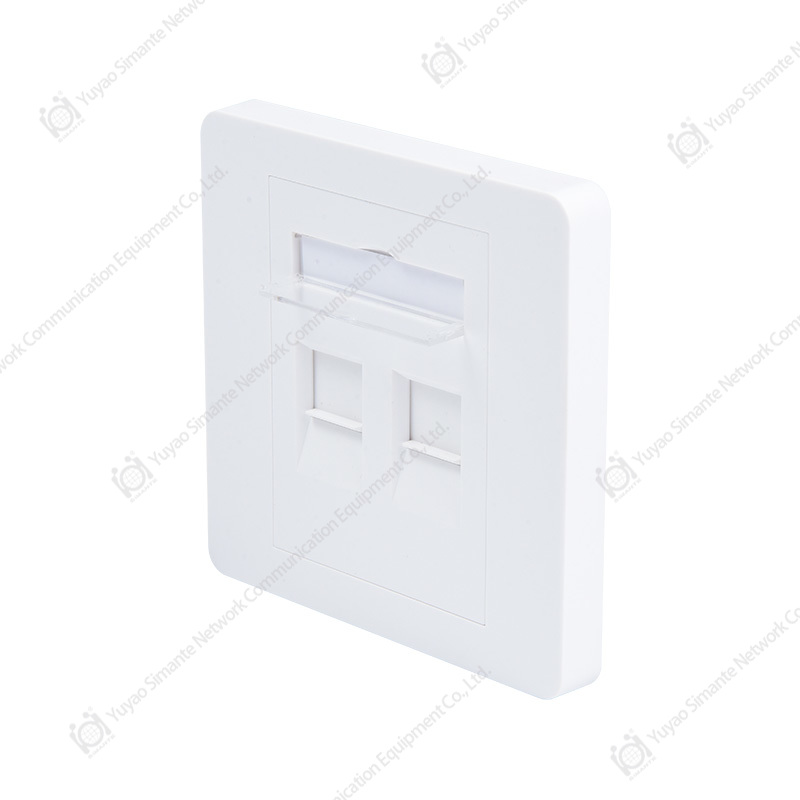
Product Overview
The SMT-4332-86F-2P Two Port 86 Type Faceplate is a wall-mounted network outlet faceplate designed to accommodate two cabling ports. The product belongs to the 2 port faceplate category and is suitable for structured cabling systems that include copper network connections, fiber-related network access points, or mixed low-voltage communication layouts when paired with suitable modules and accessories. It is used as the visible finishing component installed on the wall, workstation panel, or outlet position.
The 86 type format is widely recognized in many markets as a convenient wall plate size. This makes the faceplate suitable for standard installation boxes and common wall outlet arrangements. For installers and project contractors, this compatibility helps reduce installation uncertainty, simplifies inventory planning, and supports faster site deployment. For end users, the faceplate provides a clean and orderly connection point that integrates naturally with interior environments.
The two port configuration is particularly useful because it balances space efficiency and functional flexibility. A single outlet location can serve two separate network lines, two devices, or two service categories. In a modern office, one port may be dedicated to a workstation and another to an IP phone. In a smart home, the ports may support a router extension, a smart TV, a security device, or a home office connection. In a commercial installation, the faceplate can support service distribution in meeting rooms, hotel rooms, classrooms, medical spaces, retail counters, or public service areas.
Although the faceplate is a relatively small component, it must be produced with careful attention to material stability, molding accuracy, surface finish, port alignment, and installation reliability. Poorly manufactured faceplates may crack, deform, fit loosely, expose gaps, create uneven appearance, or make module installation difficult. A high-quality faceplate should remain dimensionally stable, allow modules to fit properly, resist daily handling, and maintain a clean appearance after installation. These qualities are central to the value of this product.
Role of the Faceplate in Structured Cabling
Structured cabling is more than the cable itself. It is a complete system involving patch panels, keystone jacks, modules, faceplates, wall boxes, patch cords, cable management, and testing. The faceplate is the user-facing part of the system. It transforms concealed cabling into a usable network outlet. A professional faceplate supports a stable connection environment and helps organize the endpoint of the cabling channel.
In copper systems, the faceplate often holds keystone jacks used for Ethernet connectivity. These may support categories such as Cat5e, Cat6, Cat6A, or other performance levels depending on the jack and installation design. In fiber-related environments, faceplates may be used with suitable adapters or modules where local optical access is required. The two port design allows flexibility for different combinations, provided that compatible inserts and installation accessories are selected.
A faceplate also assists maintenance. When network troubleshooting is required, the outlet location must be easy to identify, access, and inspect. A neatly installed faceplate reduces the risk of accidental contact with internal wiring and supports organized labeling. In large buildings, outlet consistency becomes very important because technicians may handle hundreds or thousands of connection points. A standardized faceplate design helps simplify documentation and service routines.
In addition, the faceplate contributes to the visual quality of the completed project. Clients often judge the professionalism of a cabling installation by what they can see: wall outlets, racks, patch panels, cable routing, and finishing details. A clean 86 type faceplate gives the network outlet a refined appearance and helps the installation blend with the building interior. This is especially valuable in hotels, offices, schools, apartments, and commercial facilities where technology infrastructure must be functional without appearing messy.
Key Advantages of the Two Port 86 Type Design
The first major advantage of this faceplate is practical port density. A two port outlet provides more capability than a single port plate while remaining compact. It avoids the excessive footprint of larger multi-port plates in areas where only two services are required. This makes it a balanced option for many everyday network locations.
The second advantage is installation efficiency. Because the 86 type format is familiar to many installers, it can reduce learning time and job-site complications. A consistent wall plate size helps contractors coordinate with wall boxes, mounting positions, and electrical or low-voltage layouts. During large projects, even small improvements in installation speed can reduce labor cost and improve project delivery.
The third advantage is service flexibility. The two ports can be configured based on the needs of the project. For example, one faceplate may support two RJ45 keystone jacks, while another may be configured for data and voice, or for specialized communication modules. This flexibility is important for distributors, system integrators, and OEM customers who serve different markets and require adaptable components.
The fourth advantage is a clean and professional appearance. The visible outlet point should not look like an afterthought. A molded faceplate with proper alignment, smooth finish, and stable mounting supports an organized interior design. It also provides a clear boundary between the installed cabling and the user area.
The fifth advantage is maintainability. A well-designed faceplate supports easier inspection and replacement of modules when required. In fast-changing network environments, outlets may need upgrades or reconfiguration. A faceplate that supports common structured cabling practices gives technicians a convenient platform for ongoing service.
Product Features and Practical Benefits
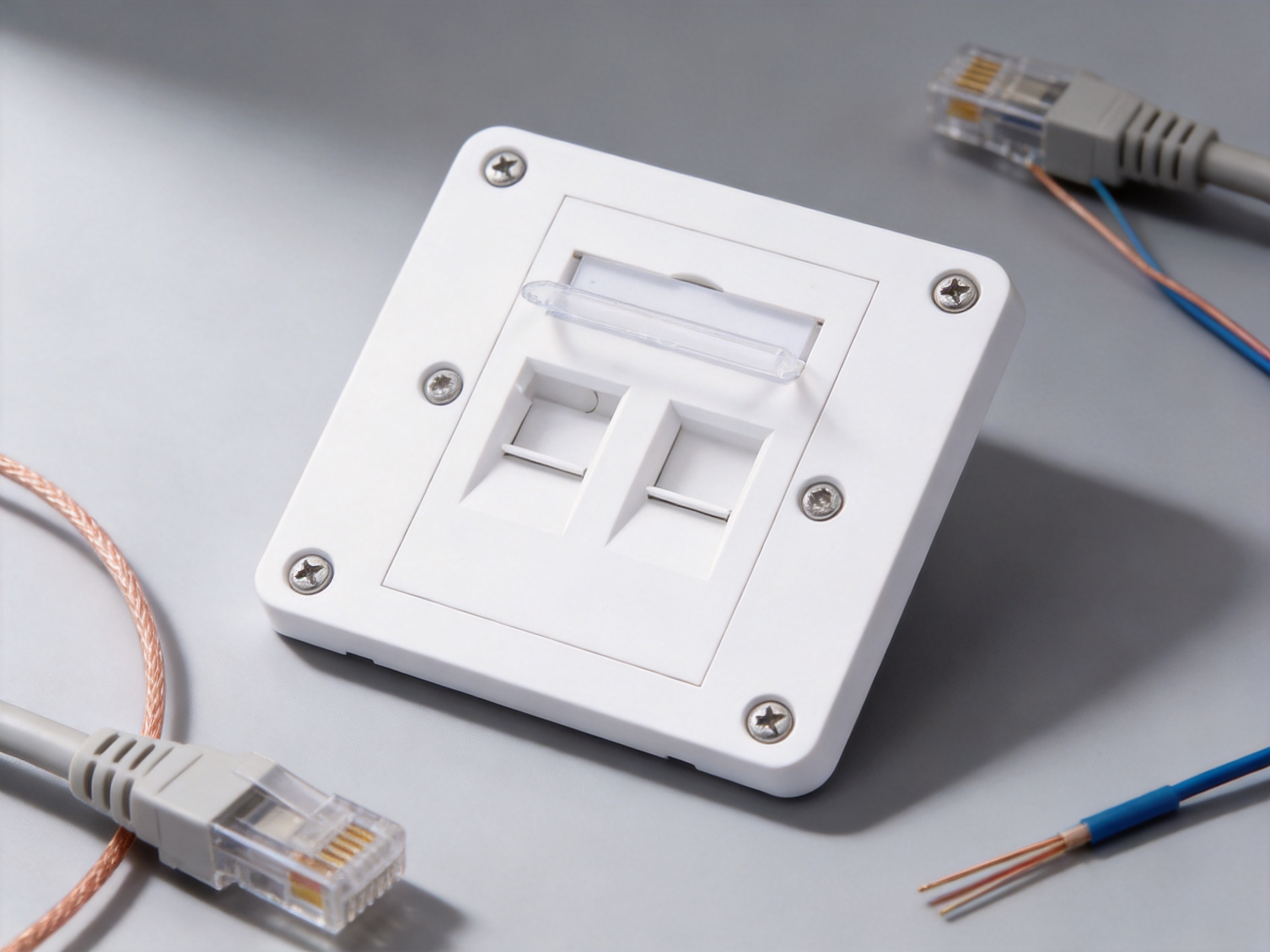
The SMT-4332-86F-2P is designed for structured cabling applications where quality, convenience, and versatility are important. Its two port layout provides a compact outlet solution for multi-service access. The faceplate helps protect the connection area while presenting a neat external finish. Its size and configuration make it suitable for office deskside walls, building service panels, smart home outlet points, and commercial spaces.
One of its practical benefits is compatibility with organized cabling design. Structured cabling depends on repeatable components. When a project uses standardized faceplates across many rooms, the result is easier documentation and a more consistent appearance. The two port faceplate supports this consistency while still giving each outlet adequate functionality.
Another benefit is improved outlet planning. Designers can specify two ports for locations where future growth is likely. Even if one port is initially used, the second port can provide expansion capacity for later needs. This is useful in office environments where personnel, equipment, and network requirements often change. Installing a two port plate at the beginning may be more efficient than reopening walls or replacing plates later.
The product also supports user convenience. End users can connect devices directly to the wall outlet rather than relying on loose cabling or temporary adapters. This helps reduce clutter and improves safety. In commercial and public environments, stable wall outlets are preferable to exposed cabling because they reduce the chance of accidental damage or disconnection.
The faceplate’s role in protecting termination points should not be underestimated. Cable ends and modules are vulnerable when left exposed. A faceplate helps keep the outlet organized and reduces contact with internal components. When paired with proper installation methods, it contributes to a longer-lasting cabling system.
Comparison with Common Competing Faceplates
Many faceplates in the market appear similar, but differences become clear during installation, long-term use, and project maintenance. Low-cost products may save a small amount at the purchasing stage but create problems later, including poor fit, inconsistent dimensions, weak plastic, uneven surfaces, inaccurate port openings, loose mounting, and limited compatibility with modules. These issues can increase labor time and reduce customer satisfaction.
The SMT-4332-86F-2P is supported by a manufacturer with extensive experience in network cabling products. The company’s background in keystone jacks, patch panels, wall face plates, data sockets, and related structured cabling components helps ensure that the faceplate is not treated as an isolated plastic part. Instead, it is developed as part of a complete network cabling ecosystem. This system-oriented understanding is an advantage over suppliers who only produce generic molded parts without deep cabling application knowledge.
Compared with many competitor products, this faceplate benefits from mature research and development processes. The manufacturer has more than 10 engineers and over 30 full-time technical personnel who contribute to product development, quality improvement, and product updates. This engineering support is important because faceplate quality depends on precise design details such as opening dimensions, wall thickness, clip positioning, screw alignment, surface consistency, and compatibility with cabling modules.
Manufacturing capability is another differentiator. The factory maintains 10 regular and customization production lines, 10 fully automatic injection molding machines, 20 semi-automatic injection molding machines, and 8 automatic installation machines. This production foundation supports stable annual output of more than 9 million units. Such capacity indicates that the company can handle volume demand while maintaining consistency, which is essential for distributors, wholesalers, contractors, and OEM customers.
The product also has an advantage in customization potential. Many projects require private labeling, specific packaging, color preferences, special module combinations, or regional market adjustments. The company undertakes OEM and ODM projects, meaning it can work with customers to adapt products to market requirements. This is a significant advantage over competitors that provide only fixed standard products with limited support.
| Evaluation Area | Two Port 86 Type Faceplate Advantage | Typical Weakness in Low-Grade Alternatives |
|---|---|---|
| Installation Fit | Designed for common 86 type wall outlet applications and structured cabling use | Inconsistent dimensions may cause loose or difficult installation |
| Port Flexibility | Two ports support multiple service combinations in one outlet position | Single-purpose designs may limit future expansion |
| Manufacturing Support | Produced by an experienced cabling equipment manufacturer with engineering resources | Generic suppliers may lack cabling system knowledge |
| Quality Consistency | Supported by established production lines, injection molding capacity, and testing awareness | Batch variation can lead to appearance and fit problems |
| Project Suitability | Appropriate for offices, smart homes, commercial buildings, and structured cabling projects | May be suitable only for basic or temporary use |
| Customization | OEM and ODM support available for market-specific requirements | Limited customization and packaging options |
Manufacturing Strength Behind the Product
A faceplate’s performance begins before it reaches the installation site. It begins with product design, tooling, raw material control, injection molding, inspection, assembly, packaging, and delivery. Yuyao Simante Network Communication Equipment Co., Ltd. has built its capabilities around network cabling and optical fiber products, allowing it to control multiple stages of this process.
The company’s nearly 20 years of service experience gives it a strong understanding of customer expectations in different markets. European customers may focus on consistent finishing and compliance-oriented documentation. Australian projects may emphasize rugged installation and long service life. Middle Eastern and African markets may require durability under varying environmental conditions. Southeast Asian customers may value cost-effective quality and flexible supply. A manufacturer serving these regions must balance product quality, stable output, and responsiveness.
Injection molding is especially important for faceplate production. The quality of the mold and the stability of the molding process determine dimensional accuracy, surface smoothness, structural strength, and batch consistency. With 10 fully automatic injection molding machines and 20 semi-automatic injection molding machines, the company has the equipment base to support large-scale and flexible production. Automatic molding improves repeatability, while semi-automatic capacity supports customized or varied production needs.
Automatic installation machines also support production efficiency and consistency for assembled products. While a faceplate itself may be simple, the company’s broader product range includes jacks, patch panels, data sockets, and other components requiring accurate assembly. This manufacturing environment encourages process discipline. A factory that produces multiple structured cabling components must pay attention to tolerances, testing, compatibility, and packaging quality.
Research and development strength is another foundation. The company has more than 10 engineers and over 30 full-time technical personnel who continue to improve quality and promote product updates. For a faceplate, engineering improvement may involve optimizing material use, strengthening clip structures, improving surface finish, refining port geometry, enhancing compatibility with modules, or adjusting designs for customer needs. These details can have a real effect on installation satisfaction.
Quality Management and Testing Awareness
High-end market positioning requires more than attractive appearance. It requires process control and testing. The company emphasizes strict production management and comprehensive performance testing based on customer requirements. For structured cabling products, testing may relate to mechanical fit, durability, electrical performance for associated components, environmental resistance, packaging strength, and batch consistency. A faceplate must be compatible with the system components it supports, and the overall solution must meet the expectations of network infrastructure professionals.
Quality stability starts at the design source. Mature research and development systems help prevent defects before mass production begins. This is important because a design flaw in a high-volume component can affect thousands of installations. By reviewing product structure, tooling feasibility, installation method, and customer feedback, the manufacturer can improve reliability before production scales up.
During production, process discipline helps maintain consistent dimensions and finish. Injection molding parameters such as temperature, pressure, cooling time, and material flow must be controlled. If these variables are unstable, the product may warp, shrink unpredictably, or show surface defects. Experienced production teams and appropriate equipment reduce these risks.
Inspection is also critical. Faceplates should be checked for visible defects, correct port opening, mounting alignment, smooth edges, and packaging accuracy. When products are shipped internationally, packaging must protect the finish and prevent deformation. A reliable manufacturer understands that quality does not end when the product leaves the molding machine; it continues through assembly, storage, packing, shipment, and customer installation.
Another important part of quality management is customer communication. Since the company integrates design, development, sales, and service, it can respond to feedback from distributors, contractors, and OEM customers. This feedback loop supports product updates and helps the manufacturer remain aligned with changing market needs.

Application Scenarios
The two port 86 type faceplate is suitable for a wide range of structured cabling applications. In office buildings, it can be installed at workstations, meeting rooms, reception counters, management offices, and shared collaboration spaces. Two ports allow one outlet location to serve both a computer and an IP phone, or a computer and a secondary device such as a printer, display system, or access control terminal.
In smart homes, the faceplate can support wired network points for televisions, routers, desktop computers, security cameras, smart control panels, and home automation equipment. While wireless networks are common, wired connections remain valuable for stable bandwidth, low latency, and secure transmission. A neat wall outlet improves the appearance of home network infrastructure and reduces exposed wiring.
In hotels and apartments, two port faceplates support guest connectivity, IPTV systems, service terminals, and management networks. A standardized faceplate format helps property developers and installers maintain consistent room layouts. It also simplifies future maintenance because technicians can easily locate and identify network outlets.
In schools and universities, network outlets are needed in classrooms, laboratories, offices, libraries, and public learning spaces. A two port faceplate can support teaching equipment, computers, access points, interactive displays, or administrative devices. The clean appearance is also helpful in learning environments where exposed cabling can become a safety or maintenance issue.
In healthcare and public service facilities, structured cabling must be organized and reliable. Network outlets may support workstations, registration terminals, medical administrative equipment, monitoring devices, and communication systems. While the specific system requirements may vary, a dependable faceplate contributes to a cleaner and more manageable infrastructure.
In industrial automation and smart building systems, low-voltage network points are increasingly used for sensors, controllers, gateways, and monitoring devices. A compact two port wall plate offers a convenient endpoint for communication links while helping protect the connection area from casual contact.
Design Value for Contractors and System Integrators
Contractors and system integrators need products that are predictable. They must install many units within limited project schedules, often while coordinating with other trades. A faceplate that fits properly, looks consistent, and supports standard installation methods helps reduce rework. Rework is costly because it consumes labor, delays project progress, and can damage customer trust.
The two port 86 type faceplate supports efficient outlet planning. System integrators can standardize on one faceplate format for many locations while changing the internal modules according to the project requirement. This reduces inventory complexity. Instead of carrying many different wall plate styles, installers can use a flexible two port platform for common outlet positions.
For contractors, visual consistency matters. A building with mismatched outlet plates appears unprofessional even if the network functions correctly. Using a consistent faceplate from a manufacturer experienced in structured cabling helps deliver a polished finish. This can improve client satisfaction and strengthen the contractor’s reputation.
Serviceability is another benefit. After a project is completed, building owners may request changes, repairs, or upgrades. A two port faceplate provides accessible connection points and supports structured maintenance. When the outlet arrangement is consistent, technicians can work more efficiently. This reduces long-term operating costs for building owners and improves the value of the original installation.
Value for Distributors, Wholesalers, and OEM Customers
For distributors and wholesalers, the product’s value is not only in its function but also in its marketability. A two port 86 type faceplate is a frequently needed cabling accessory. It can be sold alongside keystone jacks, patch panels, patch cords, data sockets, wall boxes, and other structured cabling products. Because it is used in many project types, it can become a stable inventory item.
The manufacturer’s production capacity supports reliable supply. With 10 regular and customization production lines and annual output exceeding 9 million, the company can support both standard orders and customized projects. This matters for distributors who must maintain stock availability and respond to contractor demand quickly.
OEM and ODM capability is particularly important. A distributor may need private brand packaging, modified product appearance, special color options, or market-specific labeling. An OEM customer may require a complete product family with consistent design language. The company’s experience in customization projects makes it a suitable partner for customers seeking more than simple spot purchasing.
Quality consistency also supports brand reputation. When distributors sell cabling accessories under their own brand or through long-term channels, inconsistent product quality can damage customer trust. Working with an experienced manufacturer reduces the risk of complaints related to poor fit, weak material, or unstable appearance.
International export experience is another strength. The company maintains stable export volume in Europe, Australia, Africa, the Middle East, and Southeast Asia. This indicates familiarity with shipping requirements, packaging expectations, international communication, and varied customer standards. For buyers, this experience can reduce friction in procurement and after-sales coordination.
Material and Structural Considerations
Although specific material details may vary according to customer requirements and production configuration, a high-quality faceplate should be designed with appropriate plastic material, stable structural geometry, and reliable mounting features. The material should support dimensional stability and daily durability. It should resist cracking under normal installation pressure and maintain a clean appearance over time.
Structural design affects both strength and installation feel. The faceplate should have suitable wall thickness, proper mounting hole alignment, and accurate port openings. If a faceplate is too thin, it may feel weak or deform during installation. If it is poorly molded, modules may not sit correctly. If the port opening is inaccurate, the finished outlet may look uneven or interfere with plug insertion.
Surface finish is another important consideration. In visible building areas, users expect a smooth and clean outlet appearance. Surface defects, discoloration, sharp edges, or inconsistent texture can reduce perceived quality. A manufacturer with stable injection molding processes is better able to maintain surface consistency across batches.
The faceplate must also support practical installation. Installers often work under time pressure, sometimes in confined spaces or during final construction stages. Components should be easy to position, fasten, and align. A well-made faceplate helps installers produce professional results without excessive adjustment.
Installation Best Practices
Proper installation is essential to achieve the full benefit of the two port 86 type faceplate. Before installation, the technician should confirm that the wall box or mounting position is suitable for the 86 type plate. The cabling should be routed correctly and should not be forced into sharp bends. Cable bend radius is important for maintaining signal performance, especially in high-speed copper networks and fiber-related installations.
The selected modules or keystone jacks should be compatible with the faceplate and the cabling category. For copper Ethernet installations, the installer should terminate the cable according to the project wiring standard, such as T568A or T568B, and should ensure consistent wiring across the channel. For fiber-related applications, compatible adapters and proper fiber handling practices should be used.
After module installation, the faceplate should be mounted evenly. Screws should be tightened securely but not excessively. Over-tightening may stress the plastic or distort the plate. The final installation should sit flush and straight against the wall surface. If labeling is required, it should be applied clearly and consistently according to the project documentation.
Testing should follow installation. For copper channels, certification or verification testing may be performed depending on project requirements. For fiber channels, optical inspection and testing may be necessary. While the faceplate itself is not the only determinant of channel performance, a clean and organized outlet helps protect the integrity of the termination and makes testing and maintenance easier.
Contribution to Long-Term Network Reliability
Network reliability depends on physical infrastructure. Even as wireless technologies expand, wired cabling remains the backbone of many communication systems. It supports high-speed data transfer, security, low latency, and stable power or signal delivery for many devices. Faceplates are part of this physical layer and help preserve the organization of connection points.
A low-quality outlet can create indirect reliability issues. If the faceplate fits poorly, modules may move or become exposed. If it cracks, users may handle connections carelessly. If outlets are not clearly organized, maintenance technicians may make errors. A well-designed faceplate reduces these risks by supporting a stable and professional endpoint.
Long-term reliability also includes adaptability. Buildings change over time. Offices are rearranged, homes receive new devices, hotels upgrade entertainment systems, schools add digital learning equipment, and factories install more automation. A two port outlet provides practical capacity for these changes. It helps future-proof the installation compared with single-port designs that may become insufficient sooner.
By choosing a faceplate manufactured within a mature structured cabling production system, customers gain confidence that the component is suitable for professional deployment. The product is not merely a cover; it is part of the channel environment and part of the user experience.

Why the Manufacturer’s Experience Matters
Yuyao Simante Network Communication Equipment Co., Ltd. is a professional manufacturer of network cabling solutions and optical fiber products. Its product range includes keystone jacks, patch panels, wall face plates, data sockets, and other components widely used in structured cabling, network communication, smart home systems, automation equipment, and related fields. This broad experience gives the company insight into how each component interacts within a complete cabling infrastructure.
The company’s approach combines design, development, sales, and service. This integration is important because customer requirements do not stop at product drawings. Customers need technical communication, stable production, packaging support, delivery coordination, and after-sales responsiveness. A manufacturer that understands the full customer journey is better positioned to provide value.
The factory’s production resources demonstrate manufacturing depth. Ten regular and customization production lines allow the company to handle standard production and customized orders. Fully automatic and semi-automatic injection molding machines provide both efficiency and flexibility. Automatic installation equipment supports consistency in assembled products. Together, these capabilities support stable annual output and reliable supply for customers.
Engineering talent also matters. More than 10 engineers and over 30 full-time technical personnel help maintain product improvement and quality stability. In competitive cabling markets, small design improvements can create meaningful advantages. Better fit, stronger structure, cleaner finish, and easier installation all contribute to customer satisfaction.
The company’s export experience further strengthens its position. Serving customers across multiple regions requires adaptability and quality awareness. Different markets have different preferences for packaging, product combinations, documentation, and service. A supplier with international experience is better prepared to support long-term cooperation.
High-End Market Orientation
The company states that it is based on the high-end market and therefore has higher requirements for product quality. This market orientation is important for buyers who need more than the lowest possible price. In structured cabling, the cost of a faceplate is small compared with the total cost of labor, testing, project delay, and long-term maintenance. A slightly cheaper component can become expensive if it causes installation problems or customer complaints.
High-end orientation means focusing on consistency, stable performance, careful production management, and customer testing requirements. It also means understanding that buyers expect products to be suitable for professional environments. A faceplate used in a corporate office, hotel, school, or smart building must look good and function reliably. It cannot feel fragile or inconsistent.
This quality-focused approach helps the SMT-4332-86F-2P compete against generic alternatives. The product is supported by manufacturing scale, engineering capability, and cabling industry experience. These factors combine to create a stronger value proposition than a basic low-cost plate from a supplier without structured cabling expertise.
Integration with Copper and Fiber Systems
The product belongs within the broader copper and fiber system category. In copper networks, it can be used as part of a workstation outlet with appropriate keystone jacks. Copper cabling remains widely used for Ethernet connectivity in offices, homes, commercial buildings, and industrial facilities. Faceplates provide the endpoint interface where users connect patch cords to access the network.
In fiber systems, faceplate-style outlets may support fiber access points when used with suitable adapters and accessories. Fiber is increasingly important for high-bandwidth, long-distance, and future-ready network deployments. Even when fiber does not terminate at every workstation, structured outlets and wall plates may be used in specialized areas, telecom rooms, equipment rooms, or high-performance installations.
The ability to support structured cabling environments across copper and fiber-related use cases makes the two port faceplate a flexible accessory. It can be incorporated into a complete cabling product line that includes patch panels, jacks, sockets, and other network communication equipment. This integration is beneficial for customers who prefer to source multiple components from one experienced manufacturer.
Procurement Considerations
When selecting a two port faceplate, buyers should consider more than unit price. They should evaluate compatibility, material quality, molding consistency, packaging, supplier capacity, customization options, and long-term support. The faceplate must match the installation environment and the modules to be used. Buyers should confirm required color, mounting style, port type, labeling needs, and packaging requirements before placing bulk orders.
For large projects, sample approval is recommended. Samples allow contractors and buyers to check fit, finish, module compatibility, and installation feel. They can also evaluate whether the product appearance matches project expectations. Once approved, stable batch production becomes essential.
Distributors should also consider product family consistency. If they sell keystone jacks, patch panels, and data sockets, faceplates should be compatible and visually coordinated with the rest of the line. A manufacturer offering a broad range of cabling components can help distributors build a coherent product portfolio.
OEM customers should communicate brand, packaging, and technical requirements clearly. Since the manufacturer supports OEM and ODM projects, customization can be discussed according to order quantity and market needs. Early communication helps ensure that tooling, production, and packaging align with customer expectations.
Q&A Section
What is the SMT-4332-86F-2P Two Port 86 Type Faceplate used for?
It is used as a wall outlet faceplate for structured cabling systems. It provides two port positions for network or communication modules, helping create a clean and organized connection point for copper or fiber-related cabling applications.
Why choose a two port faceplate instead of a single port faceplate?
A two port faceplate offers greater flexibility and future expansion capacity while remaining compact. It can support two network lines, data and voice combinations, or multiple device connections at the same outlet location.
Where can this faceplate be installed?
It can be installed in offices, smart homes, hotels, apartments, schools, commercial buildings, automation environments, and other locations requiring structured network outlets.
What does 86 type mean?
In this context, 86 type refers to a common wall plate format used in many installation environments. It helps support compatibility with suitable wall boxes and standardized outlet positions.
Does the faceplate work with copper cabling systems?
Yes. When paired with appropriate keystone jacks or modules, it can be used in copper structured cabling systems such as Ethernet network outlets.
Yes, it may be used in fiber-related outlet applications when configured with suitable adapters or modules. The exact configuration should be confirmed according to project requirements.
What makes this product competitive compared with generic alternatives?
Its value comes from a combination of practical design, two port flexibility, support from an experienced structured cabling manufacturer, stable injection molding capability, engineering resources, production scale, and OEM or ODM service options.
Why is manufacturing capability important for a faceplate?
Manufacturing capability affects dimensional accuracy, surface finish, product strength, batch consistency, and delivery reliability. A faceplate with poor molding quality can create installation problems and reduce the professional appearance of a project.
Can the product support customized orders?
The manufacturer undertakes OEM and ODM projects, so customization may be available depending on requirements such as packaging, branding, color, and market-specific needs.
What should installers check before installation?
Installers should confirm wall box compatibility, module compatibility, cable routing, termination quality, screw alignment, and final plate position. They should avoid excessive cable bending and avoid over-tightening screws.
Conclusion
The SMT-4332-86F-2P Two Port 86 Type Faceplate is a practical and reliable component for modern structured cabling systems. Its two port design provides flexibility for network access points, while its 86 type format supports common installation needs. It is suitable for offices, homes, hotels, educational facilities, commercial spaces, automation systems, and other environments where clean, organized, and maintainable network outlets are required.
Its competitive strength lies not only in the product design but also in the manufacturing foundation behind it. Yuyao Simante Network Communication Equipment Co., Ltd. brings nearly 20 years of experience in network cabling solutions and optical fiber products. With engineering teams, technical personnel, multiple production lines, automatic and semi-automatic injection molding machines, automatic installation equipment, and international export experience, the company is well positioned to supply consistent cabling components for professional markets.
For contractors, the faceplate supports efficient installation and a polished project finish. For distributors, it is a practical product with broad market demand. For OEM and ODM customers, it offers customization potential supported by manufacturing capacity. For end users, it contributes to a cleaner and more reliable network access point.
In structured cabling, small components can have a large impact on the final quality of the installation. A faceplate protects, organizes, and presents the network outlet that users interact with every day. Choosing a well-made two port 86 type faceplate helps create a cabling system that is not only functional, but also professional, serviceable, and ready for future communication needs.
References
1. BICSI. Telecommunications Distribution Methods Manual.
2. ISO/IEC 11801. Information Technology: Generic Cabling for Customer Premises.
3. ANSI/TIA-568. Commercial Building Telecommunications Cabling Standard.
4. ANSI/TIA-569. Telecommunications Pathways and Spaces.
5. Fluke Networks. Cabling Certification and Structured Cabling Testing Principles.
6. Newton, H. Newton’s Telecom Dictionary.