Español
 عربى
 русский
Content
- 1 Introduction
- 2 Product Overview
- 3 Why Category 6A Termination Matters
- 4 Advantages of the 90-Degree Toolless Design
- 5 Electrical and Mechanical Performance
- 6 Installation and Termination Guidance
- 7 Applications
- 8 Manufacturing Strength and Quality Control
- 9 Environmental and Compliance Considerations
- 10 Comparison with Conventional Keystone Jacks
- 11 Selection and Project Planning Checklist
- 12 Maintenance and Long-Term Reliability
- 13 Q&A
- 13.1 What is the main purpose of this product?
- 13.2 What does CAT6A capability provide?
- 13.3 Can this jack be used with CAT6 or CAT5e cable?
- 13.4 What is the benefit of the 90-degree structure?
- 13.5 Is a punch-down tool required?
- 13.6 Does the jack support both T568A and T568B?
- 13.7 What cable size is supported by the IDC terminal?
- 13.8 Why is shielding important?
- 13.9 What materials are used in the jack?
- 13.10 How durable is the connector?
- 13.11 What environmental conditions are supported?
- 13.12 Can the product be customized?
- 13.13 What makes the manufacturer suitable for large projects?
- 14 Conclusion
- 15 References
- 16 Product: SMT-1043T8C6A-FTP 90 Degree Shielded CAT6A Toolless Keystone Jack

Introduction
Modern communication networks depend on reliable connections at every point in the structured cabling system. Even when high-quality Category 6A cable, patch panels, and network equipment are installed, the performance of the complete channel can be limited by the quality of the termination hardware. Keystone jacks are especially important because they connect horizontal cabling with work-area outlets, patch panels, wall plates, and other modular components. A poorly designed jack can increase insertion loss, reduce return loss performance, create excessive crosstalk, or make installation unnecessarily slow.
The SMT-1043T8C6A-FTP 90 Degree Shielded CAT6A Toolless Keystone Jack is designed for high-performance copper structured cabling systems that require Category 6A transmission capability, shielding, compact installation, and dependable field termination. It supports transmission frequencies from 1 to 500 MHz and follows both T568A and T568B wiring schemes. Its 90-degree structure helps manage cable routing in confined spaces, while the toolless termination concept can simplify installation and reduce dependence on specialized punch-down tools.
This product is suitable for communication sockets, modular patch panels, wall outlets, equipment connections, and work-area cabling. It also provides backward compatibility with CAT6, CAT5e, and lower-category systems when used with compatible components. By combining an RJ45 interface, IDC termination, shielded construction, high-low contact positioning, corrosion-resistant metal parts, and a compact modular form factor, the jack addresses many of the practical challenges faced by installers and network operators.
In addition to product performance, the manufacturing capability behind the jack is an important consideration for distributors, system integrators, and original equipment customers. A dependable supplier must be able to control materials, injection molding, assembly, inspection, testing, packaging, and customization. Yuyao Simante Network Communication Equipment Co., Ltd. has developed a production and engineering system that supports standard products as well as OEM and ODM projects. Its manufacturing resources include multiple injection molding machines, automatic assembly equipment, dedicated production lines, and technical personnel responsible for product development and quality control.
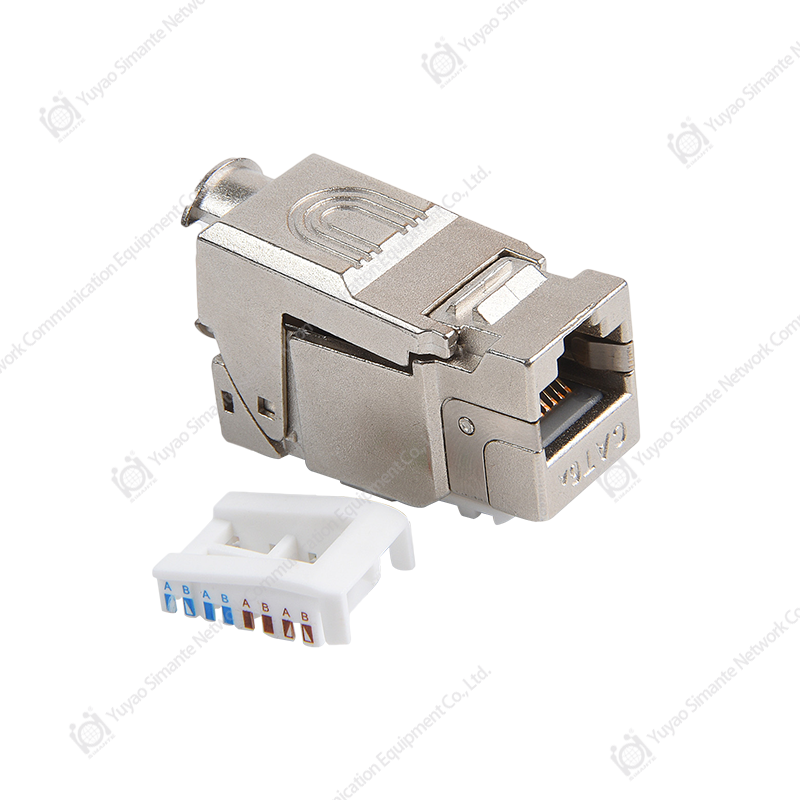
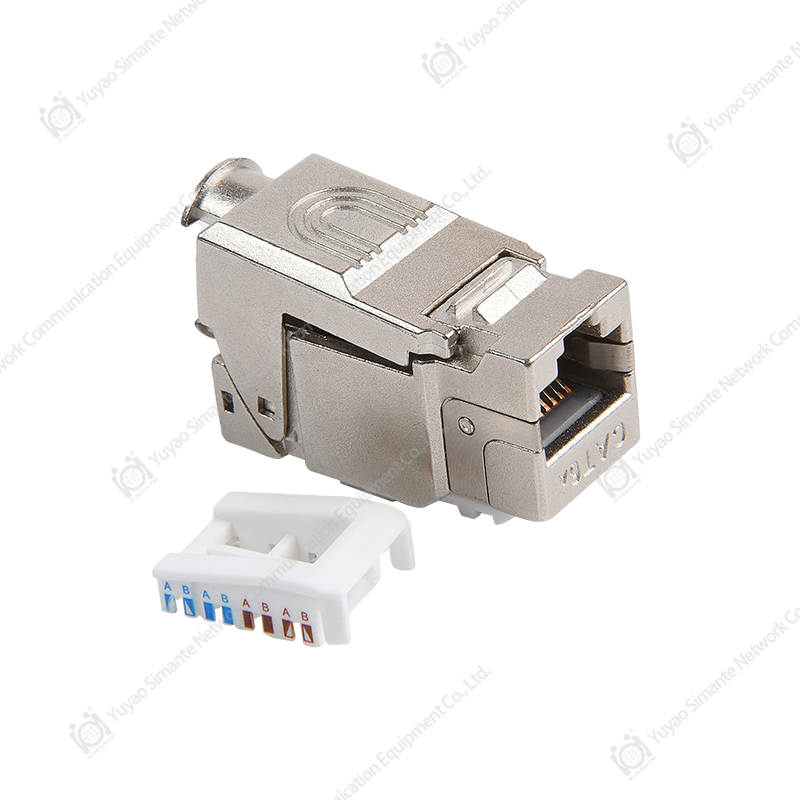
SMT-1043T8C6A-FTP 90 Degree Shielded CAT6A Toolless Keystone Jack
Product Overview
The SMT-1043T8C6A-FTP is a shielded CAT6A keystone jack with a 90-degree configuration and a toolless termination design. It is intended for horizontal cable termination and work-area connections within structured cabling systems. The jack is compatible with standard modular outlets and patch panels, allowing network designers to create flexible copper distribution systems without changing the basic installation architecture.
The product is engineered to meet Category 6A transmission requirements and is suitable for applications involving high-bandwidth Ethernet and other communication services. Its operating frequency range extends from 1 to 500 MHz, making it appropriate for systems that require increased bandwidth and improved resistance to interference compared with lower-category cabling components.
The housing incorporates a shielded construction. Shielding can help manage electromagnetic interference when the jack is installed as part of a properly bonded and compatible shielded cabling channel. This is particularly useful in industrial environments, equipment rooms, data centers, commercial buildings, and other locations where electrical equipment, motors, power distribution, or dense cabling may generate unwanted interference.
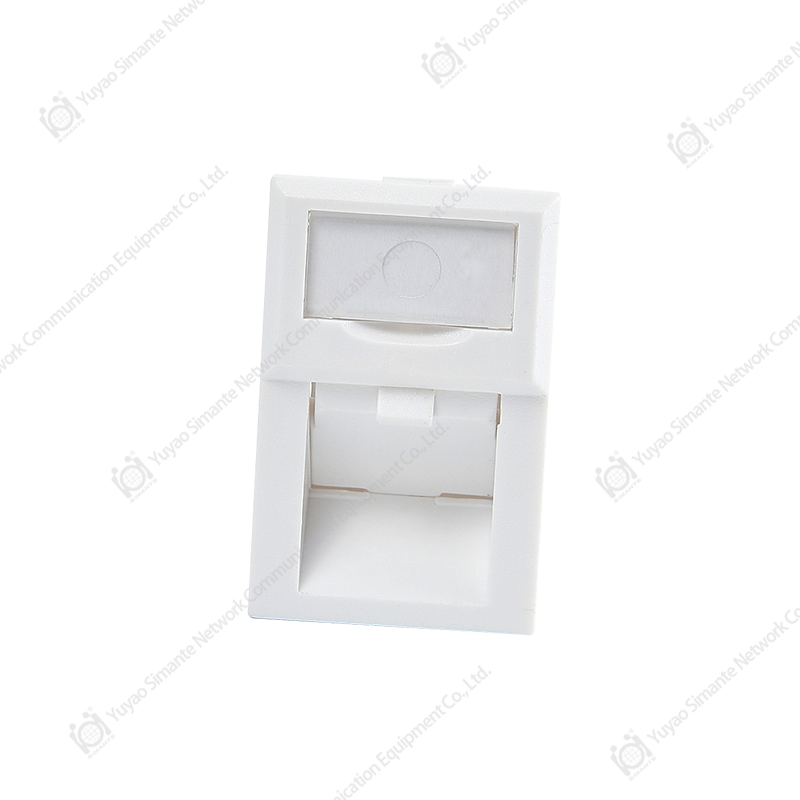
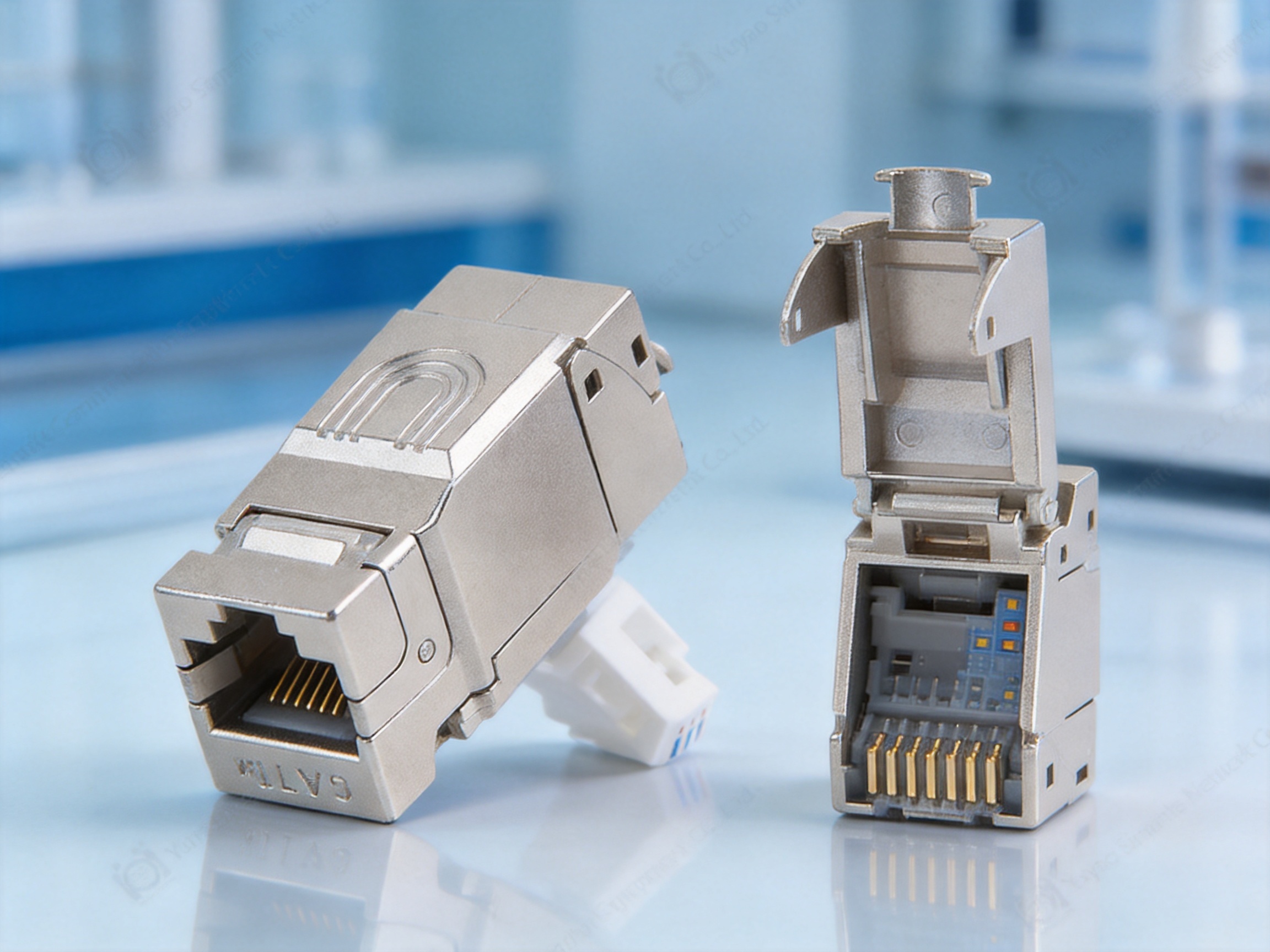
The 90-degree form is intended to support practical cable routing. Instead of forcing the incoming cable to bend sharply in line with the front face of a conventional straight jack, the angled configuration can guide the cable toward the rear or side of the termination area. This can assist installation in shallow wall boxes, compact patch panels, furniture outlets, and high-density distribution areas.
The toolless structure is another key feature. Traditional IDC termination methods may require a dedicated punch-down tool and a relatively large working area. A toolless jack can reduce the number of tools needed for field installation and may shorten the termination process. It also provides a convenient option for installers working in locations where carrying or using a punch-down tool is difficult.
Core Product Characteristics
| Item | Specification or Feature |
|---|---|
| Product type | 90-degree shielded CAT6A toolless keystone jack |
| Model | SMT-1043T8C6A-FTP |
| Transmission frequency | 1–500 MHz |
| Wiring standards | T568A and T568B |
| Interface | RJ45 jack with IDC termination |
| Backward compatibility | CAT6, CAT5e, and lower-category systems |
| IDC conductor range | 23–26 AWG twisted-pair cable |
| Working voltage | 125 V |
| Withstand voltage | DC 1000 V or AC 750 V for one minute without breakdown or arcing |
| Initial insulation resistance | At least 200 MΩ |
| Humidity-tested insulation resistance | At least 100 MΩ after constant damp heat testing |
| Plug and socket durability | 750 insertion and withdrawal cycles |
| Wire termination durability | 250 termination cycles |
| Operating temperature | -25°C to +70°C |
| Plastic material | PC polycarbonate |
| Printed circuit board | FR4 |
| Metal contacts | Phosphor bronze with gold or nickel plating according to position |
Why Category 6A Termination Matters
Category 6A systems are designed for higher-frequency transmission than CAT6 and CAT5e systems. The higher performance level is valuable for applications such as high-speed Ethernet, data-center connectivity, enterprise networks, surveillance systems, wireless access point backhaul, building automation, and other services that require stable bandwidth.
However, the category rating of a complete link is determined by the combined performance of the cable, connectors, patch panels, outlets, patch cords, installation practices, and test results. A CAT6A cable connected to a lower-quality or poorly terminated jack cannot deliver the full benefit of the cable. The jack therefore needs appropriate contact geometry, insulation, mechanical stability, and crosstalk control.
The SMT-1043T8C6A-FTP uses a high-low dislocation contact arrangement intended to reduce near-end crosstalk. Near-end crosstalk occurs when a signal on one pair creates unwanted interference in an adjacent pair near the transmitting end. In high-frequency systems, crosstalk control is essential because it directly affects signal integrity, error rates, and the usable performance margin of the channel.
The product supports both T568A and T568B wiring sequences. This provides installation flexibility because different projects may specify different wiring conventions. Clearly marked sequence labels on the module help installers identify the correct conductor positions and reduce the chance of termination errors. In large installations, clear labeling is especially useful because small wiring mistakes can lead to troubleshooting delays and inconsistent documentation.
Backward compatibility also improves project flexibility. A CAT6A jack may be installed in a network that currently uses CAT6 or CAT5e cabling, while leaving open the possibility of future upgrades. The existing jack can continue to support compatible lower-category components, provided that the complete channel is designed and tested according to the relevant category requirements.
Advantages of the 90-Degree Toolless Design
Improved Cable Routing
A straight jack can require the cable to approach the termination area in a direct line. In a crowded enclosure, this may result in tight bends, pressure on the cable jacket, or interference with neighboring modules. A 90-degree design provides a different cable entry path and can make it easier to organize conductors behind the faceplate or patch panel.
Proper cable routing is not only a matter of appearance. Excessive bending or pulling can alter the geometry of twisted pairs, increase return loss, and reduce the margin available for crosstalk performance. The angled design can help installers maintain a more controlled transition from the cable jacket to the termination area.
Efficient Installation
Toolless termination can reduce installation steps. The installer generally prepares the cable, follows the color code, positions the conductors, and closes or secures the termination mechanism according to the product design. Eliminating a separate punch-down tool can be useful for maintenance teams, small installation projects, rapid deployment work, and locations where access is restricted.
Fewer tools can also simplify logistics. A contractor working across multiple floors or buildings may not need to carry a specialized termination tool to every work area. For large projects, the time saved at each outlet can become significant when multiplied across hundreds or thousands of connections.
Compact Modular Installation
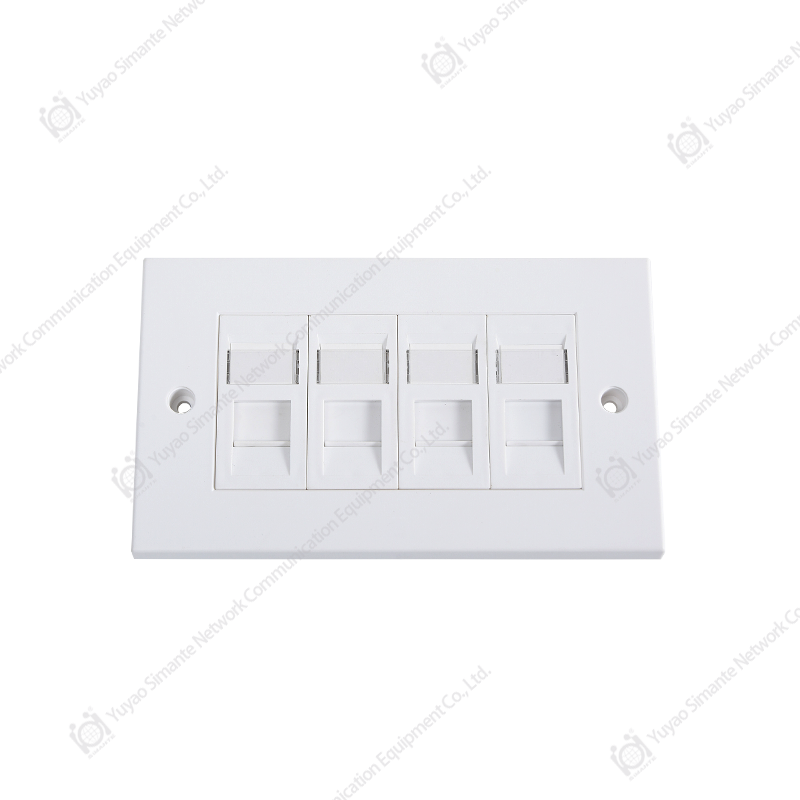
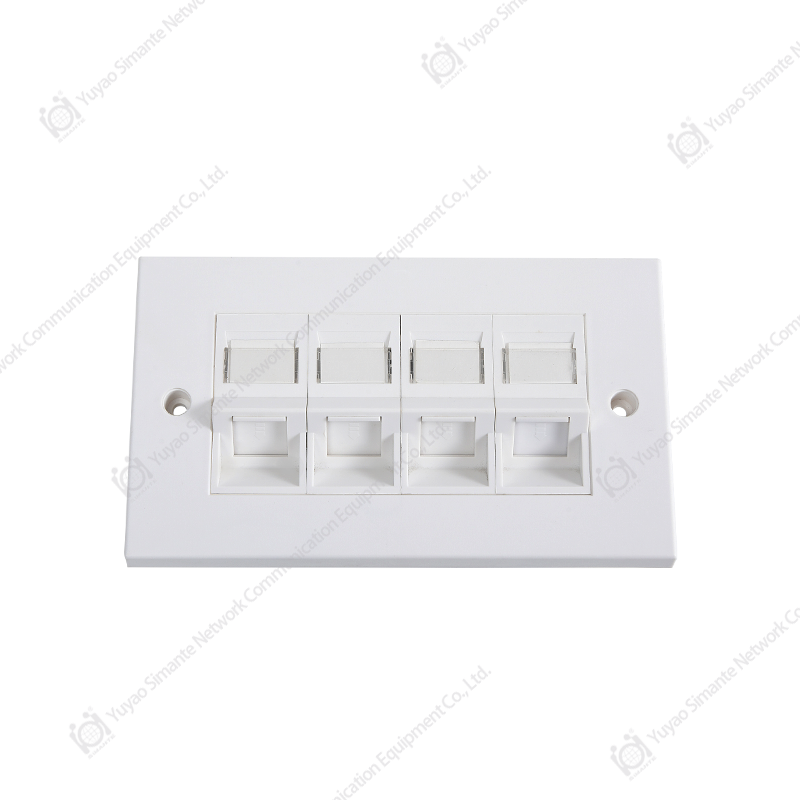
The compact keystone format allows the product to be installed in modular patch panels, wall plates, data sockets, and other compatible accessories. This makes it possible to combine copper communication outlets with other modular functions, including voice, video, fiber, or service-specific modules, depending on the selected faceplate or panel.
The embedded design also allows the jack to be installed on a distribution frame to create a modular distribution system. Modular construction is useful when network requirements change over time. Individual jacks can be replaced, rearranged, or upgraded without replacing an entire panel or wall plate.
Shielding for Demanding Environments
The shielded construction provides an additional layer of protection against electromagnetic interference when used with shielded cable, shielded patch panels, compatible shielded plugs, and a properly designed grounding and bonding system. Shielding is especially relevant in factories, transportation facilities, medical buildings, laboratories, broadcast locations, and equipment rooms with high electrical noise.
It is important to understand that a shielded connector cannot independently eliminate all interference. The complete channel must be compatible, and the metal path must be correctly connected. Nevertheless, a well-designed shielded jack gives system designers a practical component for building a more controlled and interference-resistant cabling channel.
Electrical and Mechanical Performance
Electrical Characteristics
The jack has a stated frequency range of 1 to 500 MHz and a working voltage of 125 V. Its withstand voltage is specified as DC 1000 V or AC 750 V for one minute, without breakdown or arcing. These values indicate that the product is designed for reliable insulation and electrical separation under specified test conditions.
Insulation resistance is specified at a minimum of 200 MΩ in the initial state and at least 100 MΩ after constant damp heat testing. High insulation resistance helps reduce leakage current and unwanted electrical interaction between contacts. Maintaining insulation performance after humidity exposure is important because real-world installations may experience temperature changes, condensation risk, or elevated humidity.
The product uses an FR4 printed circuit board. FR4 is a glass-reinforced epoxy laminate commonly used for electronic and communication assemblies because it offers mechanical stability, electrical insulation, and suitability for controlled circuit construction. The PCB supports the contact arrangement and helps maintain consistent spacing within the connector assembly.
Contact Materials and Surface Treatment
The gold contacts are made from phosphor bronze with gold plating. Phosphor bronze provides suitable spring characteristics and mechanical resilience for repeated mating. Gold plating is used on contact surfaces because it offers low contact resistance and good resistance to oxidation under normal operating conditions.
The IDC card wire terminals use phosphor bronze with nickel plating. Nickel provides a durable surface for the termination area and supports resistance to wear and environmental exposure. The stated gold-plating thickness range is 3 to 50U, depending on the applicable contact or configuration requirement. Material selection and surface treatment are essential because the connector must maintain contact integrity through installation, repeated patching, and long-term service.
The nonmetallic housing is made from PC polycarbonate. Polycarbonate is valued for its strength, dimensional stability, and resistance to impact. In a modular jack, the housing must protect internal contacts while maintaining accurate alignment with the mating plug and the mounting frame.
Mechanical Strength and Durability
The insertion force is specified as no more than 20 N, while the pull-out force is not less than 20 N. These requirements balance ease of use with sufficient retention. The connector should accept a compatible plug without excessive force while remaining secure during routine handling.
The connector connection device is tested at 50 N for 60 ± 5 seconds. This type of test evaluates the ability of the assembled connector to withstand a defined mechanical load. It is relevant to practical installations where cables may be moved, tied, or subjected to accidental pulling during maintenance.
The IDC terminals are designed for 23–26 AWG twisted-pair conductors. This range covers common horizontal cabling sizes used in structured network installations. Installers should confirm the cable diameter, conductor type, insulation dimensions, and compatibility before termination.
The product is rated for 750 plug-and-socket insertion cycles and 250 wire termination cycles. These durability values support repeated patching, service changes, testing, and maintenance. They are particularly beneficial in data rooms and telecommunications spaces where connections may be accessed more frequently than ordinary office outlets.
Installation and Termination Guidance
Planning the Cabling Channel
Before installation, the designer should confirm that the jack, cable, patch panel, patch cord, wall plate, and equipment interfaces are compatible. A shielded jack should normally be combined with compatible shielded components if the project requires a shielded channel. The grounding and bonding approach should be defined in accordance with the applicable project standard and local electrical requirements.
The installer should also verify whether the project uses T568A or T568B. Both wiring sequences are supported, but the selected sequence should be applied consistently across the installation unless a specific system design requires otherwise. Clear documentation can prevent accidental mixing of wiring practices.
Cable Preparation
The cable should be prepared carefully to preserve the twist structure of each pair. The jacket should be removed only as far as necessary for termination, and the conductors should not be untwisted more than required. Excessive untwisting can negatively affect crosstalk and transmission performance.
The incoming cable should be routed through the appropriate entry path created by the 90-degree design. Avoid sharp bends, crushing, excessive pulling force, or excessive tension at the termination point. Cable support should be provided so that the jack is not carrying the weight of a long unsupported cable section.
Following the Color Code
The wiring label on the module identifies the conductor positions for T568A and T568B. The installer should select the correct sequence and place each conductor in the corresponding IDC position. Maintaining pair integrity and correct pair placement is more important than simply matching individual colors because the connector is designed around the electrical relationship between the pairs.
After the conductors are positioned, the toolless termination mechanism can be secured according to the jack’s assembly method. The termination should be firm, and the conductors should not move freely after closure. Any visible damage to the housing, contacts, or cable jacket should be addressed before the connection is placed into service.
Testing After Installation
Every completed link should be tested with equipment appropriate to the required performance category. Testing may include wire map, length, insertion loss, return loss, propagation delay, delay skew, resistance, and crosstalk measurements. For CAT6A projects, certification testing is recommended when the installation must meet a formal performance requirement.
Testing can identify reversed pairs, split pairs, open conductors, short circuits, poor IDC contact, excessive untwisting, cable damage, and incompatibility between components. A high-quality jack improves the probability of passing certification, but installation technique and the performance of the complete channel remain equally important.
Applications
Commercial Office Networks
In office buildings, the jack can be used in wall outlets, floor boxes, furniture outlets, and modular work-area solutions. The compact form helps maintain a neat appearance, while the 90-degree cable path can assist installation behind shallow faceplates or within constrained furniture systems.
CAT6A capability provides a foundation for current high-speed network services and future bandwidth requirements. The jack can support connections for computers, IP phones, wireless access points, printers, network cameras, and other Ethernet-enabled equipment when the complete channel is designed appropriately.
Data Centers and Equipment Rooms
Data centers often require high port density, consistent labeling, reliable patching, and clear cable management. The modular jack format can be integrated into patch panels and distribution frames, allowing the system to be arranged according to rack layout and service requirements.
The 750-cycle plug durability rating is useful in areas where patch cords are changed regularly. The shielded construction may also be selected for equipment rooms where electromagnetic compatibility is a design consideration. Installation teams should ensure that the shield path and grounding system are implemented correctly.
Industrial and Building Automation Systems
Industrial buildings may contain motors, variable-frequency drives, control panels, lighting systems, and other sources of electrical noise. In these environments, shielded copper components can be part of a strategy to reduce the impact of interference on communication links.
The jack is also suitable for building automation and smart-building networks, including systems used for access control, environmental monitoring, energy management, and connected sensors. The modular format supports organized service outlets and makes future replacement easier.
Security and Surveillance Systems
Network cameras, recording systems, access-control devices, and security sensors increasingly rely on structured copper cabling. A dependable CAT6A termination can help maintain the physical-layer performance needed for stable network communication. The jack may be used in security cabinets, communication rooms, equipment panels, and remote outlets.
Installers should consider the environmental conditions of the camera or field device location. The stated operating temperature range is -25°C to +70°C, but the complete installation must also account for moisture, ultraviolet exposure, mechanical protection, and local enclosure requirements.
OEM and Custom Assemblies
Manufacturers of wall outlets, patch panels, network cabinets, communication boxes, and automation equipment may integrate the jack into their own products. A standard modular interface allows OEM designers to develop different front-panel configurations while using a consistent internal connectivity component.
For private-label and customized programs, packaging, labeling, color, faceplate design, documentation, and assembly requirements can be discussed with the manufacturer. The ability to support both regular production and customization is valuable for distributors and system brands that serve different regional markets.

Manufacturing Strength and Quality Control
Connector quality begins with design but depends heavily on manufacturing consistency. Dimensional variation in molded parts, inconsistent plating, inaccurate assembly, or inadequate inspection can affect electrical and mechanical performance. For this reason, the production system behind a CAT6A jack should be evaluated alongside the product specification.
Yuyao Simante Network Communication Equipment Co., Ltd. integrates design, development, sales, and service. Its engineering team includes more than ten engineers and over thirty full-time technical personnel. This technical structure supports product development, manufacturing improvement, testing, and customer communication.
The company operates ten regular and customization production lines. It also has ten fully automatic injection molding machines, twenty semi-automatic injection molding machines, and eight automatic installation machines. These resources support stable production of molded housings, internal assemblies, and completed communication accessories.
Injection molding capability is particularly important for keystone jacks because the housing must maintain accurate dimensions and alignment. Consistent molding helps ensure that the jack fits correctly into patch panels and faceplates, while also protecting the internal contacts. Automated and semi-automated equipment can help reduce variation between production batches and improve repeatability.
Automatic installation equipment can assist with assembly consistency. Connector products contain small contacts and multiple internal parts, so controlled assembly is important for maintaining contact position, spring performance, and mechanical retention. Automation may also increase productivity while allowing technical staff to focus on process control and inspection.
The reported annual output exceeds nine million units. Production capacity at this level can help support large structured cabling projects, distributor inventories, and repeat OEM programs. Capacity alone does not guarantee quality, but it gives customers greater confidence that regular supply can be maintained after product approval.
Material and Process Management
A quality-oriented production process should control incoming materials, molding conditions, plating quality, component dimensions, assembly procedures, and final inspection. For this jack, key control points include PC housing dimensions, FR4 board quality, phosphor bronze contact properties, gold and nickel plating, IDC alignment, shielding continuity, and RJ45 mating performance.
Process control is also important when products are customized. Changes to housing color, label design, packaging, or assembly configuration can affect production parameters. A manufacturer with established engineering and production systems can evaluate these changes more systematically than a supplier that only performs basic trading operations.
Testing Capabilities
The product specification includes electrical, mechanical, environmental, durability, and salt spray requirements. These categories reflect the different stresses that a connector may experience during its service life.
Electrical testing evaluates insulation resistance, withstand voltage, and other electrical characteristics. Mechanical testing examines insertion force, pull-out force, connector retention, and termination strength. Durability testing verifies repeated mating and wire termination. Environmental testing assesses performance across temperature and humidity conditions.
Salt spray testing is relevant to corrosion resistance. The specified test conditions include a sodium chloride solution concentration of 5 ± 0.1 percent, a solution pH between 6.5 and 7.2, a temperature of 35 ± 2°C, and a recommended continuous atomization duration of 48 hours. These conditions provide a controlled method for evaluating the resistance of metallic surfaces to corrosive exposure.
A manufacturer that can support comprehensive performance testing is better positioned to identify process problems before products are shipped. Testing also provides useful evidence for customers who need to qualify components for commercial, industrial, or customized network projects.
Environmental and Compliance Considerations
The product is specified as meeting RoHS requirements. Restrictions on hazardous substances are increasingly important for international procurement, environmental compliance, and responsible product design. Customers should still confirm the documentation required for their destination market and project certification process.
The operating temperature range is stated as -25°C to +70°C. The humidity requirement is specified as no more than 85 percent under the stated test condition. These values indicate suitability for a broad range of indoor commercial and industrial applications, provided the complete installation is protected from conditions outside the product’s intended environment.
Storage conditions are also important. Packaged products should be stored at an ambient temperature of -5°C to +30°C, with relative humidity no higher than 70 percent. The storage area should be free from acid, alkali, and other corrosive gases. The stated storage period is three years under the specified conditions.
Proper packaging helps protect the product from dust, impact, moisture, and handling damage. The regular packaging format includes individual product protection, a cardboard box, product accessories, and labels identifying the model and quantity. The standard packing quantity is 50 pieces per box, ten boxes per carton, or 500 pieces per carton.
Comparison with Conventional Keystone Jacks
Compared with a conventional straight, unshielded, tool-dependent jack, the SMT-1043T8C6A-FTP offers several practical advantages. The 90-degree design can improve cable routing in restricted spaces. Shielding can support better electromagnetic compatibility when the channel is properly bonded. Toolless termination can reduce installation complexity. CAT6A performance provides a higher transmission target than many basic CAT5e products.
Compared with a lower-category keystone jack, the product is better suited to applications that require higher bandwidth and increased crosstalk control. Its high-low contact arrangement, 500 MHz frequency range, and Category 6A positioning make it appropriate for modern structured cabling projects and future network upgrades.
Compared with a jack that uses only a single wiring label or limited cable compatibility, support for both T568A and T568B, together with 23–26 AWG IDC compatibility, gives installers more flexibility. The clear module markings can also reduce errors during repetitive field work.
Compared with products manufactured without strong process infrastructure, the support of a dedicated engineering and production organization can provide advantages in supply continuity, customization, technical communication, and quality consistency. These factors are particularly important for distributors and OEM customers who need repeatable product performance over many purchase cycles.
Selection and Project Planning Checklist
Before ordering or installing the jack, project managers should confirm the required transmission category. If the network is specified as CAT6A, all relevant passive components should be selected and installed as part of a CAT6A-compatible channel. Mixing components with different category ratings may reduce the achievable performance.
The project should also confirm whether shielded or unshielded construction is required. If shielding is selected, cable, plugs, patch panels, cabinets, and grounding arrangements should be reviewed together. A shielded jack connected to incompatible unshielded components may not provide the intended system-level benefit.
Available space should be measured carefully. The 90-degree form may be particularly useful in shallow boxes and high-density areas, but the complete module, cable bend radius, patch cord, and mounting frame still require adequate clearance.
Installers should confirm conductor size and cable construction. The stated IDC range is 23–26 AWG twisted pair. Solid and stranded conductors may have different termination requirements, so cable compatibility should be verified before volume installation.
Procurement teams should review packaging, labeling, required quantity, storage conditions, and any customer-specific product markings. For OEM programs, it is useful to confirm drawings, samples, inspection criteria, carton labels, and approval procedures before beginning mass production.
Maintenance and Long-Term Reliability
Routine maintenance should include visual inspection of outlets, patch panels, cable routing, and shielding connections. Dust, contamination, loose patch cords, or excessive cable tension can reduce reliability even when the original jack was installed correctly.
When a connection is moved or serviced, technicians should avoid pulling directly on the cable. Patch cords should be removed by the plug body, and horizontal cables should remain supported. Excessive movement at the IDC area can place stress on the termination and may alter pair geometry.
If a link fails testing, the technician should first examine the wire map, conductor placement, jacket removal length, cable bend radius, and termination closure. Replacing the jack may solve a defective component, but many network faults are caused by installation technique or damage elsewhere in the channel.
The product’s specified durability of 750 mating cycles and 250 termination cycles supports repeated service activity, but these values should not be interpreted as permission for careless handling. Correct installation, compatible components, and controlled maintenance remain essential for achieving reliable service life.
Q&A
What is the main purpose of this product?
The SMT-1043T8C6A-FTP is used to terminate horizontal twisted-pair cable and connect it to RJ45 equipment or work-area cabling. It can be installed in compatible modular patch panels, wall plates, data sockets, and distribution frames.
What does CAT6A capability provide?
CAT6A capability supports higher-frequency structured cabling applications and is suitable for network systems requiring improved bandwidth and crosstalk performance. The product is specified for operation from 1 to 500 MHz, subject to the performance of the complete installed channel.
Can this jack be used with CAT6 or CAT5e cable?
Yes. The product has backward compatibility with CAT6, CAT5e, and lower-category systems when compatible components and installation practices are used. However, the performance category of the complete link will depend on every component in the channel.
What is the benefit of the 90-degree structure?
The 90-degree structure provides an alternative cable entry path that can make routing easier in shallow boxes, compact patch panels, furniture outlets, and high-density installations. It can also help reduce unnecessary cable bending near the termination point.
Is a punch-down tool required?
The product is designed as a toolless keystone jack, so a separate punch-down tool is generally not required for the intended termination method. Installers should follow the product assembly procedure and confirm that the termination mechanism is fully secured.
Does the jack support both T568A and T568B?
Yes. The module includes wiring sequence markings for both T568A and T568B. The selected sequence should be applied consistently according to the project specification.
What cable size is supported by the IDC terminal?
The IDC terminal is specified for 23–26 AWG twisted-pair cable. Cable construction and conductor compatibility should be verified before installation.
Why is shielding important?
Shielding can help control electromagnetic interference when the jack is installed as part of a complete shielded and properly bonded cabling channel. It is often considered for industrial facilities, equipment rooms, data centers, and other electrically noisy environments.
What materials are used in the jack?
The housing uses PC polycarbonate, the circuit board uses FR4, the RJ45 contact uses gold-plated phosphor bronze, and the IDC card wire terminal uses nickel-plated phosphor bronze. The specified gold-plating thickness is 3–50U according to the relevant contact requirement.
How durable is the connector?
The product is specified for 750 plug-and-socket insertion cycles and 250 wire termination cycles. It also includes mechanical requirements for insertion force, pull-out force, and connector retention.
What environmental conditions are supported?
The stated operating temperature range is -25°C to +70°C, with humidity specified as no more than 85 percent under the stated test condition. The complete installation should be evaluated for moisture, dust, chemicals, ultraviolet exposure, and other local conditions.
Can the product be customized?
The manufacturer supports regular production and customization projects. Customers can discuss requirements such as packaging, labeling, product markings, assembly details, and OEM or ODM arrangements during the product approval process.
What makes the manufacturer suitable for large projects?
The manufacturer combines engineering, production, testing, and service capabilities. Its reported resources include multiple regular and customized production lines, automatic and semi-automatic injection molding machines, automatic installation equipment, engineering staff, technical personnel, and an annual output exceeding nine million units.
Conclusion
The SMT-1043T8C6A-FTP 90 Degree Shielded CAT6A Toolless Keystone Jack is designed for structured cabling projects that require high-frequency performance, practical installation, modular compatibility, and reliable mechanical construction. Its support for 1–500 MHz transmission, T568A and T568B wiring, 23–26 AWG IDC termination, and backward compatibility makes it suitable for a wide range of copper network applications.
The 90-degree layout helps simplify cable management in restricted spaces, while the toolless termination approach can reduce installation effort. Shielded construction provides an option for projects where electromagnetic compatibility is an important design consideration. High-low contact positioning is intended to reduce near-end crosstalk, and the selected phosphor bronze, gold, nickel, polycarbonate, and FR4 materials support the electrical and mechanical requirements of the assembly.
Product performance is strengthened by the manufacturing infrastructure behind it. Engineering personnel, molding capacity, automatic assembly equipment, customization lines, performance testing, and international supply experience allow the manufacturer to support distributors, installers, system integrators, and OEM customers. This combination of product design and production capability makes the jack a practical component for commercial networks, data centers, industrial systems, smart buildings, security installations, and customized structured cabling solutions.
For the best results, the jack should be installed with compatible CAT6A cable and accessories, correct wiring practices, appropriate grounding for shielded systems, controlled cable routing, and professional certification testing. When these elements are managed as one complete channel, the product can contribute to a stable, organized, and upgrade-ready network infrastructure.
References
1. YD/T 926.1-2009, General Specification for Communication Cabling Components.
2. YD/T 926.3-2009, Applicable Sub-Standard for Communication Cabling Components.
3. T568A and T568B balanced twisted-pair wiring sequence practices.
4. RoHS requirements for the restriction of hazardous substances in electrical and electronic equipment.
5. Structured cabling installation principles for copper communication channels.
6. Manufacturer-provided technical specifications for the SMT-1043T8C6A-FTP 90 Degree Shielded CAT6A Toolless Keystone Jack.
7. Manufacturer-provided material, environmental, durability, packaging, and testing information.