Español
 عربى
عربى русский
Content
- 1 Product Overview
- 2 Why the 90-Degree Configuration Matters
- 3 Advantages of the Toolless Termination Method
- 4 Cat6 UTP Application Benefits
- 5 Modular Compatibility and Flexible Deployment
- 6 Manufacturing Capability and Engineering Strength
- 7 Quality Control from Design to Production
- 8 Comparison with Conventional Keystone Jacks
- 9 Installation Considerations
- 10 Applications in Commercial and Residential Networks
- 11 Competitive Advantages for Project Buyers
- 12 OEM, ODM, and Custom Project Support
- 13 International Supply and Service Capability
- 14 Maintenance and Long-Term Serviceability
- 15 Selection Guidance for Distributors and Installers
- 16 Frequently Asked Questions
- 16.1 What type of product is the SMT-1078T8C6?
- 16.2 What does UTP mean?
- 16.3 Why choose a 90-degree keystone jack?
- 16.4 Does the product require a punch-down tool?
- 16.5 Can the jack be installed in a wall faceplate?
- 16.6 Can it be used in a patch panel?
- 16.7 Is the product suitable for Cat6 cable?
- 16.8 What wiring scheme should be used?
- 16.9 How can installers protect network performance?
- 16.10 What industries can use this product?
- 16.11 Does the manufacturer support customization?
- 16.12 What manufacturing resources support the product?
- 16.13 Can the product be purchased for large projects?
- 17 Conclusion
- 18 References
- 19 Product: SMT-1078T8C6 Cat6 UTP Toolless 90 Degree Keystone Jack
Introduction to the 90-Degree Toolless Cat6 UTP Keystone Jack
Modern buildings depend on structured cabling systems to support computers, telephones, wireless access points, security equipment, automation systems, audio-visual devices, and other connected technologies. As data demands continue to increase, installers and network designers require components that are reliable, easy to terminate, space-efficient, and suitable for both new installations and system upgrades. The SMT-1078T8C6 Cat6 UTP Toolless 90 Degree Keystone Jack is designed to address these requirements within copper structured cabling applications.
This keystone jack combines a Cat6 unshielded twisted-pair interface with a 90-degree design and a toolless termination method. Together, these features help simplify installation, improve cable management, and support the efficient use of limited space inside wall outlets, patch panels, surface boxes, and modular faceplates. The product is intended for professional network cabling projects where consistency, installation efficiency, and long-term serviceability are important.
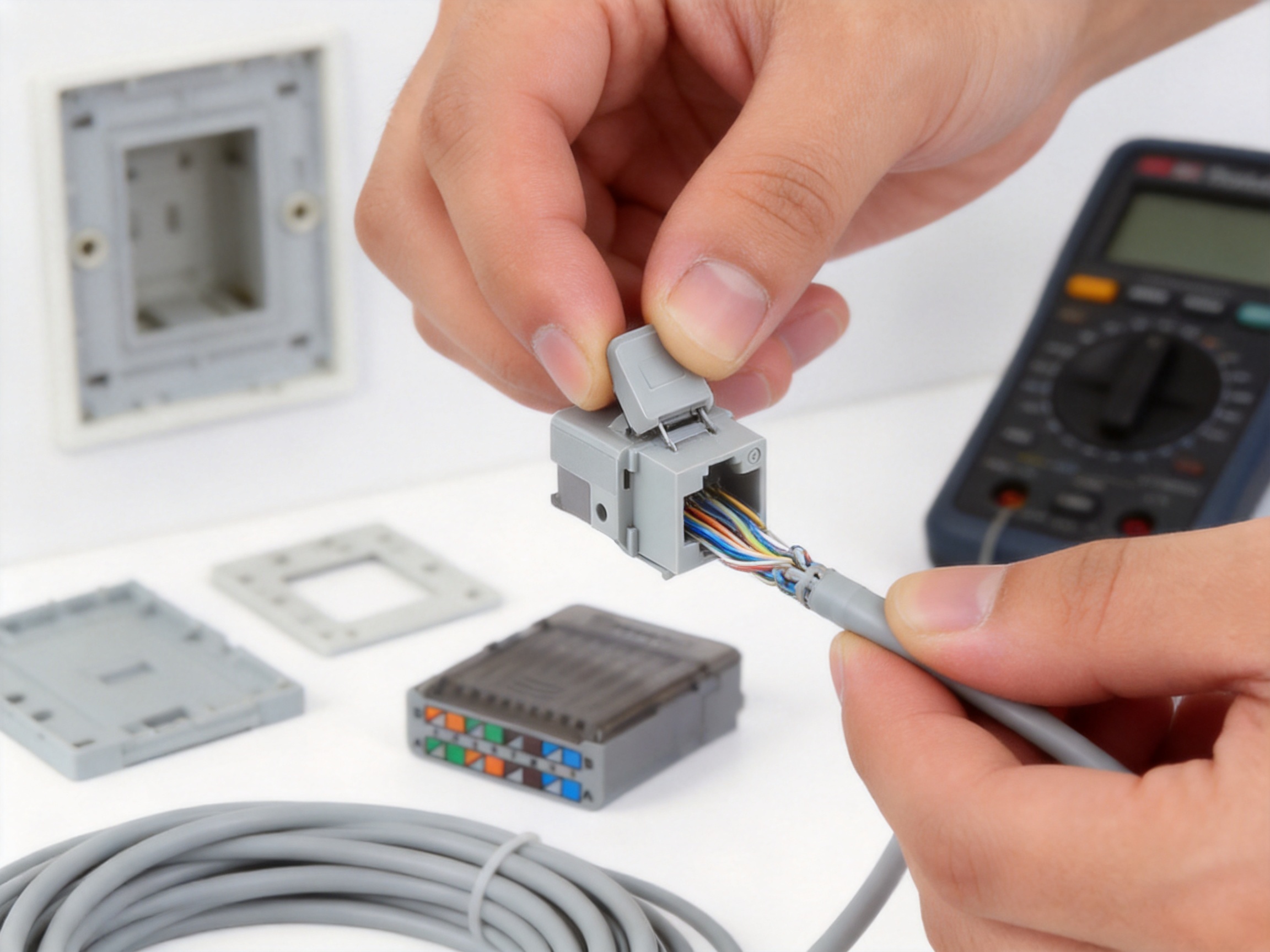
Unlike conventional keystone jacks that may require a punch-down tool, the toolless construction allows installers to terminate compatible horizontal cables by hand or with minimal auxiliary equipment. This can reduce the number of tools required at the worksite, shorten installation time, and make the termination process more accessible for maintenance personnel. The angled structure also helps guide the incoming cable in a controlled direction, reducing unnecessary bending and making cable routing more orderly.
The product is manufactured by Yuyao Simante Network Communication Equipment Co., Ltd., a professional supplier of network cabling solutions and optical fiber products. The company integrates product design, development, sales, and service, and has built its capabilities through nearly two decades of industry experience. Its product range includes keystone jacks, patch panels, wall faceplates, data sockets, and related structured cabling components.
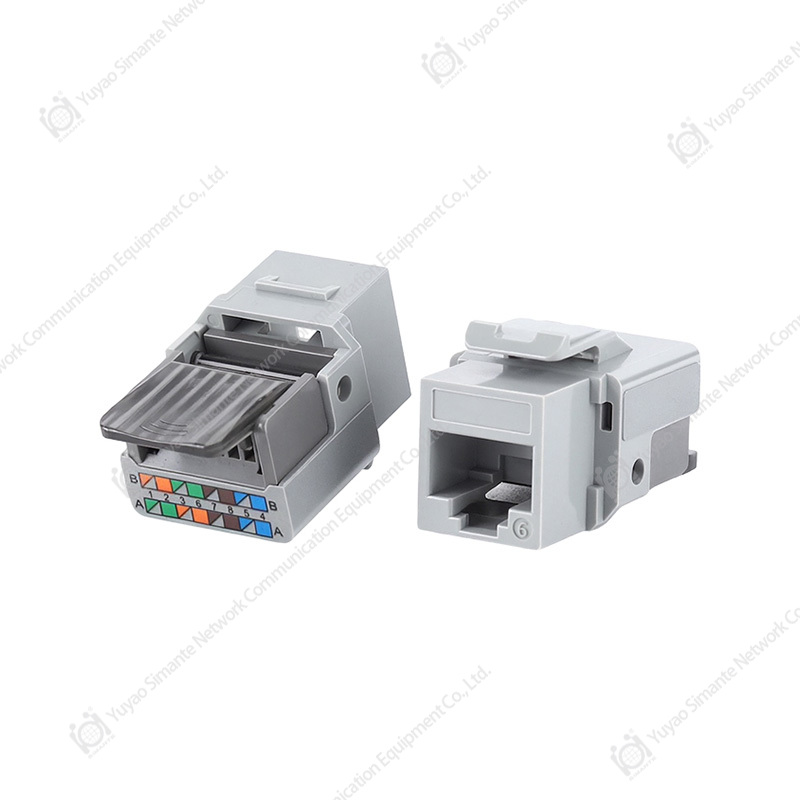
SMT-1078T8C6 Cat6 UTP Toolless 90 Degree Keystone Jack
Product Overview
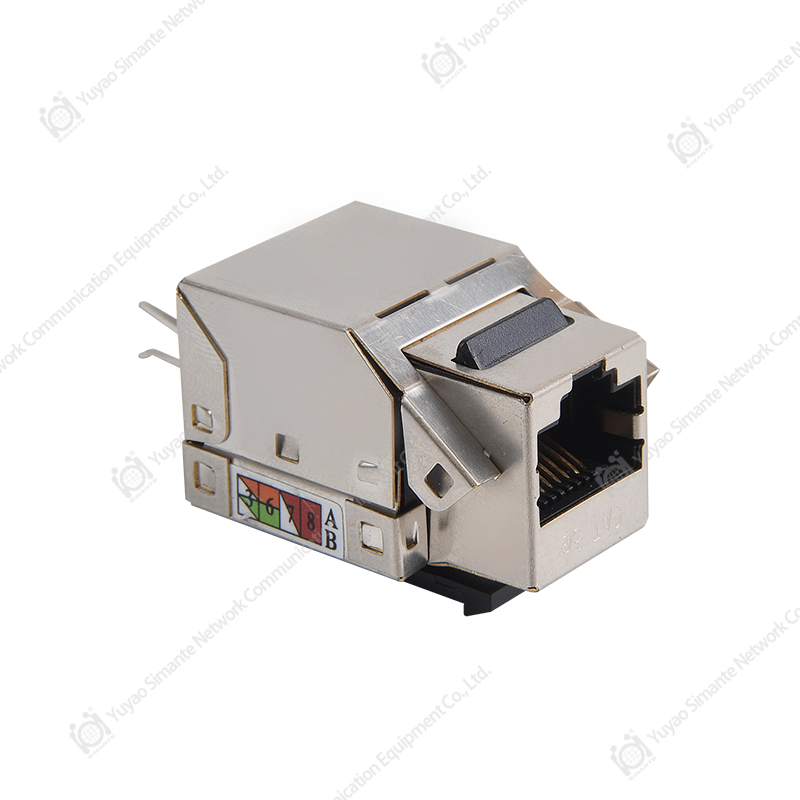
The SMT-1078T8C6 is a Cat6 UTP keystone jack intended for copper network cabling systems. “Cat6” identifies the performance category of the component within a balanced twisted-pair cabling system, while “UTP” indicates that the product uses an unshielded construction rather than an overall metal shield or individually shielded pairs. The keystone format allows the jack to be installed in a wide variety of modular network accessories.
Its 90-degree configuration differentiates it from a conventional straight keystone jack. In a straight design, the cable may approach the termination area directly from the rear, which can create additional depth requirements or increase the possibility of a sharp bend. A right-angle construction redirects the cable path, helping installers position the cable more naturally in confined spaces.
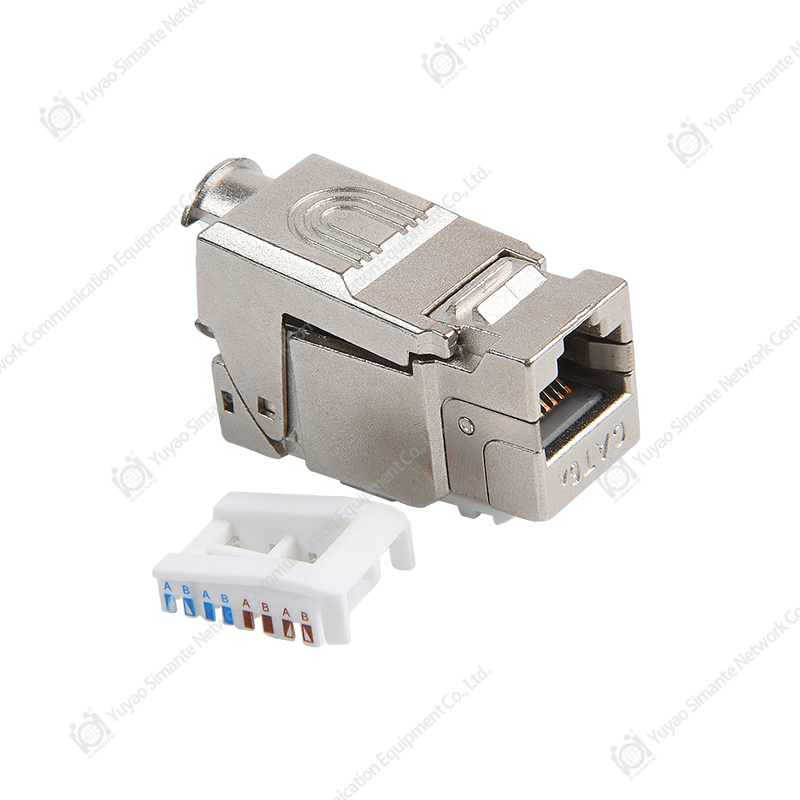
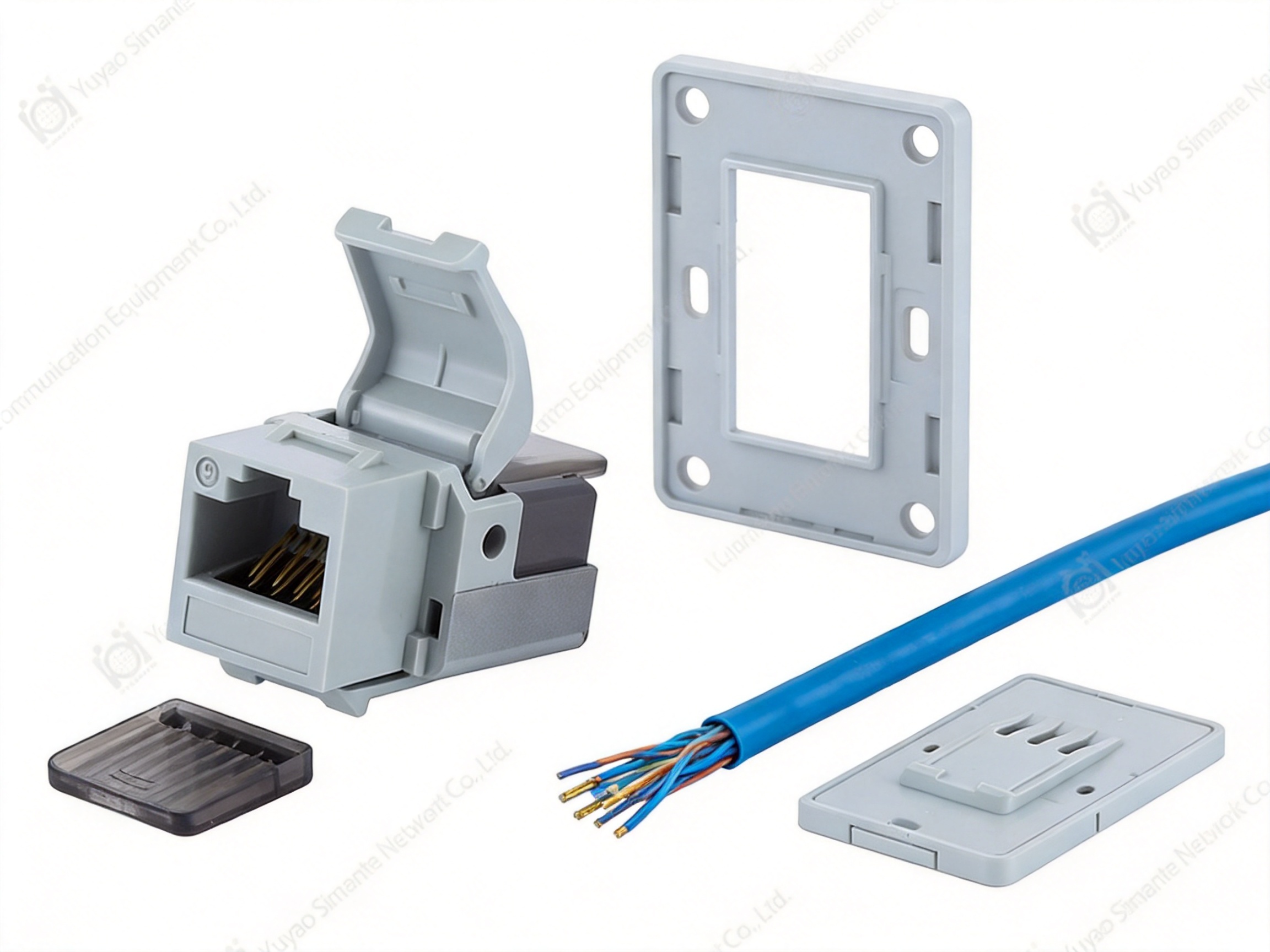
The toolless termination concept is another important feature. Traditional punch-down keystone jacks normally require the installer to place each conductor into an IDC termination slot and then use a specialized tool to seat the wires. A toolless design typically incorporates a cap, cover, or integrated termination mechanism that presses the conductors into position without requiring a separate impact tool. This approach can improve installation convenience, particularly in small projects, retrofit work, service calls, and locations where carrying a full set of tools is inconvenient.
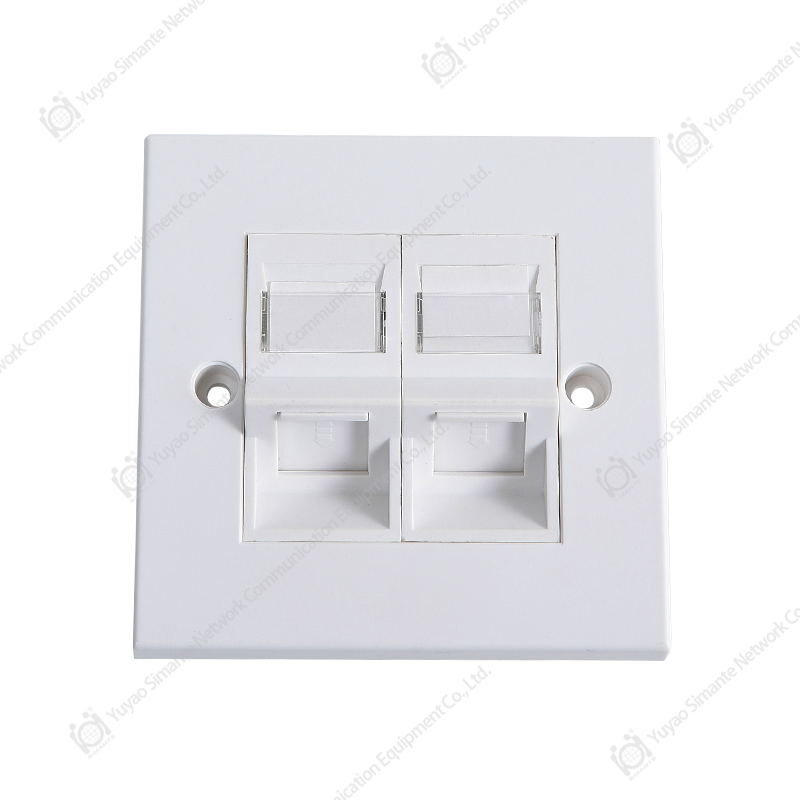
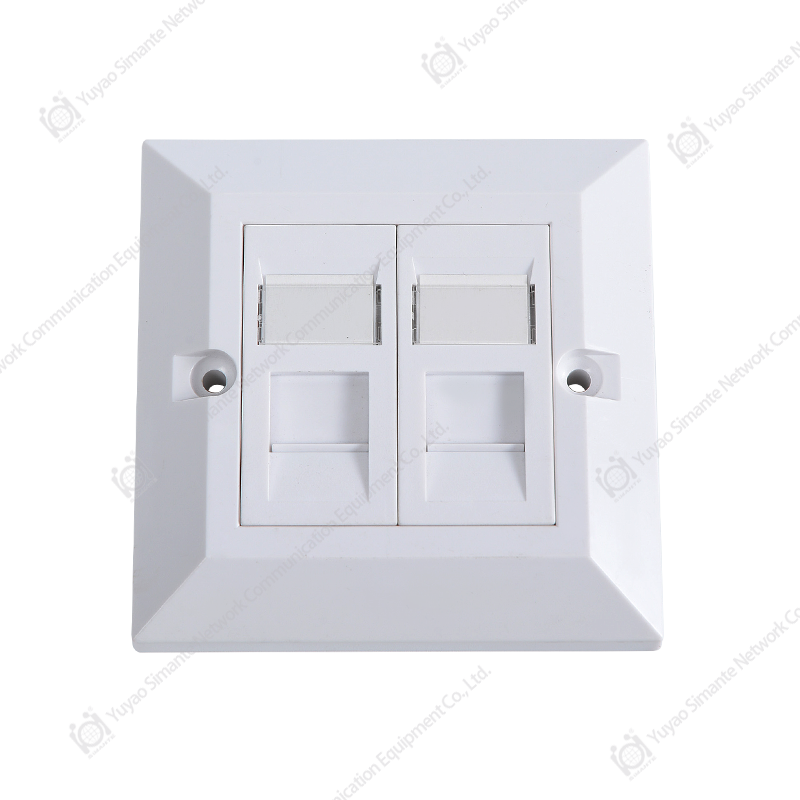
As a modular component, the jack can be used with compatible faceplates, patch panels, surface-mount boxes, and other keystone-format products. This provides flexibility for installers and distributors because one jack format can support multiple outlet configurations. It can also simplify inventory planning when the same modular component is used across offices, residences, commercial facilities, and equipment areas.
| Product Attribute | Specification or Design Feature | Practical Benefit |
|---|---|---|
| Product model | SMT-1078T8C6 | Identifies the specific product configuration |
| Network category | Cat6 | Suitable for Cat6 copper structured cabling designs |
| Transmission type | UTP | Supports unshielded twisted-pair installations |
| Termination method | Toolless | Reduces dependence on a separate punch-down tool |
| Connector format | Keystone jack | Compatible with modular faceplates and patch panels |
| Orientation | 90-degree | Helps manage cable direction and installation depth |
| Application area | Copper structured cabling | Suitable for data outlets, cabinets, and network points |
Why the 90-Degree Configuration Matters
Cable geometry has a direct effect on installation quality. Twisted-pair cables contain individually insulated conductors arranged in pairs, and the pairs are twisted at controlled rates to reduce electromagnetic interference and crosstalk. Excessive untwisting, compression, or bending can affect the consistency of the transmission path. A keystone jack that helps the cable approach the termination area smoothly can therefore contribute to a more organized and controlled installation.
The 90-degree design is particularly useful in shallow wall boxes, crowded patch panels, furniture outlets, and compact communication enclosures. In these locations, a straight jack may force the cable to extend farther behind the faceplate or require a tighter bend. The angled format can redirect the cable toward the available space, potentially reducing pressure on the cable sheath and improving the neatness of the finished assembly.
Right-angle routing can also help installers maintain a more consistent bend radius. The exact bend radius depends on the cable construction and manufacturer’s instructions, but avoiding severe bends is a general best practice for balanced copper cabling. By providing a defined direction for the cable, the jack can make it easier to organize cable slack and avoid abrupt changes in direction.
In network cabinets, the 90-degree configuration can be beneficial when several connections are installed next to each other. Cable bundles can be directed upward, downward, or laterally according to the layout of the panel. This may reduce congestion at the rear of the panel and create more room for labeling, inspection, and future maintenance.
Compared with a standard straight jack, the 90-degree version may offer a practical advantage where space is limited. It does not eliminate the need for correct cable handling, but it gives the installer a component geometry that better supports compact and orderly cable routing.
Advantages of the Toolless Termination Method
Faster Installation Workflow
The most visible advantage of a toolless keystone jack is the simplified termination workflow. An installer can prepare the cable, arrange the conductors according to the selected wiring scheme, place them into the termination structure, and secure the mechanism without searching for or repeatedly using a punch-down tool. In larger projects, even a small time saving per outlet can produce a meaningful improvement in overall productivity.
Toolless termination can be valuable during maintenance and repair work. Technicians may need to replace a damaged jack in an occupied office, retail area, hotel room, classroom, or residential property. A design that requires fewer tools can reduce preparation time and minimize disruption to users. It can also be useful for troubleshooting tasks where technicians are working at multiple locations during a single service visit.
Reduced Tool Dependence
Professional installers usually carry specialized tools, but not every technician or maintenance worker has the same equipment available. A toolless product helps reduce dependence on an impact tool for routine terminations. This can be particularly useful in small installations, remote locations, emergency repairs, and projects where installation teams must move quickly between rooms or floors.
Reducing tool dependence does not mean that installation quality becomes automatic. The cable must still be prepared correctly, the conductor sequence must be maintained, and the termination mechanism must be fully closed. However, the process can become more straightforward and less equipment-intensive.
Consistent Termination Potential
A well-designed integrated termination mechanism can help produce more consistent results between installers. With conventional punch-down methods, differences in tool pressure, insertion angle, and operator technique may influence the final termination. A toolless mechanism guides the conductors into a defined position and applies pressure through the product’s built-in structure.
Consistency is important in structured cabling because every connection contributes to the performance of the complete channel. A neatly terminated jack is easier to inspect, label, test, and service. For contractors managing several installation teams, a simplified termination process may also support more uniform work practices.
Useful for Retrofit Applications
Existing buildings often present installation challenges that are not found in new construction. Wall cavities may be shallow, cable routes may be congested, and access to tools may be restricted by furniture or finished surfaces. The combination of a toolless mechanism and a 90-degree cable orientation makes the SMT-1078T8C6 suitable for many retrofit situations where installation convenience and compact cable routing are priorities.
Cat6 UTP Application Benefits
Cat6 copper cabling is widely used for structured network installations because it provides a practical balance between performance, availability, installation familiarity, and cost. It is commonly selected for office networks, residential data outlets, educational facilities, healthcare areas, commercial buildings, security systems, and equipment rooms.
The SMT-1078T8C6 is designed to work as part of a Cat6 UTP channel. The performance of a complete channel depends on all of its components, including horizontal cable, patch cords, connectors, patch panels, outlets, and installation practices. The jack should therefore be used with compatible Cat6 components and installed according to the relevant project requirements.
UTP construction is often selected when the installation environment does not require additional shielding. Unshielded systems are generally easier to handle because they do not require bonding or grounding of cable shields and shielded hardware. They can also be lighter and more flexible than shielded alternatives. For many office, residential, and commercial network environments, UTP provides an efficient and familiar cabling solution.
Correct pair management remains essential. Installers should avoid excessive untwisting near the termination point, should not damage the conductor insulation, and should maintain the recommended cable bend radius. The product’s design supports orderly termination, but the final performance also depends on workmanship, cable quality, and compliance with the installation specification.
Modular Compatibility and Flexible Deployment
The keystone format is one of the most versatile form factors in structured cabling. A modular faceplate can accept different types of inserts, including copper data jacks, fiber adapters, telephone modules, audio connectors, and blank inserts, depending on the system design. This lets installers create customized outlet combinations without changing the entire faceplate or wall box.
The SMT-1078T8C6 can be used in modular wall outlets and other compatible keystone accessories. A data outlet may contain one jack for a basic workstation, while a larger faceplate may accommodate multiple jacks for computers, wireless access points, printers, surveillance devices, or building automation equipment.
In a patch panel, modular keystone jacks can also simplify port replacement and system changes. If a port becomes damaged or the layout is revised, the individual insert can often be replaced without removing the complete panel. This modular serviceability can reduce maintenance time and help preserve the value of the overall cabling infrastructure.
Distributors and project suppliers may benefit from the product’s broad application range. Instead of stocking separate outlet designs for every installation environment, they can supply a modular Cat6 jack that works with multiple compatible accessories. This can simplify purchasing, warehouse management, and project coordination.
Manufacturing Capability and Engineering Strength
The manufacturer has developed a production and engineering structure dedicated to network communication equipment and optical fiber products. Its business integrates design, product development, sales, and service, allowing technical considerations to be addressed throughout the product life cycle rather than only at the final assembly stage.
The company maintains a mature research and development system supported by more than 10 engineers and more than 30 full-time technical personnel. This technical team contributes to product development, process improvement, quality control, testing, and product updates. For a connector manufacturer, this type of internal capability is important because small changes in dimensions, material selection, molding accuracy, contact geometry, and assembly sequence can affect product consistency.
Experience in the network cabling sector also helps the manufacturer understand how products are used in real installations. A keystone jack must not only function as an electrical connector; it must also be easy to handle, fit into modular accessories, withstand repeated installation activities, and maintain a professional appearance after installation. Engineering decisions therefore need to consider both technical performance and field usability.
The manufacturer operates 10 regular and customization production lines. This combination allows the company to support standard product programs while also handling customer-specific requirements. Customization may involve dimensions, colors, labeling, packaging, termination configurations, or other project-related specifications, subject to technical evaluation and production feasibility.
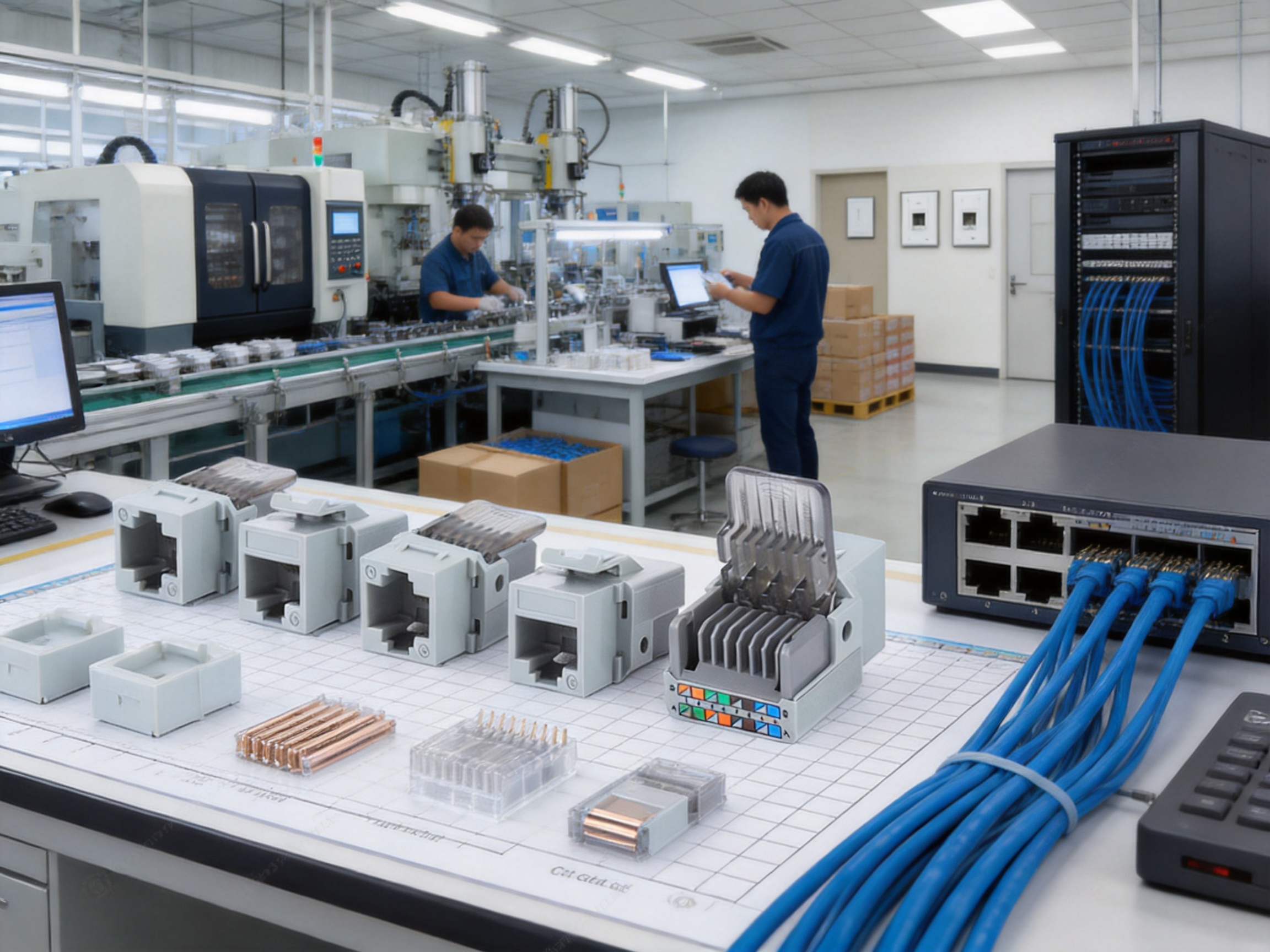
Its production facilities include 10 fully automatic injection molding machines, 20 semi-automatic injection molding machines, and eight automatic installation machines. This equipment supports the manufacture of plastic housings, modular components, and assembled network accessories. Automated and semi-automated processes can help improve repeatability, increase production efficiency, and reduce variation caused by manual operations.
An annual output of more than 9 million units demonstrates the scale of the manufacturing operation. High-volume production capability can be important for contractors and distributors managing multi-site projects because stable supply helps reduce the risk of delays caused by limited production capacity. It also supports repeat orders when a customer needs to extend an existing cabling standard across additional buildings or locations.
Quality Control from Design to Production
Product quality begins before manufacturing. Design decisions influence material performance, dimensional stability, mechanical strength, assembly accuracy, and installation behavior. By maintaining technical personnel and an established development system, the manufacturer can evaluate these factors during the design stage of products such as the SMT-1078T8C6.
Injection molding accuracy is especially relevant to keystone jacks. The housing must maintain the correct external dimensions so that it fits properly into a compatible faceplate or panel. Internal features must also hold the contact and termination components in the intended position. Small dimensional differences can affect assembly, retention, alignment, and the user’s installation experience.
Automatic installation equipment can support repeatable assembly operations. When contacts, covers, caps, or other components are assembled with controlled equipment, the process can reduce variation between units. Automation also assists production monitoring and helps maintain output during large orders.
Quality assurance should include visual inspection, dimensional checks, mechanical evaluations, and electrical testing appropriate to the product design. The manufacturer states that it uses performance testing to meet comprehensive customer requirements. For network components, testing may address continuity, conductor termination, contact reliability, insertion and retention behavior, and other relevant characteristics.
Testing is most effective when it is integrated into a broader quality system. Incoming materials should be controlled, production parameters should be monitored, assembly results should be inspected, and finished products should be checked before shipment. This layered approach helps identify potential problems earlier and supports more reliable delivery to customers.
The company’s focus on high-end markets has encouraged stricter requirements for product quality. Serving international customers typically requires attention to documentation, packaging, product consistency, communication, and shipment coordination in addition to basic manufacturing performance. These requirements help strengthen the supplier’s ability to support professional structured cabling projects.
Comparison with Conventional Keystone Jacks
The SMT-1078T8C6 offers several practical differences when compared with a conventional straight punch-down keystone jack. The following comparison is based on general design characteristics and should be considered alongside the requirements of each specific project.
| Comparison Factor | SMT-1078T8C6 | Conventional Straight Punch-Down Jack |
|---|---|---|
| Cable orientation | 90-degree routing direction | Usually direct rear entry |
| Termination equipment | Toolless mechanism | Normally requires a punch-down tool |
| Installation in confined areas | Designed to assist compact routing | May require additional rear clearance |
| Service work | Convenient for quick replacement | May require more tools and preparation |
| Modular use | Keystone format | Depends on the specific model |
| Cabling type | Cat6 UTP application | Varies by product category |
| Inventory flexibility | Suitable for multiple modular accessories | May be limited to a particular panel design |
The comparison does not suggest that a toolless right-angle jack is the correct choice for every application. Shielded environments, higher-category systems, special industrial conditions, or projects with unique grounding requirements may require different connector types. However, for Cat6 UTP installations where compact routing and convenient termination are priorities, the SMT-1078T8C6 presents a strong practical option.
Installation Considerations
Planning the Cable Route
Before termination, the installer should determine how the cable will approach the outlet or panel. The 90-degree design provides a preferred routing direction, but the surrounding cable pathway should still be planned to avoid sharp bends, excessive tension, crushing, or interference with other services.
Enough cable should be left for termination and future maintenance. Too little slack can make installation difficult and can place stress on the jack. Excessive slack, on the other hand, can create congestion behind the faceplate or in the cabinet. A balanced service loop supports both present installation and future retermination.
Preparing the Cable
The outer jacket should be removed carefully using an appropriate stripping method. The conductor insulation and pair twists should not be damaged during preparation. The twisted pairs should remain as close as practical to the termination area, because unnecessary untwisting can affect the balance and crosstalk performance of the link.
Installers should follow the wiring scheme selected for the project, commonly T568A or T568B. All outlets and patching components in the same channel should use the same scheme unless a specific application requires otherwise. Consistent color coding reduces errors and makes future maintenance easier.
Securing the Termination
Each conductor should be positioned in the correct slot before the toolless mechanism is closed. The cap or integrated termination component should be pressed into its fully seated position according to the product’s installation method. Conductors should not be forced into the wrong location, and the cable should not be pulled during the final securing step.
After termination, the installer should inspect the jack for visible gaps, displaced conductors, damaged insulation, or an incompletely seated cover. A suitable cable tester should then be used to verify wire mapping, continuity, pair integrity, and other required field parameters.
Labeling and Documentation
Every outlet and corresponding patch panel port should be labeled according to the project documentation. Good labeling helps technicians identify circuits quickly and reduces the time required for troubleshooting. In larger installations, records should include outlet identifiers, cable routes, rack or panel locations, and test results.
Applications in Commercial and Residential Networks
The SMT-1078T8C6 is suitable for office workstations where computers, IP phones, printers, and wireless equipment require organized data connections. Its compact format can support modular outlets installed in walls, furniture systems, floor boxes, and surface-mount enclosures.
In residential structured wiring, the jack can be used for home offices, entertainment areas, network cabinets, and access points. The toolless design may be useful for installers working in finished homes where minimizing tools and installation time is important. The 90-degree orientation can also help when wall boxes have limited interior depth.
Educational facilities often require large numbers of data outlets distributed across classrooms, laboratories, libraries, offices, and common areas. A modular Cat6 jack can provide a consistent outlet design throughout the building while supporting efficient installation and future maintenance.
Retail environments, hotels, and restaurants may use structured cabling for point-of-sale systems, access control, surveillance, wireless networks, and administrative equipment. In these applications, a reliable and serviceable outlet component helps maintain network availability while allowing technicians to work with minimal interruption to daily operations.
Building automation and smart-home systems may also use structured copper cabling for controllers, sensors, gateways, and communication devices. The jack can be incorporated into modular connection points where a neat and replaceable interface is preferred.
Network cabinets and small equipment rooms can use compatible keystone panels to create flexible copper patching arrangements. The right-angle structure may help direct cables away from crowded rear areas and improve access to adjacent ports.
Competitive Advantages for Project Buyers
For project buyers, the value of a network component includes more than the purchase price. Installation labor, tool requirements, product availability, replacement procedures, compatibility, and long-term serviceability all influence the total cost of ownership.
The toolless design can reduce installation labor in projects where many ports must be terminated. Even when the labor saving per port is modest, the cumulative effect across hundreds or thousands of connections can be significant. Faster termination may also help contractors meet demanding project schedules.
The 90-degree structure can reduce the need for improvised cable routing in shallow or crowded spaces. A component that naturally supports the intended cable direction can help produce cleaner installations and reduce the likelihood of excessive cable stress.
Keystone compatibility provides procurement flexibility. Project teams can select faceplates, patch panels, and enclosures according to the installation environment while retaining a common modular jack format. This can simplify replacement stock and reduce the number of unique components required in the warehouse.
Manufacturing scale provides another advantage. With multiple production lines, molding equipment, automated installation machines, and an annual output exceeding 9 million units, the supplier is positioned to support both regular demand and larger project orders. Stable supply is especially important for customers who need consistent products across multiple markets.
Customization capability can benefit OEM and ODM customers. Buyers may need specific packaging, private labeling, colors, mechanical details, or project configurations. A manufacturer with in-house engineering and production resources can evaluate these requirements more efficiently than a trading company that relies entirely on external factories.
OEM, ODM, and Custom Project Support
Structured cabling distributors and equipment brands may require products adapted to their own market positioning. OEM programs can involve customer branding, packaging, labeling, and documentation. ODM programs may involve deeper cooperation in product configuration, mechanical design, or application-specific development.
The manufacturer’s combination of engineering personnel and multiple production lines supports this type of cooperation. Custom requests should be reviewed in advance to confirm technical feasibility, tooling requirements, minimum order quantities, testing procedures, and delivery schedules.
For customers purchasing the SMT-1078T8C6 as a standard product, customization may not be necessary. Standardized procurement can provide faster project preparation and easier replacement. For customers developing a private-label product range, the same manufacturing infrastructure can support a more tailored supply program.
Clear communication is important during any custom project. Technical drawings, sample approval, color requirements, packaging specifications, inspection standards, and shipment terms should be confirmed before mass production. A documented approval process helps ensure that the delivered products match the customer’s expectations.
International Supply and Service Capability
The manufacturer maintains stable export activity in Europe, Australia, Africa, the Middle East, and Southeast Asia. Experience serving different international markets can help a supplier understand the importance of export packaging, product documentation, production scheduling, and communication across time zones.
International customers often require dependable responses before, during, and after an order. Technical questions may concern product compatibility, installation methods, packaging, samples, testing, and customization. A supplier that integrates sales and service with its engineering and manufacturing activities can provide more coordinated support.
The company’s location in Yuyao, Ningbo City, Zhejiang, China places it within an important manufacturing region with access to industrial supply chains and export logistics. This can support the procurement of raw materials, production equipment, packaging resources, and shipping services.
For distributors, a long-term supplier relationship can help create a stable product portfolio. The SMT-1078T8C6 may be combined with other copper and fiber structured cabling products to provide a broader network infrastructure offering. This can help distributors respond to customers seeking a complete cabling solution rather than a single isolated component.
Maintenance and Long-Term Serviceability
A structured cabling installation is expected to remain useful for many years. During that period, outlets may need to be reconfigured, repaired, relabeled, or expanded. A modular keystone jack supports this lifecycle by allowing the individual connector to be handled separately from the larger faceplate or panel assembly.
The toolless termination method can make replacement work more convenient. If a jack is damaged or a cable must be reterminated, a technician can perform the work without relying on a separate punch-down tool. The exact replacement procedure should follow the product’s installation instructions and the requirements of the installed cabling system.
Good maintenance also depends on documentation. Port labels, test reports, cable schedules, and installation records should be preserved after project completion. When these records are available, technicians can identify the correct cable and outlet more quickly, reducing downtime and avoiding unnecessary disturbance to adjacent connections.
Periodic inspection may be appropriate in environments with frequent moves, additions, and changes. Technicians should look for loose faceplates, damaged housings, stressed cables, missing labels, and accidental disconnection. A clean, organized installation makes these checks easier.
Selection Guidance for Distributors and Installers
When selecting the SMT-1078T8C6, buyers should confirm that the product’s Cat6 UTP configuration matches the intended cable and channel design. If the project requires shielded cabling, special environmental protection, or a category beyond Cat6, a different product may be more appropriate.
Compatibility with the selected faceplate, patch panel, surface box, or cabinet should be verified before ordering large quantities. Keystone dimensions are commonly standardized, but accessory designs can vary. Sample installation is recommended when the product will be used with an unfamiliar enclosure or a custom panel.
Project teams should also define the required wiring scheme, labeling method, testing procedure, packaging format, and inspection criteria. These details help prevent confusion when multiple installers or subcontractors are involved.
For large projects, buyers should discuss forecast quantities and delivery schedules with the supplier in advance. The manufacturer’s production capacity supports high-volume orders, but early planning remains important for custom products, special packaging, or coordinated multi-stage deliveries.
Frequently Asked Questions
What type of product is the SMT-1078T8C6?
The SMT-1078T8C6 is a Cat6 unshielded twisted-pair keystone jack with a toolless termination mechanism and a 90-degree cable orientation. It is intended for copper structured cabling applications.
What does UTP mean?
UTP means unshielded twisted pair. The cable and connector system does not use an overall metallic shield or individually shielded pairs. UTP is widely used in office, residential, commercial, and other network environments where additional shielding is not required.
Why choose a 90-degree keystone jack?
A 90-degree design helps redirect the cable into a more manageable position. It can be useful in shallow wall boxes, crowded patch panels, furniture outlets, and other areas where a straight cable path would require additional depth or a sharper bend.
Does the product require a punch-down tool?
The product is designed for toolless termination, so a separate punch-down tool is generally not required for the standard termination process. Installers should still follow the supplied product instructions and use suitable cable testing equipment after termination.
Can the jack be installed in a wall faceplate?
As a keystone-format product, it is intended for use with compatible modular faceplates and other keystone accessories. Compatibility should be checked before installation, especially when using custom or non-standard panels.
Can it be used in a patch panel?
The jack can be suitable for compatible modular patch panels that accept keystone inserts. The panel opening and retention design should be confirmed before placing a project order.
Is the product suitable for Cat6 cable?
The product is categorized as a Cat6 UTP keystone jack and is intended for use in Cat6 copper structured cabling systems. To achieve the desired channel performance, the complete link should use compatible Cat6 components and proper installation practices.
What wiring scheme should be used?
The installation should follow the wiring scheme specified by the project, commonly T568A or T568B. The same scheme should be used consistently throughout the channel unless a documented application requires otherwise.
How can installers protect network performance?
Installers should avoid excessive untwisting, sharp bends, conductor damage, cable compression, and unnecessary tension. All terminations should be fully seated and tested with an appropriate cable tester.
What industries can use this product?
Potential applications include offices, homes, schools, hotels, retail facilities, healthcare buildings, network cabinets, security systems, building automation installations, and other structured cabling environments.
Does the manufacturer support customization?
The manufacturer operates regular and customization production lines and undertakes OEM and ODM projects. Customers should provide technical, packaging, labeling, and quantity requirements for evaluation before production.
What manufacturing resources support the product?
The company has more than 10 engineers, over 30 full-time technical personnel, 10 fully automatic injection molding machines, 20 semi-automatic injection molding machines, eight automatic installation machines, and 10 regular and customization production lines.
Can the product be purchased for large projects?
The manufacturer reports an annual output of more than 9 million units and maintains export activity in several international regions. Large-project buyers should confirm forecast quantities, product specifications, inspection requirements, and delivery schedules in advance.
Conclusion
The SMT-1078T8C6 Cat6 UTP Toolless 90 Degree Keystone Jack is designed for installers and project buyers who need a practical, modular, and space-conscious copper connectivity component. Its combination of Cat6 UTP compatibility, toolless termination, and right-angle cable routing addresses several common installation challenges.
The toolless design can simplify termination, reduce dependence on specialized tools, and support faster maintenance work. The 90-degree configuration can improve cable organization in confined spaces and help installers manage cable direction more effectively. The keystone format supports flexible use with compatible faceplates, patch panels, and modular enclosures.
Its value is further supported by the manufacturer’s engineering resources, production capacity, automated and semi-automated equipment, quality testing activities, customization capability, and international supply experience. With nearly 20 years of industry service and a product portfolio covering copper and optical fiber structured cabling components, the company is positioned to support both standard orders and OEM or ODM programs.
For a successful installation, the jack should be combined with compatible Cat6 components, correct wiring practices, careful cable preparation, proper labeling, and post-termination testing. When these conditions are met, the product can contribute to a clean, efficient, and serviceable structured cabling system for commercial, residential, institutional, and industrial communication applications.
References
1. ANSI/TIA-568.2-D, Balanced Twisted-Pair Telecommunications Cabling and Components Standard.
2. ISO/IEC 11801, Information Technology — Generic Cabling for Customer Premises.
3. IEC 60603-7 Series, Connectors for Electronic Equipment — Part 7: Detail Specifications for 8-Way, Shielded and Unshielded, Free and Fixed Connectors.
4. Telecommunications Industry Association, Structured Cabling Installation and Testing Practices.
5. International Electrotechnical Commission, Generic Cabling Systems and Balanced Copper Cabling Guidance.
6. Manufacturer product information for the SMT-1078T8C6 Cat6 UTP Toolless 90 Degree Keystone Jack.
7. Manufacturer company information concerning network cabling solutions, optical fiber products, engineering resources, production equipment, testing, OEM, and ODM services.