Español
 عربى
عربى русский
Content
- 1 1. The Role of a CAT6 Keystone Jack in Structured Cabling
- 2 2. Product Design Overview
- 3 3. Electrical Performance and Signal Integrity
- 4 4. Mechanical Construction and Installation Practicality
- 5 5. Materials and Surface Treatment
- 6 6. Standards, Compatibility, and System Integration
- 7 7. Environmental Performance and Reliability
- 8 8. Advantages Over Basic or Poorly Optimized Alternatives
- 9 9. Advanced Manufacturing Capabilities
- 10 10. Quality Management and Performance Testing
- 11 11. Applications
- 12 12. Installation Recommendations
- 13 13. Packaging, Storage, and Supply Reliability
- 14 14. Why Manufacturer Capability Matters to Buyers
- 15 15. Selection Guide for Project Managers and Distributors
- 16 16. Frequently Asked Questions
- 16.1 Q1: What type of product is the SMT-1013H8C6?
- 16.2 Q2: Does it support both T568A and T568B wiring?
- 16.3 Q3: What frequency range is supported?
- 16.4 Q4: Is the module compatible with CAT5e systems?
- 16.5 Q5: What cable sizes can be terminated?
- 16.6 Q6: What materials are used for the contacts?
- 16.7 Q7: How durable is the front RJ45 interface?
- 16.8 Q8: Why is the 90-degree design useful?
- 16.9 Q9: How does the product help reduce crosstalk?
- 16.10 Q10: What standards are listed for the product?
- 16.11 Q11: Can the module be installed in a distribution frame?
- 16.12 Q12: What are the environmental specifications?
- 16.13 Q13: How should the product be stored?
- 16.14 Q14: Is customized packaging available?
- 16.15 Q15: What makes the manufacturer suitable for larger projects?
- 17 17. Conclusion
- 18 References
- 19 Product: SMT-1013H8C6 90 Degree CAT6 Keystone Jack 110 IDC

Modern communication networks depend on structured cabling components that can deliver consistent electrical performance, simplify installation, and remain reliable throughout the service life of a building. Although a keystone jack is a relatively small component, its design affects transmission quality, termination efficiency, maintenance convenience, and the overall stability of a copper cabling system. The SMT-1013H8C6 90-degree CAT6 Keystone Jack with 110 IDC termination is designed to address these requirements in commercial buildings, communication rooms, work areas, data networks, smart-home installations, and other structured cabling applications.
This module is engineered for Category 6 transmission performance over a frequency range of 1 to 250 MHz. It supports both T568A and T568B wiring sequences, provides a standard RJ45 interface on the front side, and uses a 110-style insulation displacement connection on the rear side. Its compact 90-degree form factor allows the module to be installed in suitable faceplates, surface boxes, patch panels, and modular distribution frames while helping installers manage cable routing in confined spaces.
Beyond its basic connectivity function, the product combines backward compatibility, carefully arranged contact geometry, clear wiring identification, durable materials, and controlled manufacturing processes. These features make it a practical choice for installers, distributors, system integrators, original equipment manufacturers, and project contractors seeking a dependable CAT6 connection module.
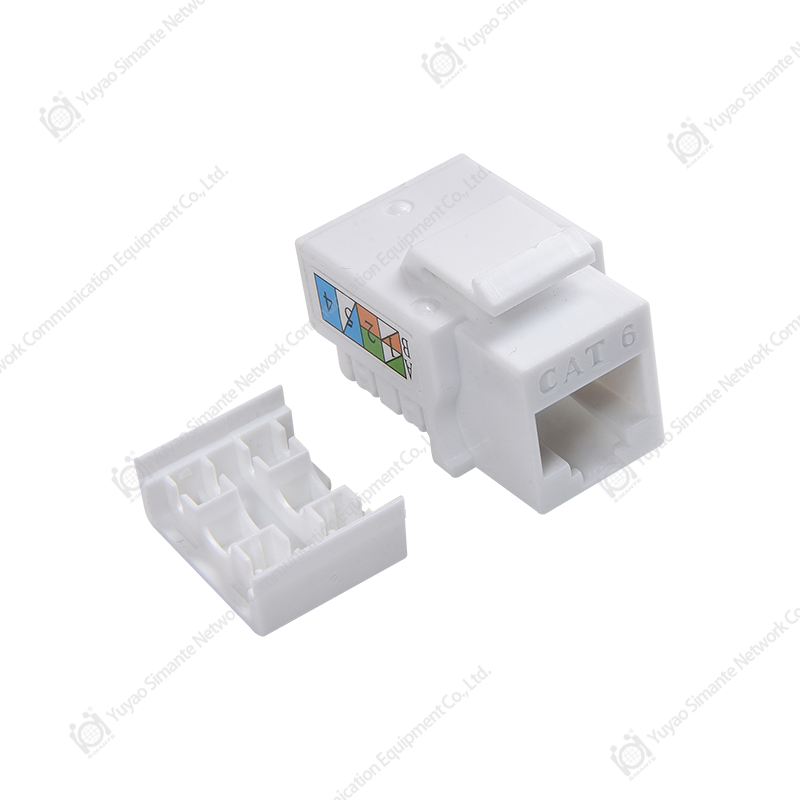
SMT-1013H8C6 90 Degree CAT6 Keystone Jack 110 IDC
1. The Role of a CAT6 Keystone Jack in Structured Cabling
A structured cabling system separates permanent horizontal cabling from flexible equipment connections. The horizontal cable typically runs from a telecommunications room or distribution point to a work-area outlet. At the work area, a keystone jack provides the interface between the installed cable and a patch cord, network device, computer, telephone, wireless access point, camera, or other compatible equipment.
The keystone jack must perform several functions at the same time. It must maintain the correct conductor arrangement, preserve the geometry of twisted pairs, provide dependable mechanical retention, minimize signal loss, and resist unwanted crosstalk. It must also be simple enough to install quickly and consistently in the field. A poor termination can undermine the performance of an otherwise high-quality cable and network switch.
The SMT-1013H8C6 is intended for communication socket connections between equipment and work areas. Its front RJ45 jack supports standard patch-cord insertion, while the rear IDC section accepts horizontal cable conductors. This arrangement creates a practical transition between fixed building cabling and removable equipment cabling.
1.1 Category 6 transmission support
Category 6 cabling is commonly used for high-speed Ethernet and other balanced copper communication applications. Compared with lower-category systems, CAT6 places greater emphasis on insertion loss, return loss, pair balance, and crosstalk performance. The supporting connector must therefore be designed with suitable contact spacing, conductor management, and pair termination geometry.
This product is specified for a frequency range of 1 to 250 MHz, corresponding to the transmission requirements associated with CAT6 systems. Its contact pin arrangement uses high-and-low dislocation technology to help reduce near-end crosstalk. This design consideration is important because crosstalk can occur when electrical energy from one pair couples into an adjacent pair at the connector interface.
1.2 A transition between permanent and flexible cabling
The permanent horizontal cable is generally installed inside walls, ceilings, conduits, raised floors, or cable trays. It is not intended to be repeatedly disconnected. In contrast, the patch cord at the front of the keystone jack is designed to be connected and disconnected as equipment is installed, moved, or replaced.
The keystone module must therefore provide a stable rear termination and a durable front interface. The SMT-1013H8C6 is rated for 750 plug-and-socket insertion cycles and 250 wire terminations. These ratings support repeated installation, service, and reconfiguration activities when the product is handled according to appropriate installation procedures.
2. Product Design Overview
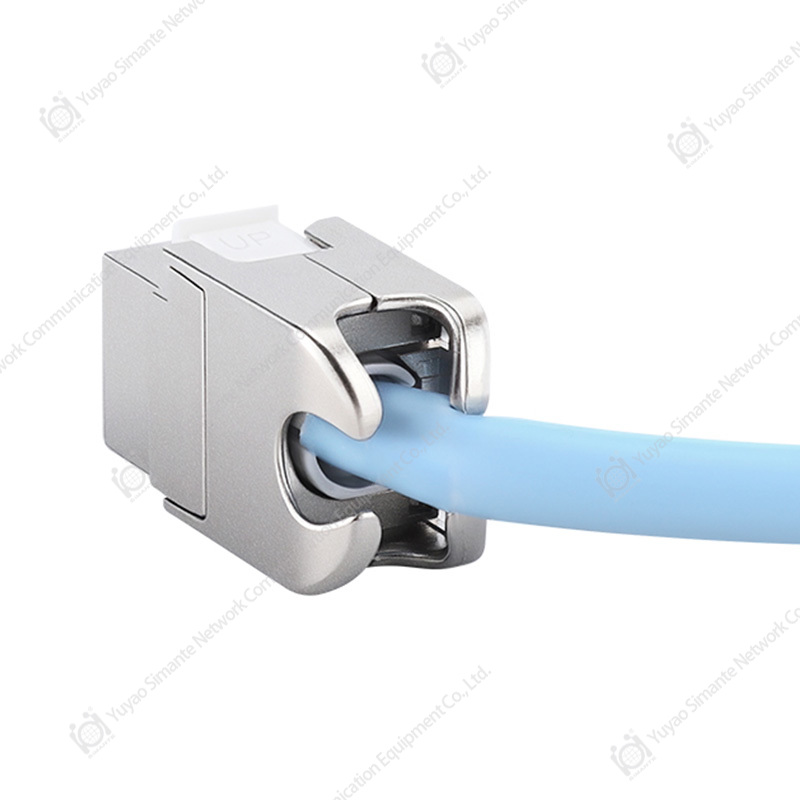
The SMT-1013H8C6 uses a compact 90-degree housing that guides the rear cable termination in a direction suitable for modular installation. A right-angle layout can be especially valuable where the depth behind a wall outlet or patch panel is limited. It can also help installers route the cable more naturally, reducing excessive bending immediately behind the module.
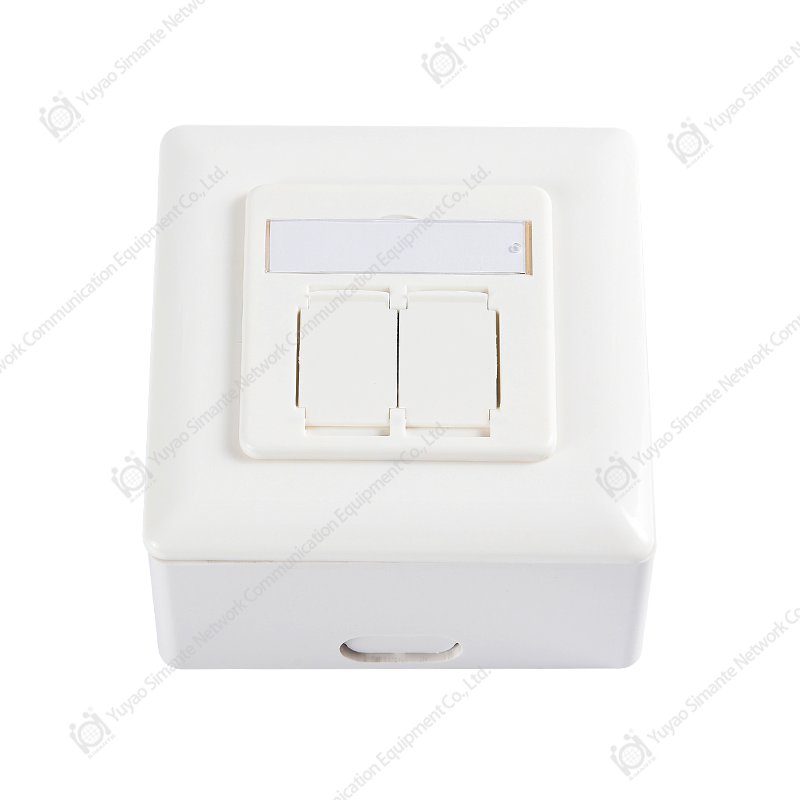
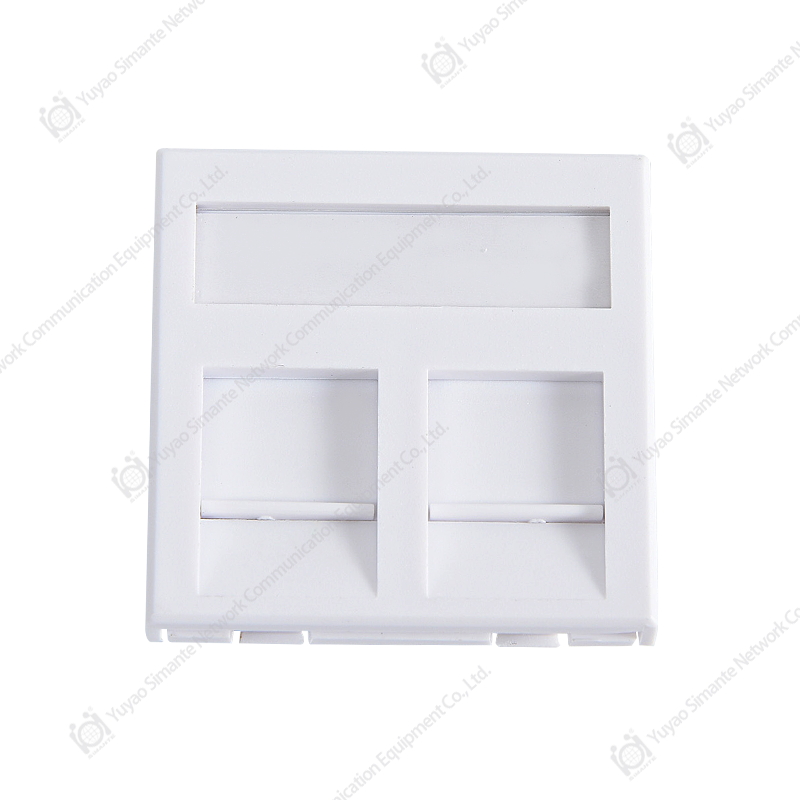
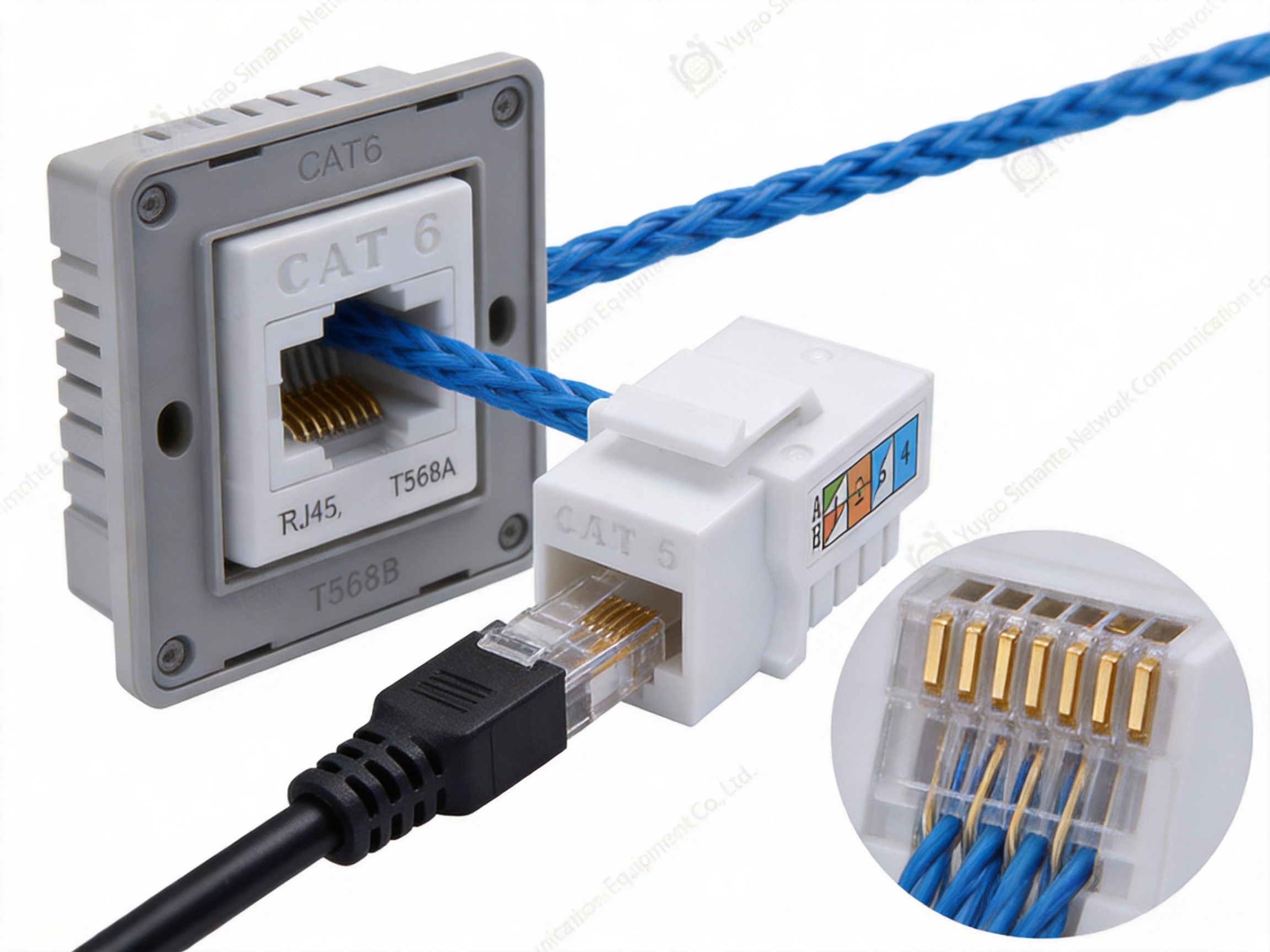
The module is designed as an embedded component. It can be installed in a compatible distribution frame to form a modular distribution frame, or placed in a suitable faceplate, data socket, surface box, or other housing designed for keystone-format modules. This modular concept allows the same type of outlet architecture to support different media and connector categories within a structured cabling project.
A universal wire-sequence label is clearly marked on the module card. The label identifies both T568A and T568B sequences, allowing the installer to select the required wiring scheme without relying on external notes or memory. Clear identification reduces the risk of pair reversal, incorrect conductor placement, and inconsistent installation between different work areas.
| Product characteristic | Specification or design feature | Installation and system benefit |
|---|---|---|
| Product type | 90-degree CAT6 keystone jack | Supports modular outlet and distribution-frame applications |
| Termination style | 110 IDC for horizontal wiring | Provides a practical insulation displacement connection |
| Front interface | RJ45 jack | Accepts compatible patch cords and equipment connections |
| Wiring sequence | T568A and T568B identification | Helps installers make accurate and consistent terminations |
| Transmission range | 1–250 MHz | Designed for CAT6 transmission requirements |
| IDC conductor range | 23–26 AWG twisted pair | Compatible with common horizontal copper cable sizes |
| Front-contact material | Phosphor bronze with gold plating | Supports conductivity and contact durability |
| IDC terminal material | Nickel-plated phosphor bronze | Supports mechanical strength and corrosion resistance |
| Housing material | PC polycarbonate | Provides a robust insulating structure |
| Durability | 750 plug insertions; 250 wire terminations | Supports service, maintenance, and reconfiguration |
3. Electrical Performance and Signal Integrity
Electrical performance is one of the most important differences between a basic modular jack and a connector designed for a higher-performance structured cabling system. At CAT6 frequencies, the connector must preserve the balance and separation of the twisted pairs. Small changes in contact placement, termination geometry, or cable handling can influence the transmission channel.
3.1 Frequency range
The specified operating frequency range is 1 to 250 MHz. This range is suitable for CAT6 system applications and gives the component the bandwidth required for common high-speed copper networking environments. The connector does not operate independently of the rest of the channel; its final performance depends on the cable, patch panel, patch cord, installation method, and connected equipment. Nevertheless, a connector designed around CAT6 requirements helps the complete channel achieve its intended performance.
3.2 Contact arrangement and near-end crosstalk control
Near-end crosstalk, often abbreviated as NEXT, is unwanted signal coupling from one pair into another near the transmitting end of a link. Connector geometry is an important factor in controlling this phenomenon. The SMT-1013H8C6 uses a high-and-low dislocation arrangement for the contact pins. By managing the relative position of the contacts, the design helps reduce coupling between adjacent signal paths.
This arrangement is a meaningful advantage over poorly optimized connector designs that place contacts too close together or fail to account for pair interaction. Reduced crosstalk contributes to cleaner signal transmission and can improve the margin available to the overall channel. For installers and network designers, this means that the connector is better suited to structured cabling applications where stable performance is required across multiple outlets and links.
3.3 Working and withstand voltage
The rated working voltage is 125 V. The product is also specified to withstand DC 1000 V, or AC 750 V, for one minute without breakdown or arcing. These specifications describe the electrical insulation capability of the module under the stated test conditions. They are not a recommendation to use the product as a high-voltage power connector. The keystone jack remains a low-voltage communications component and should be installed in accordance with applicable electrical and structured cabling practices.
3.4 Insulation resistance
The initial insulation resistance is specified at not less than 100 megohms. After a constant damp-heat test, the insulation resistance is also specified at not less than 100 megohms. Maintaining high insulation resistance after environmental exposure helps limit leakage between contacts and supports stable low-voltage signal transmission.
These values are particularly relevant in installations exposed to changing temperature and humidity. While indoor structured cabling systems are normally protected from severe weather, telecommunications rooms, industrial areas, basements, and utility spaces can experience environmental variation. Material selection and housing construction must therefore preserve insulation performance over time.
4. Mechanical Construction and Installation Practicality
A connector may have good electrical specifications but still be difficult to use if its mechanical design is weak or inconvenient. The SMT-1013H8C6 is designed to combine a compact format with a clear termination area and a standard modular body. Its mechanical characteristics support both factory assembly and field installation.
4.1 RJ45 insertion and extraction
The insertion force is specified as not more than 20 N, while the pull-out force is specified as not less than 20 N. These values balance ease of use with secure retention. A patch cord should be able to enter the jack without excessive force, while the connected plug should remain in place during normal handling, vibration, and cable movement.
The 750-cycle insertion and extraction durability specification is useful for active network environments. Offices, laboratories, classrooms, data centers, and equipment rooms may require outlets to be tested, rearranged, or serviced many times during their operating life. A durable front interface helps reduce premature replacement of the outlet module.
4.2 IDC termination
The rear IDC terminal is designed for 23 to 26 AWG twisted-pair conductors. An insulation displacement connection allows the installer to place the individual conductor into the designated slot and terminate it without stripping the conductor insulation in the traditional manner. The IDC contact cuts through the insulation and establishes contact with the conductor.
IDC termination can increase productivity because it reduces the number of separate preparation steps. It also helps maintain a consistent connection when the conductor is fully seated and terminated with an appropriate tool. The product is specified for 250 wire terminations, supporting repeated assembly, retermination, and service operations.
4.3 Cable routing and 90-degree orientation
The right-angle configuration helps direct the cable away from the rear of the module instead of forcing a sharp turn directly at the front interface. This can simplify installation behind faceplates or within shallow boxes. It may also help protect the cable from unnecessary stress when the outlet cover is installed.
Good cable management remains essential. The cable should not be sharply bent, excessively pulled, or stripped farther than necessary. Pair twists should be preserved as close as practical to the IDC termination point. The right-angle module supports good routing practice, but correct installation technique is still required to achieve the best channel performance.
5. Materials and Surface Treatment
The material system of a keystone jack affects electrical conductivity, mechanical strength, corrosion resistance, insulation, and long-term reliability. The SMT-1013H8C6 uses selected metal and non-metallic materials for the key components of the module.
5.1 Phosphor bronze RJ45 contacts
The gold pins are made from phosphor bronze with gold plating. Phosphor bronze provides a useful combination of spring properties, strength, conductivity, and resistance to fatigue. These characteristics are important in an RJ45 interface because the contact must maintain pressure against the plug contact over repeated insertion cycles.
Gold plating is used on the contact surface to support stable electrical contact and help resist surface oxidation. The specified gold-plating thickness is 3 to 50 microinches, depending on the applicable production configuration or customer requirement. In combination with the phosphor bronze base material, the plated contact is designed for reliable low-voltage signal connection.
5.2 Nickel-plated IDC terminals
The IDC card-wire terminals use phosphor bronze with nickel plating. The underlying phosphor bronze provides the mechanical characteristics required for conductor engagement, while the nickel surface treatment supports durability and corrosion resistance. The IDC terminal must maintain an effective interface with the conductor after the insulation is displaced.
5.3 Polycarbonate housing
The plastic housing is made from PC polycarbonate. Polycarbonate is widely used in electrical and communications components because it combines impact resistance, dimensional stability, and electrical insulation. A stable housing helps preserve contact alignment and protects the internal conductive elements from accidental contact with surrounding hardware.
5.4 FR4 circuit-board material
The product uses FR4 material for the PCB. FR4 is a glass-fiber-reinforced epoxy laminate commonly used in electronic and communications assemblies. It provides mechanical support and electrical insulation while maintaining dimensional stability during manufacturing and normal operation.
6. Standards, Compatibility, and System Integration
The module is designed to meet Category 6 transmission requirements and supports both T568A and T568B wiring sequences. T568A and T568B are recognized termination schemes for arranging the four twisted pairs at an RJ45 connector. Either scheme can be used consistently throughout a system, but the same scheme should normally be maintained at both ends of a permanent link unless a specific crossover arrangement is required.
The visible wiring label is a major installation advantage. It gives technicians an immediate reference at the termination point, reducing the possibility of inconsistent wiring across a project. This is particularly valuable in large installations where many installers may work simultaneously or where future maintenance staff may not have access to the original construction documentation.
The product is specified according to the general specification YD/T 926.1-2009 and the sub-standard YD/T 926.3-2009. It is also designed to meet RoHS requirements, supporting applications where restrictions on certain hazardous substances are part of the procurement or compliance process.
6.1 Backward compatibility
One of the product’s practical advantages is backward compatibility with CAT5e and lower-category systems. This makes the module suitable for network upgrades in buildings where the infrastructure may contain a mixture of cable categories. A CAT6 keystone jack can provide a consistent outlet platform while the customer gradually upgrades cable runs, patch cords, active equipment, or network services.
Backward compatibility can reduce the need to maintain several different outlet types. Distributors may simplify inventory, while contractors can use one modular solution across renovation projects and new installations. The final system performance will always be limited by the lowest-performing component in the channel, but the connector itself can support a transition toward higher-category cabling.
6.2 Inter-matching relationship
The product is intended for use with connectors of the same standard series. Compatible patch cords and plugs should be selected according to the required category and mechanical specification. Using matched components helps preserve fit, retention, electrical performance, and service life.
The mating cable and jumper applications include copper twisted-pair cables and copper patch cords. The module is intended for copper structured cabling rather than optical fiber termination. It can, however, be installed as one copper component within a broader structured cabling system that also contains fiber distribution equipment.
7. Environmental Performance and Reliability
Structured cabling components are expected to operate for many years, often inside walls or equipment areas that are not accessed regularly. Environmental performance is therefore an important part of product selection. The SMT-1013H8C6 is specified for an operating temperature range of -25°C to +70°C.
The humidity requirement is specified at no more than 85 percent under the stated test conditions, including a damp-heat environment at 85°C ±3°C. These conditions indicate that the insulation and material system are evaluated not only under ordinary room conditions but also after controlled exposure to elevated temperature and humidity.
7.1 Salt-spray testing
The product documentation includes salt-spray test requirements. The salt solution is prepared using sodium chloride and distilled or deionized water at a concentration of 5 percent by mass, with the pH value before atomization maintained between 6.5 and 7.2 at 35°C ±2°C. Continuous atomization is recommended for 48 hours.
Salt-spray testing is commonly used to evaluate the corrosion resistance of metal surfaces and plated contacts under accelerated conditions. The test does not reproduce every real-world installation environment, but it provides useful evidence that the selected materials and surface treatments can resist corrosive exposure better than untreated or poorly protected metals.
During testing, the spray air must be controlled so that oil, dust, temperature, and humidity do not introduce unrelated influences. Proper test-space management is essential because contamination can distort the results. A disciplined approach to environmental testing reflects the broader quality-control philosophy applied to the product.
7.2 RoHS-oriented material selection
The product is designed to meet RoHS requirements. For customers supplying commercial buildings, public facilities, export projects, or equipment manufacturers, RoHS-oriented material control can simplify procurement and support environmental compliance documentation. It also demonstrates that material selection is considered during product development rather than treated as an afterthought.
8. Advantages Over Basic or Poorly Optimized Alternatives
Many modular jacks may appear similar from the outside, but differences in contact design, housing accuracy, termination labeling, plating, and production consistency can affect field results. The SMT-1013H8C6 offers several advantages over basic products that are not specifically optimized for CAT6 structured cabling.
8.1 Better alignment with CAT6 requirements
A CAT6-rated application requires more than an RJ45-shaped opening. The internal contacts and pair-management structure must be designed for higher-frequency transmission. The specified 1–250 MHz frequency range and high-and-low contact dislocation technology demonstrate that the product is developed around CAT6 signal-integrity requirements rather than merely offering a universal mechanical interface.
8.2 Clearer and faster termination
The clearly marked universal wiring label supports accurate termination under field conditions. Installers can quickly identify the correct positions for T568A or T568B wiring. Compared with unmarked or poorly marked modules, this can reduce installation time, improve consistency, and lower the risk of rework.
8.3 More flexible system deployment
The embedded modular design allows the jack to be used in distribution frames and other modular mounting environments. This flexibility can be valuable for contractors handling different outlet styles or project layouts. A single connector format can support wall outlets, patching locations, and equipment-area installations when used with compatible hardware.
8.4 Wider cable compatibility
The 23–26 AWG IDC range covers common twisted-pair cable sizes used in horizontal cabling. The backward compatibility with CAT5e and lower categories also allows the product to serve in mixed or transitional network environments. This broad application range can make project planning and stock management simpler.
8.5 Durable material system
Phosphor bronze contacts, gold-plated RJ45 surfaces, nickel-plated IDC terminals, a polycarbonate housing, and an FR4 PCB create a coordinated material system. Each material is selected for a specific function. This is preferable to a low-cost design that relies on thin or inconsistent plating, weak plastics, or poorly controlled internal components.
8.6 Suitable for repeated service
The specified 750 plug-and-socket cycles and 250 wire terminations support active facilities where changes are expected. The connector can be used in environments that require periodic testing, equipment replacement, outlet reassignment, and maintenance. This reduces the likelihood that a module will need to be replaced simply because it has been used repeatedly during normal service activities.
9. Advanced Manufacturing Capabilities
Product performance depends not only on the design specification but also on the manufacturer’s ability to reproduce that design consistently. The manufacturer behind this product integrates design, development, sales, and service, with an established focus on network cabling solutions and optical fiber products.
Nearly two decades of industry service provide a practical foundation for understanding structured cabling requirements. The company maintains a research and development system supported by more than 10 engineers and over 30 full-time technical personnel. This engineering structure supports product updates, process improvement, tooling development, quality analysis, and customer-specific technical communication.
9.1 Injection-molding capacity
The production facility includes 10 fully automatic injection-molding machines and 20 semi-automatic injection-molding machines. This capacity is important for a product such as a keystone jack because the plastic housing must maintain accurate dimensions, stable mounting features, consistent wall thickness, and reliable internal alignment.
Controlled injection molding can help reduce variations in the housing that might otherwise affect contact placement or module fit. It also supports repeatable production for large orders. Automatic and semi-automatic equipment provide flexibility for standard products, smaller batches, customized components, and different tooling requirements.
9.2 Automated assembly capability
The factory operates eight types of automatic installation machines, supporting the assembly of contacts, terminals, internal components, and related parts. Automation can improve repeatability by controlling insertion depth, component positioning, assembly force, and production sequence.
For modular jacks, small dimensional differences can affect contact engagement, conductor termination, or the fit of the product in a faceplate. Automated assembly helps minimize human variation in repetitive operations while allowing trained technical personnel to monitor process conditions and conduct inspections.
9.3 Multiple production lines
Ten regular and customized production lines provide capacity for both standard catalog items and customer-specific requirements. This is valuable for buyers who need custom labeling, packaging, colors, structural modifications, or private-brand production. A manufacturer with dedicated customization capability can often manage the transition from prototype or sample approval to repeat production more efficiently than a supplier that only resells standard stock.
The reported annual output exceeds nine million units across the factory’s product range. High production capacity can support large structured cabling projects, distributor inventory programs, and long-term supply agreements. Capacity alone does not guarantee quality, but when combined with engineering management and testing procedures, it provides useful supply-chain stability.
10. Quality Management and Performance Testing
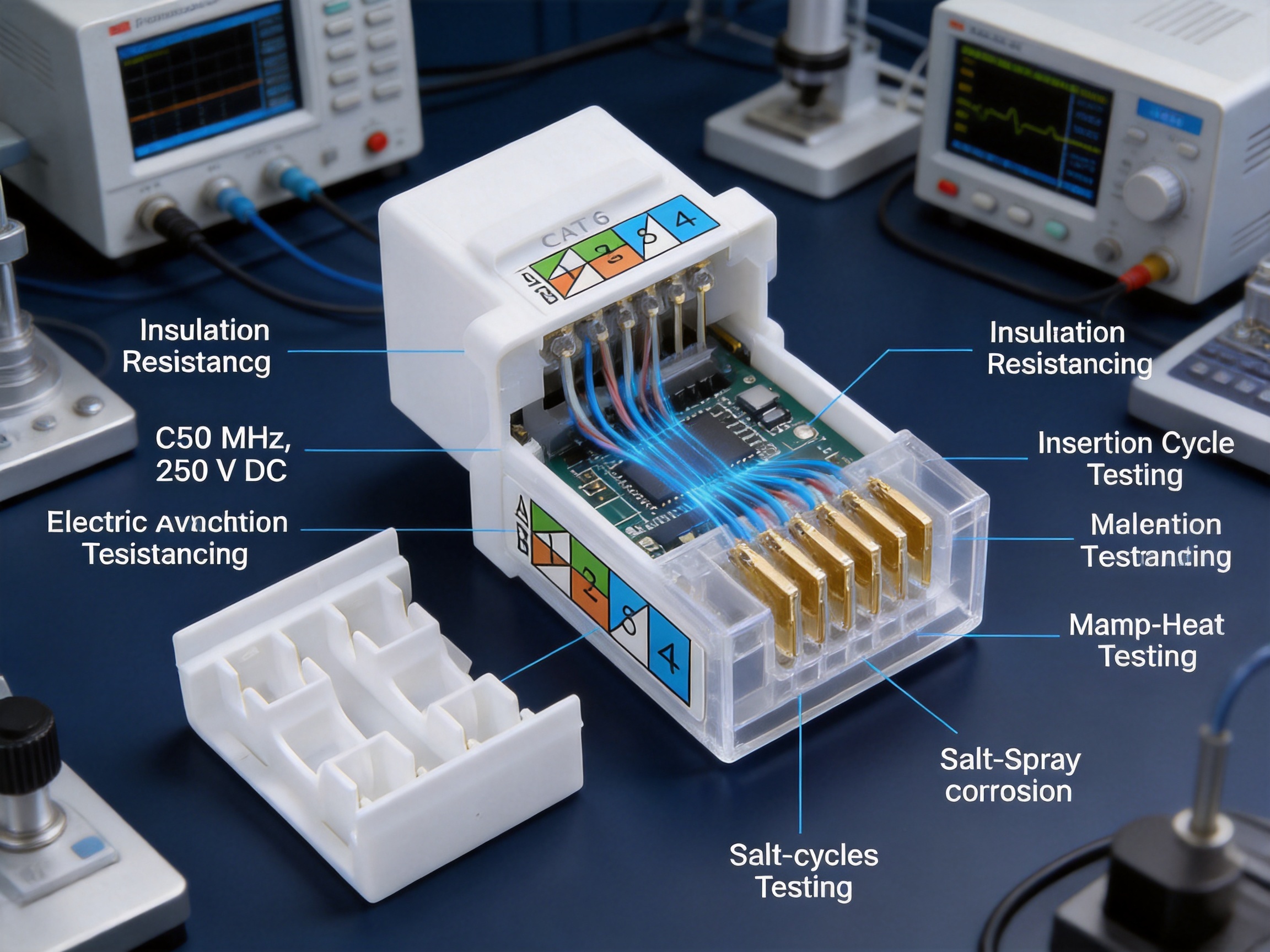
Reliable production requires more than assembly equipment. The manufacturer emphasizes performance testing to meet customer requirements and to verify product stability. Testing can include electrical characteristics, mechanical durability, environmental exposure, material inspection, dimensional checks, and visual quality control.
10.1 Electrical testing
Electrical testing is used to verify continuity, insulation resistance, contact behavior, and resistance to dielectric stress. Testing against the specified working voltage, withstand voltage, and insulation-resistance values helps identify defects such as incomplete insulation, contact misalignment, contamination, or assembly damage.
For CAT6 products, electrical performance should also be considered at the system level. Connector designs must be evaluated with appropriate cable and mating components, because insertion loss, return loss, and crosstalk are influenced by the complete channel. A manufacturer with structured testing capability is better positioned to investigate these relationships and improve the design when necessary.
10.2 Mechanical testing
Mechanical tests evaluate insertion and extraction force, plug retention, connector connection-device loading, and IDC termination performance. The specified 50 N force applied for 60 ±5 seconds provides a reference for evaluating the effect of mechanical loading on the connection device.
Mechanical testing helps confirm that the housing, contacts, and mounting features remain secure during handling and installation. It also supports quality assurance for products that may be installed in high-density patch panels or outlets where cable movement can transfer force to the module.
10.3 Durability testing
Durability testing includes up to 750 plug-and-socket insertion cycles and 250 wire terminations. These tests help evaluate the product’s ability to maintain contact pressure, mechanical integrity, and termination capability after repeated use.
Repeated testing is especially relevant to service contractors and data-center operators. A module may be accessed many times during commissioning, certification, troubleshooting, and equipment replacement. A connector that maintains its performance after repeated cycles can lower maintenance risk and support a more predictable lifecycle.
10.4 Environmental testing
Temperature, humidity, and salt-spray testing provide information about the product’s resistance to environmental stress. These tests also help validate the selection of polycarbonate, phosphor bronze, nickel plating, gold plating, PCB material, and other construction details.
Environmental tests should be interpreted according to the intended installation location. The product is designed for structured cabling applications, and the installer should still avoid direct exposure to water, aggressive chemicals, excessive condensation, or conditions outside the stated limits. Correct storage before installation is also important.
11. Applications
11.1 Office and commercial buildings
In office buildings, the module can be installed in work-area outlets, meeting rooms, reception areas, open-plan workspaces, and equipment rooms. Its CAT6 capability supports common data and voice applications, while backward compatibility allows it to be used during staged network upgrades.
11.2 Telecommunications rooms
The embedded design makes the module suitable for modular distribution frames and patching locations. Technicians can terminate horizontal cables at the rear and connect test equipment or patch cords at the front. Clear wiring identification is useful when many modules are installed side by side.
11.3 Smart homes and automation
Residential networks increasingly support wireless access points, surveillance systems, home offices, entertainment equipment, automation controllers, and building-management interfaces. A compact CAT6 keystone jack can provide organized outlets in wall plates and structured wiring cabinets.
11.4 Educational and public facilities
Schools, libraries, hospitals, and public buildings often require large numbers of standardized network outlets. A modular jack with repeatable installation characteristics helps contractors maintain consistency across many rooms and floors. Its durable front interface also supports environments where equipment is frequently connected and disconnected.
11.5 OEM and customized projects
Equipment manufacturers and system integrators may require special packaging, labeling, colors, or project-specific configurations. The manufacturer’s customization lines and OEM/ODM experience can support these requirements while maintaining a standardized technical foundation.
12. Installation Recommendations
Before installation, confirm that the selected faceplate, patch panel, surface box, or distribution frame is mechanically compatible with the keystone format. Verify that the cable category, conductor gauge, and system wiring plan match the requirements of the project.
Route the cable to the rear of the module without applying unnecessary tension. Remove only the amount of jacket required for termination and preserve the twist of each pair as close as practical to the IDC contacts. Excessive untwisting can reduce crosstalk performance and should be avoided.
Select either T568A or T568B according to the project standard. Use the wiring label on the module as the termination reference, and apply the same sequence consistently throughout the link. Insert each conductor fully into the correct IDC slot before using the appropriate termination tool.
After termination, inspect the module for fully seated conductors, damaged insulation, displaced contacts, and excessive cable bend. Secure the module in the mounting hardware without crushing the cable. A certification test should be performed when required by the project specification, especially for CAT6 installations intended to support high-speed Ethernet.
Do not use the communication module for power circuits or applications beyond its specified electrical purpose. Keep it away from corrosive substances, excessive heat, direct moisture, and strong mechanical impact. Appropriate installation and environmental control are essential for achieving the expected service life.
13. Packaging, Storage, and Supply Reliability
The product is packaged in a dedicated blister bag and then placed in a cardboard box. Product accessories are packaged together, and the carton is labeled with the product model and quantity. The regular packing arrangement is 50 pieces per box, 10 boxes per carton, and 500 pieces per carton.
This packaging structure supports counting, warehouse organization, and distribution planning. Individual or small-group protection helps reduce surface damage during handling, while carton labeling assists receiving departments and project warehouses in identifying the correct model.
Packaged products should be stored in a warehouse with an ambient temperature of -5°C to +30°C and relative humidity of no more than 70 percent. The surrounding air should be free from acid, alkali, and other corrosive gases. The stated storage period is three years under the specified conditions.
Proper storage is particularly important for plated contacts, plastic housings, labels, and packaging materials. Even a well-manufactured product can be affected by prolonged exposure to high humidity, corrosive vapors, dust, or extreme temperature. A controlled warehouse helps preserve the product before installation.
14. Why Manufacturer Capability Matters to Buyers
For buyers, selecting a network component is not only a question of comparing individual specifications. Supply continuity, customization capability, engineering support, quality consistency, and response speed can have an equal effect on project success.
A manufacturer with its own design and development capabilities can respond more effectively when a customer needs a revised housing, different label, modified packaging, or integration with another modular platform. In-house technical personnel can also assist with sample evaluation, application questions, production communication, and corrective actions.
The company’s product portfolio includes keystone jacks, patch panels, wall faceplates, data sockets, and other structured cabling products. This broader portfolio allows customers to coordinate multiple components through one supply source. It can also help ensure that product dimensions, visual appearance, and packaging are consistent across a complete outlet solution.
Export experience in Europe, Australia, Africa, the Middle East, and Southeast Asia demonstrates familiarity with international customer requirements and project logistics. OEM and ODM services provide additional flexibility for distributors and brands that require products under their own specifications or packaging.
The combination of automated equipment, semi-automatic production resources, technical personnel, testing capabilities, and customization lines provides a foundation for stable production. For large projects, this can reduce the risk of inconsistent batches and support planned delivery schedules.
15. Selection Guide for Project Managers and Distributors
When evaluating this CAT6 keystone jack for a project, buyers should first confirm the required transmission category and frequency range. If the system is CAT6, the connector, cable, patch panel, and patch cords should be selected as a coordinated channel. If the existing system is CAT5e or lower, the backward compatibility of the module can support a gradual upgrade strategy.
Next, verify the required mounting format. The 90-degree structure is well suited to compatible modular faceplates and distribution frames, but the project hardware should be checked before ordering large quantities. Confirm whether the project requires standard packaging, customer-specified packaging, private labeling, or other OEM details.
Conductor size is another important consideration. The IDC section is designed for 23–26 AWG twisted pair. The horizontal cable should fall within this range and should be compatible with the termination tool selected by the installer.
Finally, review the environmental conditions. The product is intended for suitable structured cabling environments within the specified temperature and humidity range. For locations with direct outdoor exposure, severe condensation, industrial chemicals, or special fire and environmental requirements, the complete installation design should be reviewed by a qualified engineer.
16. Frequently Asked Questions
Q1: What type of product is the SMT-1013H8C6?
It is a 90-degree CAT6 RJ45 keystone jack with a rear 110-style IDC termination. It is used to connect horizontal copper twisted-pair cabling to patch cords, network equipment, and work-area outlets.
Q2: Does it support both T568A and T568B wiring?
Yes. The module includes a clearly marked universal wiring label showing both T568A and T568B sequences. The installer should select the sequence required by the project and apply it consistently across the link.
Q3: What frequency range is supported?
The specified frequency range is 1 to 250 MHz, which is suitable for CAT6 transmission applications.
Q4: Is the module compatible with CAT5e systems?
Yes. It has backward compatibility with CAT5e and lower-category systems. However, the final performance of a complete channel depends on all connected components, and the lowest-category component may limit the channel rating.
Q5: What cable sizes can be terminated?
The IDC terminal is designed for 23–26 AWG twisted-pair conductors.
Q6: What materials are used for the contacts?
The RJ45 gold contacts use gold-plated phosphor bronze. The IDC card-wire terminals use nickel-plated phosphor bronze. The housing is made from PC polycarbonate, and the PCB material is FR4.
Q7: How durable is the front RJ45 interface?
The product is specified for 750 plug-and-socket insertion cycles. It is also specified for 250 wire terminations at the IDC section.
Q8: Why is the 90-degree design useful?
The right-angle orientation can simplify cable routing behind wall plates, patch panels, and other modular housings. It may reduce the need for sharp cable bends in confined spaces and can make installation more convenient.
Q9: How does the product help reduce crosstalk?
The contact pins use high-and-low dislocation technology. This arrangement is intended to reduce near-end crosstalk by improving the separation and interaction characteristics of adjacent signal contacts.
Q10: What standards are listed for the product?
The stated applicable standards include the general specification YD/T 926.1-2009 and the sub-standard YD/T 926.3-2009. The product is also designed to meet RoHS requirements.
Q11: Can the module be installed in a distribution frame?
Yes. Its embedded modular design allows it to be installed on a compatible distribution frame to form a modular distribution frame.
Q12: What are the environmental specifications?
The stated temperature range is -25°C to +70°C. The humidity requirement is no more than 85 percent under the specified test conditions. The product documentation also includes salt-spray test requirements and controlled damp-heat testing.
Q13: How should the product be stored?
Store it at -5°C to +30°C with relative humidity not exceeding 70 percent, in an area free from acid, alkali, and other corrosive gases. The stated storage period is three years under these conditions.
Q14: Is customized packaging available?
The product note indicates customer-specified packaging can be used. Buyers should confirm label, carton, quantity, and private-brand requirements before production.
Q15: What makes the manufacturer suitable for larger projects?
The manufacturer combines design and development resources, more than 10 engineers, over 30 technical personnel, multiple injection-molding machines, automatic assembly equipment, regular and customized production lines, performance testing, OEM/ODM experience, and established export capability.
17. Conclusion
The SMT-1013H8C6 90-degree CAT6 Keystone Jack with 110 IDC termination is designed as a practical and reliable connection point for structured copper cabling systems. Its CAT6-oriented electrical design, 1–250 MHz frequency range, high-and-low contact arrangement, T568A and T568B labeling, 23–26 AWG IDC compatibility, and backward compatibility make it suitable for both new installations and network upgrades.
The product’s advantages extend beyond its electrical specifications. The 90-degree form factor helps with cable routing, the embedded design supports modular mounting, and the durable phosphor bronze, gold-plated, nickel-plated, polycarbonate, and FR4 construction supports long-term service. Mechanical and environmental specifications provide additional confidence for commercial, institutional, residential, and industrial indoor applications.
Equally important is the manufacturer’s production capability. Engineering personnel, automated injection molding, automatic assembly equipment, multiple production lines, performance testing, OEM/ODM services, and international supply experience provide a strong foundation for consistent delivery and customized project support. For distributors, system integrators, and network contractors, this combination of product engineering and manufacturing capacity can help simplify procurement while improving the reliability of the finished cabling system.
When installed with compatible CAT6 cable, patch cords, modular hardware, and professional termination practices, this keystone jack provides a balanced solution for dependable RJ45 connectivity in modern structured cabling environments.
References
1. YD/T 926.1-2009, General Specification for Integrated Wiring Systems.
2. YD/T 926.3-2009, Sub-Standard for Integrated Wiring Systems.
3. ANSI/TIA-568 Series, Telecommunications Cabling and Balanced Twisted-Pair Cabling Requirements.
4. ISO/IEC 11801 Series, Information Technology—Generic Cabling for Customer Premises.
5. RoHS Requirements for the Restriction of Hazardous Substances in Electrical and Electronic Equipment.
6. Product Technical Information for the SMT-1013H8C6 90-Degree CAT6 Keystone Jack with 110 IDC Termination.
7. Manufacturer Product Quality, Environmental Testing, Packaging, and Storage Specifications.