Español
 عربى
 русский
Content
- 1 1. The Role of a Keystone Jack in Structured Cabling
- 2 2. Product Overview
- 3 3. Main Design Advantages
- 4 4. Installation Workflow and Practical Use
- 5 5. Comparison with Conventional Alternatives
- 6 6. Applications Across Different Environments
- 7 7. Manufacturing Strengths Behind the Product
- 8 8. Quality Management and Product Testing
- 9 9. Advantages for Distributors, Contractors, and OEM Customers
- 10 10. Installation Quality Recommendations
- 11 11. Sustainability and Lifecycle Considerations
- 12 12. Why the Product Is a Competitive Choice
- 13 13. Selection Guide for Project Buyers
- 14 14. Frequently Asked Questions
- 14.1 Q1: What type of product is the SMT-1076T8C6A-FTP?
- 14.2 Q2: What is the main advantage of the toolless design?
- 14.3 Q3: Why is the ratchet lock important?
- 14.4 Q4: Why choose a shielded keystone jack?
- 14.5 Q5: Can the jack be used in an unshielded system?
- 14.6 Q6: Is the product suitable for 10 Gigabit Ethernet applications?
- 14.7 Q7: Does toolless termination eliminate the need for testing?
- 14.8 Q8: What industries can use this product?
- 14.9 Q9: What manufacturing capabilities support the product?
- 14.10 Q10: Can customers request OEM or ODM services?
- 14.11 Q11: How should the product be maintained after installation?
- 14.12 Q12: What should buyers confirm before placing an order?
- 15 15. Conclusion
- 16 References
- 17 Product: SMT-1076T8C6A-FTP Shielded Toolless Keystone Jack with Ratchet Lock
Modern communication networks depend on passive connectivity components that can preserve signal quality, simplify installation, and remain stable over many years of service. Among these components, the keystone jack has an important role. It provides the termination point between horizontal network cabling and patching, outlets, equipment, or other modular connection systems. Although a keystone jack is compact, its design directly affects installation efficiency, mechanical reliability, electromagnetic performance, and the long-term maintainability of a structured cabling system.
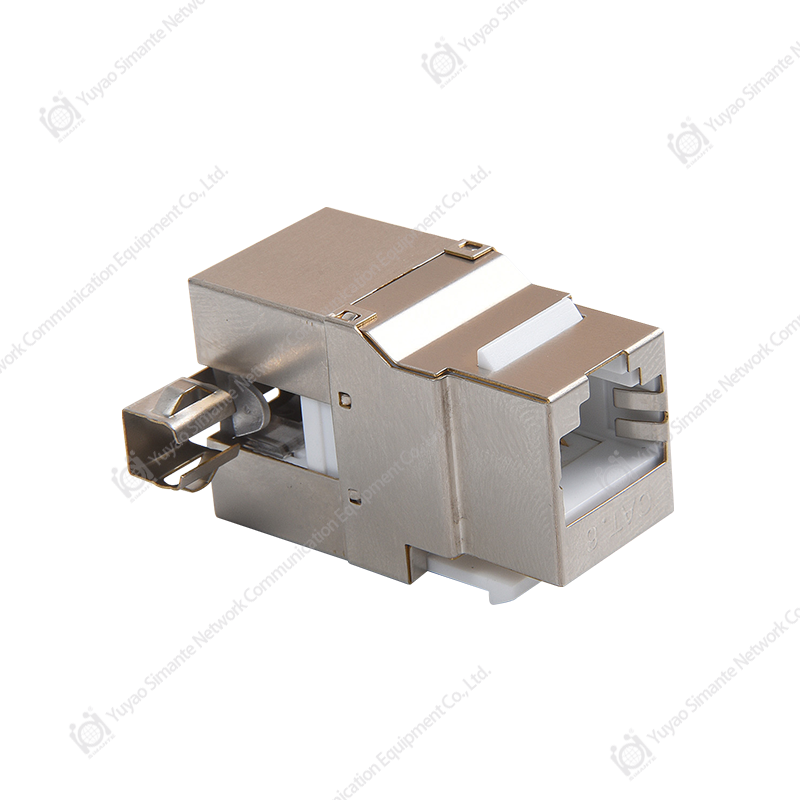
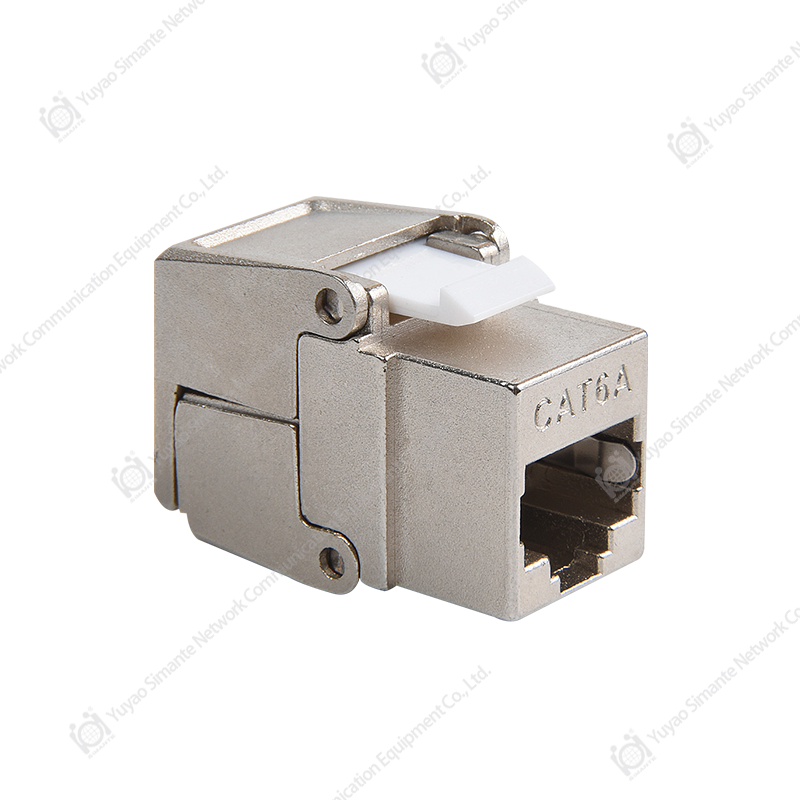
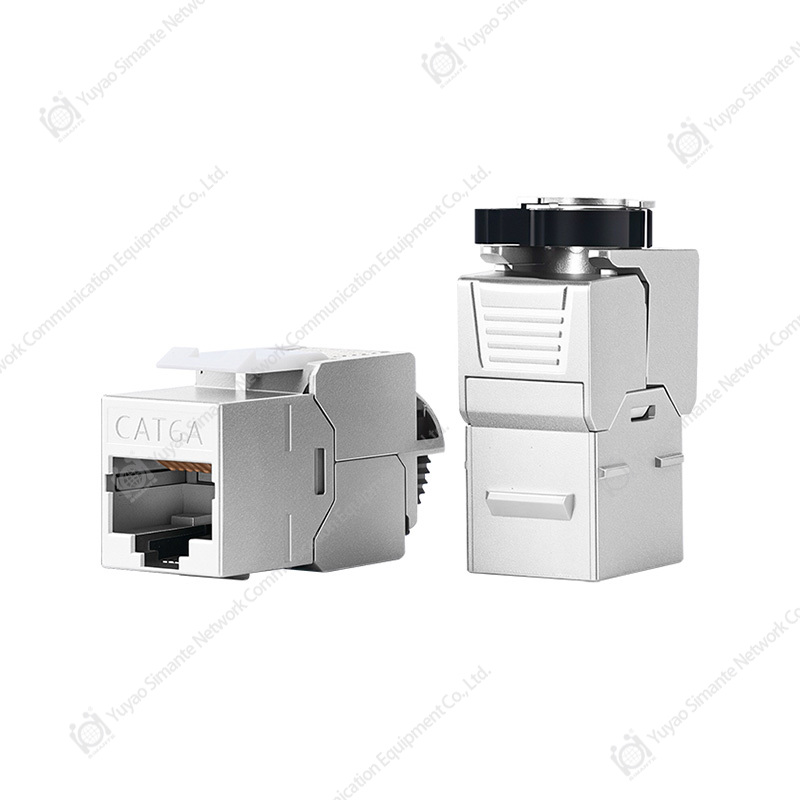
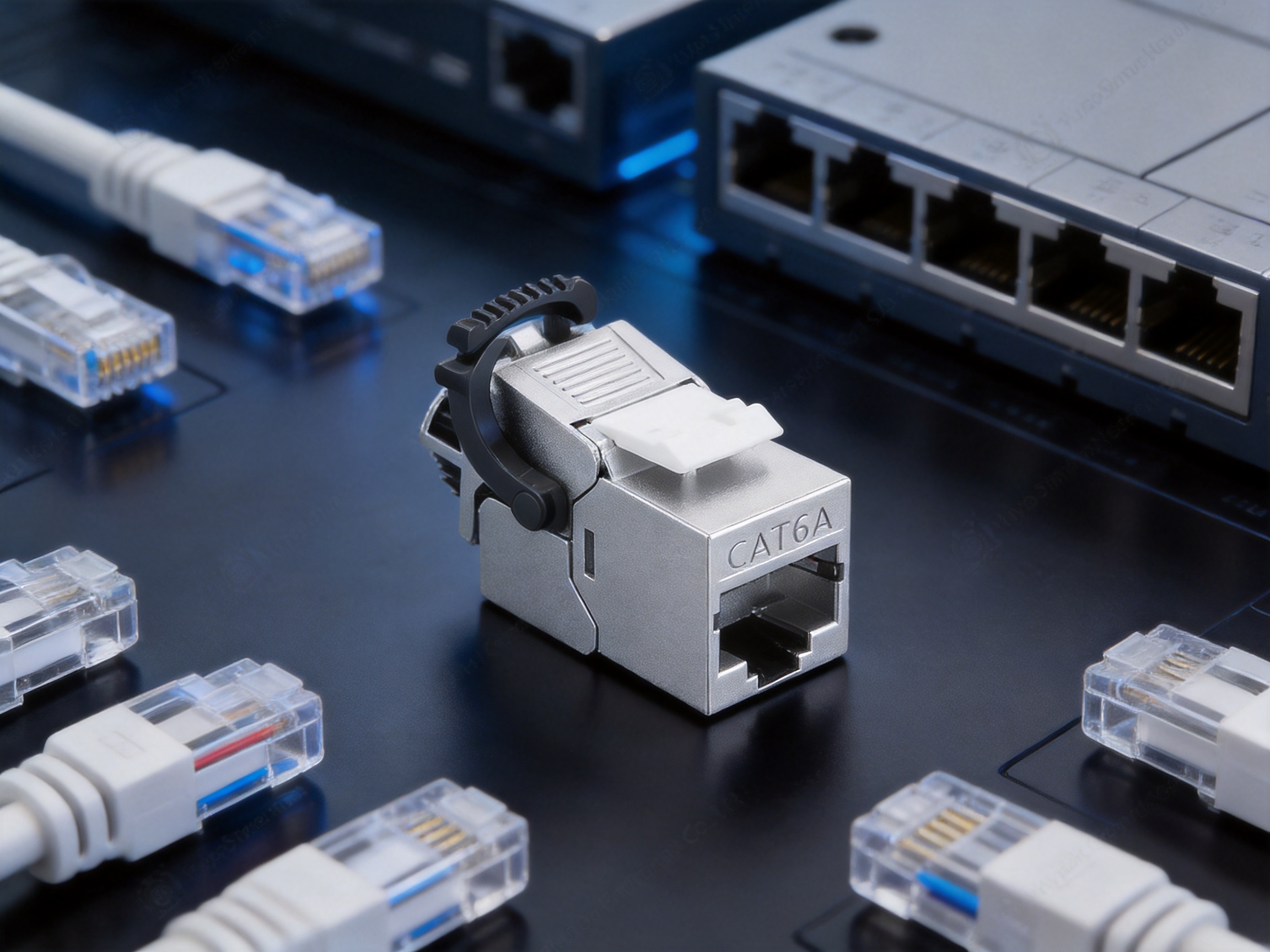
The SMT-1076T8C6A-FTP Shielded Toolless Keystone Jack with Ratchet Lock is designed for high-performance copper structured cabling applications where CAT6A-level connectivity, shielding, and dependable field installation are required. Its toolless termination concept reduces the need for separate punch-down tools, while the ratchet lock helps secure the cable and termination assembly during installation and operation. The shielded construction supports applications that require improved protection against electromagnetic interference, particularly in environments containing industrial equipment, power distribution systems, data center infrastructure, or dense network electronics.
Developed and manufactured by Yuyao Simante Network Communication Equipment Co., Ltd., the product reflects the company’s experience in network cabling solutions, optical fiber products, injection molding, automated assembly, product testing, and customized production. The manufacturer combines product development, manufacturing, quality control, sales, and technical service in one operating system. This integrated approach helps ensure that the keystone jack is not treated as an isolated plastic and metal part, but as a carefully engineered component of a complete structured cabling solution.
This article examines the product’s design concept, installation advantages, shielding value, CAT6A application potential, manufacturing strengths, quality considerations, and suitability for OEM and ODM projects. It also explains why a well-engineered toolless shielded keystone jack can offer practical advantages over conventional alternatives.

SMT-1076T8C6A-FTP Shielded Toolless Keystone Jack with Ratchet Lock
1. The Role of a Keystone Jack in Structured Cabling
A structured cabling system is made up of many interconnected elements, including horizontal cables, patch panels, outlets, face plates, cabinets, patch cords, distribution hardware, and active network equipment. The keystone jack is the modular interface that allows permanent cable links to connect with patching and outlet accessories. Because the component is used repeatedly across an installation, its quality can influence the performance and serviceability of the entire system.
A typical keystone jack must perform several functions simultaneously. It must accept the selected category of twisted-pair cable, maintain conductor positioning, preserve pair geometry, provide stable contact pressure, and fit into compatible modular panels or face plates. In a shielded product, it must also create a reliable conductive path around the cable termination and provide a degree of protection against external electromagnetic interference.
The product must also support practical field conditions. Installers may work in confined cabinets, ceiling spaces, floor boxes, wall outlets, or crowded patching areas. A design that requires excessive force, complex tools, or repeated disassembly can increase installation time and the possibility of termination errors. For this reason, a toolless construction can be an important advantage, especially in projects involving large quantities of outlets or patching positions.
The SMT-1076T8C6A-FTP is intended to address these requirements through a combination of modular compatibility, shielded construction, toolless cable termination, and ratchet-based mechanical locking. These features are directed toward the practical needs of installers, system integrators, distributors, and network owners.
2. Product Overview
The SMT-1076T8C6A-FTP is a shielded toolless keystone jack designed for CAT6A structured cabling applications. The product name identifies several key design characteristics. “Shielded” indicates that the connector incorporates a conductive protective structure intended to support electromagnetic compatibility and reduce the impact of external interference. “Toolless” indicates that the termination process is designed to reduce or eliminate the need for a conventional separate punch-down tool. “Ratchet lock” refers to the mechanical locking method used to secure the cable and termination components.
The CAT6A category is associated with higher-frequency copper networking than earlier category systems. CAT6A installations are commonly selected for high-speed Ethernet applications, data-intensive office environments, server rooms, wireless access point backbones, security systems, and other systems where additional bandwidth and improved alien crosstalk performance are important. A CAT6A-rated system depends on the performance of every connected element, including jacks, patch panels, cords, cables, and installation practices.
The keystone jack is suitable for use in compatible patch panels, wall face plates, data sockets, and modular outlet systems. Its compact modular format allows system designers to use the same general connector style in different locations. A network installation may place the jack in a wall outlet at one end of a permanent link and in a patch panel at the other end. This modularity can simplify product selection and support consistent installation practices.
The shielded format is particularly relevant where the cabling environment may be exposed to electromagnetic noise. Sources of interference can include motors, variable-frequency drives, high-current electrical conductors, fluorescent lighting systems, industrial automation equipment, radio transmitters, and dense concentrations of electronic devices. Shielding does not replace proper grounding, bonding, cable selection, or installation procedures, but it can contribute to a more controlled cabling environment when used as part of a complete shielded system.
3. Main Design Advantages
3.1 Toolless Termination
The most visible advantage of the product is its toolless termination concept. Conventional termination methods often require a punch-down tool and careful handling of individual conductors. A toolless design can reduce the number of tools required at the work location and may make installation more convenient in restricted spaces. It can also help standardize the termination process among installers with different levels of experience.
Toolless termination is especially valuable in retrofit projects, maintenance work, and distributed installations. A technician working in an occupied office, retail location, hotel, educational facility, or industrial building may not have a convenient workbench or complete tool kit. A connector that can be prepared and locked by hand can shorten the preparation process and reduce disruption to the surrounding environment.
Another benefit is the potential reduction in installation variation. With a traditional tool-based process, termination quality may depend on the force applied, the angle of the tool, the condition of the tool blade, and the installer’s technique. A well-designed toolless mechanism guides the conductors and termination components into a defined position. This can support more consistent assembly when the instructions are followed correctly.
Toolless does not mean that installation quality is automatic. The cable jacket must still be prepared correctly, pair twisting should be preserved as close as possible to the termination point, conductors must be placed in the correct sequence, and the cable must be secured. However, the simplified process can remove unnecessary steps and make proper installation easier to repeat.
3.2 Ratchet Locking Mechanism
The ratchet lock is an important mechanical feature because it supports secure engagement during termination. A ratchet structure typically provides progressive locking positions, allowing the installer to apply controlled pressure and keep the termination components in place. This can be helpful when the cable must remain aligned while the connector is being closed.
A secure locking method helps protect the termination from accidental movement. Network cabling is often pulled, bent, routed, and rearranged during installation. If the cable is not properly restrained, movement can place stress on the contacts or disturb the conductor arrangement. The ratchet lock helps the assembly maintain its intended position and can contribute to stable mechanical performance over the service life of the connection.
The locking design may also improve the installer’s tactile feedback. A clear locking action can help indicate that the assembly has reached the intended position. This is useful in high-volume work, where installers need to complete many terminations while maintaining consistent quality. The final result depends on the complete design and installation procedure, but a positive mechanical lock is a practical advantage over loose or difficult-to-confirm closure systems.
3.3 Shielded Construction
Shielding is used to help control the effects of electromagnetic interference and radio-frequency interference. In a network connector, the shield forms part of the conductive structure around the signal termination area. When installed with compatible shielded cable, patch panels, patch cords, and grounding provisions, it can help provide a continuous protective path through the cabling channel.
The shielded design of the SMT-1076T8C6A-FTP is valuable in applications where unshielded cabling may not provide sufficient environmental protection. These applications can include manufacturing areas, transport facilities, telecommunications rooms near electrical equipment, broadcast facilities, security control rooms, medical or laboratory environments, and high-density equipment rooms.
A shielded connector may also support better system planning in mixed commercial and industrial projects. Instead of using different connector styles for every area, a project designer can select a shielded modular platform for locations where additional electromagnetic protection is needed. The connector can therefore contribute to a more flexible and future-oriented cabling architecture.
It is important to emphasize that shielding is most effective when the complete channel is designed as a compatible shielded system. The cable screen, connector shield, patch panel, cabinet, grounding system, and installation practices should be considered together. A shielded jack alone cannot compensate for incorrect bonding or the use of incompatible unshielded elements.
3.4 CAT6A-Oriented Performance
CAT6A cabling is commonly selected for higher-speed applications, including systems designed to support 10 Gigabit Ethernet over appropriate channel configurations. Such systems require careful control of insertion loss, return loss, crosstalk, conductor geometry, contact alignment, and termination quality. The keystone jack must preserve the characteristics of the cable rather than introduce unnecessary disruption at the connection point.
The design of a CAT6A keystone jack should therefore consider the physical arrangement of conductors and pairs. Excessive untwisting, poor separation, inconsistent contact pressure, or weak cable retention can negatively affect link performance. A connector designed for CAT6A applications is intended to provide a controlled transition between the cable and the modular contact interface.
For network owners, the value of CAT6A is not limited to current speed requirements. It can provide additional capacity for future upgrades, higher-density wireless systems, distributed video, cloud services, surveillance systems, and data-intensive applications. A dependable CAT6A connector can help reduce the risk that a passive connection point will become an early limitation in the network.
4. Installation Workflow and Practical Use
The exact termination procedure should always follow the manufacturer’s installation instructions and the applicable cabling standard. In general, the installer first confirms the cable type, removes an appropriate portion of the outer jacket, separates the pairs only as much as necessary, and arranges the conductors according to the selected wiring scheme. The conductors are then placed into the termination component, and the ratchet locking mechanism is engaged to secure the assembly.
After termination, the connector should be installed into the selected patch panel, face plate, or data socket. The installer should confirm that the connector is fully seated, that the modular housing is not damaged, and that the cable bend radius is respected. The completed link should be tested with suitable field test equipment when certification is required.
Correct cable management is essential. Even a high-quality jack can be affected by excessive pulling force, sharp bends, compression, or unsupported cable weight. The cable should be routed so that the connector is not used as a structural support point. Strain relief and appropriate routing practices help maintain the mechanical and electrical stability of the termination.
For shielded systems, the installer should also confirm continuity of the shield path and the quality of bonding between system components. The building’s grounding and bonding design must be considered by qualified professionals. Where a project requires certification, the complete channel should be tested according to the relevant category and application requirements.
5. Comparison with Conventional Alternatives
The product offers several practical advantages when compared with conventional unshielded or tool-dependent keystone jacks. The most appropriate choice depends on the application, budget, cabling environment, and installation requirements. However, the following comparison illustrates why a shielded toolless CAT6A design can be attractive.
| Feature | Shielded Toolless CAT6A Keystone Jack | Conventional Unshielded Jack | Traditional Tool-Dependent Jack |
|---|---|---|---|
| Termination approach | Designed for simplified hand-operated termination | May use a similar modular process, depending on model | Usually requires a separate punch-down tool |
| Interference protection | Conductive shield supports a shielded channel design | Provides no equivalent metallic shielding path | Depends on whether the model is shielded |
| Mechanical retention | Ratchet lock supports controlled and secure closure | Varies by product design | Often depends on the punch-down termination and cable management |
| Application focus | High-performance copper systems and electrically demanding environments | General commercial and residential networking | Projects where traditional termination tools are available |
| Installation convenience | Reduced tool requirements and clear locking action | Generally convenient, but depends on construction | Can require more preparation and equipment |
| System planning | Suitable for structured shielded CAT6A architectures | Suitable where shielding is not required | Suitable for established tool-based installation methods |
Compared with an unshielded connector, the shielded product provides a better basis for applications where electromagnetic control is part of the design objective. Compared with a tool-dependent connector, the toolless construction can reduce installation equipment requirements and improve convenience in field conditions. Compared with a basic modular jack, the ratchet lock provides a more deliberate approach to cable retention and assembly security.
The product should not be selected solely because it has more features. The entire network channel must be considered. If a system uses unshielded cable and unshielded patch panels, a shielded jack may not provide the intended system-level benefit. Likewise, a CAT6A jack should be used with suitable CAT6A cable and accessories when CAT6A performance is required.
6. Applications Across Different Environments
6.1 Commercial Buildings
Office buildings increasingly require network connections for computers, telephones, wireless access points, cameras, room-control systems, printers, and building automation devices. A modular CAT6A keystone jack can be used in work areas, conference rooms, equipment rooms, and floor distribution locations. The toolless construction can be valuable during office renovation, where installation work must be completed quickly and with minimal disruption.
6.2 Data Centers and Telecommunications Rooms
Data centers and telecommunications rooms contain high concentrations of cables and electronic equipment. Installation teams often need to complete a large number of terminations while preserving clear labeling, routing, and service access. A compact shielded keystone jack can support structured patching arrangements in compatible panels and enclosures.
In these environments, the mechanical stability of the termination is especially important. Cables may be rearranged during equipment upgrades, and technicians may work close to existing connections. A ratchet lock can help reduce the risk of movement during assembly and maintenance, provided that the cable is correctly supported and handled.
6.3 Industrial and Automation Facilities
Industrial facilities frequently contain motors, control cabinets, robotic systems, variable-speed drives, welding equipment, and other sources of electrical noise. Network connections may be required for monitoring, production control, machine communication, and industrial data collection. A shielded connector can support a cabling architecture intended to reduce the influence of electromagnetic interference.
Industrial installations also place greater demands on mechanical planning. Cables may be exposed to vibration, movement, dust, or frequent maintenance. The connector should therefore be used together with appropriate cable jackets, enclosures, strain relief, grounding, and environmental protection. The ratchet locking feature is beneficial as part of this wider installation strategy.
6.4 Smart Homes and Building Automation
Modern residential and commercial buildings may use structured cabling for access control, surveillance, audio and video distribution, wireless networking, energy management, and automation. A modular keystone jack allows different functions to be organized using consistent outlet and panel formats.
Although residential environments may have lower electromagnetic exposure than industrial facilities, shielded options can still be useful near electrical rooms, home theaters, communication cabinets, and high-density equipment areas. The clean modular appearance of a keystone-based system also supports organized and serviceable installations.
6.5 Educational, Healthcare, and Public Facilities
Schools, hospitals, libraries, government offices, and public buildings require cabling systems that can accommodate changing layouts and new technology. Modular jacks make it easier to create standardized network outlets throughout a facility. Toolless installation may reduce labor complexity when work is carried out across many rooms or during phased renovations.
In healthcare and other mission-sensitive environments, network connectivity supports communication, monitoring, administration, security, and operational systems. Passive components should be selected with attention to reliability, documentation, testing, and compatibility with the complete infrastructure.

7. Manufacturing Strengths Behind the Product
The performance of a network connector begins long before final assembly. Material selection, mold design, dimensional control, metal forming, contact positioning, automated assembly, inspection, and testing all influence the final product. Yuyao Simante Network Communication Equipment Co., Ltd. operates as a professional manufacturer integrating design, development, sales, and service. This integrated structure supports closer control over the product life cycle.
The company has nearly two decades of experience serving the network cabling and optical fiber product markets. This experience gives the manufacturer a practical understanding of the requirements faced by installers, distributors, system integrators, and project owners. Product development can therefore be guided not only by theoretical design considerations, but also by installation feedback and market application needs.
The company has more than ten engineers and over thirty full-time technical personnel. A technical team of this kind can contribute to product modeling, mold optimization, process improvement, test planning, customer customization, and production troubleshooting. Engineering resources are particularly important for connector products because small dimensional differences can affect fit, locking force, conductor alignment, and assembly repeatability.
7.1 Injection Molding Capabilities
The manufacturer operates fully automatic and semi-automatic injection molding equipment. Injection molding is central to the production of many network cabling components because it creates the insulating housings, covers, cable guides, and structural parts used in connectors and related accessories. Stable molding conditions help maintain dimensional accuracy and consistent assembly fit.
Automatic injection molding can improve production consistency by controlling material feeding, cycle timing, pressure, and cooling conditions. Semi-automatic equipment can provide flexibility for different product sizes, customer requirements, and production volumes. The combination of equipment types allows the factory to balance efficiency with customization.
For a keystone jack, molded components must be designed to accommodate contact elements, shielding parts, cable termination pieces, and locking mechanisms. Mold quality affects wall thickness, snap features, alignment points, and the fit between moving and stationary components. Ongoing mold maintenance and process monitoring are therefore essential to stable production.
7.2 Automated Assembly
The factory also operates automatic installation machines and multiple regular and customized production lines. Automated or semi-automated assembly can help control the placement of terminals, shields, covers, and locking parts. It can also reduce variation caused by repetitive manual operations.
Automation is particularly useful for products manufactured in large quantities. The company maintains an annual output of more than nine million units across its production activities. This capacity supports stable supply for distributors, contractors, and OEM customers while providing the production scale needed for process optimization.
Automation does not eliminate the need for skilled personnel. Technical operators are required to set equipment, verify tooling, monitor production conditions, inspect samples, and respond to abnormalities. The strongest manufacturing systems combine automated repeatability with human engineering judgment and quality supervision.
7.3 Design and Development Integration
When product design and manufacturing are connected within the same organization, engineering changes can be evaluated more efficiently. A design improvement to the ratchet lock, housing, shielding structure, or cable guide can be reviewed together with the relevant mold and assembly process. This can shorten communication cycles and improve the feasibility of customized solutions.
Integrated development is also valuable for OEM and ODM work. Customers may require specific labels, colors, packaging, wiring identification, panel compatibility, or structural changes. A manufacturer with its own engineering and production capabilities can assess these requirements from both a design and manufacturing perspective.
8. Quality Management and Product Testing
Quality control for a keystone jack should include both visual and functional inspection. Visual checks may verify molding quality, shield condition, contact position, locking components, labels, and overall finish. Functional checks may evaluate modular fit, termination security, locking operation, conductor retention, and electrical continuity.
For CAT6A-oriented products, performance verification should be aligned with the applicable product requirements and the intended system application. Depending on the project, testing may involve resistance, insulation, dielectric strength, contact stability, insertion loss, return loss, crosstalk, and other transmission parameters. The exact test program should be determined by the manufacturer, relevant standards, and customer specifications.
Mechanical testing is also important. The product may be subjected to insertion and extraction cycles, cable retention evaluation, locking force checks, vibration considerations, and temperature-related assessment. The goal is to confirm that the connector remains functional under normal installation and service conditions.
Simante emphasizes performance testing as part of its manufacturing approach. This reflects the company’s position that quality should be controlled not only during production but also through verification of the finished product. A stable test process can help identify production drift and support continuous improvement.
For project customers, documentation is an important part of quality assurance. Product drawings, installation instructions, test reports, packaging records, and inspection procedures can help distributors and installers use the product correctly. Clear technical communication also reduces the risk of selecting an incompatible accessory or applying the jack outside its intended environment.
9. Advantages for Distributors, Contractors, and OEM Customers
9.1 Supply Stability
Large-scale production capacity is valuable for customers managing ongoing construction projects or distribution inventories. A supplier with multiple production lines and substantial annual output can provide a stronger basis for repeat orders. Stable supply helps contractors avoid changing connector models in the middle of a project, which can create installation and documentation problems.
9.2 Customization Support
Different markets may require different colors, labels, packaging formats, wiring instructions, branding arrangements, or accessory combinations. The manufacturer undertakes OEM and ODM projects, enabling customers to discuss product adaptations in addition to standard catalog purchases.
Customization is most effective when technical requirements are clearly documented. Customers should specify cable category, shield type, mounting format, conductor arrangement, operating environment, packaging expectations, and required test documentation. The manufacturer’s engineering team can then evaluate the request and determine the most suitable development and production approach.
9.3 Product Family Compatibility
A company that manufactures keystone jacks, patch panels, wall face plates, data sockets, and related products can help customers develop a more consistent product family. Consistent dimensions and modular formats may simplify stocking, installation, and maintenance. A customer may be able to source several parts of a structured cabling system through one experienced supplier.
9.4 Export Experience
Simante maintains export activity in Europe, Australia, Africa, the Middle East, and Southeast Asia. Experience across different markets can help the company understand varied packaging practices, customer expectations, technical documentation requirements, and project conditions. International experience is also useful for customers seeking a supplier capable of supporting cross-border distribution or regional projects.
10. Installation Quality Recommendations
The product’s advantages are best realized when installation procedures are carefully controlled. First, installers should verify that the cable is suitable for the selected CAT6A connector and that the conductor arrangement matches the project wiring scheme. Mixing incompatible cable constructions or connector types can compromise performance.
Second, the outer jacket should be removed cleanly without damaging the insulation of the internal conductors. Pair twisting should be preserved as close as practical to the termination area. Excessive untwisting can increase crosstalk and reduce the consistency of the link.
Third, all conductors should be fully inserted into their designated positions before the ratchet lock is closed. The installer should confirm that the cable is not twisted or pulled sideways and that the locking mechanism has engaged completely. A partially closed or incorrectly aligned assembly should be corrected rather than concealed inside a panel or face plate.
Fourth, the cable should be supported independently of the jack. Excessive weight, tension, or bending at the connector can affect mechanical stability. Proper cable trays, hook-and-loop ties, brackets, and routing accessories should be used according to the installation environment.
Finally, the completed channel should be inspected and tested. Certification testing is particularly important for CAT6A links used in high-speed or mission-sensitive applications. Test results can provide evidence that the installation meets the project requirements and can help identify problems before the system is placed into service.
11. Sustainability and Lifecycle Considerations
Passive network components are expected to remain in service for many years. A durable connector can reduce the need for premature replacement and help lower the material and labor costs associated with maintenance. Toolless access may also make future service work more convenient if a connection must be inspected or reterminated.
Manufacturing efficiency can contribute to responsible resource use. Stable injection molding processes, automated assembly, controlled material usage, and systematic inspection can reduce production waste and improve yield. High-quality process control also reduces the likelihood of defective products entering the supply chain.
Lifecycle planning should include documentation and compatibility. A well-documented connector is easier to identify, replace, and maintain over time. Customers should retain product information, installation instructions, and test records so that future technicians can understand the original system design.
When a network is upgraded, modular keystone architecture can provide flexibility. Instead of replacing an entire outlet or panel, technicians may be able to replace individual modular inserts. This approach can simplify phased upgrades and reduce unnecessary removal of surrounding hardware.

12. Why the Product Is a Competitive Choice
The SMT-1076T8C6A-FTP combines several features that are valuable in demanding structured cabling applications. Its CAT6A orientation supports higher-performance copper networks. Its shielded structure provides a basis for electromagnetic protection when integrated into a complete shielded channel. Its toolless design can reduce installation complexity, while the ratchet lock supports secure mechanical assembly.
The competitive value of the product also comes from the manufacturer behind it. Simante is not only a trading organization sourcing finished goods from unrelated factories. It operates its own design, development, molding, assembly, testing, and production systems. This gives customers a more direct connection between product requirements and manufacturing execution.
The company’s technical staff, equipment base, production lines, export experience, and OEM/ODM capability provide additional advantages. Customers can discuss standard products, private-label programs, custom packaging, or technical modifications with a manufacturer that understands both network cabling applications and factory processes.
Compared with a basic unshielded jack, the product is better suited to applications where interference control and CAT6A performance are priorities. Compared with a conventional tool-dependent jack, it offers a more convenient installation concept. Compared with an unstructured or low-control supply source, it provides the benefits of an established manufacturer with integrated quality and production resources.
These advantages should be evaluated within the context of the complete project. No connector can compensate for incorrect cable selection, poor grounding, excessive untwisting, weak cable management, or inadequate testing. However, selecting a well-designed connector is a fundamental step toward building a reliable and serviceable network.
13. Selection Guide for Project Buyers
Project buyers should begin by confirming the application category. If the network requires CAT6A performance, the jack, cable, patch panel, patch cord, and test procedure should all be selected accordingly. If electromagnetic interference is a concern, the buyer should determine whether a complete shielded channel is required and verify the grounding approach.
The installation environment should also be reviewed. For large office projects, the main priority may be installation speed and consistent termination. For industrial environments, shielding and mechanical stability may be more important. For data centers, modular compatibility, repeatability, labeling, and maintenance access may receive greater emphasis.
Buyers should then confirm panel and face plate compatibility. Keystone products are modular, but dimensions, retaining clips, shield clearances, and panel thickness may vary. Compatibility should be checked before ordering large quantities.
Packaging and documentation requirements should be discussed in advance. International distributors may need multilingual labels, barcodes, private-label packaging, carton specifications, or project-specific inspection documents. Simante’s OEM and ODM capabilities can support these needs when the requirements are provided clearly.
Finally, the buyer should evaluate supply capacity and after-sales support. A product may be technically suitable, but long-term value also depends on consistent availability, responsive communication, technical documentation, and the ability to resolve quality or installation questions.
14. Frequently Asked Questions
Q1: What type of product is the SMT-1076T8C6A-FTP?
It is a shielded, toolless CAT6A keystone jack with a ratchet locking mechanism. It is intended for use in compatible structured cabling panels, wall face plates, data sockets, and other modular network outlets.
Q2: What is the main advantage of the toolless design?
The toolless design reduces dependence on a separate punch-down tool during termination. It can simplify field installation, especially in confined areas, retrofit projects, maintenance work, and large installations requiring many connection points.
Q3: Why is the ratchet lock important?
The ratchet lock helps secure the cable and termination assembly during installation. It provides controlled closure and can help reduce movement that might otherwise affect conductor alignment or mechanical stability.
Q4: Why choose a shielded keystone jack?
A shielded jack is suitable for applications where electromagnetic interference or radio-frequency interference is a concern. It can contribute to a protective conductive path when used with compatible shielded cable, patching components, grounding, and bonding practices.
Q5: Can the jack be used in an unshielded system?
System compatibility should be confirmed before installation. The intended benefit of shielding is achieved when the complete channel is designed consistently. Customers should consult the product documentation and project requirements before combining shielded and unshielded components.
Q6: Is the product suitable for 10 Gigabit Ethernet applications?
The product is designed for CAT6A structured cabling applications, which are commonly used for higher-speed Ethernet systems including 10 Gigabit Ethernet over suitable channels. Actual performance depends on the complete channel, installation quality, cable type, environmental conditions, and certification testing.
Q7: Does toolless termination eliminate the need for testing?
No. Toolless termination simplifies the assembly process, but the completed link should still be inspected and tested when project requirements call for certification. Testing helps verify continuity, transmission performance, and correct installation.
Q8: What industries can use this product?
Potential applications include commercial buildings, data centers, telecommunications rooms, industrial facilities, automation systems, smart homes, educational buildings, healthcare facilities, security systems, and other structured cabling environments.
Q9: What manufacturing capabilities support the product?
The manufacturer operates design and development resources, automatic and semi-automatic injection molding equipment, automatic installation machines, multiple regular and customized production lines, and product performance testing processes. These capabilities support repeatable production and customized customer programs.
Q10: Can customers request OEM or ODM services?
Yes. The manufacturer undertakes OEM and ODM projects. Customers can discuss requirements such as packaging, labeling, product modifications, color, documentation, and other project-specific details with the technical and sales teams.
Q11: How should the product be maintained after installation?
Maintenance should include visual inspection of the panel or outlet, confirmation that cables are properly supported, and review of any changes or rework in the surrounding cabling. If a connection is moved or reterminated, it should be inspected and tested according to the project procedure.
Q12: What should buyers confirm before placing an order?
Buyers should confirm category requirements, shield type, cable compatibility, panel and face plate compatibility, wiring scheme, packaging, documentation, quantities, delivery schedule, and any testing or customization requirements.
15. Conclusion
The SMT-1076T8C6A-FTP Shielded Toolless Keystone Jack with Ratchet Lock is designed to meet the practical needs of modern copper structured cabling. By combining CAT6A-oriented construction, shielding, toolless termination, and positive ratchet locking, it provides a balanced solution for installers and system designers seeking performance, convenience, and mechanical security.
The product is particularly valuable when used in applications requiring higher-speed copper networking, electromagnetic control, modular outlet architecture, and efficient field installation. Its advantages become stronger when paired with compatible CAT6A cable, shielded patching products, proper grounding and bonding, disciplined cable management, and complete channel testing.
Behind the product is a manufacturer with nearly two decades of experience, a dedicated engineering and technical team, injection molding capacity, automated assembly resources, multiple production lines, performance testing, international export experience, and OEM/ODM support. These capabilities provide a foundation for stable quality, supply continuity, customization, and long-term customer service.
For contractors, distributors, integrators, and network owners, the product represents more than a modular connector. It is a practical component of a structured cabling strategy focused on installation efficiency, signal integrity, electromagnetic compatibility, and future network readiness. When selected and installed correctly, it can help create a more dependable, organized, and maintainable communication infrastructure.
References
1. ISO/IEC 11801, Information Technology — Generic Cabling for Customer Premises.
2. ANSI/TIA-568.2-D, Balanced Twisted-Pair Telecommunications Cabling and Components Standards.
3. IEC 60603-7 Series, Connectors for Electronic Equipment — Part 7: Detail Specifications for 8-Way, Shielded and Unshielded Free and Fixed Connectors.
4. IEEE 802.3, Ethernet Standards for Data Communication Networks.
5. BICSI Telecommunications Distribution Methods Manual, Structured Cabling Design and Installation Practices.
6. Manufacturer product information for shielded CAT6A keystone jack assemblies and structured cabling components.
7. Manufacturer information concerning network cabling solutions, optical fiber products, injection molding, automated assembly, quality testing, and OEM/ODM manufacturing services.