Español
 عربى
عربى русский
Content
- 1 Product Overview
- 2 Why Cat6A Copper Termination Matters
- 3 Anti-Crosstalk Design Benefits
- 4 Dual 110 and Krone IDC Termination Compatibility
- 5 Role of the Special Cap
- 6 Compact Keystone Form Factor
- 7 Product Advantages Compared with Basic Competitor Designs
- 8 Manufacturing and Engineering Strengths
- 9 Quality Control from Design to Shipment
- 10 Customization and OEM or ODM Support
- 11 Recommended Installation Procedure
- 12 Applications
- 13 System-Level Advantages for Project Buyers
- 14 Selection and Purchasing Checklist
- 15 Maintenance and Troubleshooting
- 16 Environmental and Operational Considerations
- 17 Why Manufacturing Partnership Matters
- 18 Conclusion
- 19 Questions and Answers
- 19.1 What type of network application is this keystone jack intended for?
- 19.2 What does anti-crosstalk mean in this product?
- 19.3 Can installers use both 110 and Krone termination tools?
- 19.4 Does the jack support both T568A and T568B wiring?
- 19.5 What is the purpose of the special cap?
- 19.6 Can the jack be installed in a patch panel?
- 19.7 Is this product suitable for OEM or ODM projects?
- 19.8 What should be checked before mass production?
- 19.9 How should a failed link be diagnosed?
- 19.10 Why is supplier manufacturing capacity important?
- 20 References
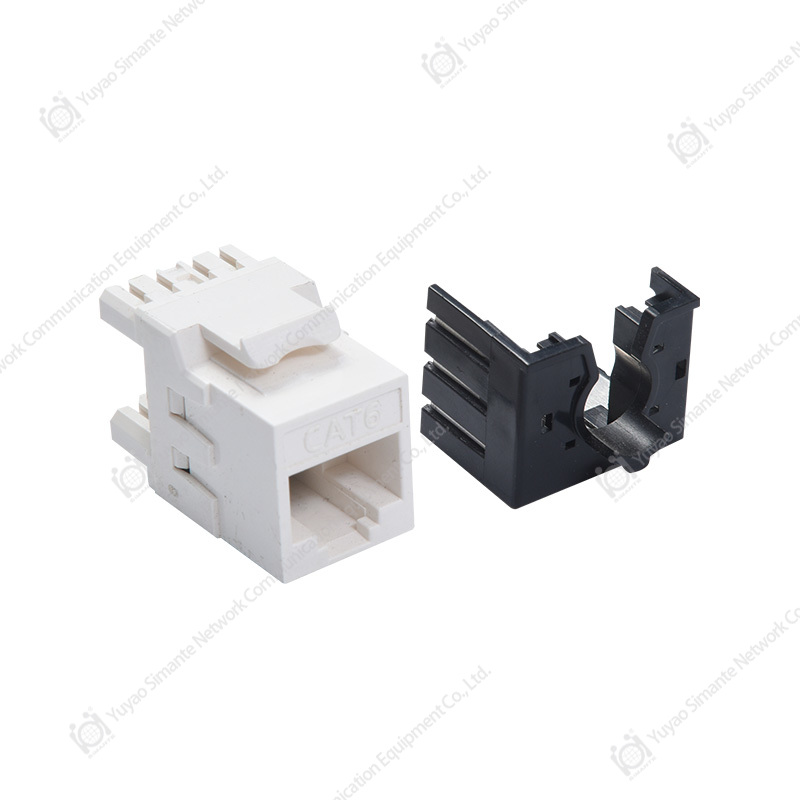
- 21 Product: SMT-1069D8C6A-AC Anti-crosstalk Cat6A UTP 110 and Krone IDC keystone jack with special Cap
Modern data networks depend on reliable connection points as much as they depend on high-performance cable, switches, and servers. A structured cabling system may contain hundreds or thousands of terminations, and every termination can influence transmission quality, installation time, long-term stability, and maintenance cost. The SMT-1069D8C6A-AC Anti-crosstalk Cat6A UTP 110 and Krone IDC keystone jack with special cap is designed for network installations that require dependable Cat6A performance, flexible termination methods, and effective control of unwanted electromagnetic coupling between conductors.
This keystone jack is part of a copper structured cabling solution for commercial buildings, data rooms, communication cabinets, industrial facilities, smart home systems, and other network environments. Its key design concept combines Cat6A unshielded twisted-pair compatibility with a termination structure that supports both 110 and Krone IDC installation practices. The special cap contributes to pair organization and termination consistency, while the anti-crosstalk design helps preserve signal quality in high-density cabling environments.
For installers, distributors, system integrators, and original equipment buyers, the value of a keystone jack is not limited to its external housing. A professional product must also provide accurate conductor positioning, stable contact pressure, repeatable assembly, suitable mechanical protection, and compatibility with the surrounding faceplate or patch panel. These details determine whether the finished link can deliver consistent performance over its service life.
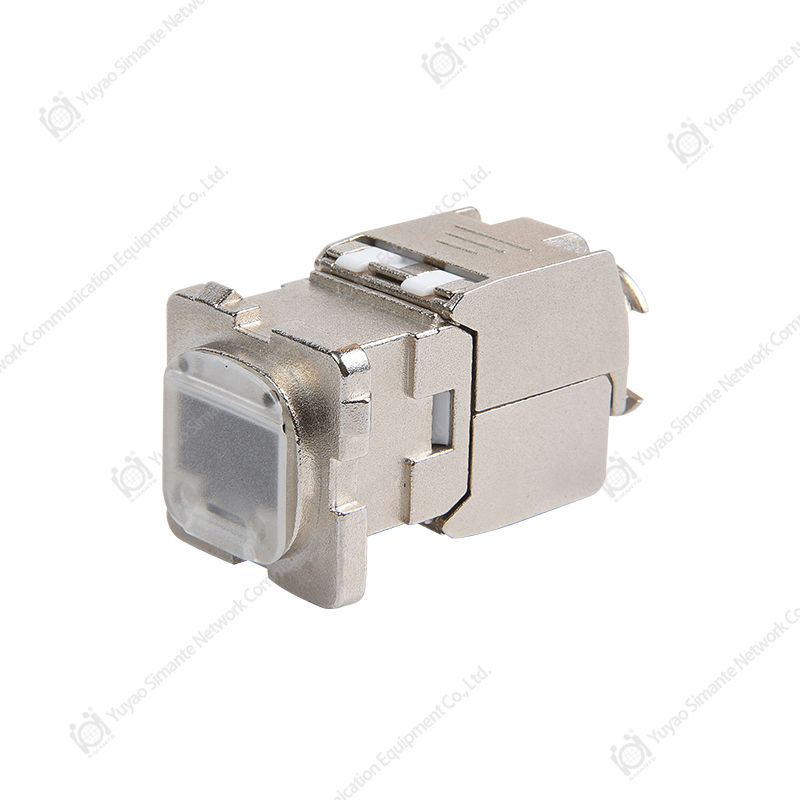
SMT-1069D8C6A-AC Anti-crosstalk Cat6A UTP 110 and Krone IDC keystone jack with special Cap
Product Overview
The SMT-1069D8C6A-AC is a Cat6A UTP keystone jack developed for copper data cabling systems. It is intended for use with unshielded twisted-pair network cable and is designed around a compact keystone form factor. This form factor allows the jack to be installed in a wide range of compatible wall plates, surface boxes, patch panels, modular workstation outlets, and other structured cabling accessories.
The product title identifies several important characteristics. “Cat6A” indicates that the jack is intended for Category 6A network cabling applications. “UTP” indicates an unshielded twisted-pair configuration. “110 and Krone IDC” identifies two widely used insulation displacement connection patterns, giving installers greater flexibility when working with different tools, regional practices, or project specifications. “Anti-crosstalk” describes the product’s focus on reducing unwanted coupling between pairs during termination and operation. The “special cap” supports the organization and protection of conductors during installation.
In a complete channel, the keystone jack operates together with horizontal cable, patch panels, patch cords, cabinets, grounding or bonding arrangements where applicable, and active network equipment. It should therefore be selected as part of a coordinated system rather than as an isolated component. Correct cable category, conductor diameter, installation method, bend radius, termination quality, and testing procedure remain essential to achieving the required result.
A keystone jack is often considered a small component, but it performs several critical functions. It creates the transition between the permanent cable and the user-side patch cord. It maintains the twist of each pair as close as practical to the contact area. It provides a stable interface for repeated plug insertion and removal. It also gives the installer a structured way to manage the eight conductors in a four-pair cable. The SMT-1069D8C6A-AC is designed around these practical requirements.
Why Cat6A Copper Termination Matters
Cat6A systems are commonly selected for demanding Ethernet networks, including applications that require high data rates and improved resistance to alien crosstalk. Compared with lower-category cabling, Cat6A installations place greater emphasis on pair geometry, termination accuracy, component consistency, and cable management. A jack that does not preserve pair separation or that allows excessive untwisting can reduce the margin available to the finished channel.
During transmission, electrical energy travels through balanced twisted pairs. The twist helps the conductors reject external interference and reduces coupling between adjacent circuits. However, the pair relationship can be disturbed at the termination point. When conductors are spread too far apart, routed incorrectly, or held under inconsistent pressure, the connection may introduce additional loss or crosstalk. For this reason, a Cat6A keystone jack must be designed with attention to both electrical behavior and installer usability.
Cat6A performance is also relevant in areas where network density is increasing. Data centers, office floors, education facilities, healthcare buildings, retail sites, and intelligent building systems may place many cables and outlets close together. A well-designed anti-crosstalk termination helps reduce the risk that the connection point becomes a weak part of the channel.
The UTP configuration offers a practical solution where an unshielded infrastructure is preferred. It can simplify installation because it does not require the same shield continuity considerations as a shielded system. At the same time, the installer must follow good cable routing practices and keep the cable away from strong sources of electrical noise. Product selection should always match the electromagnetic environment and the requirements of the overall project.
Anti-Crosstalk Design Benefits
Crosstalk is unwanted signal coupling from one pair or channel into another. In a network cable, crosstalk can occur between pairs within the same cable or between adjacent cables and connectors. Excessive crosstalk can reduce the signal-to-noise margin and may lead to retransmissions, lower effective throughput, or difficulty passing certification tests.
The anti-crosstalk concept of the SMT-1069D8C6A-AC focuses on controlling the conductors at the termination area. A special cap can help guide individual wires into consistent positions and maintain separation between pairs. The internal structure can also support a more organized transition from the twisted cable geometry to the IDC contacts. This is important because the termination area is where the natural cable twist is partially opened.
One advantage of an anti-crosstalk structure is improved repeatability. In a purely manual termination, two installers may place the same cable conductors in slightly different positions. A guided cap and defined termination layout reduce variation by giving the installer a visual and mechanical reference. Greater repeatability can support more uniform field results across a large project.
Another benefit is easier troubleshooting. When the conductors are arranged according to a clear cap layout, an installer can inspect the termination more quickly. Incorrect pair placement, excessive untwisting, uneven wire seating, or incomplete IDC insertion can be identified before the outlet is closed. This can reduce the time required for rework and help prevent hidden faults.
Anti-crosstalk design should not be understood as a substitute for correct installation. The cable must still be prepared carefully, and the installer should avoid unnecessary untwisting, sharp bends, excessive pulling force, and overfilling of pathways. The product contributes to the performance margin, while the complete link depends on every component and procedure in the channel.
Dual 110 and Krone IDC Termination Compatibility
The IDC system is widely used because it enables conductors to be terminated without removing insulation manually from each wire. When the conductor is pressed into the slot, the contact displaces the insulation and creates an electrical connection. This method supports efficient field installation and is especially useful for structured cabling projects with large numbers of outlets.
110 and Krone are two common IDC termination styles. Different markets, installers, and project standards may favor one or the other. A keystone jack that supports both approaches gives distributors and contractors more flexibility when serving international customers or mixed project requirements. It can also reduce the need to maintain separate product types for every installation team.
For the installer, dual-format compatibility can simplify tool selection and work planning. A project may use a 110-style impact tool in one region or a Krone-style tool in another. When the jack is designed to accommodate both termination methods, the same basic product platform can be integrated into more installation environments.
The termination sequence should follow the product’s wiring diagram and the project’s selected wiring scheme. Most structured cabling installations use either the T568A or T568B pinout, and both ends of a permanent link must be terminated consistently. The color code should be checked before the conductors are seated. A dual IDC jack does not eliminate the need to follow the approved wiring standard.
Good termination practice includes preparing only the required cable length, preserving pair twists as close as possible to the IDC area, placing each conductor fully into its designated slot, and using the appropriate tool with controlled force. After termination, the installer should inspect for loose wires, split insulation, damaged conductors, or wires that have not been cut cleanly.
Role of the Special Cap
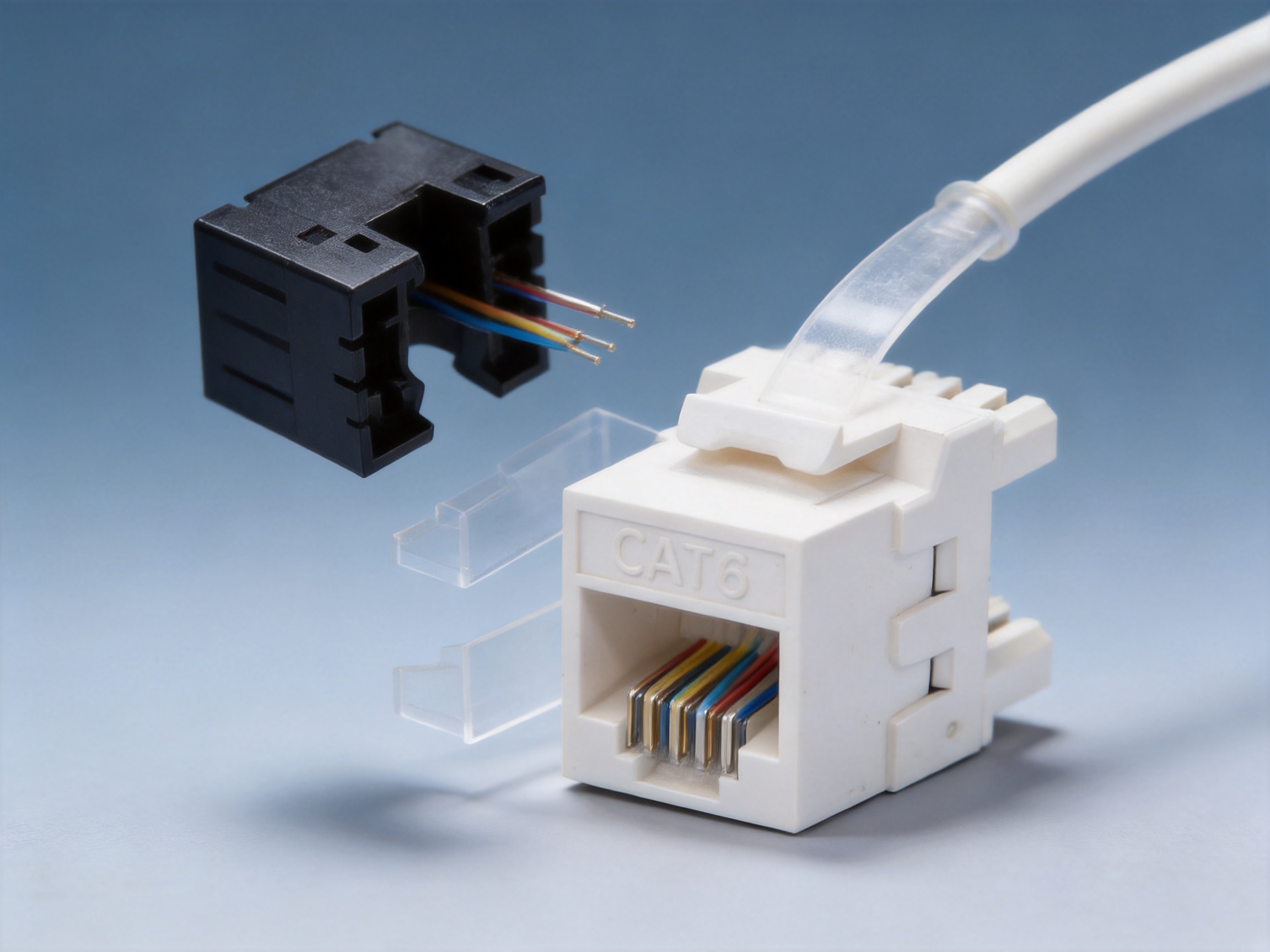
The special cap is an important part of the product concept. In a structured cabling jack, the cap may perform several practical functions, including guiding the conductors, supporting pair separation, helping maintain the intended wiring sequence, and protecting the terminated area. It can also make the installation more orderly and visually consistent.
During field work, cable conductors can move as the jack is positioned inside a faceplate or patch panel. A cap helps retain the wires and may reduce the possibility of accidental displacement. This is particularly useful where the installation is performed in a confined space or where multiple outlets must be terminated in a short period.
The cap can also support quality control. A consistent cap position provides an immediate visual indication that the termination has been assembled correctly. In production environments, this may help inspectors compare finished units. In field installations, it can assist supervisors who need to review a large number of outlets efficiently.
Mechanical protection is another potential advantage. The cap helps shield the wire arrangement from incidental contact during insertion into the modular housing. It may also help reduce stress on the conductors when the jack is moved during installation. However, the cap should be installed according to the intended sequence and should not be forced into position if wires are incorrectly routed.
For distributors, the special cap creates a clear product feature that distinguishes the jack from basic Cat6A termination products. For contractors, its value is practical: a guided and protected termination can contribute to faster work, fewer visible inconsistencies, and more predictable results.
Compact Keystone Form Factor
The keystone format is one of the most widely adopted modular designs in copper structured cabling. Its compact profile allows the same type of jack to be used in wall outlets, patch panels, workstation modules, and surface-mounted accessories. This modularity simplifies product selection and gives system designers more freedom when planning outlet density and appearance.
A compact keystone jack is useful in office renovations, residential network installations, classrooms, hospitality projects, and commercial workspaces where space may be limited. It can be combined with single-port, multi-port, angled, or other compatible modular frames, depending on the surrounding system.
Keystone compatibility also benefits maintenance. If an outlet is damaged or needs to be upgraded, the modular jack can generally be replaced without changing the complete faceplate or enclosure. This can shorten service time and reduce the number of spare parts required for routine maintenance.
The mechanical fit between the jack and the mounting accessory is important. Installers should confirm compatibility with the selected faceplate, patch panel, surface box, and cable management arrangement. A strong fit helps prevent movement, while an appropriate release mechanism supports later removal when service work is necessary.
Product Advantages Compared with Basic Competitor Designs
The first major advantage is the combination of Cat6A UTP positioning and anti-crosstalk construction. Basic jacks may provide only a simple IDC termination without a defined approach to conductor separation. In higher-performance installations, a more controlled wire arrangement can provide better consistency and help preserve the electrical balance of the channel.
The second advantage is dual 110 and Krone IDC usability. Products restricted to a single termination format may require contractors to change tools or maintain separate inventories. A dual-compatible design can support broader customer requirements and make the product more adaptable to regional practices.
The third advantage is the special cap. A standard jack may leave more of the conductor arrangement dependent on manual workmanship. A guided cap can assist with wire organization, installation inspection, and mechanical protection. This can be particularly valuable on projects where many installers must produce consistent terminations.
The fourth advantage is modular deployment. Because the product uses a keystone format, it can be integrated into various outlet and patching environments. This supports standardization across different areas of a building and helps reduce the complexity of future replacements.
The fifth advantage is suitability for professional network cabling solutions. The product is not presented merely as a low-cost connector. It is intended to function as part of a structured system in which installation repeatability, product availability, manufacturing control, and technical support are important purchasing considerations.
| Feature | Practical Value | Project Benefit |
|---|---|---|
| Cat6A UTP design | Supports high-performance unshielded copper cabling applications | Suitable for modern office, commercial, and communication networks |
| Anti-crosstalk structure | Helps organize conductors and control coupling at the termination | Improves consistency and supports the performance margin of the link |
| 110 and Krone IDC compatibility | Accommodates common field termination methods | Provides greater installer and regional flexibility |
| Special cap | Guides, retains, and protects the wire arrangement | Can reduce termination variation and simplify inspection |
| Keystone format | Fits modular faceplates, patch panels, and outlet systems | Supports flexible deployment and easier replacement |
| Factory production capability | Supports repeatable molding, assembly, and inspection | Helps maintain stable supply for standard and customized projects |
Manufacturing and Engineering Strengths
The manufacturer behind the product is an established network communication equipment producer with experience in the design, development, sales, and service of network cabling and optical fiber products. Its product scope includes keystone jacks, patch panels, wall faceplates, data sockets, and related structured cabling components.
Nearly two decades of market service provide an important foundation for product development. Network accessories must be designed not only for laboratory performance but also for installation conditions, distributor requirements, packaging, project customization, and after-sales support. Long-term involvement in the field helps a manufacturer understand the practical problems faced by contractors and system integrators.
The company maintains a research and development structure supported by more than ten engineers and over thirty full-time technical personnel. This engineering organization can contribute to product improvement in several areas, including housing design, cap geometry, IDC alignment, mold development, assembly efficiency, quality inspection, and customization.
For a precision plastic and metal assembly such as a keystone jack, engineering control begins with the design source. The housing must be dimensionally stable, the contact components must be positioned accurately, and the cap must fit consistently. Small variations can affect assembly force, wire retention, modular fit, or the user’s installation experience. A mature design review and tooling process helps reduce these risks.
The factory operates ten regular and customization production lines. It also has ten fully automatic injection molding machines, twenty semi-automatic injection molding machines, and eight automatic installation machines. This combination of equipment supports both high-volume standard production and more flexible manufacturing for customized orders.
Automatic injection molding can improve consistency in plastic component production by controlling material temperature, pressure, cycle timing, and mold operation. Semi-automatic equipment can provide flexibility for products with different structures, assembly sequences, or order volumes. Automatic installation equipment can assist with repeated assembly operations and reduce dependence on manual handling for suitable processes.
Manufacturing capacity is relevant to customers because network projects often require stable delivery over an extended period. A supplier may need to support pilot orders, phased construction, replacement stock, and future expansion. The stated annual output of more than nine million units demonstrates the factory’s ability to handle substantial production requirements while maintaining dedicated capacity for regular and customized products.
Quality Control from Design to Shipment
Quality control for a Cat6A keystone jack should cover raw materials, molded parts, metal contacts, assembly, labeling, packaging, and final inspection. A stable product depends on the combined performance of all these stages. A visually attractive jack is not enough if the IDC contacts are misaligned or if the cap does not retain the conductors properly.
At the design stage, engineers should evaluate the fit between the cable, cap, IDC contact, housing, and modular frame. The product should be reviewed for assembly sequence, contact accessibility, cable entry, wire routing, and mechanical interference. Design verification can identify problems before mass production begins.
During injection molding, operators and technicians monitor the appearance and dimensions of plastic components. Important characteristics may include latch geometry, cap engagement, connector openings, wall thickness, and absence of flash or deformation. Consistent molding contributes to a reliable fit and professional appearance.
Metal components require attention to contact shape, plating or surface treatment where specified, stamping accuracy, and resistance to deformation. IDC contacts must maintain the correct slot geometry so that the conductor insulation is displaced properly and the conductive core remains securely held.
Assembly inspection may include verification of contact placement, cap installation, housing closure, latch function, and overall appearance. Mechanical tests can evaluate insertion and retention behavior. Electrical testing can help identify open circuits, short circuits, incorrect wiring, or unstable contact conditions.
The manufacturer states that it meets comprehensive customer testing requirements through performance testing. The exact test plan can be agreed with the customer according to the project, product version, and applicable industry requirements. Buyers should request the relevant technical documentation, inspection records, and test criteria before approving a large order.
Consistent quality is especially important for OEM and ODM projects. When a customer requires a particular label, color, packaging format, cap arrangement, or mechanical adaptation, the supplier must preserve the product’s functional characteristics while managing the new requirements. A manufacturer with engineering and production resources is better positioned to control such changes.
Customization and OEM or ODM Support
Structured cabling distributors and project suppliers often need more than an off-the-shelf component. They may require private labeling, customized packaging, special colors, modified markings, adjusted accessories, or a product configured for a particular installation standard. The factory’s regular and customization production lines are intended to support these different order types.
Customization should begin with a clear technical specification. The buyer should define the intended cable category, conductor size range, wiring scheme, termination method, housing requirements, label content, packaging quantity, and inspection standard. Samples should be evaluated before the production version is released.
OEM and ODM cooperation can also support product differentiation. A distributor may use a customized cap or housing marking to create a dedicated product line. A system integrator may request packaging that matches a complete cabling solution. A project contractor may need consistent labeling across outlets and patch panels. These requirements are easier to manage when the supplier has in-house engineering and manufacturing capabilities.
Customization does not remove the need for compatibility verification. Any change to the internal structure, cable entry, contact layout, or plastic material should be reviewed for its effect on mechanical and electrical performance. Responsible development includes sample approval, process documentation, and controlled production after the design is confirmed.
Recommended Installation Procedure
Before installation, verify that the cable is suitable for the Cat6A UTP jack and that the conductor diameter is within the product’s supported range. Confirm the selected wiring scheme and prepare the appropriate 110 or Krone termination tool. The work area should be clean and adequately illuminated.
First, route the cable to the outlet or patching location while observing the cable manufacturer’s minimum bend radius. Avoid crushing the cable under heavy objects or pulling it across sharp edges. Leave enough service slack for termination and future maintenance, but do not create unnecessary loops that could increase congestion.
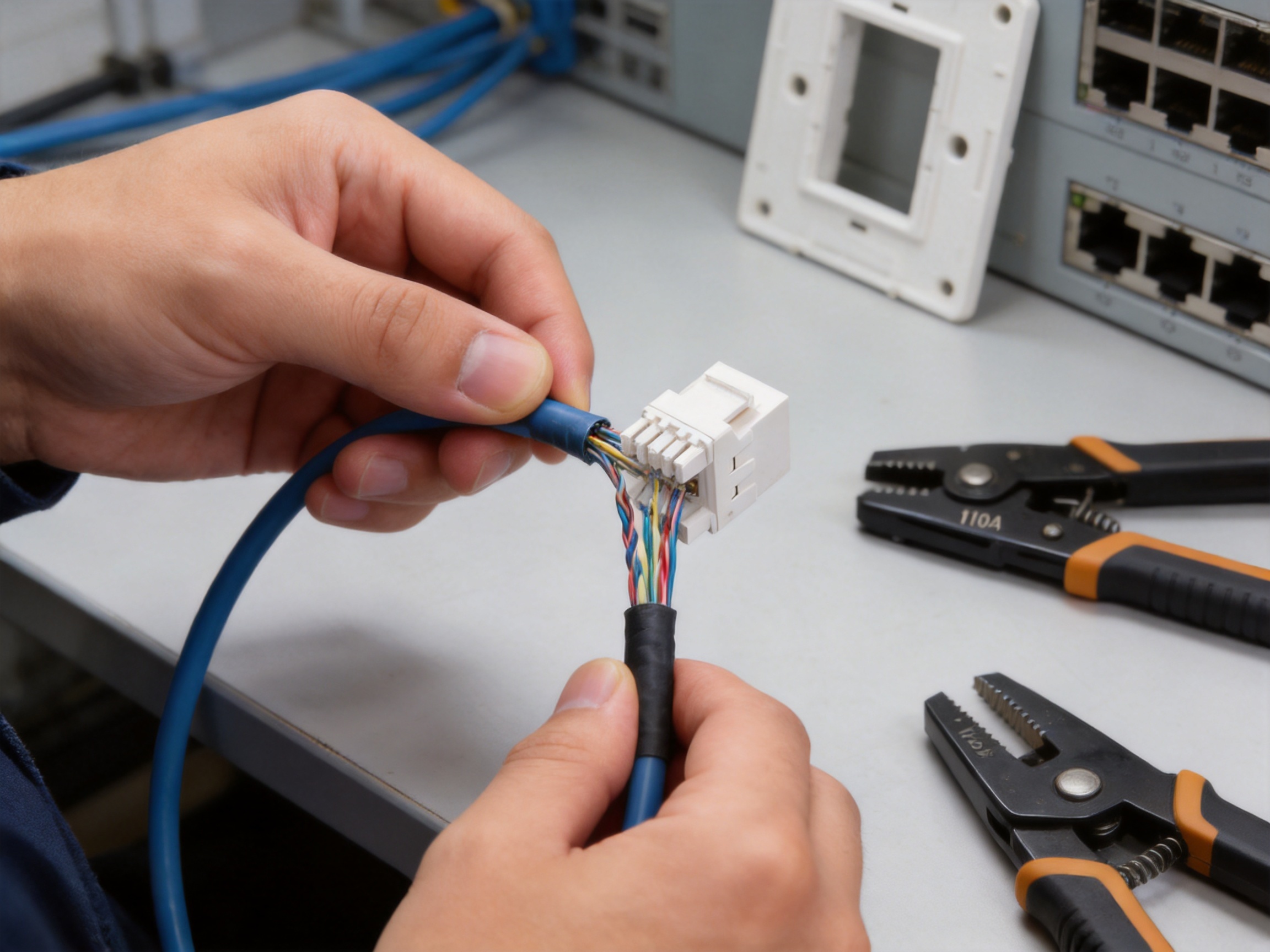
Next, remove the outer jacket carefully. The jacket should be stripped without nicking or cutting the insulated conductors. Separate the four pairs only as much as needed to place the conductors into the cap and IDC slots. Preserving the twist close to the termination area is an important part of maintaining transmission performance.
Arrange the conductors according to the selected T568A or T568B color code. Use the special cap as the guide for pair positioning and conductor order. Check the color sequence before pressing the wires into the IDC contacts. If a conductor is placed in the wrong slot, correct it before applying final termination force.
Seat each wire fully in the appropriate IDC slot. Use the selected 110 or Krone tool according to the jack’s termination structure. Apply the tool in the correct direction and avoid striking the jack repeatedly. Excessive force can damage the contact, housing, or conductor.
After termination, inspect the connection. Confirm that each conductor is fully seated, that the insulation has been displaced correctly, and that there are no loose or crossed wires. Install or secure the cap according to the intended assembly sequence. Check that the cap is fully engaged and that no conductor is being pinched or sharply bent.
Finally, install the jack into the compatible faceplate, surface box, or patch panel. Confirm that the modular latch is secure and that the cable is supported without placing stress on the rear of the jack. Test the completed link with an appropriate cable tester. For projects requiring certification, use a calibrated permanent-link or channel tester and retain the test records.
Applications
Commercial Office Networks
Office buildings require a large number of user outlets and patching points. The modular keystone format supports consistent installation across meeting rooms, workstations, reception areas, and shared spaces. Anti-crosstalk termination can be valuable where many cables are routed through dense pathways and communication cabinets.
Data Rooms and Communication Cabinets
Data rooms often contain high-density patching equipment and a large number of short connection paths. A structured IDC jack can provide an organized termination point for permanent cable links. The dual termination format also gives service teams flexibility when maintaining installations built by different contractors.
Education and Healthcare Facilities
Schools, universities, clinics, and hospitals typically require dependable network access throughout many rooms and departments. Modular outlets can simplify future repair or reconfiguration. The special cap and guided termination structure may help standardize workmanship across large multi-phase installations.
Smart Home and Building Automation Systems
Modern buildings use network connectivity for access control, surveillance, sensors, energy management, audiovisual equipment, and automation systems. Cat6A copper components can provide a robust physical infrastructure for these applications when the cable route, termination, and testing procedures are properly managed.
Hospitality and Retail Projects
Hotels, restaurants, shopping centers, and retail facilities need network outlets for point-of-sale systems, wireless access points, digital signage, security devices, and management systems. Keystone components allow designers to adapt outlet configurations to different rooms, counters, and service areas.
System-Level Advantages for Project Buyers
When evaluating a network component, purchasing teams should consider the total cost of ownership rather than only the unit price. A low-cost jack that takes longer to terminate, produces inconsistent results, or requires frequent replacement may increase project costs. A better-designed component can reduce labor variation and improve maintenance efficiency.
The SMT-1069D8C6A-AC offers several system-level advantages. Its Cat6A positioning supports higher-performance copper infrastructure. Its anti-crosstalk structure addresses a key concern in dense network environments. Its dual IDC compatibility supports different installation teams and regional standards. Its special cap can improve organization and inspection. Its keystone form factor supports a broad range of mounting accessories.
Supply capability is another purchasing factor. A project supplier must be able to provide consistent products during the construction period and for later expansion. The factory’s production lines, molding equipment, automatic installation machines, and technical personnel support a stable manufacturing base. This is particularly important for distributors that need repeat orders with consistent dimensions and appearance.
Export experience can also benefit international customers. Different regions may have different preferences for termination tools, packaging, documentation, labeling, and customization. Experience serving Europe, Australia, Africa, the Middle East, and Southeast Asia indicates familiarity with diverse customer requirements and export workflows.
Technical communication should remain part of the purchasing process. Buyers should exchange drawings, samples, cable compatibility details, packaging requirements, and testing expectations with the supplier. Clear communication at the beginning helps prevent errors after mass production starts.

Selection and Purchasing Checklist
Before ordering the keystone jack, confirm the complete product description, including Cat6A category positioning, UTP configuration, anti-crosstalk structure, special cap, and 110 and Krone IDC compatibility. Ask for a product drawing or sample if the jack will be installed in a specific faceplate or patch panel.
Confirm cable compatibility. Important details may include solid or stranded conductor type, conductor diameter, insulation diameter, cable overall diameter, and the recommended jacket preparation length. The jack should be matched to the cable used in the project rather than selected only by category name.
Confirm the project wiring scheme and labeling requirements. If the customer uses T568A, the jack markings should be clear and consistent with that scheme. If the project uses T568B, installers should follow the corresponding color sequence. Clear markings help reduce field errors.
Review packaging and logistics. Large projects may need individual bags, bulk cartons, barcode labels, private labels, spare quantities, or phased shipment. These requirements should be documented before order confirmation.
For customized products, approve a pre-production sample. Review the cap fit, housing appearance, markings, modular compatibility, and installation procedure. If the product is part of a certified cabling system, confirm the testing responsibility and documentation required for the complete channel.
| Purchasing Check | Questions to Confirm | Reason |
|---|---|---|
| Electrical application | Is the jack intended for the required Cat6A UTP installation? | Ensures the component matches the project design |
| Cable compatibility | Are conductor type, diameter, and insulation dimensions suitable? | Prevents difficult or unreliable termination |
| Wiring scheme | Will the project use T568A or T568B? | Maintains consistent pinout across the link |
| Termination tools | Will installers use 110, Krone, or both? | Confirms the field method and training requirement |
| Mounting accessories | Does the jack fit the selected faceplate or patch panel? | Prevents mechanical incompatibility |
| Testing | What inspection and certification records are required? | Defines acceptance criteria before shipment |
| Customization | Are special labels, colors, packaging, or markings needed? | Supports project identity and inventory control |
Maintenance and Troubleshooting
A properly installed keystone jack normally requires little maintenance, but network outlets should remain accessible for inspection when possible. Avoid placing excessive weight on patch cords connected to the jack. Side loading can stress the modular plug and the jack’s internal contact area.
If a link fails testing, begin with a visual inspection. Check whether the patch cord is fully inserted, whether the jack is seated correctly in the faceplate, and whether the cable has been sharply bent behind the outlet. Then inspect the cap and IDC area for loose, crossed, or incompletely seated conductors.
Common termination faults include reversed pairs, split pairs, open conductors, short circuits, excessive untwisting, and damaged insulation. A wire can appear to be in the correct location while not being fully engaged in the IDC slot. Re-termination may be necessary if the conductor or contact has been damaged.
In high-density areas, also inspect cable routing. Excessive bundling pressure, parallel routing alongside power cables, or poor separation from electrical equipment can affect network performance even when the jack itself is correctly terminated. Troubleshooting should therefore consider the complete link.
If a jack must be replaced, document the original wiring scheme before removal. Use the same category and compatible product type for the replacement. After replacement, repeat the required continuity, wire-map, and performance tests and update the maintenance record.
Environmental and Operational Considerations
The jack should be installed in an environment that matches the specifications of the complete structured cabling system. Excessive heat, moisture, chemical exposure, dust, vibration, or mechanical impact may affect plastic, metal contacts, and cable insulation. Indoor commercial use is generally the primary environment for modular keystone components, while special locations require additional evaluation.
Unshielded systems should be planned with suitable separation from high-voltage wiring and strong electromagnetic noise sources. The UTP configuration can provide excellent performance in appropriate environments, but no copper component can fully compensate for unsuitable cable routing or severe interference.
During storage and transport, products should remain in their original packaging and should be protected from moisture, crushing, and extreme temperature. Small accessories such as caps and labels should be kept with the corresponding jacks to prevent mixing during installation.
Why Manufacturing Partnership Matters
A network component supplier should be evaluated not only by catalog range but also by its ability to convert design requirements into stable production. The combination of engineering personnel, molding capacity, automatic installation equipment, regular production lines, and customization capability provides a stronger foundation than simple trading or assembly without process control.
An experienced manufacturer can support customers throughout the product life cycle. This may include initial technical communication, sample preparation, tooling development, production scheduling, inspection, packaging, shipment coordination, and after-sales service. Such support is valuable when the product is being integrated into a complete cabling solution rather than purchased as an isolated item.
The manufacturer’s product portfolio also creates opportunities for system matching. Customers may source keystone jacks together with patch panels, wall faceplates, data sockets, and other copper or optical fiber products. Coordinating components through one experienced supplier can simplify technical communication and improve consistency across a project.
Stable capacity is especially important for international distributors. A product that is available for one shipment but difficult to reorder can create inventory and project risks. A factory with more than nine million units of stated annual output and multiple production lines is better prepared to support recurring demand, subject to order planning and capacity confirmation.
Quality expectations should be clearly agreed. Customers can specify product samples, appearance standards, packaging rules, electrical test requirements, inspection levels, and documentation. The supplier’s technical team can then convert these expectations into controlled production instructions.
Conclusion
The SMT-1069D8C6A-AC Anti-crosstalk Cat6A UTP 110 and Krone IDC keystone jack with special cap is designed for structured cabling projects that require more than a basic modular connector. Its Cat6A UTP application, anti-crosstalk approach, dual IDC termination compatibility, special cap, and keystone form factor address important needs in modern copper networks.
Compared with simpler competitor designs, the product can offer greater termination flexibility, improved conductor organization, easier inspection, and broader modular deployment. These advantages are most valuable when combined with disciplined cable preparation, correct wiring practice, appropriate tools, and complete link testing.
The manufacturing foundation behind the product further supports its value. Engineering resources, nearly twenty years of industry service, multiple regular and customization production lines, injection molding equipment, automatic installation machines, performance testing, and export experience provide a strong basis for stable supply and OEM or ODM cooperation.
For contractors and system integrators, the product can help standardize field termination. For distributors, it provides a differentiated Cat6A component with practical installation features. For project owners, it supports a modular and maintainable copper infrastructure. As with every structured cabling component, final performance depends on the complete channel, but a carefully designed and consistently manufactured keystone jack is an important foundation.
Questions and Answers
What type of network application is this keystone jack intended for?
It is intended for Cat6A unshielded twisted-pair copper structured cabling applications. Typical uses include commercial networks, communication rooms, office outlets, smart building systems, education facilities, hospitality projects, and other installations that use modular data outlets.
What does anti-crosstalk mean in this product?
Anti-crosstalk refers to design features intended to control unwanted signal coupling between pairs or adjacent terminations. In this jack, the conductor arrangement and special cap help organize the wires and support a more controlled transition into the IDC contacts.
Can installers use both 110 and Krone termination tools?
The product is identified as supporting 110 and Krone IDC termination methods. Installers should use the appropriate tool and follow the supplier’s termination instructions. The selected method should be consistent with the project procedure and wiring standard.
Does the jack support both T568A and T568B wiring?
The jack should be terminated according to the wiring diagram marked on the product and the selected project standard. Structured cabling projects commonly use T568A or T568B. The important requirement is to use the same approved scheme consistently at both ends of the link.
What is the purpose of the special cap?
The special cap helps guide and retain the conductors during termination. It can support pair organization, protect the wire arrangement, and make the completed termination easier to inspect. It should be installed in the correct sequence and should not be forced over incorrectly positioned wires.
Can the jack be installed in a patch panel?
It is designed in a keystone format, which is commonly used in compatible modular patch panels, wall faceplates, surface boxes, and workstation outlets. Buyers should confirm the exact mechanical compatibility of the selected mounting accessory before placing a project order.
Is this product suitable for OEM or ODM projects?
The manufacturer undertakes OEM and ODM projects and operates regular and customization production lines. Customized requirements should be discussed in advance, including labels, packaging, colors, markings, accessories, drawings, samples, and inspection criteria.
What should be checked before mass production?
Customers should review a technical drawing or sample, confirm cable compatibility, approve the termination layout, verify modular fit, define packaging, and agree on testing and inspection requirements. Sample approval helps ensure that the production version matches the project expectation.
How should a failed link be diagnosed?
Begin with a wire-map and continuity test, followed by a visual inspection of both ends. Check for reversed or split pairs, open conductors, incomplete IDC seating, excessive untwisting, damaged cable, poor patch-cord insertion, and sharp bends. If necessary, re-terminate or replace the jack and test the link again.
Why is supplier manufacturing capacity important?
Large cabling projects often require repeated shipments, replacement stock, and consistent product dimensions over time. Multiple production lines, injection molding equipment, automatic installation machines, and technical personnel help a supplier support stable output and customized project requirements.
References
ANSI/TIA-568 Series, Balanced Twisted-Pair Telecommunications Cabling and Components.
ISO/IEC 11801 Series, Information Technology — Generic Cabling for Customer Premises.
IEC 60603-7 Series, Connectors for Electronic Equipment — Part 7: Detail Specifications for 8-Way, Unshielded and Shielded Connectors.
Telecommunications Industry Association, Structured Cabling Installation and Testing Practices.
International Electrotechnical Commission, Insulation Displacement Connection Technology and Connector Performance Guidance.
Product information supplied for the SMT-1069D8C6A-AC Anti-crosstalk Cat6A UTP 110 and Krone IDC keystone jack with special cap.
Manufacturer information supplied for network cabling solutions, optical fiber products, production capability, customization, and quality management.