Español
 عربى
عربى русский
Content
- 1 Product Overview
- 2 Key Product Advantages
- 3 Electrical and Mechanical Performance
- 4 Materials and Construction Quality
- 5 Manufacturing Strengths and Quality Control
- 6 Applications in Structured Cabling Systems
- 7 Installation Recommendations
- 8 Comparison with Conventional Keystone Jacks
- 9 Supply, Customization, and Service Capability
- 10 Why Choose a Professional Manufacturer
- 11 Frequently Asked Questions
- 11.1 What type of product is the SMT-1043T8C6A-FTP?
- 11.2 Does the keystone jack support both T568A and T568B?
- 11.3 Can it be used with CAT6 or CAT5e cable?
- 11.4 What cable size can be terminated?
- 11.5 What is the advantage of the 90-degree design?
- 11.6 Why use a shielded keystone jack?
- 11.7 Is the module suitable for high-speed Ethernet?
- 11.8 Does toolless termination mean no installation skill is required?
- 11.9 How durable is the connector?
- 11.10 What materials are used?
- 11.11 What environmental conditions are specified?
- 11.12 How is the product packaged?
- 11.13 Can packaging be customized?
- 11.14 Can the manufacturer support OEM or ODM projects?
- 11.15 Where can this product be installed?
- 12 Purchasing Considerations
- 13 Conclusion
- 14 References
- 15 Product: SMT-1043T8C6A-FTP 90 Degree Shielded CAT6A Toolless Keystone Jack

Modern communication networks depend on a structured cabling system that can deliver stable performance, efficient installation, long service life, and dependable compatibility. As data rates increase and network equipment becomes more demanding, every passive component in the channel must be designed with care. The keystone jack is especially important because it provides the termination and connection point between horizontal cabling, patch cords, work-area outlets, patch panels, and active network equipment.
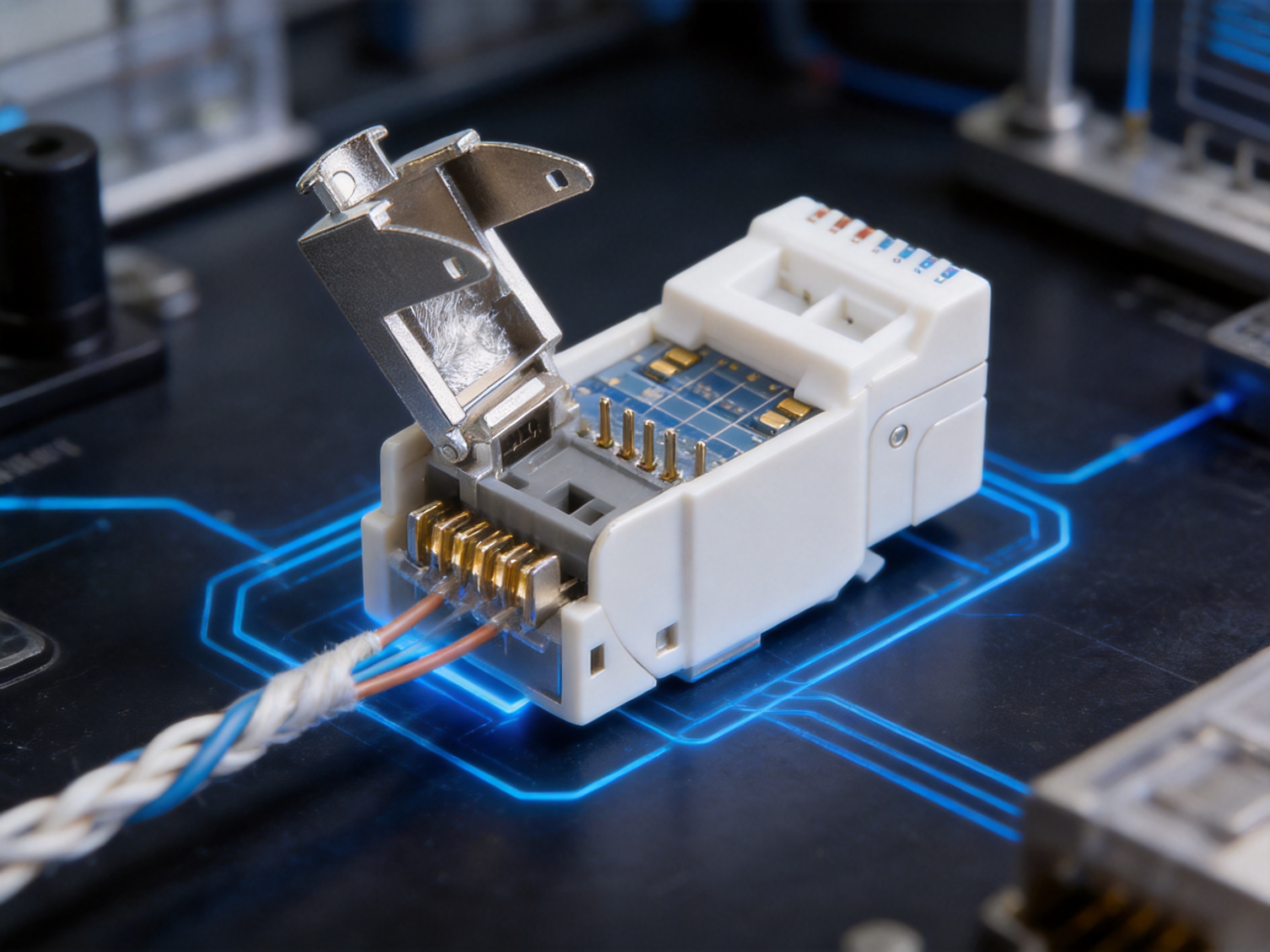
The SMT-1043T8C6A-FTP 90 Degree Shielded CAT6A Toolless Keystone Jack is engineered for Category 6A structured cabling applications. It is designed to meet Category 6A transmission requirements while supporting T568A and T568B wiring sequences. Its compact 90-degree form, shielded construction, toolless termination concept, and clearly marked universal wiring guide make it suitable for professional data cabling systems in commercial buildings, industrial facilities, communication rooms, smart homes, and other network environments.
Unlike a basic unshielded data module, this product is intended for installations where electromagnetic interference control, high-frequency transmission stability, and organized cable management are important. The design also provides backward compatibility with CAT6, CAT5e, and lower-category systems, helping users upgrade network performance without replacing every existing component at once.
Product Overview
The SMT-1043T8C6A-FTP is a 90-degree shielded CAT6A toolless keystone jack developed for RJ45 network connections. It is used to connect horizontal wiring to work-area wiring or to provide modular interface conversion between network cabling and terminal equipment. The module can be installed in compatible faceplates, surface boxes, patch panels, distribution frames, and other modular outlets.
Its Category 6A design supports a frequency range of 1 to 500 MHz. This broad operating range is suitable for high-speed Ethernet applications and for network infrastructure that requires improved bandwidth performance compared with older Category 5e or Category 6 systems. The product is suitable for use with copper twisted-pair horizontal cables and copper patch cords manufactured to the same general cabling standards.
The 90-degree configuration helps guide the cable naturally toward the rear or side of the module. This can improve cable routing in confined spaces, reduce excessive bending, and support a cleaner installation inside a patch panel or wall outlet. It is particularly useful where front-facing cable exits would create congestion or place unnecessary stress on the cable termination.
The shielded structure is intended to provide additional protection against electromagnetic interference and radio-frequency interference. In environments containing motors, fluorescent lighting, industrial controls, power distribution equipment, or dense electronic installations, shielding can help reduce the risk of external noise affecting data transmission. The actual performance of a shielded channel also depends on the cable, patch cord, panel, grounding, and installation method, so the complete system should be designed and installed consistently.
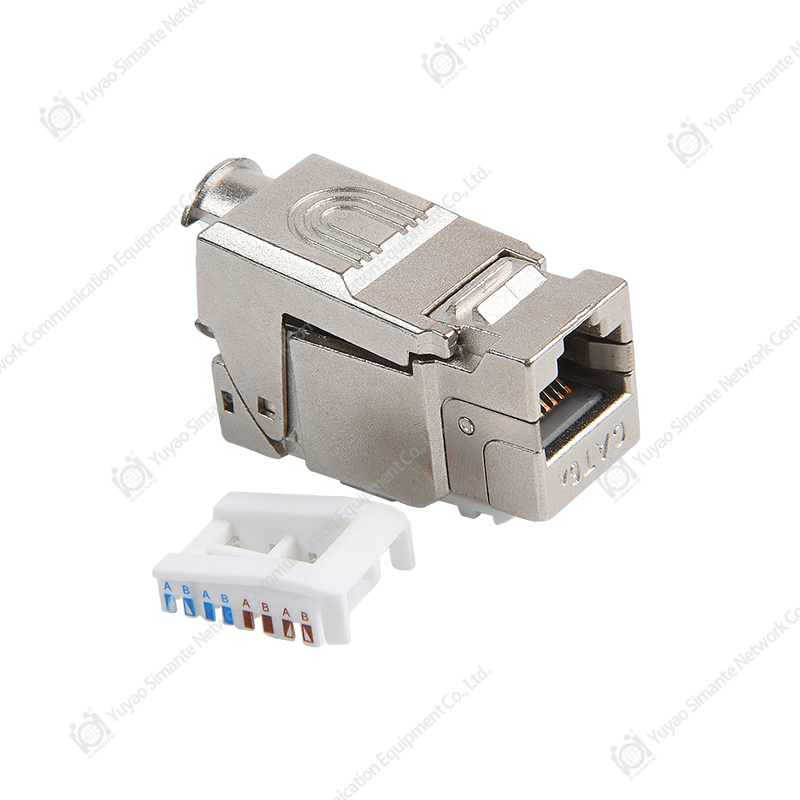
SMT-1043T8C6A-FTP 90 Degree Shielded CAT6A Toolless Keystone Jack
Key Product Advantages
Category 6A Transmission Capability
The most important advantage of this keystone jack is its Category 6A positioning. Category 6A infrastructure is designed for higher-frequency transmission than conventional Category 5e systems and provides a practical foundation for demanding network applications. With a stated frequency range of 1 to 500 MHz, the module is suited to structured cabling systems that require stable high-speed communication over copper twisted-pair cabling.
Higher-frequency network transmission places greater demands on geometry, contact design, termination quality, and control of crosstalk. A component that appears mechanically simple must maintain the correct electrical relationship between pairs while offering reliable contact over its service life. The SMT-1043T8C6A-FTP incorporates contact pin placement using high-low dislocation technology. This design approach helps reduce near-end crosstalk by improving the separation and electrical balance between signal contacts.
For installers and system designers, Category 6A support provides additional network headroom. It can be selected for new installations where users expect future upgrades, increased device density, higher access-point performance, video distribution, server connectivity, or bandwidth-intensive business applications.
Shielded Construction for Demanding Environments
Shielding is a major differentiating feature compared with standard unshielded keystone jacks. In a shielded system, the metal construction helps create a conductive barrier around the termination area. When paired with shielded cable, shielded patch panels, and appropriate grounding practices, this barrier can help reduce the impact of external electromagnetic noise.
Shielded cabling is often considered for factories, laboratories, transportation facilities, data centers, security control rooms, broadcast spaces, and commercial buildings with substantial electrical infrastructure. It may also be beneficial in offices where network cabling is routed near power cables, lighting circuits, elevator systems, air-conditioning equipment, or other potential interference sources.
The shielded design can also help support channel consistency. A well-designed metal housing provides a defined mechanical structure around the contact area and can improve the overall robustness of the module. For installers, this means the component can be integrated into a professional cabling system rather than treated as a simple consumer-grade outlet.
Toolless Termination Convenience
Traditional termination methods may require specialized punch-down tools, additional handling time, and careful control of the termination sequence. The toolless concept of this module is intended to simplify installation and improve efficiency. The installer follows the clearly marked T568A or T568B wiring guide, places the conductors into the appropriate positions, and completes the termination according to the module’s design.
Toolless installation can be especially valuable when a large number of outlets must be completed in a short period. It can reduce the number of tools carried to the work area and may help improve consistency between installers. It is also useful in maintenance situations where a technician needs to replace or reterminate a module quickly without setting up a full tool kit.
Although toolless termination improves convenience, professional workmanship remains essential. The cable jacket should be retained as close to the termination point as practical, pair twists should not be unnecessarily untwisted, and the cable should not be subjected to sharp bends or excessive pulling force. Proper strain relief and correct grounding are also important when installing a shielded product.
90-Degree Cable Management
The right-angle shape gives the module a practical advantage in crowded installations. A conventional straight configuration may force the cable to bend sharply behind the outlet or create a larger service loop. The 90-degree orientation allows the cable to approach the IDC area in a more controlled direction.
Better cable management can improve the appearance of wall outlets and patch panels while also supporting long-term reliability. Excessive bending can place stress on conductors, disturb pair geometry, and complicate future maintenance. By guiding the cable along a more natural route, the right-angle design can help installers maintain a more orderly bend radius.
The compact profile is also useful in modular distribution frames. Several jacks can be arranged in a dense panel while retaining a clear front-facing RJ45 interface. This supports high port density without requiring a large amount of rack or wall space.
Backward Compatibility
The module is backward compatible with CAT6, CAT5e, and lower-category systems. This feature is useful for staged network upgrades. A building owner may want to install CAT6A-ready components in new rooms while continuing to operate existing CAT5e or CAT6 links in other areas. Using a compatible keystone jack can simplify inventory, maintenance, and future expansion.
Backward compatibility does not automatically convert a lower-category cable into a Category 6A channel. The final performance depends on every link component, including the horizontal cable, patch panel, patch cords, connectors, and installation quality. However, the ability to operate with lower-category systems provides flexibility and reduces the need to maintain multiple module types for different parts of a project.
Support for T568A and T568B Wiring
The universal wiring label is clearly marked on the module card wire. This supports accurate termination according to either T568A or T568B sequence. Both wiring schemes are widely recognized in structured cabling, and the most important installation principle is consistency throughout the link.
A clear wiring guide reduces the possibility of conductor placement errors, especially when many outlets are being installed. It also helps maintenance technicians identify the termination arrangement without referring to separate documentation. In projects involving multiple teams or subcontractors, visible labeling can improve standardization and reduce troubleshooting time.
Electrical and Mechanical Performance
Frequency Range and Working Voltage
The specified frequency range is 1 to 500 MHz. This is aligned with the performance expectations of a Category 6A component and provides a suitable operating window for high-speed copper network channels. The working voltage is specified as 125 V.
The module also has a stated withstand voltage of DC 1000 V, or AC 750 V, for one minute without breakdown or arcing. This dielectric withstand specification indicates the insulation system is designed to resist electrical stress under the stated test conditions. It should not be interpreted as a recommendation to use the data jack as a power connection or to expose it to voltages beyond the intended network application.
Insulation Resistance
The initial insulation resistance is specified as at least 200 MΩ. After a constant damp-heat test, the value is specified as at least 100 MΩ. High insulation resistance helps reduce unwanted leakage between contacts and supports reliable separation of signal paths.
Moisture and environmental exposure can affect insulating materials and electrical contacts over time. The damp-heat performance requirement demonstrates that the product is evaluated not only under initial laboratory conditions but also after exposure to a challenging humidity and temperature environment.
Insertion and Withdrawal Performance
The insertion force is specified as no more than 20 N, while the withdrawal force is specified as no less than 20 N. These requirements balance ease of use with secure mating. A connector should not require excessive force during normal installation, but it must also retain the plug securely enough to prevent accidental disconnection.
The connection device is tested with a 50 N load for 60 ± 5 seconds. This mechanical requirement is relevant to installations where cables may be pulled, moved, or subjected to accidental tension. A robust connection design helps protect the termination and the connector interface from ordinary handling stress.
IDC Compatibility
The IDC terminal is designed for 23 to 26 AWG twisted-pair cable. This range covers common horizontal network cable sizes used in structured cabling installations. The installer should confirm the conductor type, cable diameter, insulation dimensions, and construction before beginning a project, particularly when using large-diameter Category 6A cable.
Correct IDC termination requires the conductor to be positioned securely and the cable jacket to be managed in accordance with the product’s installation method. Avoiding unnecessary untwisting is especially important for high-performance cabling because pair geometry contributes directly to crosstalk control and impedance consistency.
Durability
The product is specified for 750 plug-and-socket insertion cycles and 250 wire terminations. These durability values support repeated service and maintenance activities. A network outlet may be reconnected many times during testing, equipment replacement, moves, additions, and changes. Similarly, a modular jack may need to be reterminated during renovation or troubleshooting.
High durability is an advantage over low-cost modules that may be designed only for occasional use. A stronger contact system and durable housing can reduce the likelihood of premature failure and help protect the long-term value of the structured cabling installation.
| Specification Category | Product Information | Installation Significance |
|---|---|---|
| Product type | 90-degree shielded CAT6A toolless keystone jack | Suitable for modular RJ45 network outlets and distribution frames |
| Frequency range | 1–500 MHz | Supports high-frequency Category 6A transmission applications |
| Wiring sequence | T568A and T568B | Provides flexible and clearly identified termination options |
| Backward compatibility | CAT6, CAT5e, and lower categories | Supports staged upgrades and simplified inventory |
| IDC conductor range | 23–26 AWG twisted pair | Compatible with common structured cabling sizes |
| Working voltage | 125 V | Defined electrical operating parameter for the module |
| Withstand voltage | DC 1000 V or AC 750 V for 1 minute | Demonstrates insulation resistance to electrical stress |
| Initial insulation resistance | At least 200 MΩ | Supports electrical separation between contacts |
| Plug and socket durability | 750 insertion cycles | Suitable for repeated connection and maintenance |
| Wire termination durability | 250 terminations | Supports retermination and service work |
| Operating temperature | -25 to +70°C | Suitable for a broad range of indoor installation environments |
| Humidity condition | Up to 85% under specified test conditions | Provides environmental performance information for system planning |
Materials and Construction Quality
Phosphor Bronze Gold-Plated Contacts
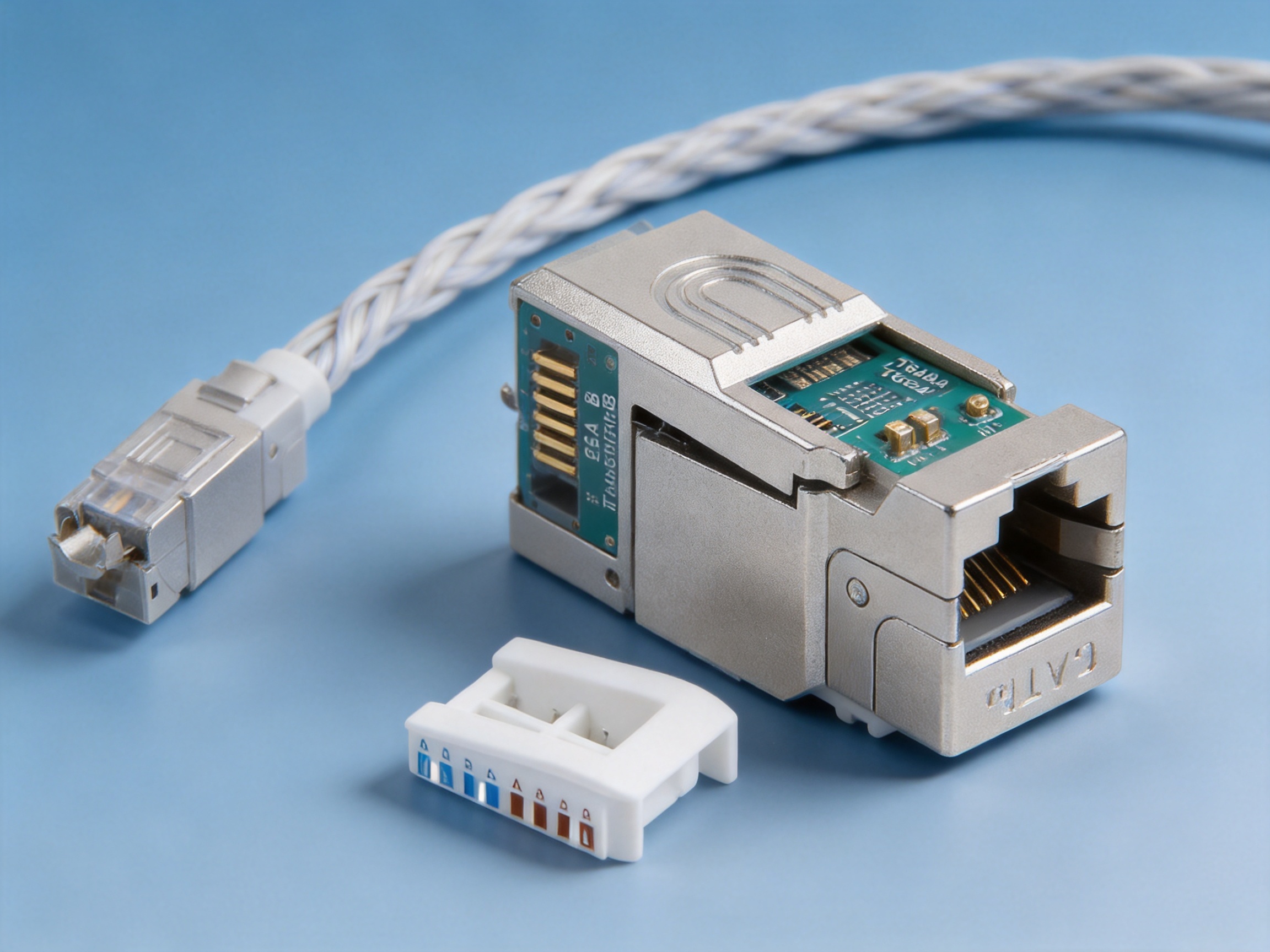
The gold needle contact is made from phosphor bronze with gold plating. Phosphor bronze provides a useful combination of conductivity, mechanical spring properties, and resistance to fatigue. These characteristics are important in an RJ45 interface that must maintain contact pressure through repeated plug insertion and removal.
Gold plating is used on the contact surface because it helps resist oxidation and supports stable electrical contact. The specified gold-plated layer thickness is 3 to 50 U as provided in the product information. Actual plating thickness may vary according to the applicable production specification or order requirement, so project purchasers should confirm the exact value when a particular plating thickness is mandatory.
Nickel-Plated IDC Terminals
The IDC card wire terminals are made from phosphor bronze with nickel plating. Nickel provides a durable surface for the insulation displacement termination area. The IDC structure must maintain a reliable connection with the copper conductors while resisting environmental effects and mechanical disturbance.
The combination of phosphor bronze base material and plated surface is intended to provide a dependable termination over the specified conductor range. It also supports repeated termination operations, which is useful during installation, testing, and future maintenance.
PC Polycarbonate Housing
The non-metallic housing is made from PC polycarbonate. Polycarbonate is widely used in communication components because it offers a useful balance of strength, dimensional stability, impact resistance, and electrical insulation. A stable housing helps maintain the position of internal contacts and protects the termination area during installation.
For modular network products, the housing must also be formed accurately so the jack can fit correctly into compatible faceplates, patch panels, and distribution frames. Dimensional consistency is important for both installation efficiency and the visual quality of the finished system.
FR4 PCB Material
The product uses FR4 PCB material. FR4 is a glass-reinforced epoxy laminate commonly used for printed circuit boards and high-reliability electrical assemblies. It provides mechanical support and electrical insulation while maintaining dimensional stability over a broad temperature range.
Using an appropriate PCB material is important in a high-frequency module because the circuit structure, contact arrangement, and insulation system all contribute to transmission performance. Material selection at this level reflects a more deliberate engineering approach than a basic low-cost connector assembled without attention to high-frequency requirements.
Manufacturing Strengths and Quality Control
The manufacturer behind this product is an established network communication equipment company integrating design, development, sales, and service. With nearly 20 years of industry service, the company has developed experience in network cabling solutions, optical fiber products, keystone jacks, patch panels, wall faceplates, data sockets, and related structured cabling components.
Its manufacturing capability includes 10 regular and customization production lines, 10 fully automatic injection molding machines, 20 semi-automatic injection molding machines, and eight automatic installation machines. This equipment base supports the production of plastic housings, connector assemblies, and other components required for network cabling products.
A stable annual output of more than nine million units demonstrates the ability to support volume projects. Production scale can be important for distributors, system integrators, and original equipment customers that require predictable supply, consistent product specifications, and repeat orders over an extended period.
Design-Led Product Development
Product quality begins before the manufacturing stage. The company has a mature research and development system supported by more than 10 engineers and over 30 full-time technical personnel. This team contributes to product design, performance improvement, manufacturing support, quality management, and product updates.
A design-led approach helps ensure that the module is not developed solely around appearance or cost. High-frequency connector design requires attention to contact geometry, pair separation, connector fit, material selection, termination access, shielding continuity, and mechanical strength. Engineering involvement at the source can reduce design-related variation and support more stable production.
Injection Molding Capability
Injection molding is a critical process for producing precise polycarbonate components. The housing must maintain accurate dimensions so that the jack fits securely into a modular panel or outlet. It must also protect internal components while allowing the installer to access the termination area correctly.
The combination of automatic and semi-automatic injection molding equipment provides production flexibility. Automatic equipment can support high-volume repeat orders, while semi-automatic equipment can be useful for specialized configurations, product variations, and customized requirements. This balance helps the manufacturer serve both standard product demand and OEM or ODM projects.
Automated Assembly
Automatic installation equipment can improve repeatability in the assembly of contacts, terminals, shields, and other internal components. Automation helps control component positioning and reduces the possibility of manual assembly inconsistency. It can also improve production efficiency when large quantities are required.
Automation does not eliminate the need for skilled workers and technical supervision. Instead, it works together with engineering procedures, process checks, material inspection, and final testing. The combination of equipment and experienced personnel is especially valuable for products that must maintain both mechanical precision and electrical performance.
Performance Testing
The manufacturer emphasizes performance testing to meet comprehensive customer requirements. For a Category 6A keystone jack, testing may include electrical continuity, insulation resistance, dielectric withstand, connector retention, insertion and withdrawal durability, termination performance, dimensional inspection, material verification, and environmental assessment.
The stated product information includes environmental and salt spray requirements. Salt spray testing uses a sodium chloride solution with a concentration of 5 ± 0.1 percent and a pH value between 6.5 and 7.2 before atomization. Continuous atomization is recommended for 48 hours under controlled conditions. These requirements are intended to evaluate resistance to corrosive exposure and surface degradation.
Testing should be understood as part of a wider quality system. Incoming material inspection, production process control, sample approval, final inspection, packaging verification, and traceability all contribute to consistent product delivery. Customers with specialized requirements can discuss applicable test reports, inspection standards, packaging specifications, and sampling plans before placing an order.
Applications in Structured Cabling Systems
Commercial Office Buildings
In office buildings, the keystone jack is commonly installed in wall outlets, floor boxes, workstation areas, and communication rooms. The 90-degree design can help manage cables inside compact outlet boxes, while the shielded construction is appropriate for installations where network cables pass near electrical systems or dense office equipment.
The product can support desktop computers, IP phones, wireless access points, printers, surveillance devices, building management systems, and other Ethernet-connected equipment. Its backward compatibility makes it practical for office renovations where existing Category 5e or Category 6 cabling must coexist with newer Category 6A links.
Data Centers and Equipment Rooms
Data centers require organized, serviceable, and high-performance cabling. A modular CAT6A jack can be used in copper patching areas, management panels, equipment racks, and structured cabling zones. The shielded construction may be considered where high equipment density creates a more demanding electromagnetic environment.
In a data center, cable organization is as important as nominal transmission category. The right-angle configuration can help reduce congestion behind modular panels and support orderly cable paths. Clearly labeled wiring positions also make installation and future changes easier to manage.
Industrial and Automation Facilities
Industrial sites may contain variable-frequency drives, motors, welding equipment, power converters, industrial robots, and control systems that generate electromagnetic noise. Shielded copper cabling is often selected in these environments as part of a broader interference-control strategy.
The keystone jack should be installed with compatible shielded cable and properly bonded components. The shielding path must be considered from end to end. A shielded module alone cannot provide the full benefit if the rest of the channel is unshielded or if grounding and bonding are not addressed correctly.
Smart Homes and Building Automation
Smart buildings rely on a growing number of connected devices, including security cameras, access-control readers, sensors, lighting controllers, HVAC systems, intercoms, and wireless access points. A structured copper network provides a flexible foundation for these systems.
Installing Category 6A-capable components during construction can provide additional capacity for future devices. The compact keystone format also allows the same module family to be used in wall plates, structured media enclosures, patch panels, and other modular locations.
Education, Healthcare, and Public Facilities
Schools, hospitals, libraries, government facilities, and transportation buildings typically require durable network infrastructure that can be maintained over many years. These environments often involve frequent equipment changes and a wide variety of users.
A reliable keystone jack can simplify replacement and reconfiguration. The ability to terminate 23 to 26 AWG cable, support both T568A and T568B labeling, and accept repeated plug cycles makes the module practical for facilities with continuing maintenance requirements.
Installation Recommendations
Confirm System Compatibility
Before installation, verify that the cable, patch panel, faceplate, patch cord, and keystone jack are compatible in category, shielding, conductor size, and physical dimensions. For a complete Category 6A channel, all relevant components should meet the required performance level.
Check that the selected panel or wall plate accepts the module’s keystone form factor. Confirm that the cable diameter is suitable for the termination area and that the shielded design can be integrated into the grounding and bonding plan.
Select One Wiring Scheme
Choose T568A or T568B according to the project specification and local installation practice. The same scheme should normally be used at both ends of a standard straight-through link. The wiring label on the module should be used as the primary visual guide during termination.
Inconsistent conductor ordering can create a reversed-pair or split-pair condition. Such faults may sometimes appear to work at lower speeds but cause significant performance problems at higher frequencies. Careful adherence to the selected wiring scheme is therefore essential.
Protect Pair Geometry
Category 6A performance depends partly on the preservation of pair geometry. Remove only as much cable jacket as necessary, keep the twisted pairs together for as long as practical, and avoid excessive untwisting near the IDC contacts.
Do not compress the cable excessively with ties or force it into a bend tighter than the cable manufacturer recommends. Keep the cable away from strong sources of electromagnetic interference when practical, and maintain appropriate separation from power wiring according to the project standard.
Maintain Shield Continuity
When using this shielded keystone jack, the shielding strategy should be continuous through the channel. Shielded horizontal cable, shielded patch cords, compatible patch panels, and appropriate grounding or bonding should be considered together.
Improperly connected shields can reduce the expected benefit and may create unwanted grounding conditions. The installer should follow the applicable electrical and telecommunications standards and the requirements of the building’s grounding system.
Test the Completed Link
After installation, the completed link should be tested with suitable copper cabling test equipment. Testing should confirm wire map, continuity, pair integrity, length, insertion loss, return loss, crosstalk, and other parameters required by the project.
A visual inspection should also confirm that the module is fully seated in the panel, the cable is not under excessive stress, the termination is secure, and the shield connection is properly assembled. Test results should be recorded for commissioning and future maintenance.
Comparison with Conventional Keystone Jacks
Compared with a basic unshielded CAT5e keystone jack, the SMT-1043T8C6A-FTP offers a higher-category design, a broader frequency range, shielding, and a more suitable platform for future network expansion. It is not merely a replacement outlet; it is a component intended for a more demanding structured cabling channel.
Compared with a standard straight keystone jack, the 90-degree body can improve cable routing and reduce congestion behind the panel. This may be particularly valuable in dense installations, shallow boxes, and compact communication cabinets.
Compared with a tool-dependent termination design, the toolless approach can reduce installation steps and help field technicians work more efficiently. The clearly marked universal wiring guide supports consistent T568A or T568B termination without requiring the installer to repeatedly consult a separate diagram.
Compared with low-cost products that use unspecified materials or limited testing, this module provides documented information about contact materials, housing material, PCB material, insulation resistance, durability, environmental conditions, and salt spray testing. This level of specification gives purchasers more information for project evaluation and quality control.
Supply, Customization, and Service Capability
The manufacturer serves customers in Europe, Australia, Africa, the Middle East, Southeast Asia, and other international markets. This export experience supports familiarity with different customer requirements, product documentation expectations, packaging methods, and structured cabling applications.
The company also undertakes OEM and ODM projects. Customization may involve product labeling, packaging, color, configuration, production quantity, documentation, or other project-specific details. Customers should provide complete technical requirements at the quotation stage so that compatibility, tooling, testing, and production lead time can be evaluated accurately.
The company’s integrated design, development, production, sales, and service structure allows customer feedback to move more directly into product improvement. This is valuable for distributors and system integrators that need more than a standard catalog item. A capable manufacturer can support product selection, sample evaluation, packaging confirmation, technical communication, and repeat-order management.
Packaging and Storage
The product is packaged in a special blister bag and then placed in a cardboard box with its accessories. A label identifying the product model and quantity is affixed to the upper-left area of the carton front. This packaging arrangement helps protect the module during handling and provides basic identification for warehouse operations.
The regular packing quantity is 50 pieces per box, with 10 boxes per carton, for a total of 500 pieces per carton. Customers with different logistics or retail requirements can discuss customer-specified packaging options.
Packaged products should be stored in a warehouse with an ambient temperature of -5 to +30°C and relative humidity not exceeding 70 percent. The surrounding air should be free from acid, alkali, and other corrosive gases. The stated storage period is three years under the specified conditions.
Why Choose a Professional Manufacturer
Choosing a network component is not only a matter of comparing unit prices. The cost of a structured cabling project also includes labor, testing, rework, replacement, logistics, downtime, and future maintenance. A product that is easy to terminate, mechanically stable, and consistently manufactured can help reduce hidden project costs.
A professional manufacturer contributes value through controlled materials, repeatable molding, accurate assembly, technical documentation, performance testing, and responsive service. The ability to produce more than nine million units annually also indicates that the manufacturer can support both routine demand and larger project schedules.
Engineering resources are equally important. More than 10 engineers and over 30 technical personnel provide a foundation for handling product updates, customized designs, production issues, and customer technical questions. This support is particularly useful for system integrators that need to coordinate the keystone jack with a wider structured cabling solution.
The manufacturer’s product range includes keystone jacks, patch panels, wall faceplates, data sockets, and optical fiber products. A broader portfolio can simplify sourcing and help customers maintain consistent design and quality across multiple network components.
Frequently Asked Questions
What type of product is the SMT-1043T8C6A-FTP?
It is a 90-degree shielded CAT6A toolless keystone jack with an RJ45 interface and IDC termination area. It is designed for modular structured cabling systems.
Does the keystone jack support both T568A and T568B?
Yes. The module includes a clearly marked universal wiring guide for both T568A and T568B wiring sequences. The selected sequence should be applied consistently according to the project specification.
Can it be used with CAT6 or CAT5e cable?
Yes. The product is backward compatible with CAT6, CAT5e, and lower-category systems. However, the final link performance is determined by the lowest-category component in the complete channel and by installation quality.
What cable size can be terminated?
The IDC terminal is specified for 23 to 26 AWG twisted-pair cable. The installer should also confirm the cable’s outer diameter and construction before installation.
What is the advantage of the 90-degree design?
The right-angle form helps guide the cable in a controlled direction, which can reduce congestion, improve cable organization, and help prevent excessive bending behind a wall outlet or patch panel.
Why use a shielded keystone jack?
A shielded jack can help reduce the effect of external electromagnetic interference when it is used as part of a complete shielded channel. The cable, patch cords, panels, grounding, and bonding should be compatible with the shielded design.
Is the module suitable for high-speed Ethernet?
It is designed as a Category 6A component with a specified frequency range of 1 to 500 MHz. It is suitable for high-performance copper structured cabling applications when all channel components meet the required specifications.
Does toolless termination mean no installation skill is required?
No. Toolless termination simplifies the process, but the installer must still follow the wiring label, preserve pair twists, control the cable bend radius, secure the cable, and complete the shield connection correctly.
How durable is the connector?
The product information specifies 750 plug-and-socket insertion cycles and 250 wire terminations. These values support repeated maintenance, testing, and service activities.
What materials are used?
The gold needle contact uses gold-plated phosphor bronze. The IDC terminal uses nickel-plated phosphor bronze. The housing uses PC polycarbonate, and the PCB material is FR4.
What environmental conditions are specified?
The operating temperature range is -25 to +70°C. The product information also specifies humidity conditions up to 85 percent under the stated test conditions and includes salt spray testing requirements.
How is the product packaged?
The product is placed in a special blister bag and then packed in a cardboard box with accessories. The regular quantity is 50 pieces per box and 500 pieces per carton.
Can packaging be customized?
Yes. Customer-specified packaging is noted as an available product-use option. Packaging requirements should be confirmed before production.
Can the manufacturer support OEM or ODM projects?
Yes. The manufacturer undertakes OEM and ODM projects and operates regular and customized production lines. Project-specific requirements should be discussed in advance.
Where can this product be installed?
Typical applications include commercial offices, data centers, communication rooms, industrial facilities, smart homes, building automation systems, schools, healthcare facilities, public buildings, and other structured cabling environments.
Purchasing Considerations
When purchasing this keystone jack, buyers should first confirm the required category, shielding type, termination method, cable gauge, panel compatibility, color, labeling, packaging, and quantity. For large projects, it is recommended to request samples for physical fit, termination evaluation, and channel testing before approving mass production.
Buyers should also clarify whether the project requires specific test reports, inspection records, material declarations, RoHS documentation, packaging labels, or customer-branded cartons. The product is stated to meet RoHS requirements, while additional compliance documents can be discussed according to the project and destination market.
For shielded systems, the purchasing specification should cover the entire channel rather than the keystone jack alone. Confirm the compatibility of the selected cable, patch panel, patch cords, racks, grounding components, and accessories. A complete system approach provides a more reliable basis for achieving the desired performance.
Conclusion
The SMT-1043T8C6A-FTP 90 Degree Shielded CAT6A Toolless Keystone Jack combines high-frequency Category 6A capability, shielded construction, right-angle cable management, toolless termination, clear T568A and T568B labeling, and backward compatibility with older copper cabling categories.
Its electrical specifications include a 1 to 500 MHz frequency range, 125 V working voltage, high insulation resistance, and defined dielectric withstand performance. Its mechanical specifications include secure connector retention, compatibility with 23 to 26 AWG twisted pair, 750 plug-and-socket cycles, and 250 wire terminations. Materials such as phosphor bronze contacts, gold and nickel plating, polycarbonate housing, and FR4 PCB support the product’s durability and electrical stability.
The product is also supported by a manufacturer with substantial experience in network communication equipment, structured cabling solutions, optical fiber products, injection molding, automated assembly, performance testing, OEM, ODM, and international supply. Its engineering team, production resources, customized lines, and broad product portfolio provide a strong foundation for both standard orders and project-specific requirements.
For installers, the module offers practical termination and cable-routing benefits. For system integrators, it provides a flexible component for high-performance copper networks. For distributors and project purchasers, it offers documented specifications, scalable production, professional packaging, and supplier support. When installed as part of a properly designed shielded Category 6A channel, it can contribute to a clean, durable, and upgrade-ready structured cabling infrastructure.
References
1. YD/T 926.1-2009, General Specification for Communication Cables and Wiring Components.
2. YD/T 926.3-2009, Sub-Standard Requirements for Communication Wiring Components.
3. Category 6A Structured Cabling Design and Installation Practices.
4. T568A and T568B Balanced Twisted-Pair Wiring Arrangements.
5. RoHS Environmental Compliance Principles for Electronic and Communication Components.
6. Copper Structured Cabling Testing and Certification Practices.
7. Manufacturer-provided technical specifications for the SMT-1043T8C6A-FTP 90 Degree Shielded CAT6A Toolless Keystone Jack.