Español
 عربى
 русский
Content
- 1 Product Overview
- 2 Functional Design for Practical Installation
- 3 Material Selection and Physical Durability
- 4 Advantages Compared with Basic Faceplate Designs
- 5 Applications in Copper and Fiber Structured Cabling
- 6 Manufacturing Capabilities and Quality Foundation
- 7 Customization, OEM, and ODM Support
- 8 Packaging, Storage, and Logistics
- 9 Installation and Port Management Considerations
- 10 Why Manufacturing Process Matters to Buyers
- 11 Quality and Testing Perspective
- 12 Selection Guidance for Distributors and Contractors
- 13 Long-Term Value of a Well-Designed Faceplate
- 14 Frequently Asked Questions
- 14.1 What is the SMT-4323AP-86-1X?
- 14.2 Which back boxes can be used with this faceplate?
- 14.3 Which modules are compatible with the product?
- 14.4 Does the faceplate have visible screws?
- 14.5 What is the purpose of the red and blue identification blocks?
- 14.6 Does the product protect unused ports?
- 14.7 Can the port label be changed later?
- 14.8 What material is used?
- 14.9 What is the temperature range?
- 14.10 Does the product meet environmental requirements?
- 14.11 How should the product be stored?
- 14.12 Is customized packaging available?
- 14.13 Does the manufacturer support OEM and ODM projects?
- 14.14 What manufacturing resources does the company have?
- 14.15 What should be checked before installation?
- 15 Conclusion
- 16 References
- 17 Product: SMT-4323AP-86-1X 86 Type Single Port Rotary Faceplate

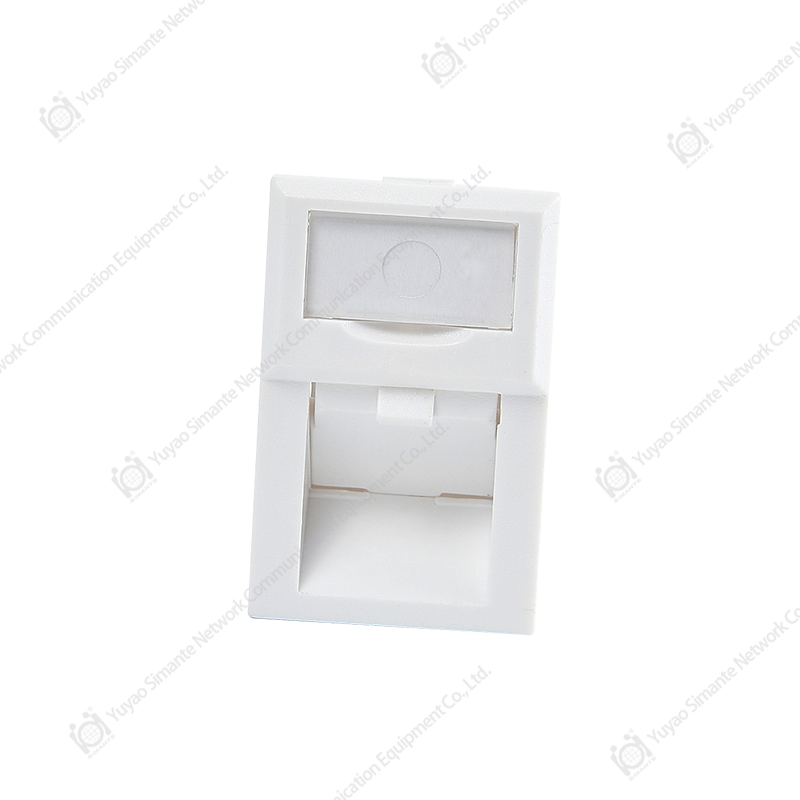
Modern communication networks depend on small but essential components that protect connections, simplify installation, and support consistent port management. The 86 Type Single Port Rotary Faceplate, model SMT-4323AP-86-1X, is designed for this purpose. It is a wall-mounted information panel for copper and fiber structured cabling environments, providing a clean and practical termination point for compatible telephone, data, and other AMP interface information modules.
Although a faceplate is often considered a simple accessory, its design affects the appearance, usability, maintenance, and long-term reliability of an entire cabling installation. A well-designed faceplate should fit the back box accurately, remain secure during everyday use, protect the installed connector from dust, provide enough space for identification, and allow technicians to complete installation or replacement efficiently. The SMT-4323AP-86-1X addresses these requirements through an embedded frame, a rotary single-port structure, color identification blocks, a spring-type dust-proof door, a detachable nameplate, and a durable ABS engineering plastic body.
The product is suitable for common Type 86 exposed and concealed back boxes. It is also compatible with all AMP interface information and telephone modules, making it a practical choice for structured cabling contractors, network installers, electrical distributors, system integrators, and original equipment customers. Its compact wall-mounted form supports installations in offices, homes, commercial properties, education facilities, hospitality spaces, and other locations where communication outlets must remain neat and easy to manage.
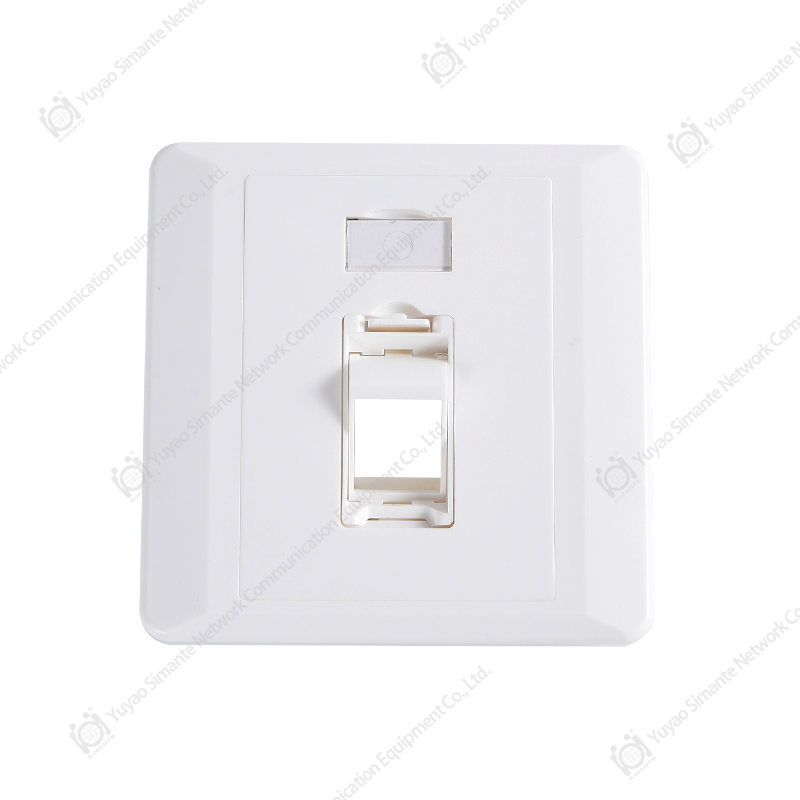
SMT-4323AP-86-1X 86 Type Single Port Rotary Faceplate
Product Overview
The SMT-4323AP-86-1X is a one-port rotary faceplate intended for wall-mounted information outlets. The faceplate forms the visible interface between the installed communication module and the room or working area. It provides mechanical support for the module while also contributing to the overall appearance and organization of the cabling system.
The product belongs to the 1 Port Faceplate category and is identified by the product title “SMT-4323AP-86-1X 86 Type Single Port Rotary Faceplate.” Its Type 86 format is widely used for wall-mounted electrical and communication accessories. The design is compatible with both exposed and concealed Type 86 back boxes, allowing installers to use the faceplate in different construction and renovation conditions.
The rotary structure helps provide a flexible presentation for the installed port. Instead of using a flat, visually exposed fastening arrangement, the faceplate integrates an embedded frame that conceals screws from the front surface. This results in a cleaner appearance and helps preserve the professional finish of the installation.
| Item | Specification or Description |
|---|---|
| Product model | SMT-4323AP-86-1X |
| Product type | 86 Type Single Port Rotary Faceplate |
| Category | 1 Port Faceplate |
| Application | Wall-mounted information and communication outlet |
| Compatible back boxes | Type 86 exposed and concealed back boxes |
| Module compatibility | AMP interface information and telephone modules |
| Material | ABS engineering plastic |
| Identification features | Red and blue identification blocks, front labeling area, detachable nameplate |
| Protection feature | Spring-type dust-proof door |
| Environmental compliance | Designed to meet RoHS requirements |
| Operating temperature | -25°C to +70°C |
Functional Design for Practical Installation
Embedded Face Frame
One of the most important design features is the embedded face frame. The frame is integrated so that no screws are visible on the front surface. This creates a more refined appearance than a conventional faceplate with exposed fasteners. It also supports a uniform visual standard when several communication outlets are installed in the same room or across a larger project.
Concealed fastening improves more than appearance. When screws are not exposed, the front surface has fewer areas where dust can collect or where the faceplate may be unintentionally caught during cleaning or daily use. The embedded construction also reduces the visual difference between outlets installed in different locations, which is particularly valuable in commercial interiors, office fit-outs, and residential projects that require a consistent finish.
The structure is designed for straightforward installation and disassembly. This is important because communication modules may need to be inspected, replaced, upgraded, or reconfigured during the life of a cabling system. A faceplate that can be removed without unnecessary effort helps reduce service time and limits disruption to users.
Red and Blue Identification Blocks
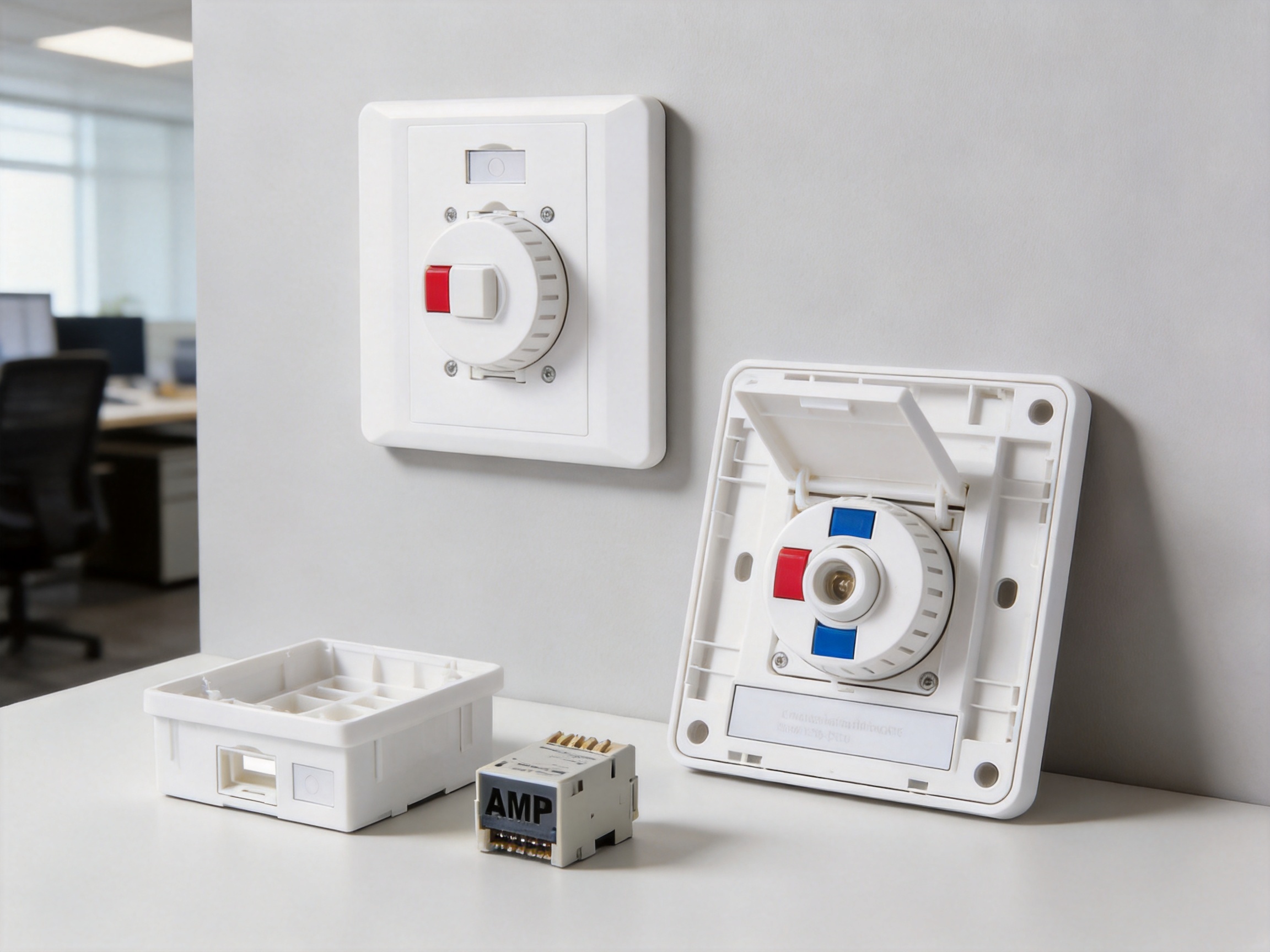
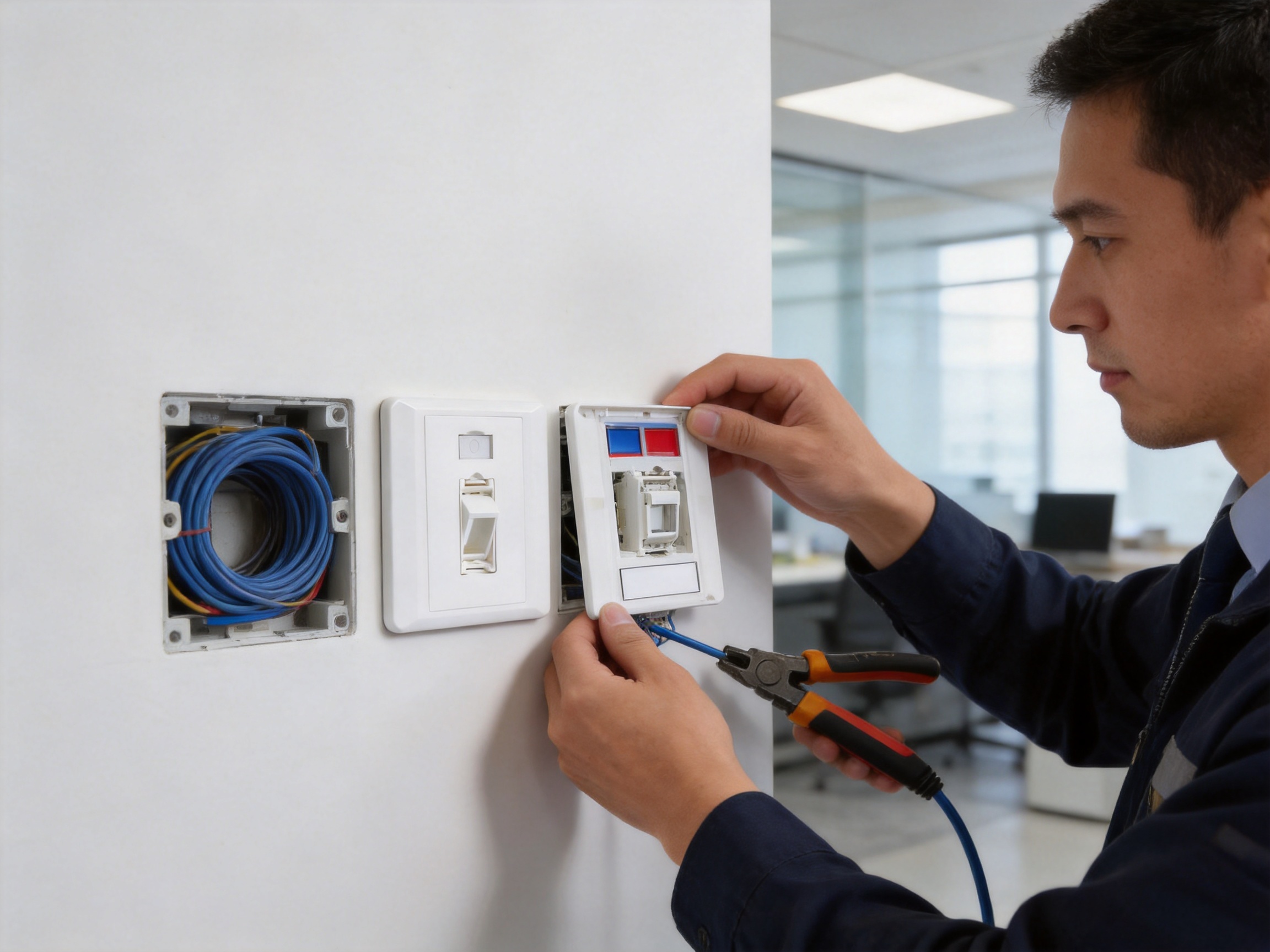
The front of the faceplate includes red and blue identification blocks. These color indicators help distinguish the types of connectors installed behind the faceplate. In a mixed communication environment, color coding can improve the speed and accuracy of port recognition.
For example, installers or maintenance staff can use the color blocks to identify whether an outlet is designated for telephone service, data service, or another planned connection type. The exact labeling convention can be defined according to the project requirements, but the presence of dedicated color areas provides a convenient starting point for organized port management.
Clear visual differentiation is especially helpful in offices, equipment rooms, classrooms, hotels, residential developments, and other sites where users or technicians may need to identify a port without opening the outlet. Color identification can reduce the possibility of connecting equipment to an unsuitable service point and can support a more systematic approach to structured cabling documentation.
Spring-Type Dust-Proof Door
The faceplate is equipped with a spring-type dust-proof door. This door covers the port when it is not in use, helping reduce the direct entry of dust and airborne particles into the connector area. When a module or connecting plug is required, the door can open for access and return toward its protective position when released.
Dust protection is useful in both residential and commercial spaces. Offices, workshops, public buildings, retail locations, and renovation environments can expose wall outlets to airborne particles. A protective door helps maintain a cleaner outlet area and supports more responsible connector protection between periods of use.
The spring-assisted design also supports a tidy appearance. Instead of leaving an unused opening visibly exposed, the door keeps the port area visually closed. This contributes to a cleaner installation and can make the faceplate easier to maintain as part of routine interior cleaning.
Large Identification Area and Detachable Nameplate
Port identification is an important part of structured cabling management. The SMT-4323AP-86-1X provides a large frontal identification space and a detachable nameplate. These features give installers and facility managers a practical area for recording port numbers, service types, room references, or other project-specific information.
A detachable nameplate is particularly useful when a room changes function or when a network outlet is reassigned. Instead of replacing the entire faceplate, personnel can update the identification element. This can reduce material waste and simplify future changes.
Clear port labeling also benefits troubleshooting. When a technician needs to locate a specific connection, a readable label can reduce the time required to trace cabling or consult installation records. In larger facilities, consistent labels across many outlets can contribute to more efficient maintenance workflows.
Material Selection and Physical Durability
The product uses high-quality ABS engineering plastic. ABS is widely used for communication accessories because it offers a useful combination of rigidity, impact resistance, processability, and appearance. For a wall faceplate, the material must be able to withstand routine handling during installation, module replacement, cleaning, and normal use.
The specified material is designed to resist collision and impact and is not easily deformed under ordinary service conditions. This is valuable during transport and installation, when faceplates may be handled repeatedly before they are finally mounted. It is also beneficial in public or commercial environments where outlets may be exposed to incidental contact.
Material stability is closely linked to installation quality. A deformed faceplate may not sit flush against the wall or back box, may create uneven gaps, or may interfere with the appearance of adjacent accessories. A robust ABS body helps the product maintain its intended shape and supports a more consistent finished installation.
ABS engineering plastic also supports efficient injection molding. This allows the manufacturer to form the faceplate with integrated details such as the embedded frame, door structure, identification area, and other contours. Consistent molding is important because a faceplate must align with the corresponding module and back box without excessive adjustment.
Temperature Performance
The stated environmental temperature range is -25°C to +70°C. This range allows the faceplate to be used in many indoor and sheltered installation conditions, including environments with seasonal temperature changes, transportation exposure, and moderate heat accumulation.
Actual installation suitability should always be evaluated together with the conditions of the surrounding building and the requirements of the installed communication module. The faceplate is intended for normal structured cabling applications, while project designers should consider moisture, direct sunlight, chemical exposure, mechanical loading, and other site-specific factors when selecting any wall-mounted accessory.
RoHS-Oriented Environmental Performance
The product is designed to meet RoHS standards. RoHS-oriented material selection supports customers that require products aligned with restrictions on certain hazardous substances. This consideration is relevant to international procurement, commercial construction projects, environmentally responsible product programs, and customers that maintain material compliance records.
Environmental compliance is not limited to a declaration on a product specification sheet. It is also related to material control, supplier management, production discipline, and documentation. A manufacturer with an established production system is better positioned to manage these factors consistently across regular and customized orders.
Advantages Compared with Basic Faceplate Designs
Faceplates from different suppliers can appear similar at first glance, but their practical value may differ substantially. The SMT-4323AP-86-1X provides several features that distinguish it from a basic flat plate or a low-feature wall outlet accessory.
Cleaner Front Appearance
Many basic faceplates rely on visible screws or exposed fastening points. The embedded face frame of this model hides the fastening arrangement from the front, creating a cleaner and more integrated appearance. This is an advantage in projects where communication outlets must match a modern interior design.
Improved Port Recognition
A plain faceplate may offer little space for labeling. This can make port identification difficult after installation, especially when several outlets are installed in one room. The red and blue identification blocks, large front labeling space, and detachable nameplate give this model a more structured approach to port management.
Additional Connector Protection
A simple open port can collect dust and may appear unfinished when not connected. The spring-type dust-proof door provides an additional protective feature that is not always present in entry-level faceplates. This makes the product more suitable for installations where unused outlets need to remain covered.
Service-Friendly Construction
Communication systems are rarely static. Modules may be replaced, service types may change, and facilities may be renovated. The product is designed for installation and disassembly, helping technicians access the outlet without replacing the whole wall accessory. This can support lower maintenance effort over the life of the installation.
Consistent Manufacturing Potential
Product performance depends not only on the design but also on production consistency. The manufacturer operates multiple production lines, automatic and semi-automatic injection molding equipment, and automatic installation machinery. This production capacity helps support repeatable dimensions, stable appearance, and dependable supply for regular projects.
Suitability for Standard Type 86 Projects
The faceplate is designed for common Type 86 exposed and concealed back boxes. Customers do not need to develop a special wall enclosure for ordinary Type 86 applications. This compatibility supports easier specification, installation, and replacement across common structured cabling projects.
Applications in Copper and Fiber Structured Cabling
The product is suitable for structured cabling environments that use wall-mounted information outlets. In copper systems, it can provide a finished mounting point for compatible data or telephone modules. In fiber-related installations, it may be used where an appropriate compatible information module and project design call for a wall-mounted interface.
The faceplate itself is a mechanical and presentation component rather than a complete transmission device. Network performance depends on the selected module, cable, termination quality, installation method, and compliance with the applicable cabling standard. Nevertheless, the faceplate plays an important role in protecting and organizing the connection point.
Office and Commercial Buildings
Offices commonly require a combination of data, telephone, and service outlets. The color identification blocks and labeling area can help distinguish ports at workstations, meeting rooms, reception areas, and shared offices. The clean front appearance is also suitable for professional interiors where visible infrastructure should be neat and unobtrusive.
Residential and Smart Home Installations
Residential projects increasingly include structured cabling for broadband, voice, entertainment, security, and automation systems. A compact Type 86 faceplate can fit naturally into residential wall accessory layouts. The dust-proof door and concealed front fastening help maintain a finished appearance in living rooms, bedrooms, home offices, and utility areas.
Education and Public Facilities
Schools, training centers, libraries, and public facilities often require durable wall outlets that can withstand frequent use. The ABS body, impact-resistant design, and clear labeling features are useful in these environments. Facility staff can identify outlets more easily, while the protective door helps keep unused ports covered.
Hotels and Hospitality Projects
Hotels and serviced apartments place particular emphasis on appearance, ease of maintenance, and consistent room standards. A faceplate without visible screws can complement modern interior finishes. Detachable labels and replaceable modules also support maintenance teams when room layouts or service requirements change.
Industrial and Automation Areas
In light industrial, control, and automation environments, wall outlets may be used for service terminals, maintenance connections, or communication equipment. The environmental temperature range and robust plastic construction can support suitable indoor applications, provided that the installation environment remains within the product’s intended conditions and does not expose it to corrosive substances or excessive mechanical stress.
Manufacturing Capabilities and Quality Foundation
The manufacturer, Yuyao Simante Network Communication Equipment Co., Ltd., is a professional producer of network cabling solutions and optical fiber products. Its activities integrate product design, development, sales, and service. This integrated structure allows product requirements to be considered across the full process, from initial design and tooling through production, packaging, and customer support.
The company has nearly 20 years of service experience in the network communication field. During this period, it has developed products for structured cabling, network communication, smart home systems, automation equipment, and related applications. Experience across these areas helps the manufacturer understand how faceplates, modules, patch panels, connectors, and other accessories must work together as part of a broader cabling solution.
Research and Development Resources
The company maintains a mature research and development system. More than 10 engineers and over 30 full-time technical personnel support product development, production improvement, quality control, and technical service. These staff members contribute to design refinement, manufacturing coordination, process optimization, and product updates.
A structured engineering team is especially important for molded communication accessories. Small dimensional differences can affect fit, assembly, appearance, and user experience. Engineering involvement helps connect the design drawing with the mold, molding process, assembly method, and inspection procedure.
Injection Molding Capacity
The factory operates 10 fully automatic injection molding machines and 20 semi-automatic injection molding machines. This combination provides flexibility for different product structures, order volumes, and manufacturing requirements. Automatic equipment can support efficient and repeatable production, while semi-automatic equipment can provide adaptability for product variations and customization projects.
Injection molding quality influences the faceplate’s surface finish, dimensional accuracy, rigidity, and ability to accommodate integrated features. Stable control of molding conditions, material handling, mold maintenance, and cycle procedures is essential for achieving consistent results across production batches.
Automated Assembly
The factory also operates eight types of automatic installation machines. Automated assembly can improve repeatability in processes such as component fitting, door installation, identification element placement, or other product-specific operations. It can also reduce variation caused by inconsistent manual handling.
Automation does not eliminate the importance of skilled personnel. Instead, it combines equipment repeatability with technical supervision, process inspection, and production management. This approach is useful for products that must maintain consistent assembly force, alignment, and appearance across large quantities.
Production Scale and Supply Stability
The factory maintains 10 regular and customization production lines and has an annual output of more than 9 million units across its product range. This scale supports both standard product supply and customer-specific projects. For distributors and system integrators, production capacity can be an important factor when planning repeat orders, regional stock, or large construction schedules.
A supplier with sufficient capacity can also help reduce the risk of prolonged lead times during project peaks. The exact lead time depends on order quantity, product configuration, packaging requirements, material availability, and production scheduling, but an established manufacturing base provides a stronger foundation for dependable delivery.
Customization, OEM, and ODM Support
Structured cabling projects often require more than a standard catalog product. Customers may need special packaging, private labeling, color identification, documentation, or other project-specific arrangements. The manufacturer undertakes OEM and ODM projects, providing a basis for cooperation with distributors, brands, engineering companies, and system solution providers.
The product information specifies customer-designated packaging as a usage mark. This indicates that packaging requirements can be considered according to customer needs. Custom packaging may support brand identity, regional distribution, product grouping, project identification, or warehouse management.
Customization should be evaluated at the quotation and engineering stages. Important factors may include minimum order quantity, mold requirements, color selection, label content, artwork approval, inspection standards, packaging configuration, and delivery schedule. Early technical communication helps ensure that the requested changes remain compatible with the product structure and manufacturing process.
Packaging, Storage, and Logistics
The product is placed in a dedicated blister bag and then packed into a cardboard box. Product accessories are placed together with the faceplate, and a label showing the product model and quantity is attached to the upper-left area of the carton front. The packaged products are then placed in the carton according to the stated packing arrangement.
This packaging method provides several practical benefits. The blister bag helps keep individual products organized and reduces direct contact with dust during handling. The cardboard box supports grouping for transportation and warehouse storage. Model and quantity labeling can help warehouse staff identify shipments without opening every carton.
The regular packing quantity is described as 10 boxes per box, 20 pieces per box, and 200 pieces per carton. Customers should confirm the exact interpretation of inner and outer packaging during order communication, especially when products are prepared for export, private labeling, or project-specific logistics.
Packaged products should be stored in a warehouse with an ambient temperature of -5°C to +30°C and relative humidity not exceeding 70%. The surrounding air should not contain acid, alkali, or other corrosive gases. Under the stated conditions, the storage period is three years.
Proper storage is important for preserving packaging quality and product appearance. Cartons should be kept away from water, direct heat, chemical vapors, and excessive compression. Warehouse personnel should also follow a first-in, first-out method where practical, particularly when stock is held for long-term distribution.
Installation and Port Management Considerations
Confirming the Back Box
Before installation, the contractor should confirm that the wall box is a compatible Type 86 exposed or concealed back box. The back box should be securely fixed, correctly aligned, and free from excessive debris. A stable back box provides the foundation for a flush and attractive faceplate installation.
Checking the Module
The selected information or telephone module should be compatible with the faceplate and appropriate for the planned service. The product is designed to work with AMP interface information and telephone modules, but the specific module type should be verified before installation. The connector category, cable type, termination method, and network application should also be checked as part of the project design.
Managing Cable Slack
Technicians should leave an appropriate amount of cable slack for termination and future maintenance without forcing the cable into a sharp bend behind the faceplate. Excessive tension can affect the module, cable termination, or wall outlet alignment. Organized slack management helps keep the faceplate flush and reduces stress on the installed connection.
Using the Identification Area
Port labels should be applied consistently across the project. A useful label may include the room number, outlet number, rack reference, service type, or other information defined by the facility’s documentation system. The detachable nameplate allows identification to be updated when the assignment changes.
Final Inspection
After installation, the technician should check that the faceplate is secure, aligned, clean, and free from visible damage. The spring-type door should open and return properly, the nameplate should be seated correctly, and the installed module should not interfere with the front structure. Where applicable, the connected cable should be tested according to the project’s chosen cabling standard.
Why Manufacturing Process Matters to Buyers
Purchasers of structured cabling accessories are not only buying a plastic wall plate. They are selecting a component that must fit a broader system, remain available for future expansion, and support the reputation of the installer or distributor. Manufacturing process control therefore matters as much as the product’s visible features.
Stable injection molding helps maintain consistent dimensions from batch to batch. Consistent assembly helps ensure that doors, frames, identification parts, and other components operate as intended. Controlled packaging helps reduce mix-ups during shipping and storage. Engineering support helps address special requirements before they become production problems.
The combination of design resources, production lines, injection molding equipment, automated installation machinery, technical personnel, and testing practices gives the manufacturer a broad foundation for product consistency. Customers can use this foundation when evaluating suppliers for standard supply, long-term distribution, or customized OEM and ODM programs.
Quality and Testing Perspective
Product quality should be evaluated through several dimensions. Visual quality includes surface finish, color consistency, molding appearance, label placement, and absence of obvious defects. Mechanical quality includes the fit of the faceplate, stability of the frame, operation of the dust-proof door, and durability during ordinary handling.
Dimensional quality is also essential. The faceplate must correspond correctly with the Type 86 back box and compatible module. If dimensions are inconsistent, installation may become slower, the faceplate may not sit flush, or the finished outlet may appear uneven. Production inspection and process control are therefore important parts of the product’s value.
Environmental and material requirements should be supported by appropriate records and supplier controls. RoHS-oriented compliance, ABS material selection, storage recommendations, and operating temperature information all contribute to a more complete technical evaluation.
Customers with special project requirements may request additional inspection items, samples, test records, packaging approvals, or pre-shipment checks. These details should be agreed upon before mass production so that the manufacturer and customer share the same quality expectations.
Selection Guidance for Distributors and Contractors
Distributors should consider whether the faceplate fits their existing Type 86 product range and whether the single-port format meets local demand. They should also evaluate packaging, labeling, stock quantity, color requirements, and compatibility with modules commonly used in their market.
Contractors should consider installation speed, port identification, service access, dust protection, and appearance. A faceplate that saves time during installation and later maintenance may provide greater overall value than a lower-priced product with fewer features.
System integrators should evaluate the faceplate as part of the complete structured cabling solution. The module, cable, back box, labeling system, and testing process should all be compatible. The faceplate can support the physical organization of the outlet, but network performance ultimately depends on the complete system design and installation quality.
OEM and ODM customers should discuss color, material, markings, packaging, production quantity, documentation, and inspection requirements with the manufacturer. The factory’s existing production scale and customization experience can support projects requiring repeatable private-label supply.
Long-Term Value of a Well-Designed Faceplate
The initial purchase price of a faceplate is only one part of its total value. Installation labor, maintenance time, replacement frequency, outlet identification, visual quality, and supply continuity can all influence the long-term cost of a structured cabling project.
The SMT-4323AP-86-1X contributes value through its service-friendly construction, concealed front fastening, protective door, labeling features, and durable ABS body. These features can help reduce avoidable installation difficulties and make future maintenance more organized.
For large projects, consistent appearance across hundreds or thousands of outlets can also support the professional image of the building. A uniform product simplifies procurement, installation training, replacement stocking, and facility documentation.
Frequently Asked Questions
What is the SMT-4323AP-86-1X?
The SMT-4323AP-86-1X is an 86 Type single-port rotary faceplate for wall-mounted communication outlets. It belongs to the 1 Port Faceplate category and is designed for compatible information and telephone modules.
Which back boxes can be used with this faceplate?
The faceplate is designed for common Type 86 exposed and concealed back boxes. The back box should be correctly installed and dimensionally suitable before mounting the faceplate.
Which modules are compatible with the product?
The product is compatible with AMP interface information and telephone modules. The exact module should be confirmed for the intended application before ordering or installation.
Does the faceplate have visible screws?
No. The embedded face frame is designed so that screws are not visible on the front surface, creating a cleaner finished appearance.
What is the purpose of the red and blue identification blocks?
The red and blue blocks help users and technicians distinguish different connector or service types, such as telephone and data applications. The project can define the specific identification convention.
Does the product protect unused ports?
Yes. It includes a spring-type dust-proof door that covers the port area when it is not being used.
Can the port label be changed later?
Yes. The faceplate includes a detachable nameplate, allowing port identification to be updated when the outlet assignment changes.
What material is used?
The faceplate is made from high-quality ABS engineering plastic. The material is selected for its impact resistance, anti-collision properties, and resistance to deformation under ordinary service conditions.
What is the temperature range?
The stated environmental temperature range is -25°C to +70°C. Project conditions should also be reviewed for moisture, corrosive gases, direct heat, and other environmental factors.
Does the product meet environmental requirements?
The product is designed to meet RoHS standards. Customers requiring formal compliance documentation should request the relevant records during procurement.
How should the product be stored?
Packaged products should be stored at -5°C to +30°C, with relative humidity not exceeding 70%. The warehouse should be free from acid, alkali, and other corrosive gases. The stated storage period is three years under the recommended conditions.
Is customized packaging available?
The product information identifies customer-specified packaging as an available usage mark. Packaging requirements, artwork, quantities, and labeling should be confirmed with the manufacturer before production.
Does the manufacturer support OEM and ODM projects?
Yes. The manufacturer undertakes OEM and ODM projects and operates regular and customization production lines for network cabling and optical fiber products.
What manufacturing resources does the company have?
The company operates 10 regular and customization production lines, 10 fully automatic injection molding machines, 20 semi-automatic injection molding machines, and eight automatic installation machines. It also has more than 10 engineers and over 30 full-time technical personnel.
What should be checked before installation?
Installers should check the Type 86 back box, module compatibility, cable routing, cable slack, faceplate alignment, labeling requirements, and final operation of the dust-proof door and nameplate.
Conclusion
The SMT-4323AP-86-1X is a practical and refined solution for single-port wall-mounted communication outlets. Its Type 86 compatibility, embedded face frame, concealed front fastening, red and blue identification blocks, spring-type dust-proof door, detachable nameplate, and ABS engineering plastic construction address many of the everyday requirements found in structured cabling installations.
Compared with a basic faceplate, it offers a stronger combination of appearance, port protection, identification, serviceability, and installation flexibility. These advantages make it suitable for copper and fiber structured cabling environments, including offices, homes, commercial buildings, education facilities, hospitality projects, and selected industrial applications.
The product is supported by a manufacturer with nearly two decades of industry experience, an established research and development system, a large technical team, multiple injection molding resources, automatic assembly capability, regular and customized production lines, and experience in OEM and ODM cooperation. This manufacturing foundation is important for customers that require stable quality, repeatable supply, project customization, and long-term product support.
For distributors, contractors, system integrators, and project owners, the faceplate provides more than a finished wall accessory. It contributes to organized port management, a professional installation appearance, easier future maintenance, and a more reliable structured cabling infrastructure.
References
1. Product specification information for SMT-4323AP-86-1X 86 Type Single Port Rotary Faceplate.
2. Manufacturer-provided information on Type 86 wall-mounted information panels and compatible communication modules.
3. Manufacturer-provided information on ABS engineering plastic construction, operating temperature, packaging, and storage conditions.
4. Manufacturer-provided company profile covering research and development, injection molding, automated assembly, production capacity, OEM, and ODM services.
5. General structured cabling installation and port-identification practices for commercial and residential communication outlets.
6. General RoHS-oriented material and product compliance principles for electronic and communication accessories.