Español
 عربى
 русский
Content
- 1 Introduction
- 2 Understanding the Role of a Blank Patch Panel
- 3 Product Overview
- 4 Advantages of the 24-Port 1U Configuration
- 5 Benefits Compared with Fixed-Port Patch Panels
- 6 Engineering Considerations for Structured Cabling
- 7 Manufacturing Strengths Behind the Product
- 8 Quality Control and Product Stability
- 9 Installation Guidance
- 10 Applications Across Different Environments
- 11 Supply, Customization, and OEM Support
- 12 Why Choose a Blank Modular Design?
- 13 Purchasing Checklist
- 14 Frequently Asked Questions
- 14.1 What is a 1U 24-port blank patch panel?
- 14.2 What does “blank” mean in this product?
- 14.3 Can the panel be used for both copper and fiber systems?
- 14.4 Why use a blank panel instead of a fixed-port panel?
- 14.5 Is a 24-port panel suitable for a data center?
- 14.6 What types of modules can be installed?
- 14.7 Does the panel itself determine the network category?
- 14.8 Can unused ports be reserved for future expansion?
- 14.9 How should the panel be labeled?
- 14.10 What manufacturing capabilities support this product?
- 14.11 Can the product be customized?
- 14.12 What information should be included in an inquiry?
- 15 Conclusion
- 16 References
- 17 Product: SMT-2046-24P 1U 24 port blank patch panel
Introduction
Modern communication networks depend on organized, serviceable, and adaptable cabling infrastructure. Whether installed in a commercial office, data center, education facility, industrial site, residential development, or telecommunications room, the physical layer must provide more than simple cable termination. It must support orderly installation, reliable connections, efficient maintenance, future expansion, and consistent performance over the service life of the network.
The SMT-2046-24P 1U 24-port blank patch panel is designed to serve as a flexible component within copper and fiber structured cabling systems. Its blank modular format allows installers and system designers to configure the panel according to project requirements instead of being restricted to a permanently fixed port arrangement. By accepting compatible modular jacks, couplers, adapters, or other connection modules, the panel can be adapted for different media types, connector formats, and network layouts.
With a standard 1U rack height and 24-port capacity, this patch panel provides a practical balance between density, accessibility, and installation efficiency. It is suitable for network cabinets, server racks, distribution frames, communication rooms, and other environments where cables need to be terminated and organized in a structured manner.
The product is manufactured by Yuyao Simante Network Communication Equipment Co., Ltd., a professional supplier of network cabling solutions and optical fiber products. The company combines product design, development, production, sales, and service, supported by an established research and development system, experienced technical personnel, multiple production lines, automated equipment, and export experience across several international markets.
This article examines the function, design value, technical advantages, manufacturing strengths, installation considerations, and application potential of a 24-port 1U blank patch panel. It also explains why a modular blank panel can offer practical advantages over fixed-format alternatives in structured cabling projects.
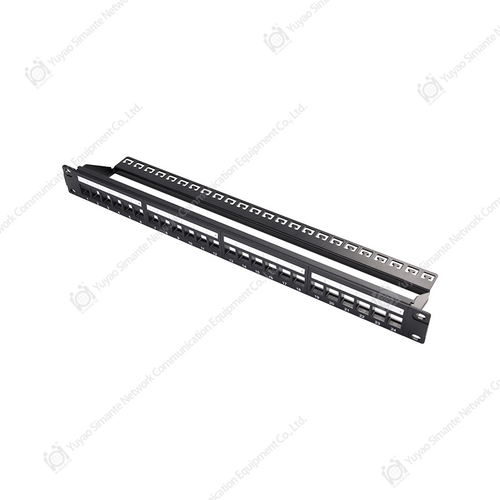
SMT-2046-24P 1U 24 port blank patch panel
Understanding the Role of a Blank Patch Panel
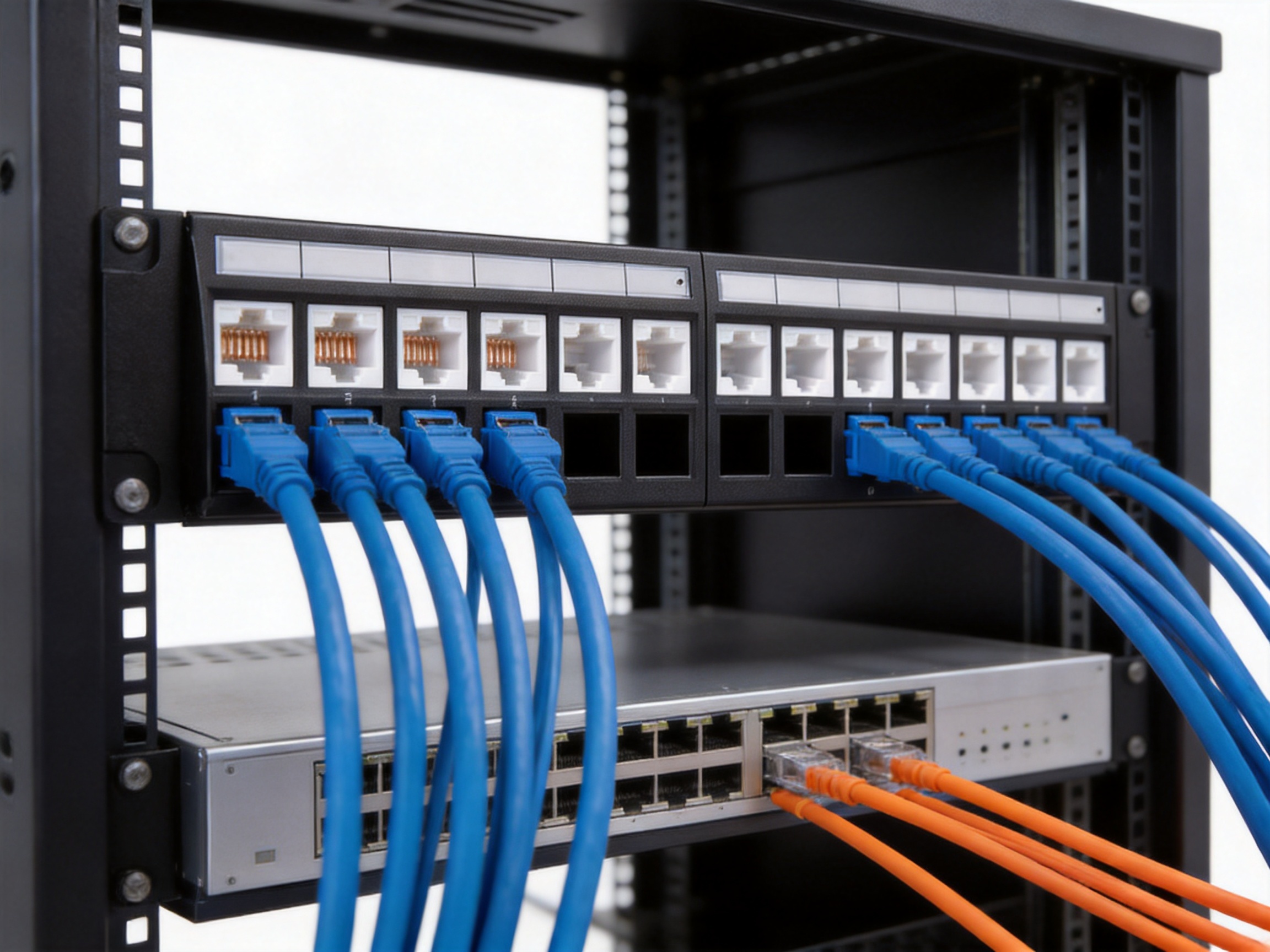
A patch panel is a passive network component installed in a rack, cabinet, wall-mounted enclosure, or distribution frame. It provides a controlled point where horizontal cables, backbone cables, equipment cords, and cross-connects can be terminated and managed. Instead of connecting every field cable directly to active network equipment, installers route cables to a patch panel and use short patch cords to connect the panel to switches, routers, servers, or other devices.
This arrangement improves cable organization and reduces the mechanical and operational stress placed on active equipment. It also creates a clearly defined demarcation point between permanent cabling and equipment connections. If a switch is replaced, the structured cabling can remain in place. If a work area is reconfigured, technicians can change patch-cord connections without disturbing permanently installed cables.
A blank patch panel differs from a panel with permanently integrated ports. It is supplied with open module positions, allowing the installer to select the appropriate modules for the project. Depending on the system design, these positions may accommodate copper keystone jacks, fiber adapters, HDMI modules, coaxial connectors, USB modules, audio connectors, or other compatible interfaces.
This flexibility is especially valuable when a project contains more than one type of connection. A single panel may be configured with copper data ports in some positions, fiber adapters in others, and spare openings reserved for future expansion. The final layout can therefore reflect the actual network architecture rather than forcing the project into a predetermined port format.
The blank design also helps distributors and contractors simplify inventory. A universal panel can be stocked before the final connector requirements are known. Modules can then be selected when the customer’s cable type, application, or equipment schedule is confirmed. This can reduce the need to hold multiple versions of fully populated patch panels.
Product Overview
The SMT-2046-24P is a 1U, 24-port blank patch panel intended for rack-based structured cabling installations. Its principal characteristics include a compact rack-mount format, twenty-four modular positions, and a blank faceplate configuration that supports customized port loading.
| Item | Specification or Description |
|---|---|
| Product type | Blank modular patch panel |
| Model | SMT-2046-24P |
| Rack height | 1U |
| Port capacity | 24 modular positions |
| Primary system use | Structured cabling and network communication |
| Compatible application direction | Copper systems, fiber systems, and mixed modular configurations subject to module compatibility |
| Installation environment | Network cabinets, server racks, communication rooms, distribution frames, and equipment enclosures |
| Panel format | Rack-mounted modular blank panel |
| Typical function | Cable termination, cross-connection, labeling, organization, and future expansion |
The 1U format helps conserve vertical rack space. In environments where cabinet space is limited, high-density components are important because every rack unit has an operational and financial value. A 24-port layout allows a substantial number of connections to be placed in a relatively small area while preserving a clear, readable interface for patching and troubleshooting.
The blank front panel can be populated according to the system plan. This means the same base product can support different project configurations without requiring a new panel design for each application. For contractors and system integrators, this adaptability can simplify project preparation and improve purchasing efficiency.
Advantages of the 24-Port 1U Configuration
Efficient Use of Rack Space
Rack space is a limited resource in many communication rooms and data centers. A 1U patch panel provides a compact termination point while leaving additional rack positions available for switches, cable management hardware, fiber enclosures, power distribution units, and other equipment.
The 24-port capacity is suitable for many small and medium-scale installations. It can support a local distribution area, a group of office outlets, a small server room, a network zone, or a section of a larger data cabling system. Multiple panels can be installed together when a project requires a larger number of ports.
Compared with lower-density designs, a 24-port panel can reduce the number of rack positions used for termination. Compared with extremely high-density configurations, it can offer better access to individual modules and more space for labeling and patch-cord routing. This balance is important for technicians who must install, inspect, test, and replace connections in real working conditions.
Flexible Port Configuration
The principal advantage of a blank patch panel is its ability to accept selected modules. Fixed panels may be convenient when a project uses one connector type throughout, but they can become restrictive when a network includes different media or when future requirements are uncertain.
A modular panel allows the installer to determine the port mix at the point of installation. For example, an office network may use copper keystone jacks for workstation connections while reserving several positions for fiber adapters connected to an uplink or backbone. A training facility may require a combination of data, audiovisual, and service connections. A commercial building may need a phased installation in which only part of the panel is populated initially.
Unused openings may be fitted with blank inserts where required. As the network expands, additional compatible modules can be installed without replacing the complete panel. This approach supports staged deployment and can reduce material waste.
Improved Cable Organization
Unstructured cabling can create confusion, obstruct airflow, increase service time, and make fault identification more difficult. A rack-mounted patch panel gives cables a defined destination and creates a consistent reference point for labeling and documentation.
When each cable is terminated at an identifiable port, technicians can trace the path from the work area or device to the rack more efficiently. Port numbering and written records can be used to identify room locations, panel positions, switch ports, service types, or customer circuits. This improves the quality of moves, adds, and changes throughout the life of the installation.
The panel also helps separate permanent cabling from flexible patch cords. Permanent cables can be routed and secured behind the panel, while shorter cords provide the adjustable connection between the panel and active equipment. This separation reduces unnecessary movement of fixed cables and supports a cleaner rack layout.
Support for Future Expansion
Network requirements frequently change after the original installation. Additional users may occupy a building, new devices may be added, wireless access points may require more connections, or a facility may introduce fiber uplinks and specialized services.
A blank 24-port panel provides a reserve capacity strategy. A project may initially populate only the number of ports needed for immediate operation, while leaving the remaining positions available for later use. This can be more economical than installing fully populated panels everywhere, especially when expansion is expected to occur in stages.
The modular approach also reduces the risk of premature obsolescence. If a compatible connector or media type changes, the panel structure may remain useful while the modules are updated. This can extend the practical service life of the rack infrastructure.
Benefits Compared with Fixed-Port Patch Panels
Fixed-port patch panels are designed with integrated connectors or jacks that cannot normally be exchanged. They can be appropriate for standardized installations, but they provide less configuration freedom than a blank modular panel. The SMT-2046-24P offers several advantages in projects where requirements vary or may evolve.
Adaptability to Different Network Designs
A fixed panel generally requires the buyer to choose a specific connector arrangement in advance. If the project later changes from one cable category to another, or if fiber connectivity is added, the original panel may no longer provide the best solution. A blank panel allows the connector modules to be selected closer to the installation stage.
This is useful for distributors and original equipment manufacturers serving multiple markets. Instead of stocking numerous fixed panels, they can maintain a common panel platform and combine it with different modules. The resulting inventory system can be simpler and more responsive.
Lower Replacement Impact
When an individual modular jack becomes damaged or needs to be changed, the installer may be able to replace only the affected module. With a permanently integrated panel, damage to a connector can require replacement of the entire unit or more extensive repair work.
Module-level replacement can reduce downtime and maintenance cost, although the exact procedure depends on the selected modules and the installation standard. It also allows a technician to upgrade selected ports without disturbing the entire panel.
Better Support for Mixed Media
Many modern communication systems use both copper and fiber. Copper cabling is often used for horizontal links and device connections, while fiber supports backbone links, long distances, higher bandwidth, or electromagnetic-noise-sensitive locations.
A blank panel can help create a consistent rack interface for a mixed-media environment. The front of the rack can maintain a uniform appearance even when different connector types are installed behind the panel positions. This simplifies visual management and may reduce the number of separate rack components required.
Reduced Project Risk
In a large project, the final connector schedule may not be available when the initial procurement decision is made. A modular panel reduces the risk of selecting the wrong fixed configuration. The installer can order the panel platform first and finalize the module arrangement after cable routes, equipment specifications, and client requirements have been confirmed.
This flexibility is particularly useful in construction projects, system integration contracts, renovation work, and international distribution, where the same product may be applied to different technical standards and customer preferences.
Engineering Considerations for Structured Cabling
A patch panel is a passive component, but its installation affects the performance, maintainability, and documentation quality of the entire cabling system. The panel should therefore be considered as part of a complete structured cabling architecture rather than as an isolated accessory.
Cable Category and Module Selection
The chosen modules should match the cable category and the intended transmission performance. For copper systems, installers should select compatible jacks designed for the applicable cable type and performance class. The module should also be suitable for the conductor construction, including solid or stranded conductors where relevant.
For fiber systems, the selected adapter or coupler should match the fiber type, connector format, polishing style, and application. Single-mode and multimode systems have different performance characteristics, and connector selection must be consistent with the link design.
Because the SMT-2046-24P is a blank panel, the panel itself does not determine the complete performance category of the installed channel. The final result depends on the modules, cables, patch cords, termination practices, and testing procedures used in the system.
Permanent Link and Channel Planning
Structured cabling designers normally distinguish between the permanent link and the complete channel. The permanent link includes the fixed cabling and termination points, while the channel may also include patch cords and equipment cords.
A patch panel is commonly installed at one or both ends of the permanent link. Its location should support appropriate cable routing, bend-radius control, labeling, access, and connection to active equipment. The design should avoid excessive cable tension and should provide sufficient room for service operations.
Labeling and Documentation
Port identification is one of the most important practical functions of a patch panel. Each port should be assigned a unique identifier that corresponds with drawings, rack elevations, cable schedules, outlet labels, and network records.
Clear labeling reduces troubleshooting time and helps prevent accidental disconnection. In a large facility, documentation may include the room number, outlet identifier, cable number, service type, switch name, switch port, VLAN information, or customer circuit reference. The exact method should follow the project’s documentation policy.
The 24-port format offers a manageable number of positions for clear visual identification. When several panels are installed in a rack, each panel can be assigned a unique reference, and each port can follow a consistent numbering sequence.
Grounding and Bonding Considerations
Metallic rack components and copper cabling systems must be installed in accordance with applicable electrical, telecommunications, and building standards. Where a bonding or grounding connection is required, the installer should follow the instructions for the selected panel, modules, rack, and cabling system.
The patch panel should be mounted securely in the rack, and all associated bonding arrangements should be inspected during commissioning. Requirements can vary by region, building type, cable design, and regulatory framework, so project engineers should confirm the applicable standards before installation.
Manufacturing Strengths Behind the Product
The reliability of a structured cabling component begins with its design and manufacturing process. A patch panel must maintain dimensional consistency, mounting stability, module retention, and a professional finish across production batches. These characteristics are influenced by tooling quality, material control, process management, assembly accuracy, inspection, and testing.
Yuyao Simante Network Communication Equipment Co., Ltd. integrates design, development, sales, and service within its business operation. The company has built experience in network cabling and optical fiber products over nearly two decades. This product focus gives the manufacturer practical knowledge of the requirements faced by installers, distributors, system integrators, and network equipment buyers.
Research and Development Capability
The company maintains a mature research and development system supported by more than ten engineers and over thirty full-time technical personnel. This technical team contributes to product design, production improvement, quality control, product updates, and customer-specific development.
For modular patch panels, engineering attention may include faceplate dimensions, port spacing, module retention, rack compatibility, material selection, assembly tolerances, labeling areas, and ease of installation. Small dimensional errors can create problems during rack mounting or module insertion, so design discipline is essential.
Continuous product development also enables the manufacturer to respond to changes in structured cabling technology. As network systems evolve, customers may request new module formats, updated materials, revised mounting details, or customized branding and packaging. A capable engineering team helps translate those requirements into manufacturable products.
Multiple Production Lines
The factory operates ten regular and customization production lines. This production structure supports both standard products and customer-specific requirements. It can also help separate production schedules, manage different product families, and respond to varying order quantities.
Customization capability is valuable for distributors and project suppliers that require special packaging, labeling, color options, logo treatment, assembly configurations, or product combinations. The exact scope of customization should be confirmed during technical and commercial discussions, but the presence of dedicated regular and customization lines indicates an ability to support more than one production model.
Injection Molding Resources
The factory has ten fully automatic injection molding machines and twenty semi-automatic injection molding machines. Injection molding is an important process for producing many network cabling components, including plastic housings, module frames, jack bodies, faceplate elements, protective parts, and other precision-molded components.
Automatic and semi-automatic equipment can serve different production requirements. Fully automatic machines may support consistent high-volume output, while semi-automatic machines can offer flexibility for varied orders, product updates, or smaller customized batches. The combination allows the factory to balance efficiency and responsiveness.
Consistent molding quality is important because modular products rely on accurate dimensions. A properly produced component should fit correctly, retain the selected module securely, and maintain a clean appearance after assembly. Mold maintenance, raw-material control, machine parameter management, and inspection procedures all contribute to the final result.
Automated Assembly Equipment
The company also operates eight types of automatic installation machines. Automated assembly can improve repeatability and production efficiency for processes that require consistent positioning, insertion, fastening, or component installation.
Automation reduces dependence on manual variation in repetitive operations. It can support stable production rates, improve process control, and help maintain consistent assembly quality. At the same time, technical personnel remain important for equipment setup, process verification, inspection, maintenance, and response to production changes.
Production Capacity
The factory maintains a stable annual output of more than nine million units. This capacity is relevant to customers that require continuity of supply, scheduled deliveries, or support for large distribution networks. A stable production base can help reduce lead-time uncertainty and support repeat orders over the product life cycle.
Capacity alone does not define quality, but it demonstrates that the manufacturer has established production systems capable of handling substantial demand. When combined with engineering support, automated equipment, and inspection resources, production capacity can provide a stronger foundation for consistent supply.

Quality Control and Product Stability
Structured cabling components are installed inside infrastructure that customers expect to operate for many years. Quality problems can be costly because they may require site visits, retermination, replacement, or network downtime. Product stability should therefore be considered from the design source through molding, assembly, inspection, packaging, and shipment.
The manufacturer emphasizes quality control beginning at the design stage. This approach is important because defects caused by unsuitable geometry, insufficient strength, poor module retention, or difficult installation may not be solved effectively through final inspection alone. Preventive design review can reduce the probability of recurring production issues.
Performance Testing
The factory uses performance testing to support customer requirements. Testing procedures may vary according to the product type and order specification, but can include dimensional inspection, appearance inspection, assembly verification, material checks, mechanical evaluation, and functional testing of applicable components.
For a blank patch panel, relevant inspection points may include rack-mounting dimensions, port opening dimensions, module fit, panel flatness, surface finish, screw-hole alignment, labeling area quality, and resistance to normal installation handling.
Where the panel is supplied with additional components, those components may require separate inspection. If modules are installed, the assembled product may also be evaluated for retention, connector alignment, and compatibility with the specified cable system.
Batch Consistency
For network contractors and distributors, consistency between batches is highly valuable. A product installed in one project may need to match products supplied months later for expansion or maintenance. Consistent dimensions, color, finish, packaging, and module compatibility simplify replacement and extension work.
Manufacturing systems with controlled processes, documented specifications, and trained technical personnel are better positioned to maintain this consistency. The company’s combination of regular production lines, customization lines, molding equipment, assembly equipment, and technical staff supports a structured approach to batch production.
Customer-Specific Testing
Different customers may apply different acceptance criteria. A telecommunications contractor may focus on mechanical and installation details, while a distributor may require packaging, labeling, and visual consistency. An OEM customer may provide its own inspection requirements or product specifications.
The company undertakes customer projects and supports comprehensive product performance testing. This is useful for buyers who need products aligned with internal quality procedures, project specifications, or market requirements. Testing details should be agreed before production so that the appropriate inspection plan can be prepared.
Installation Guidance
Before Installation
Before mounting the panel, verify the rack or cabinet dimensions, available rack space, selected modules, cable quantities, labeling scheme, and accessory requirements. Confirm that the panel is intended for the selected rack system and that the modules are compatible with the openings.
Inspect the panel and modules for visible damage. Confirm that all required mounting hardware is available. Review the rack elevation and determine the most practical position relative to switches, cable managers, fiber enclosures, power equipment, and service access areas.
Rack Mounting
Position the panel at the designated 1U location and align the mounting holes with the rack rails. Install the appropriate rack screws or cage-nut hardware according to the cabinet design. Tighten the fasteners evenly so that the panel remains level and is not distorted.
A level and securely mounted panel provides a better reference for module insertion, cable routing, and labeling. It also reduces the likelihood of mechanical stress on connected cables.
Module Installation
Install compatible modules according to the module manufacturer’s instructions. Confirm that each module is fully seated and retained. Avoid forcing a module into an opening if resistance is unusual, as this may indicate an incompatibility, incorrect orientation, or damaged component.
Where unused positions remain, use suitable blank inserts if required by the project design. Blank inserts can improve appearance, reduce the entry of dust and debris, and make the final port arrangement easier to understand.
Cable Termination
Terminate cables using the approved procedure for the selected module. Maintain the cable’s recommended bend radius and avoid excessive untwisting of twisted-pair conductors near the termination point. For fiber, protect the cable from sharp bends, tensile stress, contamination, and improper connector handling.
Use cable management accessories to support the weight and direction of the cables. The patch panel should not carry unnecessary cable tension. Route cables in a way that allows individual connections to be serviced without disturbing adjacent ports.
Testing and Commissioning
After termination, test the installed links according to the project requirements. Copper links may require wire-map, continuity, length, insertion loss, return loss, crosstalk, and other field-test measurements depending on the specified category and standard. Fiber links may require continuity, polarity, insertion loss, and other relevant optical tests.
Record test results and associate them with the panel and port identifiers. Proper documentation helps confirm acceptance and supports future troubleshooting.
Applications Across Different Environments
Commercial Offices
In office buildings, a 24-port blank patch panel can organize connections serving workstations, printers, wireless access points, meeting rooms, security devices, and building automation systems. Its modular format allows the panel to support different service requirements in the same rack.
Office layouts often change as departments move or workspaces are renovated. A modular panel can help accommodate these changes while preserving the fixed cabling infrastructure.
Small and Medium Data Rooms
Small and medium data rooms require efficient use of cabinet space without sacrificing service access. The 1U format provides a compact termination point for server, storage, network, and management connections.
In these environments, clear labeling and cable separation are particularly important because a limited number of technicians may be responsible for the entire network. The panel provides a consistent interface between structured cabling and active equipment.
Education Facilities
Schools, training centers, colleges, and universities may have mixed connectivity needs across classrooms, laboratories, offices, libraries, and security areas. A blank panel allows the installer to configure ports according to the needs of each building or telecommunications room.
Because educational facilities often expand in stages, reserve positions can support future classroom additions, wireless coverage, audiovisual equipment, or upgraded backbone connections.
Industrial and Automation Sites
Industrial facilities may use network connections for control systems, monitoring equipment, machine interfaces, cameras, access control, and enterprise systems. Depending on environmental conditions, the patch panel may be installed in a protected communication cabinet or control room.
Where copper and fiber are both required, modular connectivity can help keep the rack interface organized. The final selection of modules and enclosure should reflect temperature, dust, vibration, electromagnetic interference, and other site conditions.
Residential and Smart-Building Projects
Large residential developments, hotels, serviced apartments, and smart-building projects can use structured cabling for internet access, building management, security, access control, audiovisual systems, and other services.
A compact 24-port panel can be used in a central distribution cabinet or local communications room. Its flexible port layout supports different phases of construction and allows system integrators to adapt the configuration to the specific services required by the building.
Supply, Customization, and OEM Support
Different customers purchase network cabling products in different ways. Some require standard products for distribution, while others need customized configurations, packaging, labels, branding, or project-specific assemblies. A manufacturer with both standard production and customization capability can support these different purchasing models.
Yuyao Simante Network Communication Equipment Co., Ltd. undertakes OEM and ODM projects in addition to supplying standard network products. This can be valuable for importers, distributors, system brands, and project suppliers seeking a manufacturing partner for private-label or customized product programs.
OEM and ODM cooperation typically requires technical drawings, product specifications, sample approval, packaging requirements, inspection standards, order quantities, and delivery schedules. Early communication helps ensure that the finished product meets the intended market and installation requirements.
The company’s product range includes keystone jacks, patch panels, wall face plates, data sockets, and optical fiber products. This broader portfolio can help customers source related components from one supplier. Consolidated sourcing may simplify purchasing, product matching, packaging coordination, and quality communication.
Why Choose a Blank Modular Design?
The strongest reason to choose a blank modular panel is that it separates the rack structure from the connector decision. The panel creates the physical platform, while the modules determine the actual port functions. This separation gives project designers greater freedom.
It also supports a more efficient inventory strategy. A distributor can stock the panel and select modules according to regional demand. A contractor can purchase the panel before every cable detail has been finalized. An end user can leave space for future services without installing unnecessary ports today.
Blank modular panels are not the correct choice for every project. A highly standardized installation with one known connector type may benefit from a preconfigured panel. However, where flexibility, mixed media, future expansion, or customized layouts are important, a blank 24-port 1U design offers significant practical value.
The SMT-2046-24P combines this modular principle with a space-efficient rack format, suitable density, and support from a manufacturer experienced in network cabling and optical fiber products. Its value lies not only in the panel itself but also in the installation flexibility, supply support, and manufacturing infrastructure behind it.
Purchasing Checklist
Before ordering the SMT-2046-24P or a similar blank patch panel, buyers should review the following points:
Confirm that the 1U rack format matches the cabinet or rack system.
Confirm that twenty-four ports provide sufficient immediate and future capacity.
Identify the required copper, fiber, or other compatible modules.
Check that selected modules fit the panel openings and match the intended cable system.
Define the required labeling method and documentation format.
Review mounting hardware and cable-management requirements.
Confirm packaging, inspection, testing, and delivery requirements.
For customized products, provide drawings, samples, branding files, and technical specifications before production.
Verify project standards and any required regulatory or customer-specific criteria.
Frequently Asked Questions
What is a 1U 24-port blank patch panel?
It is a rack-mounted modular panel occupying one rack unit and providing twenty-four openings for compatible network connection modules. It is used to terminate, organize, label, and cross-connect structured cabling.
What does “blank” mean in this product?
Blank means that the panel is supplied without permanently integrated connection jacks in the port positions. Installers can select and insert compatible modules according to the project requirements.
Can the panel be used for both copper and fiber systems?
The panel can support copper, fiber, or mixed configurations when the selected modules or adapters are mechanically compatible with the panel. The final system performance depends on the modules, cables, connectors, installation procedures, and testing practices.
Why use a blank panel instead of a fixed-port panel?
A blank panel provides greater flexibility. It can accommodate different connector types, support future expansion, simplify inventory, and allow individual modules to be replaced or changed without necessarily replacing the entire panel.
Is a 24-port panel suitable for a data center?
It can be suitable for small and medium data rooms, distribution areas, equipment racks, and selected data center applications. The correct choice depends on port density, cable type, rack layout, cooling requirements, and the project’s applicable standards.
What types of modules can be installed?
Compatible modules may include copper keystone jacks, fiber adapters, couplers, and other structured cabling interfaces. The exact module types must be confirmed according to the panel design and the module manufacturer’s specifications.
Does the panel itself determine the network category?
No. The transmission category and performance of the completed link depend on the complete channel, including cable, jacks, patch cords, termination quality, installation practices, and test results. The panel provides the modular mounting and organization platform.
Can unused ports be reserved for future expansion?
Yes. Unused positions can generally be left available or fitted with suitable blank inserts, subject to the project design. Compatible modules can be added later when more connections are required.
How should the panel be labeled?
Each port should have a unique identifier linked to the cable schedule, rack elevation, outlet label, and network documentation. A consistent labeling system makes future maintenance and troubleshooting more efficient.
What manufacturing capabilities support this product?
The manufacturer operates regular and customization production lines, automatic and semi-automatic injection molding equipment, automatic installation machines, engineering resources, and product performance testing processes. These capabilities support standard supply, customization, and OEM or ODM projects.
Can the product be customized?
Customization may be available depending on the project requirements. Potential areas can include product configuration, packaging, labeling, branding, color, and related manufacturing details. Buyers should provide technical specifications for confirmation before production.
What information should be included in an inquiry?
An inquiry should include the required quantity, intended application, cable and module types, rack requirements, labeling or branding needs, packaging preferences, inspection criteria, delivery location, and target schedule.
Conclusion
The SMT-2046-24P 1U 24-port blank patch panel is a flexible foundation for structured cabling installations. Its modular blank format allows copper, fiber, and other compatible connection modules to be arranged according to project requirements. Its 1U rack profile conserves cabinet space, while the 24-port capacity provides a practical level of density for many commercial, industrial, institutional, residential, and communication-room applications.
Compared with fixed-port alternatives, the panel offers greater adaptability, easier configuration changes, support for mixed media, simpler inventory planning, and a practical path for future expansion. When correctly installed, labeled, tested, and documented, it can improve the organization and maintainability of a complete network cabling system.
The manufacturing foundation is another important consideration. Yuyao Simante Network Communication Equipment Co., Ltd. combines nearly two decades of industry experience with engineering personnel, regular and customized production lines, injection molding resources, automated assembly equipment, quality testing, and OEM and ODM support. Its broader product range across network cabling and optical fiber categories can also help customers coordinate related components through one supply channel.
For distributors, contractors, system integrators, and project owners seeking a configurable rack-based termination solution, a 24-port 1U blank patch panel offers a balanced combination of flexibility, density, serviceability, and future readiness. The final performance of any installation depends on the complete cabling system and professional installation practices, but the right panel provides a dependable starting point for building an organized and adaptable network infrastructure.
References
1. ANSI/TIA-568 Series, Balanced Twisted-Pair Telecommunications Cabling and Structured Cabling Requirements.
2. ISO/IEC 11801 Series, Information Technology — Generic Cabling for Customer Premises.
3. ANSI/TIA-606 Series, Administration Standard for Telecommunications Infrastructure.
4. ANSI/TIA-569 Series, Telecommunications Pathways and Spaces.
5. IEC 60364 Series, Low-Voltage Electrical Installations and Protective Bonding Principles.
6. Manufacturer product information for the SMT-2046-24P 1U 24-port blank patch panel.
7. Manufacturer technical information concerning network cabling products, optical fiber products, production facilities, and quality-control practices.